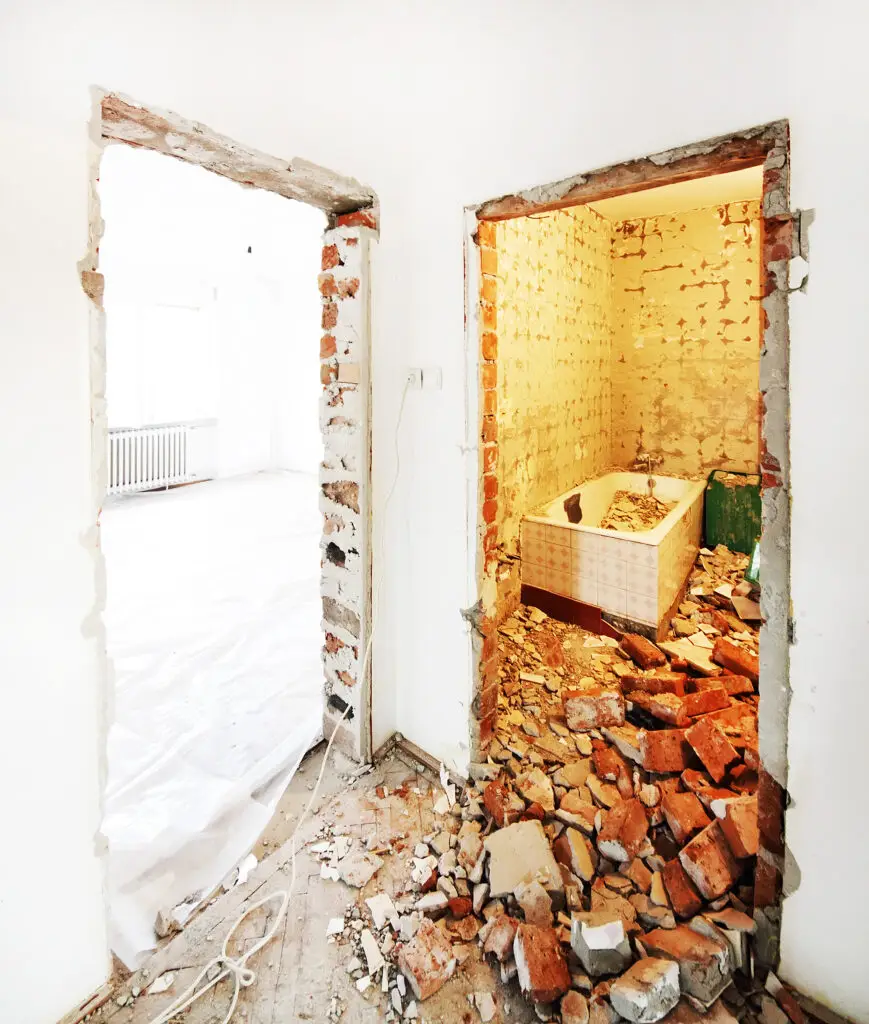
Full renovation in Vienna done properly once, not half-done three times.
Full renovation in Vienna: from the construction company that does the work — not from a broker.
Full renovation in Vienna: a full renovation in Vienna costs €1,200 to €2,200 per square metre. Every trade is renewed: pipework, electrics, heating, floors, bathrooms, windows and surfaces. One contractual partner, one construction schedule, one fixed price under ÖNORM B 2110. Construction time 4 to 12 months.
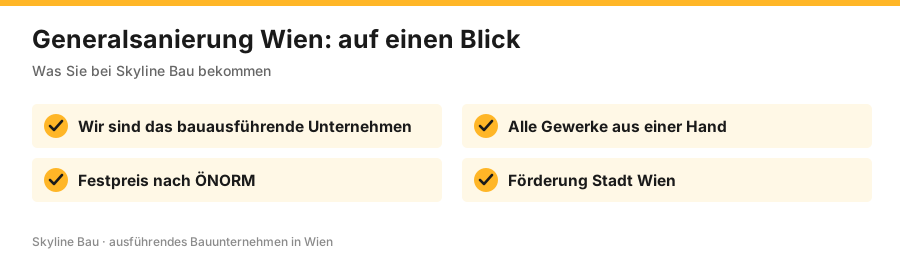
Full renovation in Vienna from a single source
Full renovation in Vienna (Generalsanierung) means the comprehensive refurbishment of a building or a flat in which every part of the building is renewed — from the building fabric and the building services through to the interior finishing. A full renovation is the most thorough form of refurbishment: it turns a property that has seen better days into a building that meets modern living standards.
The term is clearly distinct from smaller measures. Whereas a redecoration freshens up surfaces and a partial renovation renews individual areas, a full renovation covers the entire property. It is the right approach when a building has built up a considerable maintenance backlog over the years and isolated repairs are no longer enough.
Skyline Bau carries out full renovations as the executing construction company, in cooperation with licensed master builder partner firms. That is exactly what matters in a full renovation: it involves a large number of trades that have to work together in a precisely interlocking sequence. Skyline Bau coordinates all of this as a single point of contact — from planning and dealings with the authorities through to the handover of the renovated property.
A full renovation typically comprises the complete refurbishment of the building fabric, the renewal of the electrical and plumbing installations, the interior finishing and, where appropriate, a new room layout, the facade renovation, the roof renovation and the modernisation of the building services. Depending on the property, further measures are added — the scope is defined individually for each building.
A key concept in a full renovation is the maintenance backlog (Sanierungsstau). Anyone who puts off necessary work for years ends up paying more: old water pipes cause water damage, a leaking roof lets moisture into the fabric, and outdated electrics become a safety risk. A full renovation clears this accumulated need in one planned operation. Instead of tackling every problem individually and belatedly, the building is brought thoroughly up to date in one go.
In Vienna in particular, with its large stock of period buildings, full renovation is an important subject. Many buildings have long since ceased to meet today’s standards — draughty windows, outdated heating, old pipework, uninsulated facades. A full renovation brings these buildings up to date and secures their value for decades to come. In doing so it also helps to preserve the city’s characteristic townscape.
An important topic is subsidies. Vienna subsidises renovation generously — from thermal refurbishment and heating replacement to individual measures, several subsidies can often be combined. Skyline Bau clarifies which programmes are currently available and supports you with the application process, which significantly reduces the effective cost of the full renovation.
We know the building stock — the Gründerzeit houses (built 1848–1918), the interwar buildings and the post-war buildings, each with their typical weak points. Skyline Bau plans every full renovation individually and carries it out with all trades coordinated, with the necessary approvals in place and at a binding fixed price. A full renovation is one of the largest investments you can make in a property — which is why it matters to entrust it to an experienced partner who takes responsibility for the entire project.
Full renovation in Vienna — all services
Building fabric
Complete refurbishment of load-bearing and non-load-bearing components — the foundation of the building.
Electrics & plumbing
Complete renewal of the electrical, water supply and drainage installations.
Interior finishing & layout
New room layout, drywall, floors and surfaces to modern standards.
Facade & insulation
Facade renovation and thermal insulation — saving energy and protecting the fabric.
Roof renovation
Renewal of the roof structure, roof covering and waterproofing as part of the full renovation.
Windows & doors
New, well-sealed windows and doors — for thermal insulation, sound insulation and security.
Heating & building services
Modernisation of the heating and all building services to a contemporary standard.
General contracting
All trades coordinated from a single source — one contract, one fixed price, one point of contact.
Comprehensive full renovation with all trades from a single source — building fabric, electrics and plumbing, interior finishing, facade, roof and building services — an executing construction company with a network of licensed master builder partners, fixed price under ÖNORM B 2110, our own construction team, subsidy handling, 3-year warranty under § 933 ABGB.
Market benchmarks in Vienna — full renovation 2026
These figures mark the range within which the Viennese market moves. They come from publicly available cost breakdowns on specialist portals and advice sites. We list them here so that you can place our offer in context — not to compare ourselves with them.
Flat — complete renovation
1.000 – 1.800 €/m²
Entire building
1.500 – 2.500 €/m²
Market benchmark net (plus 20% VAT)
1.000 – 1.300 €/m²
Tenement building — overall project
from €600,000
Important for context: ranges are not prices. Where you land within the range depends on the condition of the building fabric — rising mains, electrics, floor build-up, structure. You only see that once things are opened up. That is why we state the price as a fixed price after the site visit, not beforehand as a range in a brochure.
What does a full renovation in Vienna cost?
The cost of a full renovation in Vienna depends on the condition of the property, the scope of the renovation, its size and the standard of fit-out. After a site inspection and measurement, Skyline Bau prepares a binding fixed-price offer under ÖNORM B 2110.
As of 2026 · net · guide values · condition, scope and fit-out determine the final price · binding price after site inspection.
The range is wide because a full renovation can take many forms — from the complete refurbishment of a single period flat to the full renovation of an entire building including facade, roof and building services. One important effect: the larger the property, the lower the cost per square metre, because trades such as electrics or scaffolding do not become more expensive in proportion.
Other factors also determine the price: the condition of the fabric, whether windows and subfloors are replaced, the transport routes on site — lift, access road, courtyard — and above all the chosen quality of fit-out. Austrian tradespeople’s rates are noticeably higher than the figures quoted in many online comparison calculators from Germany. A fixed-price offer is therefore rarely comparable with the lowest online guide values — nor should it be.
When planning costs, it makes sense to include a contingency for the unforeseen — particularly in older buildings, some damage only comes to light once the walls are open. Skyline Bau calculates completely and realistically from the outset, lists every item transparently and quotes a binding fixed price.
On top of this comes the City of Vienna’s funding, which can cover a substantial part of the costs — Skyline Bau handles it for you on request. A complete, honestly calculated offer is no disadvantage: it is the figure that actually applies at the end, rather than a teaser price that becomes expensive through change orders.
What defines a full renovation
The term full renovation is used often, but not always precisely. It pays to understand exactly what a full renovation is — and what distinguishes it from other measures.
A full renovation is the comprehensive, complete refurbishment of a property in which every part of the building is modernised. It does not concern individual rooms or trades but the entire building or the entire flat — building fabric, installations, interior finishing and often also the facade, roof and building services. The result is a property that meets modern technical and energy standards. A full renovation is therefore more than a repair — it repositions the building for the decades ahead.
The line between this and a gut renovation (Kernsanierung) is blurred — both terms describe a very far-reaching refurbishment. A gut renovation emphasises that the building is stripped back to its load-bearing core, the shell, and then rebuilt. Full renovation is the more general term for a refurbishment that covers every part of the building without necessarily going back to the shell.
A full renovation can relate to a single flat or to an entire building. In the full renovation of a tenement building (Zinshaus), the particular features of a multi-occupancy building come into play; Skyline Bau covers this on its own page on tenement building renovation. In the full renovation of a period building, preserving its historic character takes centre stage.
Stucco, box-type double windows (Kastenfenster), ceiling heights and the articulation of the facade are assets that a good full renovation preserves while renewing the building’s technical systems. In every case, a full renovation is the most thorough response to a maintenance backlog. It involves more effort than a partial renovation, but it solves a building’s problems permanently rather than postponing them.
Full renovation, partial renovation, redecoration
Anyone who wants to put a building or a flat in order has various routes open to them — and the terms for them are often mixed up. A clear distinction helps you choose the right approach.
Redecoration (Renovierung) is the lightest form: it freshens up surfaces — new paint, new floors, new tiles. It does not alter the building fabric but improves its appearance. A redecoration is quick and inexpensive, but it does not solve any technical or structural problems.
A partial renovation goes deeper: it renews individual areas or trades — the bathroom, the electrics or the windows, for example. It makes sense when only certain elements have reached the end of their service life and the rest of the property is in good order. A partial renovation spreads the investment over manageable stages.
Finally, a full renovation is the comprehensive solution: it renews every part of the building in one planned operation. It is the right approach when a property has a considerable maintenance backlog and piecemeal measures would merely drag out the effort.
Which route is right depends on the condition of the property — as an executing construction company with licensed master builder partner firms, Skyline Bau gives honest advice on which form of renovation genuinely makes sense and does not automatically propose the largest measure. A renovation that is too ambitious wastes money, while one that is too modest fails to solve the problem — the right assessment saves the client both.
When a full renovation makes sense
A full renovation is a big decision. But there are clear signs that indicate a comprehensive renovation is the right way forward.
The clearest sign is an accumulated need for renovation across several trades at once. When the electrics are outdated, the pipework has reached the end of its service life, the windows are draughty and the heating is inefficient — then it is more economical to renew all of it in one planned operation than to tackle each problem separately, one after the other.
A second reason is cost-effectiveness. Bundling trades saves money: scaffolding that is already up for the facade can also be used for the roof; walls that are open for new pipework are also the right moment for insulation. A full renovation exploits these synergies, which are lost when measures are spread out individually.
A third reason is value growth. A fully renovated building meets modern standards, is energy-efficient and is therefore worth considerably more — whether for owner occupation or as an investment. Particularly when buying a Viennese period building in need of renovation, a full renovation is often part of the plan from the very start.
Anyone acquiring an inexpensive property in need of renovation should factor the cost of a full renovation into their calculations from the outset. Skyline Bau advises whether, and to what extent, a full renovation makes sense for a specific property. Sometimes a full renovation is clearly the right approach; sometimes a well-planned partial renovation is sufficient — this honest assessment is part of our advice.
The trades and their coordination
A full renovation is not a single trade but the coordinated interplay of many. That is precisely where its complexity lies — and why it belongs in the hands of a general contractor.
In a full renovation, typically up to ten different trades work together: demolition, bricklayers, electricians, plumbers, drywall installers, screed layers, tilers, painters, roofers and window fitters. Each trade has its place in a fixed sequence — installations before the screed, the screed before the tiles, the windows before the interior finishing.
Anyone who commissions these trades separately becomes their own site manager: coordinating dates, managing interfaces and clarifying responsibility in the event of a dispute. If one trade is delayed, the next one comes to a standstill — and costs rise. Without professional site management, a full renovation quickly runs into expensive delays.
As the executing construction company, Skyline Bau takes on precisely this coordination. We manage all trades with our own construction team for the main works and a well-established network of specialist partners, keep to the sequence and the deadlines and bear overall responsibility. The client has a single point of contact and a binding fixed price — a complex full renovation becomes a manageable project. This simplification is the real value a general contractor offers in a full renovation.
Authorities, hazardous substances and subsidies
A full renovation touches not only on building technology but also on legal and safety issues. An experienced builder keeps these in view from the very beginning.
The first topic is the building permit. Pure maintenance work such as painting or laying floors does not require a permit in Vienna. However, as soon as load-bearing walls are altered, the layout is reconfigured, windows in the facade are moved or the designated use of rooms is changed, a building permit under the Vienna Building Code (Wiener Bauordnung) is required. Additional requirements apply in protected zones (Schutzzonen) and to listed buildings.
The second topic is hazardous substances. In buildings from the 1950s to the 1980s, asbestos may be present in old plasters or tile adhesives, as well as lead-based paints or PAHs in old adhesives. A hazardous substance survey is strongly recommended before a full renovation, and for demolition projects it is required by law. Skyline Bau keeps this in view and arranges the necessary surveys. Hazardous substances are no reason not to carry out a full renovation — they simply have to be identified and dealt with properly.
The third topic is subsidies. Vienna subsidises renovation generously — thermal refurbishment, heating replacement and individual measures for energy efficiency and safety. Several subsidies can often be combined. As the executing construction company, Skyline Bau works with licensed master builder partners to clarify permit questions, arranges the hazardous substance survey and handles the subsidy application — the client does not have to work through regulations and programmes on their own.
Energy modernisation
A central aspect of almost every full renovation is energy modernisation. It not only reduces running costs but is also the area in which subsidies are most generous.
Old buildings lose a great deal of energy — through uninsulated facades, old windows, uninsulated roofs and basement ceilings, and through inefficient heating systems. Thermal refurbishment as part of a full renovation addresses all of these points: facade insulation, new windows, roof insulation and the modernisation of the heating all work hand in hand.
The advantage of carrying out energy modernisation as part of a full renovation lies in the synergies. If the facade is being worked on anyway, the extra cost of insulation is modest; if the walls are open for new pipework, internal insulation can be planned in at the same time. Spread out individually over several years, the same measures would be considerably more expensive.
Skyline Bau plans energy modernisation as an integral part of the full renovation — tailored to the building and with an eye on the available subsidies. The renovated building thus becomes not only more modern but also permanently cheaper to run. Over the years, the energy costs saved pay back part of the renovation investment. Energy modernisation is therefore not only an ecological decision but also an economic one.
Specifics: Gründerzeit buildings, Dippelboden ceilings, box-type windows
- Maintenance backlog — a full renovation clears the accumulated need across several trades in one go.
- All trades from a single source — up to ten trades coordinated, one point of contact.
- Viennese period buildings — Gründerzeit, interwar and post-war buildings with their typical weak points.
- Building permit — required under the Vienna Building Code for interventions in the structure or the layout.
- Hazardous substance survey — strongly recommended before renovation for buildings from the 1950s–1980s.
- City of Vienna subsidies — renovations are generously subsidised, and several programmes can often be combined.
- Exploiting synergies — bundled trades lower costs compared with measures spread out individually.
- Realistic Austrian prices — prices in Austria are higher than comparable figures in Germany.
- Cost contingency — in older buildings, some damage only comes to light once the walls are open.
- Fixed price under ÖNORM B 2110 — fully calculated rather than advertised with teaser prices.
Full renovation in Vienna — active in all Viennese districts
Process and construction time
A full renovation is a large project — and questions about the process and duration rightly come first. A well-organised full renovation follows a clear, planned sequence.
It begins with a site inspection, survey of the existing condition and planning. Skyline Bau assesses the condition of the property, clarifies the scope of the renovation, examines the building-law questions and prepares a binding fixed-price offer. This is followed — where necessary — by the planning submission and the building permit. Then the construction phase begins with the strip-out, followed by the trades in their fixed sequence.
The construction time of a full renovation depends heavily on its scope — the complete refurbishment of a flat takes anything from a few weeks to a few months, while the full renovation of an entire building takes correspondingly longer. Skyline Bau states a binding time frame in the fixed-price offer and coordinates all trades so that this time frame holds.
A realistically planned schedule is more honest than an overly optimistic one that cannot be met from the outset. If you cannot live in the property during the full renovation, you should plan for this from the start — Skyline Bau discusses it with you beforehand.
What matters in the execution
A full renovation is a large project with many parties involved — and the quality of the result is decided by a few clear points. It pays to know them.
The first point is planning. A full renovation that is started without a well-thought-out overall concept runs the risk of trades working at cross purposes or decisions being taken too late. Careful planning at the outset — with a survey of the existing condition, a defined scope and a clear sequence — is the basis for smooth execution.
The second point is site management. During the construction phase, the trades have to be coordinated, quality has to be checked and the unforeseen has to be dealt with. An executing construction company with licensed master builder partner firms that takes responsibility for site management ensures that the full renovation stays on track — in terms of schedule, quality and budget.
The third point is honest communication. In a full renovation of an older building, things almost always come to light that were not visible beforehand. What matters is how they are dealt with: a reputable builder discusses such findings openly, sets out the options and keeps the client informed.
Skyline Bau stands for exactly these points — well-thought-out planning, responsible site management and honest communication throughout the full renovation. In this way, a large project that seems unwieldy at first glance becomes a plannable one with a reliable result.
Full renovation in Vienna for owners, buyers & investors
Flat owners
Complete refurbishment of your own flat to a modern standard — comfort, energy efficiency and preservation of value.
Period property buyers
Full renovation of a newly acquired period flat or house in need of renovation.
Homeowners
Full renovation of the entire building including facade, roof and building services.
Investors & private investors
Adding value to properties in need of renovation through a comprehensive full renovation.
Typical service packages for full renovation in Vienna
- Site inspection, survey of the existing condition and renovation concept
- Clarification of the building permit and planning submission
- Hazardous substance survey for buildings from the 1950s–1980s
- Clarification and handling of subsidies
- Strip-out and gutting
- Refurbishment of the building fabric and the load-bearing structure
- Renewal of the electrical, water supply and drainage installations
- Interior finishing, drywall and new room layout
- Facade renovation and thermal insulation
- Roof renovation and window replacement
- Modernisation of heating and building services
- Handover of the fully renovated property at the fixed price
From planning to handover
Why choose Skyline Bau for your full renovation in Vienna
- Executing construction company — full renovation with full responsibility for the construction work.
- All trades from a single source — up to ten trades coordinated, one point of contact.
- Our own construction team — the main trades carried out by our own staff, reliable deadlines.
- Fixed price under ÖNORM B 2110 — binding and fully calculated, no teaser prices.
- Expertise with the authorities — building permit, hazardous substance survey and planning submission included.
- Subsidy handling — clarification and processing of renovation subsidies.
- Experience with period buildings — knowledge of the typical weak points of the building stock.
- Honest advice — we recommend the sensible scope, not automatically the largest measure.
- €3 million construction liability insurance.
Definition: what does “full” actually cover?
A full renovation is the fundamental and comprehensive refurbishment of an existing property — either a building or a piece of infrastructure. The term goes well beyond a complete renovation and aims to renew the entire property completely or bring it up to the latest technical standard. For real estate, a full renovation covers the following areas:
- Load-bearing components and roof structures — structural assessment, strengthening under ÖNORM B 4015 where necessary (Vienna is in seismic zone 3), renewal of timber roof structures.
- Heating, plumbing and electrical installations — new risers, riser renovation, preparation for heat pumps, RCD protection and modern distribution boards.
- Windows and doors — complete renewal with components that meet U-value requirements, with replica box-type windows in protected zones.
- Facade insulation — ETICS under ÖNORM B 6122; for buildings in protected zones, internal insulation under OIB Guideline 6 as an alternative.
- Fire protection upgrade under OIB Guideline 2 — new fire walls, shaft walls, escape route doors.
- Energy efficiency — the aim is to cut energy consumption by 50 to 80% and thereby extend the service life of the property by decades.
The term Generalsanierung is not only common in construction — Deutsche Bahn also uses it for its “high-performance network” renovation programme (4,000 km of track in 40 corridors by 2036). For real estate, however, full renovation means a holistic structural intervention.
How does it differ from a complete renovation and a gut renovation?
- Redecoration = superficial freshening up (painting, wallpapering, new flooring). No intervention in the building fabric.
- Renovation = repairing damage and restoring usability. A medium-level intervention.
- Complete renovation = holistic modernisation of the flat or house (all trades at the same time). Focus on interior finishing.
- Full renovation = comprehensive renewal of the entire property from basement to roof, including structural engineering, the load-bearing structure, the thermal envelope and building services. The most extensive intervention short of a gut renovation.
- Gut renovation = stripping back to the shell + rebuilding. The maximum intervention, often from €150,000 upwards for a 100 m² house.
Full renovation in Vienna — specific costs for 2026
- Full renovation of a 90 m² Viennese period flat: €90,000 to €135,000 (€1,000–1,500/m²).
- Full renovation of an entire house: from €150,000, up to €400,000 with extensive structural strengthening and energy efficiency measures.
- Full renovation of a Viennese tenement building: typically €800 to €2,500/m² for 800–2,000 m² of total living space, often with basic refurbishment funding (Sockelsanierung) from wohnfonds_wien (40%).
- Structural strengthening in preparation for adding a storey: an additional €30,000–80,000.
- Energy component (ETICS, windows, roof, heating replacement): €250–500/m² of living space.
Working-hours rules and noise protection in Vienna
Anyone planning a full renovation needs to know the statutory rules on construction working hours:
- On weekdays from 6 am to 8 pm, construction work is generally permitted in Vienna.
- No statutory midday quiet period — in Vienna, unlike many German federal states.
- At night (8 pm–6 am) and on Sundays, strict noise protection requirements apply — noisy work is not permitted.
- Protected zone notification to MA 19 before any work on facades that shape the townscape.
- MA 37 building notification for interventions in load-bearing components, layout changes or extensions.
- Federal Monuments Office (Bundesdenkmalamt) where the fabric is listed.
Funding landscape: Raus aus Gas, THEWOSAN, renovation bonus
- Raus aus Gas / Raus aus Öl (“Get out of gas / oil”) — federal funding for heating replacement; the 2026 focus is on heat pumps, district heating connections and pellet heating.
- Renovation cheque (Sanierungsscheck) via sanierungsoffensive.gv.at — up to €9,000 for thermal measures on a detached house, up to €14,000 for comprehensive renovation.
- wohnfonds_wien basic refurbishment (Sockelsanierung) — up to 40% of the eligible costs for tenement buildings. The most important funding lever for large projects.
- MA 50 housing subsidy — can be combined with thermal and energy funding.
- OeKB climate loan — low-cost loan financing.
- Hauskunft Wien — free advice on combining subsidies.
- Renovation quality platform (qp-sanierung.at) — quality assurance supported by the City of Vienna.
Who does what with us
First — depth rather than surface. A full renovation intervenes in the load-bearing structure and the structural engineering, not just in surfaces. Skyline Bau coordinates with licensed master builder partners who carry out calculations under ÖNORM B 4015 (seismic zone 3) — and therefore deliver sound results even when preparing to add a storey or opening up load-bearing walls.
Second — routine with the authorities. MA 37 building authority, MA 19 urban design, MA 50 housing subsidies and, where applicable, the Federal Monuments Office. We know who is responsible for what and submit complete documentation.
Third — all four funding streams combined. Skyline Bau plans the renovation cheque + basic refurbishment funding + MA 50 + Raus aus Gas in one application process.
Fourth — fixed price under ÖNORM B 2110:2023. A binding fixed price even for an extensive scope of work — no hourly-rate calculation, no open change orders.
What is the difference between a full renovation and a tenement building renovation?
Full renovation: complete refurbishment of a residential unit or a single-family or multi-family house. Cost range €1,000–1,800/m² (flat) or €1,500–2,500/m² (entire building), net guide values from Skyline Bau. Viennese tenement building renovation: refurbishment of a Gründerzeit rental building subject to the rent rules of the Austrian Tenancy Act (MRG), with a typical cost range of €1,500–3,000/m² owing to the MA 19 protected zone requirements + preservation of original details. There are separate pages on both: Period building renovation in Vienna and Tenement building renovation in Vienna.
How much does a full renovation in Vienna cost?
As a net guide value: €1,000 to €1,800 per m² for a flat, €1,500 to €2,500 per m² for an entire building including facade and roof. Where a renovation ends up within this range depends above all on the condition of the pipes and ceilings, the scope of new building services and whether floor plans are changed. We only quote a binding fixed price after the site visit, once these points have been clarified.
Skyline Bau acts as a construction company carrying out building work. Regulated trades — in particular master builder services (§ 94 no. 5 GewO), design and structural engineering services, electrical engineering (§ 94 no. 16 GewO), gas and plumbing (§ 94 no. 25 GewO) and tiling work (§ 94 no. 38 GewO) — are carried out exclusively by appropriately authorised subcontractors and partner firms. Construction work is carried out by tradespeople within the group of companies holding a valid licence.
The short answer to the most frequent question
Which type of provider suits which project
Three kinds of firm come into question for a full renovation. They do not differ in quality but in the size of contract they are set up for. The most common mistake is to approach the wrong type — and then receive either an inflated offer or none at all.
Single-trade contractor
Painter, plumber, electrician. The right choice if you need exactly one trade and take on the coordination yourself. In a full renovation, this means six to twelve contracts, six to twelve warranties and the site management left to you.
Executing construction company
Its own crew for the construction work, licensed partners for regulated trades, one contract under ÖNORM B 2110. The usual route for flats, single-family houses and tenement buildings with a construction budget of up to around two million euros. That is our field.
Large general contractor
Comes into play from around five million euros, typically for public buildings and developer projects with many specialist trades. For a single property, the overhead is usually disproportionate.
What you should expect regardless of the type: €1,000 to €1,800 per square metre for a flat, €1,500 to €2,500 per square metre for an entire building. These figures only become binding after the site inspection.
Full renovation or tenement building renovation: a clear distinction
Clients often confuse the terms. Full renovation and tenement building renovation are two different classes of renovation with different official procedures, cost ranges and economic calculations:
- Full renovation: complete refurbishment of a residential unit or a single-family / multi-family house. Costs as net guide values from Skyline Bau: €1,000–1,800/m² (flat) or €1,500–2,500/m² (entire building incl. facade + roof). The client is typically an owner or a condominium owners’ association (WEG). Official procedure: Vienna Building Code (BO für Wien) §§ 60–62a.
- Viennese tenement building renovation: refurbishment of a Gründerzeit rental building with several residential units subject to the rent rules of the Austrian Tenancy Act (MRG). Clients are typically Viennese tenement building owners, property funds and developers. Additional aspects: MRG § 3 (maintenance obligation), MRG § 18 (right to increase rent for useful improvements), Wohnfonds Wien renovation funding, requirement to preserve the historic fabric.
- Cost difference: Viennese tenement building renovation typically costs €1,500–3,000/m² owing to the MA 19 protected zone requirements, preservation of original details (box-type windows, stucco, original doors, original parquet), listed building procedures + Wohnfonds funding conditions.
- Related services: Skyline Bau offers full renovation and tenement building renovation as two separate core services. Tenement buildings follow their own logic — see Tenement building renovation in Vienna.
- Reference to the Vienna Building Code: Skyline Bau’s range of €1,000–1,800/m² applies to full renovation without the specifics of a Viennese tenement building. For Viennese tenement building renovation there is a separate cost range of €1,500–3,000/m² owing to the protected zone and MRG requirements.
Vienna Building Code §§ 60–62a: notification, permit, procedure
- § 60 Vienna Building Code — permit requirement for the scope of a full renovation: when opening load-bearing walls, adding a storey, building an extension or changing the use. A submission plan is required. Procedure takes 3–8 months.
- § 62 Vienna Building Code — projects requiring notification: when changing non-load-bearing partition walls or modifying the interior layout without structural intervention. Notification period 8 weeks.
- § 62a Vienna Building Code — projects not requiring a permit: purely internal redecoration without structural intervention. No notification to the authorities required.
- Contents of the submission plan: existing floor plan, new floor plan, sections, structural verification, building description, neighbours’ consents.
- Cost of the submission plan: €850–3,850 net depending on complexity. Prepared by an architect or a chartered engineer (Ziviltechniker).
- MA 37 building authority responsibility: building procedures at the relevant Viennese district office.
- MA 19 protected zone consultation: for addresses in a protected zone (most of districts 1–9, parts of districts 10–19).
- Federal Monuments Office (BDA): for listed buildings.
- Structural verification: mandatory, provided by an authorised licensed master builder partner or a chartered engineer with a structural engineering licence.
- Completion notice under § 128 Vienna Building Code: mandatory submission to MA 37 once construction is finished.
- Skyline Bau’s support with the authorities: the site manager accompanies the preparation of the submission plan, the MA 19 consultation, the neighbours’ consents and the completion notice.
Wohnfonds subsidies 2026 and the renovation cheque
- Wohnfonds Wien renovation funding: for building owners and property managers. Loans and grants for climate-relevant renovations.
- Vienna Climate and Innovation Agency: advice for innovative renovation projects.
- Federal renovation cheque programme: halted as of 02.02.2026. The boiler replacement bonus continues.
- Boiler replacement bonus 2026: when switching to a heat pump or district heating. Grant of up to €4,500.
- Thermal insulation funding: regional funding is available for ETICS renovation.
- Window replacement funding 2026: for triple glazing with a U-value below 1.1.
- Barrier-free renovation funding: Vienna Social Fund (FSW) funding for adapting flats to the needs of older people.
- MA 25 housing subsidy: for first-time buyers with a renovation before first occupancy.
- Listed building funding: a grant from the Federal Monuments Office (BDA) is possible for listed buildings.
- Skyline Bau’s support with funding: initial advice in the first consultation free of charge.
- Hauskunft Wien: neutral advisory body (hauskunft-wien.at) for renovation questions.
- Free energy advice in Vienna: municipal energy advice with an energy advice report.
What distinguishes a full renovation from a renovation
The difference is not a marketing term; it has consequences for permits, subsidies and construction time.
- All trades in one go: a full renovation renews the electrics, plumbing, heating, floors, bathroom and surfaces together. A renovation may cover only part of this.
- Check the permit requirement: as soon as load-bearing components, the layout or the building envelope are affected, a submission to MA 37 is required. Purely surface work does not need a permit.
- Funding requires a certain scope: the City of Vienna’s renovation funding only applies from certain packages of measures, usually in connection with thermal insulation or heating replacement. Individual measures are often excluded.
- Use during construction: a full renovation of an occupied property is possible but extends the construction time by 30 to 50 per cent, because the work is done in stages and with dust barriers.
- Warranty from a single source: the decisive practical advantage. If the floor starts to move after two years, there is no need to establish whether the cause is the screed, the underfloor heating or the floor covering.
Tenement buildings follow their own rules, above all because they are occupied and because of the basic refurbishment funding: Tenement building renovation in Vienna.
Financing, payment plan and tax deduction
- Our standard payment plan: 30% deposit on award of contract, 40% interim payment on completion of the first-fix installation, 30% final payment on final acceptance.
- Alternative payment plan for small contracts: 60% deposit / 40% final invoice for contracts under €25,000.
- Renovation loan conditions 2026: effective interest rate 4.5–6.8% depending on creditworthiness. Term 5–25 years depending on the construction budget.
- KIM Regulation 2025 (mortgage lending rules): 40% equity share, maximum loan term of 35 years, 40% debt service-to-income ratio.
- ERP loan: interest-subsidised loan for climate-relevant renovations.
- Building society loans: s Bausparkasse, Wüstenrot, start:bausparkasse.
- Tax advantage for landlords renovating: deduction as income-related expenses (Werbungskosten) in the income tax assessment.
- Tax advantage for owner-occupiers: special expenses deduction for energy-efficiency renovations under § 18 EStG (Income Tax Act).
- Input VAT deduction for business clients: 20% input VAT fully deductible.
- Skyline Bau’s preparation of funding applications: the Skyline site manager supports the preparation of the application.
Full renovation, complete renovation, gut renovation — what is what?
The three terms are used interchangeably on the Viennese market, and that is no coincidence: anyone who sells a partial renovation and labels it “full” gets more enquiries. For you, the difference decides your budget, the construction time and whether the property is genuinely up to date afterwards.
Redecoration — the surface
Floors, paintwork, doors, perhaps sanitary fittings. The fabric remains untouched: the pipes stay in place, the electrics stay as they are, the screed stays in. This takes weeks, not months, and costs a fraction. Makes sense if the technical systems are intact and the property merely looks old.
Partial renovation — individual trades
A new bathroom, replaced windows, a converted heating system. Clearly defined, plannable and often eligible for funding. Makes sense if a specific defect needs to be remedied and the rest is sound. Risky if the new bathroom is connected to a 60-year-old riser — then the problem lies behind the fresh tiles.
Full renovation — the entire fabric
Strip-out down to the shell. Building services, electrics, plumbing, heating, floor build-up and windows are renewed — and for buildings, the facade, roof and basement ceiling as well. The property is brought up to the current state of the art, not merely to a current look. Necessary if there are galvanised risers, electrics without RCDs, damp building fabric or a gas-fired flat heating system (Gasetagenheizung).
Gut renovation — a term without a standard
Technically, there is no binding definition. It usually means the same as full renovation, but sometimes only stripping out without rebuilding the building services. Ask specifically in the offer what happens to the pipework, electrics and floor build-up — that is where it is decided what you actually get.
How to recognise what you need
- Brown water after a period of non-use → full renovation. The riser is corroding from the inside.
- No RCD, old fabric-insulated cables → full renovation. This is a safety defect, not a cosmetic flaw.
- Gas-fired flat heating → full renovation. Switching away from it entails new pipe routing, screed and radiators — and is eligible for funding.
- Damp patches, mould on external walls → clarify the cause first. It may be building physics (a thermal bridge) or a pipe leak.
- Everything technically sound, it just looks old → redecoration. Save your money.
During the viewing, we will tell you which category your property falls into — even if the answer is “a partial renovation is enough” and we earn less as a result.
Three things you should ask every provider for.
What you receive from us before signing the contract
In construction, a lot is claimed and little is proven. These three pieces of evidence are the difference between a promise and a commitment — and you should ask for them from every provider, not just from us.
1. The GISA number
Ours: 37945732 (Bling Bling GmbH, building trade business under § 99 GewO). Publicly searchable in GISA — checked in thirty seconds. A business that will not give you its number has a reason for it.
2. Proof of licence for the partner firms
For structural engineering (§ 94 no. 5), electrics (§ 94 no. 16), gas/plumbing (§ 94 no. 25) and tiling (§ 94 no. 38) we use licensed firms. You receive their proof of licence before signing the contract — not on request, not later.
3. The fixed price under ÖNORM B 2110
With a bill of quantities. It also states what is not included. Variations only with your written consent — with photo documentation, before work continues.
And what we document is something you would otherwise never see: photos of the first-fix installation before the walls are closed. The waterproofing before it is tiled over. Both disappear behind plaster and tiles — and both decide whether the property will still be watertight in twenty years. You receive the pictures at acceptance. Not on request.
What we do not promise.
Four things you will hear elsewhere — but not from us
Trust does not come from someone promising everything. It comes from someone telling you where the limit is.
- "We are the cheapest." — We are not. Anyone who cuts out drying times, leaves out the waterproofing and does not price in waste disposal is cheaper. Until the final invoice.
- "It can be done in two weeks." — Cement screed needs around 28 days before it is ready for floor coverings. That is physics, not something to negotiate. Anyone who promises otherwise is working against the screed's readiness — and in two years you will have hollow-sounding tiles.
- "I can tell you straight away on the phone what it will cost." — No. What a renovation costs is decided by the condition behind the wall. You only see that once it is opened up. A price given over the phone is either too high — and we lose the job — or too low, and then the variations follow.
- "We do everything ourselves." — We are not allowed to. Structural engineering (§ 94 no. 5), electrics (§ 94 no. 16), gas/plumbing (§ 94 no. 25) and tiling (§ 94 no. 38) are regulated. Anyone who claims to do all of it themselves either holds four licences — or has a problem.
Full renovation in Vienna — what it involves
A full renovation brings all trades together. What is connected:
Renovation of Gründerzeit buildings with all their peculiarities.
The full renovation of a single flat.
Renovation of the entire tenement building from basement to roof.
Drywall, screed, floors and surfaces of the renovated rooms.
Replacement of the water, drainage and electrical risers.
The overview of all renovation services.
When you do not need us
Not every project needs a construction company. At the site visit we will tell you honestly if we are not the right choice — even if that means losing a job.
A single trade
If all you need is a painter, you do not need a coordinator. Hire the painter directly — it is cheaper.
Mainly structural engineering and design
If your project consists mainly of permit planning and structural calculations, go straight to a licensed master builder (Baumeister). A construction company in between is one layer too many.
Technically sound, just old
Copper pipework, waterproofing intact, no damp damage? Then a refurbishment is enough. Save yourself the money.
Why we say this: a customer we sold an unnecessary renovation to will not come back and will not recommend us. A customer we told honestly that their bathroom will last another ten years will call us in ten years — and in the meantime, when the riser renovation in the building comes up.
Full renovation in Vienna — what you should know
So that you know exactly what lies ahead, we answer the most important questions about full renovation in Vienna here — honestly and from the day-to-day experience of a construction company that carries out the work.
What exactly does full renovation mean?
In a full renovation, the entire property is comprehensively renewed — in contrast to a partial renovation, which only affects individual areas. Typical elements are new electrics, plumbing and heating, renewed floors and bathrooms, and often the facade and roof as well. The aim is to bring the building up to an as-new standard, both technically and visually, without demolishing it. For you, this means one project, one contract and one point of contact instead of ten separate firms.
Full renovation or gut renovation — what is the difference?
A full renovation renews comprehensively but usually leaves the layout and the load-bearing structure in place. A gut renovation goes further still: the building is stripped back to its load-bearing walls and completely rebuilt, often with a new layout. A gut renovation is the larger intervention and more expensive, but in return it practically creates a new-build condition. What makes sense for your property depends on its condition.
How much does a full renovation cost?
As a guide, a full renovation costs around €800 to €1,800 per square metre, depending on its scope. The decisive factors are the condition of the building fabric, how much of the technical installation is renewed and the fit-out. After a viewing with a survey of the existing condition, you receive a binding fixed-price offer under ÖNORM, broken down by trade.
How long does a full renovation take?
That depends heavily on size and scope. A flat is often finished in two to four months, while an entire house can take six months or longer. What matters is a realistic schedule with a fixed sequence of trades — we draw it up in advance so that you know where you stand.
“Fully renovated” in a property listing: what the word actually means
In short: the term is not defined in any standard or law. Professionally, it means that all essential components and pipework of a property have been renewed – not just the surfaces. Whether that is true is proven by documents, not by the photo in the sales brochure.
Anyone buying or renting a period flat will find the word in almost every other listing. Because no one has defined how far the intervention has to go, sellers write “fully renovated” even when only the floors, bathroom and paintwork are new. The meaning a buyer rightly expects is a different one: the electrical installation is new and tested, the water and drainage pipes have been replaced right up to the riser, the heating meets current standards, and the windows and floor build-up have been renewed.
You can check this with a few questions. Is there a current electrical inspection report? Is there a pressure test record for the new pipes? When was the renovation carried out, and by whom? If structural changes were involved, was the renovation notified to the building authority? Have the pipes only been renewed inside the flat, or the building’s riser as well? If the seller cannot produce these documents, you should calculate the price as though most of the work were still to come. You will find more on the distinction between flat and building projects on the page on flat renovation.
Building services in period buildings: why they determine scope and price
In a Viennese Gründerzeit building, the walls and ceilings are often astonishingly robust. What is no longer fit for purpose after a hundred years is the technology. Water pipes made of galvanised steel or even lead, cast-iron drains with encrusted cross-sections, electrical risers designed for a few light bulbs per flat, and gas boilers that will have to be replaced in the foreseeable future. It is precisely these pipes and cables that run through every storey, through shafts and wall chases, and they determine the sequence of the entire construction site.
This gives rise to a simple rule: first the new building services are planned – heating system, pipe routes, power supply – and only then the layout, bathroom and surfaces. Anyone who proceeds the other way round opens up freshly plastered walls a second time. For the planning of heating, ventilation and plumbing, please see our page on HVAC and plumbing in period buildings, and for the power supply the page on electrical work; these trades are carried out by authorised partner firms within our construction process.
Opening up components before the offer: how a range becomes a reliable price
The range of €1,200 to €2,200 per square metre that we quote as a net guide value is wide because the condition behind the plaster and under the floor is unknown. This uncertainty can be reduced before a contract is signed. For larger properties, we recommend targeted openings at a few telling points: a section of floor next to the external wall to see the beam ends and the fill; a section of wall at the riser; a look into the loft at the bearings and any traces of moisture; and, where suspected, a sample for hazardous substances in adhesives and floor coverings. This costs a day’s work but saves the most expensive change orders later on.
What the openings reveal goes straight into the bill of quantities. If something still remains uncertain – how many beam ends actually need replacing, for example – we list it as a separate item with a unit price rather than hiding it in a lump sum. You can therefore see in advance what an unfavourable finding would cost and decide how much reserve to plan for. If the intervention goes right back to the shell, a gut renovation is the more appropriate framework.
Frequently asked questions about full renovation in Vienna
How can I tell that a full renovation is necessary?
When is construction work permitted in Vienna?
Full renovation: is Skyline Bau a master builder?
When is a building notification to MA 37 required?
Who is liable in a full renovation?
What is a full renovation?
What is the difference between a full renovation and a redecoration?
What is the difference between a full renovation and a partial renovation?
What is the difference from a gut renovation?
When does a full renovation make sense?
Which trades does a full renovation involve?
How long does a full renovation take?
Does a full renovation require a building permit?
What about hazardous substances such as asbestos?
Does the City of Vienna subsidise full renovations?
Full renovation: why hire a construction company rather than individual trades?
Can a single flat be fully renovated?
Does a full renovation pay off financially?
Why are some offers so cheap?
Full renovation: is there a fixed price?
Should I plan for a cost contingency?
Does a full renovation increase the value of the property?
Full renovation: what warranty does Skyline Bau give?
Does Skyline Bau plan the full renovation?
Does Skyline Bau also take on the full renovation of a tenement building?
Does a full renovation preserve the character of a period building?
Full renovation: does Skyline Bau also work outside Vienna?
How much does the full renovation of a single-family house cost?
How much does the full renovation of a tenement building cost?
In what order is a full renovation carried out?
How much does the site set-up cost?
How many change orders are normal?
Full renovation: what cost contingency should I plan for?
Can I carry on living in the property during the full renovation?
What happens to the tenants?
How are the trades coordinated?
What happens if a trade is delayed?
What about the heating?
Does the energy performance certificate improve?
What about sound insulation between the flats?
Are stucco and historic features preserved?
What is the difference from a basic refurbishment (Sockelsanierung)?
How much value does a full renovation add?
What documents should I receive after a full renovation?
As a buyer, how can I tell whether a period building really has been fully renovated?
Why is the floor opened up at individual points before the offer?
Should the building services be planned first, or the layout?
Related services Skyline Bau
Related services
Renovated and handed over — with the cleaning in between.
A full renovation calls for a final builders’ clean on every storey, plus the staircase and basement. Bling Premium Reinigung takes care of this in step with the construction schedule, so that the handover does not depend on it. Find out more at bling-bling.at.
Send enquiry
Enquire directly here — fixed-price quotation free of charge. Skyline Bau replies within 2 working days.
Ready for your full renovation?
Write to us directly on WhatsApp — send us the key details of your property. Reply within two working days.
Note: Skyline Bau is the brand name of the construction and renovation division of Bling Bling GmbH and not a separate legal entity. The sole contractual partner is Bling Bling GmbH. Bling Bling GmbH is a restricted building trade business under § 99 GewO (Austrian Trade Regulation Act) and not a licensed master builder (konzessionierter Baumeister). Under § 99 (5) GewO, the title „Baumeister“ (master builder) is reserved for businesses licensed under § 94 no. 5 GewO. Regulated trades — master builder services, structural engineering, gas and plumbing, electrical engineering — are carried out exclusively by authorised, licensed partner firms.