Water damage restoration Vienna everything is decided in the first 48 hours.
Water damage restoration Vienna: from the building contractor that does the work — not from an agent.
Water damage restoration Vienna: restoring water damage in Vienna costs 1,800 to 45,000 euros, depending on the extent. One room €1,800–4,500, several rooms €4,500–14,000, with screed removal up to €45,000. Drying, removal and reinstatement from one source – with documentation for the insurer.
What you should do immediately
These seven steps in this order, before anyone even arrives. They determine the amount of damage and whether the insurer pays.
If water has entered through a leaking terrace, the waterproofing must be renewed first: terrace renovation Vienna.
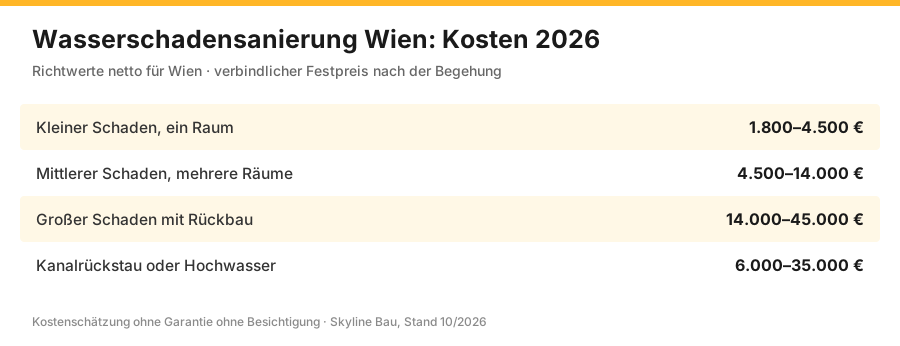
Water damage restoration Vienna: costs 2026
Net guide values, as of 2026, binding after a site visit. The range results from the type of water, its spread and the build-up of the affected components. The largest single item is almost always technical drying – how it works and what it costs in detail is explained on the building drying page.
| Scope | What is done | Net price | Duration |
|---|---|---|---|
| Small damage, one room | Drying, painting, floor covering | 1.800–4.500 € | 2–4 weeks |
| Medium damage, several rooms | additionally screed drying, drywall | 4.500–14.000 € | 4–8 weeks |
| Major damage with removal | Screed out, new insulation, reinstatement | 14.000–45.000 € | 8–16 weeks |
| Several apartments affected | Coordination, sections, alternative accommodation | by effort | 3–6 months |
| Sewer backflow or flooding | Black water, disinfection, disposal | 6.000–35.000 € | 6–14 weeks |
Unit prices so you can check an invoice
| Item | Unit | Net price | What is included |
|---|---|---|---|
| Emergency first response | lump sum | 350–900 € | Extract water, secure, photo record |
| Leak detection | lump sum | 300–900 € | Thermography, acoustic detection, endoscope |
| Moisture measurement and damage mapping | lump sum | 250–700 € | Measuring points, record for the insurer |
| Room drying, condensation or desiccant dryer | device/day | 18–45 € | Rental, set-up, monitoring |
| Drying of the insulation layer under the screed | m²/day | 2,50–6,00 € | Core drilling, compressors, hoses, filters |
| Electricity costs for drying | Month | 180–650 € | Sub-meter, billing to the insurer |
| Removing and disposing of floor covering | m² | 12–35 € | Parquet, laminate, carpet, adhesive |
| Removing screed | m² | 35–75 € | Breaking up, insulation out, disposal |
| New screed incl. insulation | m² | 45–80 € | Edge strips, separating layer, screed |
| Removing and rebuilding a drywall partition | m² | 75–140 € | Removal, disposal, rebuilding, filling |
| Hacking off and renewing plaster | m² | 45–95 € | up to above the damp line, newly plastered |
| Disinfection with black water | m² | 15–40 € | Agent, contact time, follow-up cleaning |
| Painting after drying | m² | 12–28 € | Primer, filling, two coats |
| Laying new parquet | m² | 28–55 € | Laying without material, glued |
| Check measurement and release | lump sum | 150–350 € | Readiness-for-covering measurement, record |
Total around €16,400 net. For covered mains water damage, this is generally paid by the building or household insurance – provided the damage was reported and documented before the work began.
The three types of water and why they determine the price
| Category | Where it comes from | What this means |
|---|---|---|
| Clean water | Drinking water pipe, heating, rain through the roof | Drying usually sufficient, material is preserved |
| Grey water | Washing machine, dishwasher, shower drain | Disinfection required, porous materials are replaced |
| Black water | Sewer backflow, sewage, flooding | Complete removal of porous components, disinfection, disposal as contaminated |
With black water, nothing is dried; it is removed: screed, insulation, drywall, floor coverings. Everything that has soaked up water and cannot be disinfected has to go. That is why sewer backflow in the same apartment costs three to four times as much as a burst pipe.
Drying methods: what is used when
Condensation dryer
Draws moisture from the room air and collects it in a container. The standard at room temperatures above 15 °C. €18 to €35 per device per day.
Desiccant dryer
Also works at low temperatures and achieves deeper levels of drying. For basements, unheated rooms and winter. €25 to €45 per device per day.
Drying of the insulation layer under the screed
Under the screed there is insulation in which water collects and does not dry from above. Air is blown in or extracted via core holes – the method that avoids removing the screed.
Cavity and wall drying
For soaked lining walls, suspended ceilings and raised floors. With special nozzles through small openings instead of opening up the whole construction.
Which method is right is decided by measurement – not by the equipment of whichever firm happens to have time. Anyone who only sets up condensation dryers although the water is in the insulation layer spends weeks drying the air and not the damage.
Five special features of water damage in old Viennese buildings
1. Galvanised risers at the end of their service life
The most common trigger in Viennese tenement buildings. Galvanised steel lasts 40 to 60 years, and much of the existing stock is older. A burst riser rarely affects just one apartment – usually several storeys are involved. Anyone who only repairs after the damage will have the next burst in two years: then riser pipe replacement should be considered.
2. Timber beam ceilings as water channels
Water runs along the beams inside the ceiling and sometimes emerges two rooms further on. The stain on the ceiling therefore does not tell you where the damage is. In addition, fill made of slag or rubble stores water for months. That is why timber ceilings are measured over a large area, not at single points.
3. No as-built plans
Nobody knows where which pipe runs. That is why leak detection with thermography, acoustic detection and endoscopy is not a luxury but the alternative to chiselling open on suspicion – €300 to €900 compared with a ripped-open wall.
4. Several parties affected
Water knows no apartment boundaries. Typically three to five units, three insurers and one property management are involved. We document separately for each apartment so that every party receives its documents, and coordinate the sections so that not all of them are uninhabitable at the same time.
5. Basement and backflow
In lower-lying districts and during heavy rain, water comes back through the sewer. A working backflow valve is a precondition for many insurance policies – check whether one is in place before you need it.
How water damage restoration works
Who pays: the insurance question
| Constellation | Responsible | What to watch out for |
|---|---|---|
| Burst pipe in the apartment | Building insurance for the fabric, household insurance for the contents | sudden event, report before work begins |
| Burst riser pipe | Building insurance of the property | handled via the property management |
| Water from the neighbour | their liability insurance, if at fault | e.g. a poorly maintained washing machine |
| Sewer backflow | only with separate additional cover | a working backflow valve is often a precondition |
| Flooding, heavy rain | Natural hazard cover | must be insured separately, often with a limit |
| Gradual soaking | nobody – counts as maintenance | that is why establishing the cause is also financially decisive |
| Rented apartment, structural damage | Landlord under § 3 MRG | Rent reduction possible if unusable |
The eight mistakes that cost the most after water damage
- Waiting for the insurer to get in touch. In this time, a drying case becomes a removal case.
- Tidying up before taking photos. What is not documented is rarely replaced.
- Drying without knowing the cause. Water keeps flowing in, the equipment runs for weeks for nothing.
- Only drying the air. If the water is in the insulation layer under the screed, no condensation dryer in the room will help.
- No sub-meter on the drying electricity. Then there is a dispute about €180 to €650 a month.
- Laying flooring without a readiness measurement. Cupping, open joints and, in the worst case, mould under the covering.
- Disposing of damaged items before they have been recorded.
- Not thinking ahead after the repair. With a 60-year-old galvanised riser, the next burst is only a matter of time.
How to check an offer or an invoice
Who we restore for
Property management companies
Several affected units, separate documentation per apartment, coordination with several insurers, construction phases arranged so that not everything is uninhabitable at the same time.
Apartment owners
Drying and reinstatement from one source, with the documentation your insurer needs – instead of three companies and three invoices.
Tenants
Documentation of the condition for the landlord and household insurance, including the documents for any rent reduction.
Commercial
Business interruption as short as possible: work at night and at weekends, in sections, with dust protection towards ongoing operations.
When you do not need us
If a glass of water has been knocked over and the parquet looks dry again an hour later, you do not need anyone – ventilating is enough. If only the washing machine has overflowed and the water was on tiles, mop it up and watch the joints for two weeks. Contact us if water has run into screed, insulation or a timber ceiling, if it has gone through the ceiling to the neighbour or if you cannot find the cause. That is where waiting quickly becomes a mould case.
Water damage restoration in 1110 Vienna: what is often behind it in Simmering
Structurally, Simmering is a district of contrasts. Around Simmeringer Hauptstraße there are older tenement buildings, next to them large residential complexes from the 1950s to 1970s, plus new residential quarters and extensive commercial areas towards Kaiserebersdorf and Albern. Each of these building types has its own weak point when water escapes.
In the post-war buildings it is often the risers and apartment pipes made of galvanised steel that clog from the inside and rust through at the threads. The damage often only shows in the apartment below, because the water continues to run in the screed or along the shaft. In the commercial halls it is more often flat roofs and roof drains, and in basements in lower-lying areas backflow from the sewer after heavy rain. For the restoration this means: first clarify where the water comes from and whether drinking water, rainwater or waste water is involved, then dry, and only then reinstate. Anyone who owns an apartment in a large complex in the 11th district should also involve the property management early, because the riser is usually a common part of the building and the building insurance handles the claim. If the riser is worn out, it is worth considering riser pipe replacement for the whole building.
Drying company, plumber or building contractor: who does what after water damage
After a leak, many people first ask for a drying company. That is understandable but covers only part of it. Water damage has three phases, and in each one someone else is needed:
- Stop the cause: the leak itself is repaired by a licensed plumber. Without this repair, any drying is in vain.
- Drying: measuring, setting up equipment, drying the insulation layer under the screed, monitoring. This can be done by a pure drying company or by a building contractor that also organises technical building drying.
- Reinstatement: plaster, screed, drywall, painting, flooring. This requires several trades in the right order.
If you commission each phase separately, you coordinate yourself – and bear the risk that weeks pass between drying and the floor layer. We take on the second and third phases together and coordinate with the plumber so that the measurement records for the insurer remain continuous.
Water from above: when the roof or terrace causes the damage
Not all water damage comes from a pipe. In the loft and the top apartments, the cause is often a leaking roof, a blocked gutter or a roof terrace whose waterproofing has given way at the door connection. Typically, the stains only grow after rain and fade again in summer. Drying only helps in the short term here: as long as the envelope leaks, the water comes back with the next thunderstorm. That is why the cause at the top must be fixed first, through roof renovation or terrace waterproofing, and only then the interior. This difference is important for the insurer, because penetrating rainwater is covered differently from a burst pipe.
Frequently asked questions about water damage restoration in Vienna
How much does water damage restoration in Vienna cost?
What is water damage restoration?
Is it enough to mop up the water damage?
Who pays for water damage restoration?
Does Skyline Bau help with the insurance claim?
Why is leak detection important?
What is technical drying?
How long does the drying take?
Why is acting quickly important?
Does the restoration prevent mould?
What determines the costs?
What are common causes of water damage?
Does Skyline Bau carry out leak detection itself?
What happens to soaked screed?
Does Skyline Bau also carry out the reinstatement?
When should I report the water damage to the insurer?
Are the electricity costs of drying reimbursed?
How long does water damage restoration take in total?
Water damage restoration: is there a fixed price?
What needs to be considered with water damage in a tenement building?
What is the difference from fire damage restoration?
Water damage restoration: does Skyline Bau also work outside Vienna?
How do I reach Skyline Bau after water damage?
What do I do in the first hours after water damage?
Why are the first 48 hours so important?
Where is the main stopcock?
How much does water damage restoration cost?
How much does the drying cost?
What is insulation-layer drying under the screed?
Are the drying devices loud?
Can I stay in the apartment during drying?
Does the insurer pay for the electricity for drying?
Which insurance is responsible?
What is covered and what is not?
Do I have to wait for the insurer's approval before the restoration?
What do I need to document?
Who pays if the water came from the neighbour?
Who pays in a rented apartment?
Can I reduce the rent?
How do I find the cause if nothing is visible?
What are typical causes in old Viennese buildings?
How do I recognise hidden water damage?
What is black water?
What to do with sewer backflow?
When can the floor be laid again?
Can mould develop after water damage?
Do you also do the reinstatement?
How quickly can you be on site?
What to do if water damage happens at the weekend?
May I choose the restoration company myself if the insurer suggests a partner firm?
Is water leaking from the washing machine mains water damage?
Related services
Dry? Deep cleaning comes next.
After drying and removal, deep cleaning is necessary, and with sewage damage also disinfection. Bling Premium Cleaning takes care of both. More at bling-bling.at.
Send enquiry
Enquire directly here — fixed-price quote free of charge. Skyline Bau replies within 2 working days.
Have water damage restored?
Write to us directly on WhatsApp — send the property, extent of damage and key data. Skyline Bau will get back to you quickly.
Note: Skyline Bau is the brand name of the construction and renovation division of Bling Bling GmbH and is not a separate legal entity. The sole contractual partner is Bling Bling GmbH. Bling Bling GmbH is a restricted construction trade business under § 99 GewO (Austrian Trade Regulation Act) and not a licensed master builder (Baumeister). Under § 99 (5) GewO, the title “Baumeister” is reserved for businesses licensed under § 94 no. 5 GewO. Regulated trades — master-builder services, structural engineering, gas and sanitary engineering, electrical engineering — are carried out exclusively by authorised, licensed partner companies.