Stairlift Vienna plenty of advertising, few answers. Here is the answer.
Stairlift Vienna: it is not the brochure that decides, but your staircase. An honest assessment from the construction company that does the work — not a lift dealer, not a commission portal.
Stairlift Vienna: a seated stairlift in Vienna costs €4,000 to €18,000 net including installation, a wheelchair platform lift €10,000 to €32,000, a vertical lifting platform €12,000 to €25,000. Up to a height of about 30 cm, a ramp is usually the better solution. Which one fits is decided not by the brochure but by whether the person can still transfer – and by the staircase.
Stairlift, platform lift or ramp? Five questions instead of fifty brochures
The internet is full of advertising and offers little that answers the real question: what solves my problem? The right solution does not depend on the brochure but on five things. Answer them and you will usually have narrowed the choice down to one or two options.
| Question | Reply | Then consider |
|---|---|---|
| 1. Can the person still sit safely and transfer? | yes | Seated stairlift (stairlift with a seat) |
| no, the person stays in the wheelchair | Platform lift, vertical lifting platform or ramp | |
| 2. How large is the difference in height? | up to about 50 cm | Ramp – if there is room for its length |
| 50 cm to about 3 m | Vertical lifting platform or platform lift | |
| a whole storey or more | Seated stairlift, platform lift or passenger lift | |
| 3. Is the staircase straight or curved? | straight | standard rail, cheaper and available sooner |
| curved, with a landing | made to measure, more expensive, 6–10 weeks' delivery time | |
| 4. Inside the flat or in the communal stairwell? | Stairwell in a multi-occupancy building | check escape route width and consent – often a seated stairlift with a folding seat |
| 5. How long will the solution be needed? | a few months | rental or second-hand lift, portable ramp |
| permanently, condition is getting worse | choose the wheelchair solution straight away |
Stairlift Vienna compared: seated stairlift, platform lift, vertical lifting platform, ramp
| Solution | How it works | Suitable for | Space required | Cost net incl. installation |
|---|---|---|---|---|
| Seated stairlift, straight | the seat travels on a rail along the staircase | can walk and sit, but can no longer climb stairs | staircase from approx. 70 cm wide, folding seat | 4.000–8.000 € |
| Seated stairlift, curved | as above, rail made to measure around bends and landings | as above, curved staircase or several flights | as above | 9.000–18.000 € |
| Standing stairlift | small standing platform with a grab bar on the rail | can stand but has difficulty bending the knees | very narrow staircases | 4.000–9.000 € |
| Platform lift | platform carries the wheelchair along the staircase | the person stays in the wheelchair | staircase from approx. 90–100 cm, folding platform | straight €10,000–18,000, curved €18,000–32,000 |
| Vertical lifting platform | platform rises vertically like a small lifting table | wheelchair, rollator, short heights | footprint approx. 1.0 × 1.4 m, often outdoors | €12,000–25,000 up to approx. 1.8 m, more for greater heights with an enclosure |
| Home lift / vertical platform lift | small cabin across several storeys, without a masonry shaft | everyone, including wheelchair users | approx. 1.0–1.5 m² footprint, opening in the floor slab | 25.000–50.000 € |
| Passenger lift | cabin in a shaft, for the whole building | all residents | shaft, permit | €150,000–400,000, see lift installation |
| Fixed ramp | inclined surface with a handrail | wheelchair, rollator, pushchair | long: roughly 1.7 m of length per 10 cm of height at 6% | €350–9,000 depending on height |
| Portable ramp | aluminium channel or wedge that is simply laid down | thresholds, single steps | minimal, but often too steep for self-propelling users | 60–900 € |
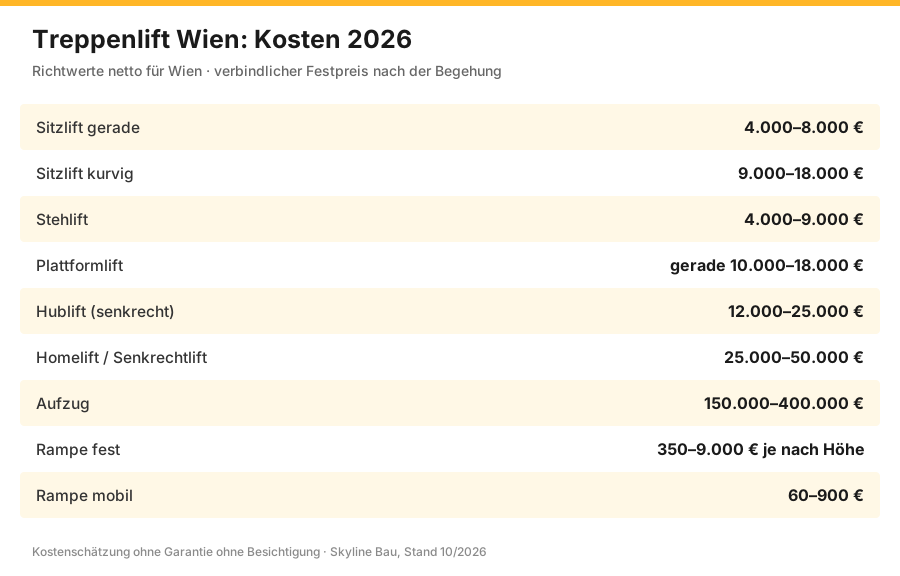
The prices are guide values for Vienna, as of 2026, net, including delivery and installation, excluding preparatory building work. Manufacturers often quote gross prices, so bear this in mind when comparing. Maintenance costs roughly €200 to €450 a year, depending on the type of lift.
Ramp or lift? Every centimetre of height costs 17 centimetres of ramp
A ramp is the simplest and most robust solution – no electricity, no maintenance, no breakdowns. Its problem is length. Under ÖNORM B 1600 (the Austrian standard for barrier-free building), a ramp should have a gradient of no more than 6% so that a wheelchair user can travel up it unaided. On top of that come landings at the start and end and, on longer ramps, an intermediate landing.
| Difference in height | Ramp length at 6% | With landings approx. | Recommendation |
|---|---|---|---|
| 5 cm (threshold) | 0,8 m | – | Threshold wedge or transition profile |
| 15 cm (one step) | 2,5 m | 4–5 m | Ramp if there is room; otherwise a portable ramp with a helper |
| 30 cm (two steps) | 5,0 m | 7–8 m | Ramp usually feasible outdoors, rarely indoors |
| 50 cm (three steps) | 8,3 m | 11–12 m | Borderline: ramp only with plenty of space, otherwise a vertical lifting platform |
| 100 cm | 16,7 m | 20 m and more | Vertical lifting platform or platform lift |
| one storey (approx. 3 m) | 50 m | not practical | Seated stairlift, platform lift, home lift or passenger lift |
Stairlift Vienna: costs 2026
Building work almost always comes on top of the lift itself. That is exactly the part lift dealers do not do – and the part we take on as the construction company carrying out the work. The lift is supplied and installed by a licensed lift engineering partner with whom we coordinate.
| Building work | What for | Cost net |
|---|---|---|
| Power supply with its own circuit protection | every lift | €350–900 (electrical work via partner) |
| Foundation, base slab for an outdoor vertical lifting platform | outdoor vertical lifting platform | 900–2.800 € |
| Pit or recess for the vertical lifting platform | level access | 1.200–3.500 € |
| Wall opening, widening a doorway | access to the platform | 1.200–3.500 € |
| Floor opening for a home lift, including trimming of the structure | vertically through a floor slab | €3,500–9,000 including structural engineering |
| Landing, removing or relocating a step | stop at the top and bottom | 600–2.400 € |
| Relocating the handrail, adapting the balustrade | the rail needs space | 350–1.200 € |
| Fixed ramp in concrete or steel with handrail | entrance, terrace | 1.800–9.000 € |
| Weather protection, canopy for an outdoor lift | lift outdoors | 1.500–5.000 € |
Total roughly €6,800 net, installed in one day, delivery time 2–4 weeks. The staircase remains usable for everyone else.
Total roughly €23,800 net in about three weeks. At 68 cm, a ramp would have needed more than 14 metres including landings – impossible to fit into the front garden.
Wheelchair-accessible and barrier-free: the dimensions that matter
A lift alone does not make a house wheelchair-accessible. Whether someone in a wheelchair can live independently depends on manoeuvring spaces, door widths and heights. ÖNORM B 1600 governs barrier-free building; here are the key values at a glance:
| Area | Guide value | Why |
|---|---|---|
| Turning space | Circle 150 cm in diameter | turning the wheelchair, in the bathroom, kitchen, hallway and in front of doors |
| Doors | clear passage width of at least 80 cm, preferably 90 cm | passing through without knocking your hands |
| Thresholds | ideally none | every edge slows the wheelchair down or tips it |
| Ramps | maximum gradient 6%, width at least 120 cm, handrails on both sides | usable without assistance |
| Lift platform | at least approx. 80 × 125 cm, preferably 90 × 140 cm | wheelchair and feet fit safely |
| Switches, handles, door openers | at a height of around 85–100 cm | within reach from a seated position |
| Washbasin, sink | with knee clearance underneath | knees fit under the surface |
| Shower | level-access, wheelchair-accessible, with seat and grab bars | showering without transferring, see barrier-free bathroom |
For the whole flat – bathroom, doors, floors, kitchen, lighting – see age-friendly home adaptation in Vienna.
Stairlift in a communal stairwell: escape route and consent
In a multi-occupancy building, the stairwell is an escape route. A stairlift must not narrow this route impermissibly; that is why models with a folding seat and folding footrest, which take up little space when parked, are almost always used in stairwells. Whether the remaining width is sufficient is checked before ordering – this is part of our site visit.
- Owner-occupied flats (Wohnungseigentum): since the 2022 amendment to the Austrian Condominium Act (WEG), barrier-free adaptation counts as a change subject to simplified approval. If the other owners do not object within two months of being properly notified, consent is deemed to have been given.
- Rented flats: the landlord must be notified; in council housing this is Wiener Wohnen, in a housing cooperative the cooperative.
- Fire safety: the remaining stair width, clear landings and the parking position are checked against the lift partner's drawing.
- Removal: if you move out or the need no longer exists, the rail is removed and the drill holes are filled – this should be agreed in advance.
The legal review of each individual case is carried out by your property manager or a lawyer. We provide the technical description, the dimensions and the costs needed for it.
Sometimes a handrail is enough: practical aids before a lift
| Aid | Solves | Cost net, installed |
|---|---|---|
| Second handrail on the staircase | walking with both hands – this is often enough for years | 250–950 € |
| Marking step edges, better lighting | seeing the steps and not missing them | €15–35 per step |
| Seat on the landing | taking a break | 250–600 € |
| Threshold wedge, portable ramp | single step, balcony threshold | 60–900 € |
| Stair climber (portable, with a helper) | wheelchair up and down the stairs without any installation | rental or purchase, through a medical supply shop |
| Moving the bedroom to the ground floor | stairs no longer needed every day | depends on the conversion, often cheaper than a lift |
Funding for stairlifts and barrier-free measures in Vienna
The City of Vienna subsidises barrier-free and disability-friendly measures and, depending on the situation, the Social Ministry Service (Sozialministeriumservice) adds grants. For lifts in residential buildings, the Vienna Housing Fund (wohnfonds_wien) may also be responsible. Amounts and requirements change, so here are only the points on which it depends in practice:
- Apply before ordering. Anyone who buys first usually gets nothing.
- Proof of need: care allowance decision (Pflegegeldbescheid), disability pass (Behindertenpass) or a doctor's certificate.
- Separate costs: lift and building work listed in one breakdown – we provide this.
- Several quotes: some bodies require comparative quotes for the lift.
How it works with Skyline Bau
| Step | What happens | Duration |
|---|---|---|
| 1. Enquiry | photos of the staircase or entrance, the height, who will use the lift | reply within 2 working days |
| 2. Site visit | measuring, checking the escape route, assessing ramp or lift – honestly, even if a handrail is enough | around 60 minutes |
| 3. Quotation | building work by us, lift by the licensed lift partner, everything in one breakdown | 5–10 working days |
| 4. Funding, consent | you submit the application, we supply the documents and description | depends on the body |
| 5. Execution | building work first, then lift installation | seated stairlift 1 day, vertical lifting platform 1–3 weeks |
| 6. Handover | instruction, acceptance, maintenance contract with the lift partner | 1 day |
When you do not need us
If a straight seated stairlift fits on an unobstructed staircase without any building alterations, the lift dealer alone is enough. We are the right people to talk to as soon as building work is required – foundation, wall opening, ramp, door widening, bathroom – or if you want an independent assessment of which solution fits at all before you decide.
Stairlifts in Viennese period staircases: stone steps, curved flights, landings
In Vienna, stairlifts are often installed in buildings that were never designed for them. Gründerzeit staircases (in buildings from 1848–1918) have stone steps cantilevered from the wall, wrought-iron balustrades on the inner side and half landings where the staircase changes direction. This has consequences for the rail and its installation.
The rail of a seated stairlift is usually not fixed to the wall but bolted to the steps via supports. With stone steps, this means drilling into a material that can be brittle and often already has chipping at the front edge. The installer therefore has to know where fixings are permitted and position the supports so that no step is weakened. In a multi-occupancy building, these interventions in common parts require the consent of the owners or the property management.
Curved flights and landings call for a curved, made-to-measure rail. It is bent to an exact survey – which is why curved lifts cost more and take longer to deliver than straight ones. With very tight stairwells, it may only be possible to run the rail along the outer side, where the route is longer and the steps are wider. If the staircase is too narrow for that, a lift in the courtyard or stairwell void is more likely to be the answer.
What happens in a power cut
Most current seated stairlifts run on batteries that are recharged at the stops at the top and bottom. In a power cut, a few more journeys are therefore usually possible and nobody gets stuck halfway. What matters is that the lift is parked in the charging position after every journey. Depending on the model, platform lifts and vertical lifting platforms have an emergency lowering function or a hand crank. Ask to be shown how it works at the handover, and hang the short instructions where they are clearly visible next to the lift.
When others keep using the stairs
Most buildings are home to several people who do not use the lift. On almost all models, the seat, armrests and footrest can therefore be folded up. The parking position should be chosen so that it is not at the narrowest point of the staircase – with curved rails, often a little way round the corner on the landing. Before ordering, check with a folding rule how much width remains free with the seat folded. A second handrail on the opposite side helps everyone on foot; how to adapt the flat as a whole is described on the page on age-friendly home adaptation.
Frequently asked questions about stairlifts, platform lifts and ramps in Vienna
What is the difference between a stairlift and a platform lift?
What is a vertical lifting platform?
How much does a stairlift cost in Vienna?
When is a ramp enough?
How steep may a wheelchair ramp be?
How wide does the staircase need to be for a stairlift?
May I install a stairlift in the communal stairwell?
What if the person's condition gets worse?
Are second-hand or rental stairlifts available?
What is a home lift?
How long does installation take?
Does a stairlift need electricity?
Is funding available?
Do you install the lift yourselves?
Which is cheaper: a stairlift or moving house?
Apart from the lift, what does a wheelchair-accessible home need?
Can a vertical lifting platform be installed outdoors?
Is help with the household available too?
How much does maintenance cost?
Can a stairlift be fitted to stone steps in a period building?
Does a stairlift still run during a power cut?
How much space is left on the staircase when the stairlift is parked?
Related services
Stairs mastered – what about the housework?
When stairs become difficult, so does cleaning. Our partner company Bling Bling Premium Reinigung takes care of regular domestic cleaning with a permanent team, window cleaning and, after installation, the final clean. Find out more at bling-bling.at.
Send enquiry
Enquire directly here — fixed-price quotation free of charge. Skyline Bau replies within 2 working days.
Photos of the staircase are enough – we will tell you what fits.
Write to us directly on WhatsApp — send photos. Reply within 2 working days.
Note: Skyline Bau is the brand name of the construction and renovation division of Bling Bling GmbH and not a separate legal entity. The sole contractual partner is Bling Bling GmbH. Bling Bling GmbH is a restricted building trade business under § 99 GewO (Austrian Trade Regulation Act) and not a licensed master builder (konzessionierter Baumeister). Under § 99 (5) GewO, the title „Baumeister“ (master builder) is reserved for businesses licensed under § 94 no. 5 GewO. Regulated trades — master builder services, structural engineering, gas and plumbing, electrical engineering — are carried out exclusively by authorised, licensed partner firms.