Basement renovation Vienna that makes the basement dry and keeps it dry.
Basement renovation Vienna: from the building contractor that does the work — not from an agent.
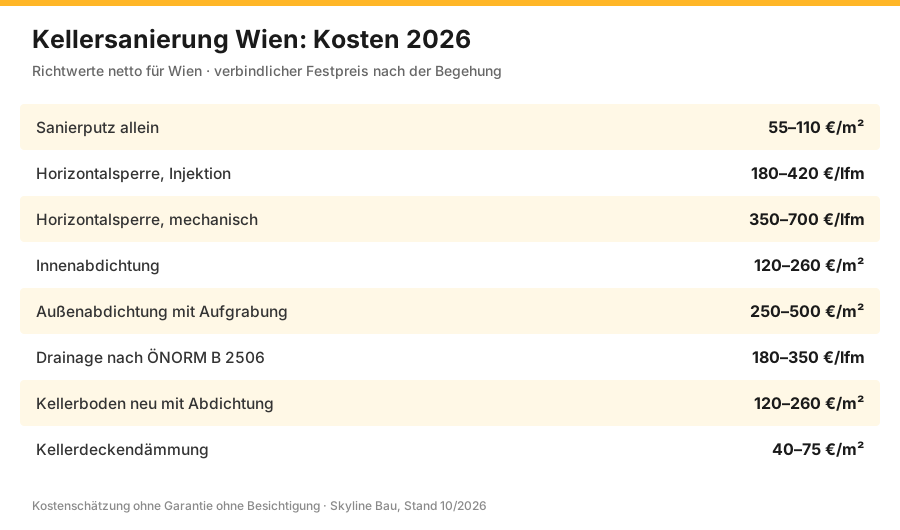
Basement renovation Vienna: renovating a basement in Vienna costs 150 to 400 euros per square metre. Horizontal barrier €180–700/rm, internal waterproofing €120–260/m², external waterproofing with excavation €250–500/m², renovation plaster €55–110/m². Every measure starts with measurement.
Basement renovation Vienna: costs 2026
Net guide values, as of 2026, binding after moisture measurement. The range is so wide because a "damp basement" can have five different causes – with five different solutions.
| Measure | What it helps against | Net price | Construction time |
|---|---|---|---|
| Renovation plaster alone | Residual moisture and salts after the cause has been eliminated | €55–110/m² | 1–2 weeks |
| Horizontal barrier, injection | rising damp in the masonry | €180–420/lin. m | 3–8 days |
| Horizontal barrier, mechanical | heavily soaked or thick masonry | €350–700/rm | 1–3 weeks |
| Internal waterproofing | water penetrating from the side when excavation outside is not possible | €120–260/m² | 2–3 weeks |
| External waterproofing with excavation | pressing and non-pressing water from outside | €250–500/m² | 3–6 weeks |
| Drainage to ÖNORM B 2506 | Keep water away from the building | €180–350/rm | 1–2 weeks |
| New basement floor with waterproofing | rising damp through the floor slab | €120–260/m² | 2–4 weeks |
| Basement ceiling insulation | cold floors on the ground floor | €40–75/m² | 3–6 days |
Unit prices, so you can check a quote
| Item | Unit | Net price | What is included |
|---|---|---|---|
| Complete moisture diagnosis | lump sum | 800–2.500 € | Core samples, oven-dry analysis, salt analysis, moisture profile, report |
| Hacking off and disposing of old plaster | m² | 22–45 € | up to 80 cm above the visible damp line, salt-contaminated |
| Pressureless injection | lin. m | 180–320 € | Drilling, injecting, sealing |
| Pressure injection | lin. m | 250–420 € | for denser masonry |
| Driving in chrome steel plates | lin. m | 350–700 € | only with a continuous bed joint |
| Renovation plaster system to WTA | m² | 55–110 € | Spatter coat, porous base plaster, renovation plaster, slurry |
| Poultice plaster for salt extraction | m² | 35–75 € | Application, dwell time, removal, disposal |
| Internal waterproofing with sealing slurry | m² | 65–140 € | Substrate preparation, fillet, two coats |
| Excavation for external waterproofing | m³ | 55–110 € | Excavation, storage or removal, backfilling |
| Thick bitumen coating outside | m² | 45–95 € | Primer, two coats, protective layer |
| Dimpled membrane and protective layer | m² | 18–40 € | Laying, fixing, finishing profile |
| Drain pipe with filter gravel and fleece | lin. m | 85–170 € | Fall, flushing shafts, connection |
| Sealing or renewing a light well | pcs | 450–1.400 € | Connection to waterproofing, grating, drainage |
| Replacing basement windows | pcs | 380–900 € | Removal, installation, plastering in, sealing |
| Building drying | Month | 300–900 € | Equipment, electricity, monitoring |
| New electrics in the basement | lump sum | 1.200–4.500 € | by a licensed electrician, RCD, damp-room design |
Total around €24,800 net, which is €413 per m² of basement area. If excavation outside were also needed, €15,000 to €30,000 would be added – in Vienna this usually fails because of the surrounding buildings.
After flooding or a burst pipe in the basement, the order matters: water damage restoration Vienna.
Five causes of a damp basement
The treatment differs completely. Anyone who assumes the wrong cause renovates past the problem – and that only becomes visible after two years. After flooding, waterproofing is always preceded by building drying, otherwise residual moisture is trapped.
| Cause | Signs | Solution |
|---|---|---|
| Rising damp | horizontal band up to about 1 m high, salt efflorescence, higher in summer than in winter | Horizontal barrier |
| Water penetrating from the side | damp patches near the floor of the wall in contact with soil, worse after rain | Waterproofing outside or inside, drainage |
| Condensation | Moisture on cold walls in summer, drops on pipes, musty smell | Change ventilation behaviour, insulation, mechanical ventilation |
| Defective pipe | limited patch, grows quickly, often warm | Leak detection, pipe repair |
| Surface water | after heavy rain, defective downpipes, slope towards the house, blocked light wells | Provide drainage outside |
Ventilating an old basement correctly
- In summer only ventilate at night or early in the morning, when the outside air is cooler than the basement wall. At midday at 30 °C and high humidity, every open door brings moisture in.
- In winter ventilating is no problem, because cold air carries little moisture and does not condense when it warms up in the basement.
- A hygrometer costs €15 and is the cheapest investment: only ventilate when the absolute humidity outside is lower than inside.
- Basement windows permanently tilted open in summer are the classic mistake – they create exactly the problem they are meant to solve.
Diagnosis: what is measured before every renovation
This diagnosis costs €800 to €2,500. It is the cheapest item of the entire measure and the only one that prevents €20,000 from flowing into the wrong method.
The methods in detail
Horizontal barrier against rising damp
It interrupts the capillary transport of water in the masonry. Two methods are proven: injection with silane or silicone agents, in which drill holes are made at 10 to 12.5 cm spacing and filled, and the mechanical barrier, in which stainless steel plates are driven into a continuous bed joint or wall sections are cut open.
- Injection €180 to €420/rm, gentle, no intervention in the load-bearing structure, works with brick masonry up to about 60 cm thick.
- Mechanical barrier €350 to €700/rm, the most reliable method, but an intervention in the load-bearing structure – therefore only in sections and with structural supervision.
- Electrophysical methods are not something we offer. Their effectiveness has not been reliably proven in independent studies.
Waterproofing against water penetrating from the side
The technically better route is waterproofing from the outside: excavate down to the bottom of the foundation, clean the wall, thick bitumen coating in two layers, dimpled membrane as protection, drainage to ÖNORM B 2506 if required. Costs €250 to €500/m² of wall area, including excavation and backfilling.
In Vienna this often fails because of the surrounding buildings: the neighbouring building is directly adjacent, the pavement lies above, the courtyard cannot be accessed by vehicles. Then internal waterproofing with sealing slurry remains, €120 to €260/m². It is technically more demanding because the water pressure comes from the wrong side – fillet, substrate preparation and connection details decide on success.
Renovation plaster: what it can and cannot do
A renovation plaster system according to the WTA guideline has a high pore volume. It absorbs salts, lets moisture evaporate and stays dry on the surface. It is not a substitute for a horizontal barrier but a supplement to it – and it lasts 15 to 25 years, not forever. Applying renovation plaster to actively rising damp delays the damage by a few years.
Drainage
A drain pipe with filter gravel and fleece carries water away from the building, €180 to €350/rm including excavation. It needs a fall, flushing shafts and a connection – without an outfall or soakaway the water stands in the pipe. Drainage without waterproofing is pointless: it reduces water pressure but does not seal anything.
Five special features of Viennese basements
1. Rubble stone masonry instead of brick
Many Gründerzeit basements have base masonry of rubble stone with irregular joints. There the chrome steel plate method does not work because there is no continuous bed joint. Injection is then the way – with higher material consumption, because the masonry absorbs unevenly.
2. Wall thicknesses over one metre
Base walls in old buildings are often 80 to 120 cm thick. This doubles the injection effort and considerably extends drying: at one centimetre of wall thickness per month, a 100 cm wall theoretically needs eight years to dry completely – in practice an equilibrium is reached sooner.
3. No possibility of excavating
Closed development, pavement, courtyard without access. External waterproofing, which would technically be the better solution, cannot be carried out on most inner-city tenement buildings. That is why the combination of horizontal barrier and internal waterproofing is the rule in Vienna.
4. High groundwater near the Danube
In parts of Floridsdorf, Donaustadt, Leopoldstadt and Brigittenau the groundwater is high. There, waterproofing against non-pressing water is not enough – a design against pressing water to ÖNORM B 2209 is needed, in extreme cases a waterproof tank. That is a different price class and must be clarified beforehand.
5. Old pipes in the basement
In Viennese tenement buildings, basements are pipe hubs: water, gas, electricity, sewer. During renovations, defective connections and leaking sewer pipes regularly come to light – a common, often overlooked source of moisture, which is checked as part of the diagnosis.
How a basement renovation works
The eight most common mistakes in basement renovations
- Renovating without a diagnosis. Five causes, five solutions – guessing misses in four out of five cases.
- Confusing condensation with rising damp. The most expensive mistake: a horizontal barrier for a ventilation problem.
- Renovation plaster on active damp. Delays the damage by three years, does not fix it.
- Hacking off plaster only up to the visible line. The salts sit considerably higher.
- Dense paint or tiles in the basement. They trap the moisture and the plaster flakes off.
- Drainage without waterproofing. Reduces the pressure, does not seal.
- Sealing too early. Sealing after three months traps moisture in the wall.
- Gluing polystyrene to the basement wall. Moisture condenses behind it, creating mould that nobody sees.
What the dry basement can do afterwards
Storage and junk room
Damp-proofing is sufficient for this. No permit required, no requirements for room height or daylight.
Workshop, gym, hobby room
Also possible without rezoning, as long as it is not a habitable room within the meaning of the Building Code. Electrics in damp-room design, ventilation recommended.
Living space
Requires a permit from MA 37, sufficient room height, daylight, ventilation and a second escape route. That is the high hurdle – rarely achievable in Gründerzeit basements.
Lettable space
A dry basement compartment noticeably improves lettability and is a real argument when re-letting. Lockable compartments, light, a clean floor – this costs little and has a big effect.
Who pays for the basement renovation
| Case | Who pays | Basis |
|---|---|---|
| Rented building, damp basement | Landlord, from the rent reserve | Maintenance obligation under § 3 MRG |
| Reserve not sufficient | Refinancing through increased main rents | Procedure under § 18 MRG |
| Condominium ownership | Owners' association, from the reserve fund | Basement and foundation are common parts |
| Moisture from a burst pipe | Building or household insurance | sudden event, report before repair |
| Moisture from flooding or backflow | depending on the policy | Check natural hazard cover |
| Rising damp, gradual | Owner | counts as maintenance, not insured |
Who we renovate basements for
Tenement building owners
Basement as part of the basic renovation, together with risers and courtyard drainage. Partly eligible for subsidies via wohnfonds_wien.
Property management companies
Verifiable bill of quantities with diagnostic report for the owners' meeting, re-measurement after one and two years as proof of success.
Homeowners
Damp-proofing, waterproofing and making usable in one go – from the report to the finished room.
After water damage
Detection, drying, repair and documentation in the form insurers require.
When you do not need us
If the basement only seems damp in summer and is dry in winter, you probably have a ventilation problem and not structural damage – a €15 hygrometer clarifies this before you commission anyone.
If a basic renovation of the building is due anyway, the basement belongs in it and should not be awarded as a separate measure. And if there is a single damp patch that grows after rain, first have the downpipes and the fall in the courtyard checked – this costs nothing and in a third of cases is the whole cause.
Basement damp-proofing Vienna: specialists for wet basements
Damp-proofing is the first step of every basement renovation. Depending on the moisture path, injection is used (€180 to €420 per running metre) or a mechanical horizontal barrier is installed (€350 to €700/rm). Only when the wall dries do renovation plaster and fit-out follow. The methods in detail are on wall damp-proofing Vienna.
Renovating wet basements: what is usual in Austria and what is added in Vienna
Anyone searching for wet basement renovation in Austria finds two very different cases under the same word. In the first, the masonry is soaked, the plaster crumbles, it smells musty – the water rises capillary from the ground or comes in from the side from the soil. In the second, there is actually water standing on the floor after heavy rain or backflow. The first case is damp-proofing; the second is first a search for the cause at the sewer, light well or external waterproofing.
For damp-proofing moist masonry, Austria has its own set of rules in ÖNORM B 3355, which describes diagnosis and choice of method. Its basic idea matches practice: first measure how much moisture and how much salt is in the wall, then choose the method. In Vienna there is also the fact that many basements consist of mixed masonry with rubble stone, the courtyard side can rarely be excavated and groundwater is higher near the Danube. Methods that work in the countryside on a detached house with a free external wall therefore do not automatically suit a Gründerzeit basement. How injection and the mechanical barrier work in detail is explained on the wall damp-proofing page.
Renovating vaulted basements: what the vault requires and what it costs
Many old Viennese buildings have brick vaults under the ground floor – as a barrel vault over the whole room or as shallow segmental vaults between steel beams. These vaults are load-bearing and durable as long as they can breathe. The most common damage is caused by well-meant renovations: cement plaster, emulsion paint or tiles trap the moisture, salts crystallise under the layer and blow off the brick surface.
In the renovation, the dense old plaster is therefore removed first and the vault is examined for cracks. Longitudinal cracks at the crown or rusted beams in segmental vaults must be shown to a structural engineer before work continues. Then follow repointing, salt-tolerant plaster and a vapour-permeable surface. The individual prices above apply as net guide values: hacking off €22–45/m², renovation plaster system €55–110/m², poultice plaster with heavy salt load €35–75/m². A medium-sized vaulted basement with 40 m² of wall and ceiling area thus comes to around €3,000 to €7,000 for the surfaces alone, without horizontal barrier and floor build-up.
Basement renovation company nearby or specialist firm: what the choice should be based on
When choosing, how close the firm is matters less than how it proceeds. Three points separate serious damp-proofing from a quick plastering job. First: before the price there is a measurement with a written result, not a glance at the damp line. Second: the offer names the suspected cause in one sentence and assigns every item to this cause. Third: it states openly how long the wall must dry out afterwards and when it may be painted or furnished again.
If one of these points is missing, a second opinion is worthwhile. Anyone who wants to fit out the dry basement later should mention it right away – then pipe routing, floor and possible insulation of the basement ceiling can be planned in one go.
Frequently asked questions about basement renovation in Vienna
How much does a basement renovation in Vienna cost?
How much does damp-proofing cost per running metre?
Why is the price range so wide?
How much does the moisture diagnosis cost?
Is the moisture in the basement rising or lateral?
How do I recognise condensation?
My basement is damp in summer – what should I do?
How do I distinguish damp from a burst pipe?
How is the moisture measured?
What is the degree of moisture penetration?
Why the salt analysis?
What is a horizontal barrier?
How does injection work?
Does injection also work with rubble stone?
What is a mechanical horizontal barrier?
Do electrophysical methods work?
Waterproof from the inside or the outside?
How much does external waterproofing with excavation cost?
When do I need drainage?
What needs to be considered with high groundwater?
Why is normal plaster not applied to the wall in a basement?
Is renovation plaster alone enough?
What is a poultice plaster?
How high is the old plaster hacked off?
How long does drying take?
Can drying be accelerated?
When can I paint again?
May I tile the basement?
Can I insulate the basement wall?
What about the basement floor?
What about light wells?
What about mould in the basement?
What to do after flooding or backflow?
Basement renovation: does the insurance pay?
Basement renovation: who pays in a rented building?
Basement renovation: who pays in condominium ownership?
Is basement renovation subsidised?
Basement renovation: do I need a building permit?
Is structural supervision necessary for the horizontal barrier?
Basement renovation: how long does the renovation take?
Can I use the basement during the work?
Can the basement be used as living space afterwards?
How long does a basement renovation last?
Is there a guarantee that the basement will stay dry?
What happens if the moisture comes back?
Basement renovation: does Skyline Bau carry out the work itself?
Basement renovation: is there a fixed price?
Basement renovation: how quickly can I get an appointment?
Can a vaulted basement be sealed from the inside?
Which standard applies in Austria to damp-proofing masonry?
If water is standing in the basement after heavy rain – is that a case for damp-proofing?
Related services
Basement renovated? Deep cleaning included.
After a basement renovation, deep cleaning makes sense before things are stored again. Bling Premium Cleaning takes care of basement, floor and storeroom cleaning. More at bling-bling.at.
Send enquiry
Enquire directly here — fixed-price quote free of charge. Skyline Bau replies within 2 working days.
Ready for your basement renovation in Vienna?
Write to us directly on WhatsApp — send photos of the basement walls and damp damage. Reply within two working days.
Note: Skyline Bau is the brand name of the construction and renovation division of Bling Bling GmbH and is not a separate legal entity. The sole contractual partner is Bling Bling GmbH. Bling Bling GmbH is a restricted construction trade business under § 99 GewO (Austrian Trade Regulation Act) and not a licensed master builder (Baumeister). Under § 99 (5) GewO, the title “Baumeister” is reserved for businesses licensed under § 94 no. 5 GewO. Regulated trades — master-builder services, structural engineering, gas and sanitary engineering, electrical engineering — are carried out exclusively by authorised, licensed partner companies.