Call nowWhatsAppEmail

Foundations Vienna the subsoil decides, not the concrete.

Foundations Vienna: from the contractor who does the work — not from a broker.

Foundations Vienna: a foundation in Vienna costs €140 to €420 per linear metre or square metre. Strip foundation €140–320/lin. m, pad foundation €280–750 each, floor slab €180–380/m². Frost-free from a depth of 80 cm, designed on the basis of a geotechnical report.

A foundation in Vienna costs €140 to €320 per linear metre for a strip foundation and €180 to €380 per square metre for a floor slab. Which type and which dimensions are needed is decided not by preference but by the subsoil: bearing capacity, soil layers and groundwater level are set out in the geotechnical report, which costs €1,800 to €5,000. In Vienna the ground changes over short distances between gravel terraces, Tegel clay and made ground – sometimes within a single plot. Foundations are placed frost-free from a depth of 80 cm.
✓ Geotechnical report before design✓ Frost-free from 80 cm✓ Structural design by a licensed partner firm✓ Reinforcement inspection before pouring✓ Concrete quality test documented

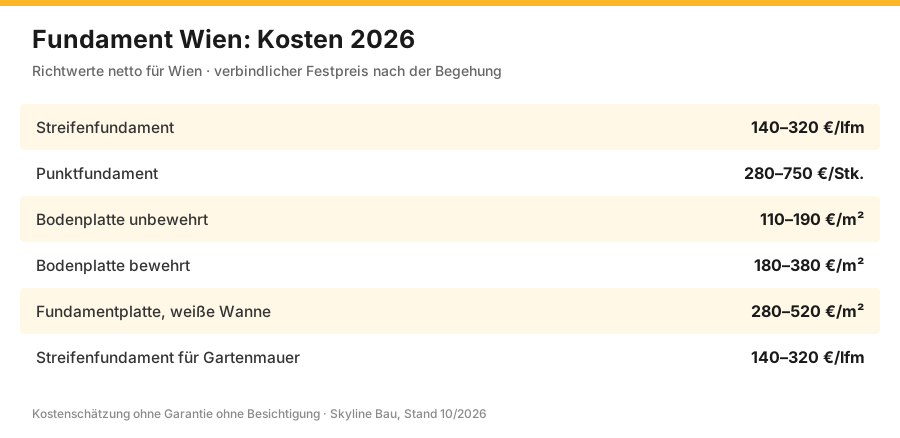
Foundations Vienna: costs 2026

Guide prices net, as of 2026, binding after the geotechnical report and structural design.

TypeWhat forNet priceUsual dimensions
Strip foundationload-bearing walls, masonry walls€140–320/lin. m40–80 cm wide, 80–120 cm deep
Pad foundationcolumns, carport, terrace posts€280–750 each60×60 to 100×100 cm
Unreinforced floor slaboutbuildings, garden shed€110–190/m²15–20 cm thick
Reinforced floor slabhouse without basement€180–380/m²25–35 cm with frost apron
Foundation slab, watertight concrete tankwith high groundwater€280–520/m²watertight concrete
Strip foundation for a garden wallboundary wall, privacy screen€140–320/lin. m30–50 cm wide, from 80 cm deep
Foundations Vienna: costs 2026 – net price overview
Foundations Vienna: the prices from the table at a glance, as of 2026, net.

Unit prices

ItemUnitNet priceWhat is included
Soil investigationlump sum1.800–5.000 €Core drilling, lab values, report
Structural designlump sum800–3.500 €via a licensed partner company
Excavationm³28–95 €Loosening, loading, removal
Blinding layerm²18–35 €Lean concrete as a working surface
Formworkm²35–85 €Erecting, aligning, striking
Supplying and placing reinforcementkg4,50–9,00 €Mesh or bar steel to plan
Supplying and placing concretem³180–320 €Delivery, placing, compacting
Concrete pumpUse450–1.400 €where access is poor
Frost apronlin. m85–180 €Thickened edge for floor slabs
Perimeter insulation under the slabm²28–65 €pressure-resistant, for heated buildings
Waterproofing against soil moisturem²18–45 €Membrane or coating, under the slab
DewateringWeek600–2.200 €with a high groundwater level
Concrete quality testpcs180–450 €Test cubes, compressive strength test
Installing the earthing systemlin. m12–35 €Foundation earth electrode, before pouring
Worked example · 95 m² floor slab for a detached house without basement
Subsoil, structural design, excavation€9,800
Frost apron 42 lin. m, blinding layer€6,400
Insulation, waterproofing, earth electrode€7,200
Formwork, reinforcement, concrete, testing€14,900

Total approx. €38,300 net, i.e. €403/m². A strip foundation with a basement would not be cheaper – basement walls and waterproofing are added, but in return you gain usable space at the lowest price per square metre of the whole house.

Which foundation for what

ProjectUsual solutionWhat matters
Detached house with basementStrip foundation under basement wallsFoundation depth, waterproofing, drainage
Detached house without basementreinforced floor slab with frost aproninsulation under the slab, earth electrode
Extension to an existing buildingsame foundation depth as the existing buildingotherwise uneven settlement and cracking
Garden wall, boundary wallStrip foundation from 80 cm deepfrost-free, otherwise frost will lift it
Carport, terrace roofPad foundationsloads per column, set fixings beforehand
Garden shed, outbuildingunreinforced slab or stripsbearing capacity of the ground
High groundwater levelwatertight concrete tankwatertight concrete, waterstops
Poor subsoilSoil replacement or micropilesdecided by the geotechnical report
Frost-free in Vienna means a foundation depth of at least 80 cm. Above that, frost acts on the water in the soil, lifts the foundation and does not let it return to its position in spring. This is the most common cause of leaning garden walls, sunken terrace posts and cracked outbuildings – and the cheapest mistake to avoid.

How a foundation is built

1 · Ground investigationCore drilling, soil samples, lab values, geotechnical report. It states bearing capacity, soil layers and groundwater level — the three values that determine everything else.
2 · Structural designDimensions, reinforcement, foundation depth, by a licensed partner firm under § 94 no. 5 GewO. Only then is it clear what the foundation will cost.
3 · Setting out and excavationSurveying the axes, excavating to foundation depth, checking the formation level. If the ground differs from the report, work stops and it is reassessed.
4 · Blinding layerLean concrete as a clean working surface, so that the reinforcement does not lie in the soil and the concrete cover is correct.
5 · Formwork and reinforcementErecting and aligning the formwork, placing reinforcement to plan, fitting spacers. The foundation earth electrode goes in now — later it is no longer possible.
6 · Reinforcement inspectionChecked against the plan, documented with photos. After pouring the reinforcement can no longer be inspected — which is why this is the most important checkpoint on the whole site.
7 · PouringConcrete of the specified grade, placed in layers and compacted. Test cubes are taken for the compressive strength test.
8 · CuringKept moist and protected from sun, wind and frost. Concrete that dries out too quickly does not reach its strength and develops shrinkage cracks.
9 · Striking and releaseOnce striking strength is reached, dimensions are checked and the work is handed over to the next trade with records.

The seven mistakes that ruin a foundation

  • Designing without a geotechnical report. The ground in Vienna changes over short distances. What bears the load next door need not bear it on your plot.
  • Not founded frost-free. Above 80 cm frost lifts the foundation — the most common cause of leaning walls and sunken posts.
  • Reinforcement without spacers. If the steel lies too close to the surface, the concrete cover is missing and it starts to rust.
  • Poured on an unsuitable formation. Softened or disturbed ground must be replaced, not concreted over.
  • Foundation earth electrode forgotten. It must be placed before pouring — retrofitting takes many times the effort.
  • No curing. Concrete that dries out too quickly does not reach its strength and cracks.
  • A different foundation depth for an extension. Old and new settle differently, and a crack along the joint follows in the first year.

How to check a quote

Is there a geotechnical report?Without one, the design is guesswork. €1,800 to €5,000, and the basis for everything else.
Which foundation depth has been priced?At least 80 cm, more in cohesive soils. It belongs in the quote in centimetres.
Which concrete grade and how much reinforcement?In kilograms per cubic metre or to plan. "Concrete as required" is not a line item.
Are the blinding layer and spacers included?Small items with a big effect on durability.
Is the foundation earth electrode included?€12 to €35 per linear metre, must be placed before pouring.
Is there a concrete quality test?Test cubes with compressive strength test, €180 to €450 per test, recorded.
How are deviating ground conditions handled?Rules for soil replacement and extra depth, with unit prices instead of negotiation on site.
Who does the structural design?A licensed partner firm under § 94 no. 5 GewO, named in the quote.

When you do not need us

For a garden shed on four paving slabs you do not need a construction company — that is DIY work, as long as nothing load-bearing goes on top. Pad foundations for a light terrace roof are also feasible if the frost-free depth is respected. Call us if something load-bearing will stand on it, if the subsoil is unclear or if you are connecting to an existing building. That is where it is decided whether a crack runs through the wall in five years.

Strip foundation: work out the price per metre yourself

The range of €140 to €320 per linear metre looks broad, but it can be broken down into its components. The calculation here uses a typical cross-section of 40 cm width and 80 cm depth, founded frost-free and poured directly against the soil in stable ground.

ComponentQuantity per linear metreGuide price net per lin. m
Excavation including removalapprox. 0.5 m³14–48 €
Blinding layer0.4 m²7–14 €
Concrete supplied and placed0.32 m³58–102 €
Reinforcement as per structural designapprox. 8–15 kg36–135 €
Foundation earth electrode1 lin. m12–35 €

Together this comes to around €130 to €330 per metre – exactly the range in the price table. It gets more expensive if the ground does not stand and needs formwork, if the structural design requires a wider cross-section or if the excavated soil is contaminated. It stays cheaper with short distances for the truck mixer and little reinforcement, for example under a low boundary wall. For a 20-metre foundation for a garden wall, around €2,800 to €6,400 net is realistic.

Pouring a foundation: costs that are not in the price per cubic metre

Anyone comparing quotes usually looks at the price per cubic metre of concrete. But the differences often arise elsewhere. Concrete plants charge a surcharge for small quantities, because a truck mixer is on the road just as long for two cubic metres as for eight. If the mixer cannot drive up to the formwork – the norm in a Viennese courtyard or behind a detached house – a concrete pump costing €450 to €1,400 per use is added.

In winter, concrete needs protection from frost during the first days, meaning covers, possibly a heated enclosure or an adjusted mix. And finally, documentation costs money: reinforcement inspection with photos and test cubes for compressive strength. These items look small, but they decide whether you can later prove that the foundation was built to plan. A quote without them is not cheaper, it is incomplete.

Foundations for smaller projects: carport, garden shed, terrace

Not every foundation carries a house. For a carport with six columns, pad foundations are usually enough; at €280 to €750 each you are looking at around €1,700 to €4,500, depending on size, access and whether anchors or post bases are cast in straight away. A 12 m² garden shed stands on an unreinforced slab or on strips; as a slab that comes to about €1,300 to €2,300 at €110 to €190/m². For a terrace roof attached to the house, the foundation depth must match the existing floor slab, otherwise the two parts settle differently.

Doing it yourself is most feasible for excavating by hand. Reinforcement, pouring and above all setting out should be done by professionals, because errors in position and height can only be fixed afterwards by breaking out. If a house is being planned at the same time, the floor slab for the main building is the real topic.

Frequently asked questions about foundations in Vienna

How much does a foundation cost?
Strip foundation €140 to €320 per linear metre, pad foundation €280 to €750 each, reinforced floor slab €180 to €380/m². A 95 m² floor slab for a detached house without basement comes to around €38,300 net including subsoil, structural design and insulation.
How deep does a foundation need to be?
In Vienna at least 80 cm, i.e. frost-free. Deeper in cohesive soils and exposed locations. The exact depth is set by the structural design based on the geotechnical report — not by rule of thumb.
What does founded frost-free mean?
The base of the foundation lies below the depth to which frost penetrates. Above it, water in the soil freezes, expands and lifts the foundation. In spring it does not return to its position — this is the most common cause of leaning garden walls and sunken terrace posts.
Do I really need a geotechnical report?
For anything load-bearing, yes. Vienna sits on gravel terraces, Tegel clay and made ground that change over short distances — sometimes within a single plot. €1,800 to €5,000, and without these values every design is guesswork.
Strip foundation or floor slab?
A strip foundation carries loads in lines under walls and is usual for buildings with a basement. A floor slab spreads the load over the whole area and is standard for houses without a basement — it is also the ground floor and takes the insulation and earth electrode.
What is a frost apron?
A thickened edge of the floor slab taken down to frost-free depth, €85 to €180 per linear metre. It prevents frost from reaching under the edge of the slab. Without it the slab lifts at the edge — and cracks.
Foundations: what is a watertight concrete tank?
A structure made of watertight concrete that is sealed against pressing water without additional waterproofing, €280 to €520/m². Necessary with a high groundwater level. The waterstops are decisive — that is where it fails, if it fails at all.
What is a foundation earth electrode?
A steel strip or round bar embedded in the foundation that earths the electrical installation, €12 to €35 per linear metre. It must be placed before pouring — retrofitting takes many times the effort and can often only be solved with a deep earth rod.
Why is the reinforcement photographed?
Because it can no longer be inspected after pouring. Before every pour the reinforcement is checked against the plan and documented with photos. Incorrectly placed reinforcement is the most serious foundation defect and can hardly be fixed afterwards.
What is concrete cover and why does it matter?
The distance between the reinforcing steel and the concrete surface. If it is too small, moisture reaches the steel, it rusts and spalls the concrete. This is ensured with spacers — a small item with a big effect on service life.
What is curing?
After placing, concrete is kept moist and protected from sun, wind and frost. Concrete that dries out too quickly does not reach its strength and develops shrinkage cracks. It costs almost nothing and is still often left out.
How long does concrete need to cure?
Formwork is struck after a few days, depending on the element and temperature. Concrete reaches its nominal strength after 28 days. It may be loaded earlier, but only after release — that is set by the structural design, not the schedule.
Can concrete be poured in winter?
Above 5 °C yes, in frost not without additional measures. With antifreeze admixtures, heating mats and covers a lot is possible, but slower and more expensive. Concrete is never poured on frozen ground.
What if the ground cannot bear the load?
Then it is replaced, compacted or the foundation goes deeper — depending on the findings. With very poor ground, micropiles that transfer the load into load-bearing layers are an option. What is needed is decided by the geotechnical report, not on site.
How deep do I need to found an extension?
At the level of the existing foundation. Different foundation depths lead to uneven settlement and thus to a crack along the joint. What foundation the existing building has is revealed by a trial opening — see extension Vienna.
How much does a foundation for a garden wall cost?
€140 to €320 per linear metre at 30 to 50 cm width and at least 80 cm depth. For a wall this is often the largest single item — and the one where people most often cut corners. Details on garden wall Vienna.
How much does a pad foundation cost?
€280 to €750 each, depending on dimensions and excavation depth. What matters are the loads per column and that fixings such as post anchors are set before pouring — drilling afterwards weakens the foundation.
Does a garden shed need a foundation?
For small, light sheds, paving slabs or pad foundations are enough. As soon as something load-bearing goes on it, it is used permanently or has service connections, it needs a slab or a strip foundation underneath.
Do I need to insulate under the floor slab?
For heated buildings yes, with pressure-resistant perimeter insulation, €28 to €65/m². Without it, heat goes straight into the ground and the floor surface stays cold — this cannot be fixed afterwards.
Foundations: what records do I receive?
Structural calculation, reinforcement inspection records with photos, delivery notes and concrete quality tests, measurement sheets, setting-out record and the acceptance record under ÖNORM B 2110. These documents are part of the handover.
How long does a foundation take?
For a 95 m² floor slab, allow two to four weeks including excavation, formwork, reinforcement, pouring and curing time. Strip foundations for a garden wall are finished in a few days, but also need curing time before building on them.
Foundations: do I need a permit?
The foundation itself is part of the permitted building project. For freestanding walls, carports and outbuildings it depends on size and location — we clarify this with MA 37 before planning.
Who does the structural design?
A licensed partner firm under § 94 no. 5 GewO, named in the quote, €800 to €3,500. Execution, reinforcement inspection and documentation are handled by our site management — you have one contact person.
Foundations: how quickly will I get a quote?
Site visit within five working days anywhere in Vienna with an initial assessment. For a reliable quote we need the geotechnical report and the structural design — these values determine the price more than the area does.
How much concrete does a strip foundation need per metre?
That is width times depth. At 40 cm width and 80 cm depth it is 0.32 m³ per linear metre, at 60 × 100 cm already 0.6 m³. Add a few percent reserve, because the trench walls are never perfectly straight. The exact dimensions are set by the structural design, not the builders' merchant.
Why is a small foundation often more expensive per metre than a large one?
Because fixed costs are spread over fewer metres. Bringing in equipment, setting out, concrete delivery with a small-quantity surcharge and a possible pump cost the same for five metres as for fifty. A short foundation can therefore be over €320 per linear metre, even though the cross-section and material are simple. Having several elements founded at the same time noticeably lowers the price per metre.
Can I pour a foundation myself?
For a garden shed or a small boundary wall it is possible if depth, reinforcement and concrete grade are right. For load-bearing foundations of a house or extension we advise against it: reinforcement, position and pouring sequence must follow the structural design and be documented. Mistakes only show up years later as cracks, and by then the cause in the ground can hardly be fixed.

Related services

◆ Partner company · Bling Premium Cleaning

Foundation done? Site cleaning during and after.

Earthworks bring dirt onto the driveway and adjacent areas. Bling Premium Cleaning handles site and final cleaning, including the mandatory cleaning of public areas. More at bling-bling.at.

Send enquiry

Enquire directly here — fixed-price quote free of charge. Skyline Bau replies within 2 working days.

Enquiry about: Foundations Vienna
Construction emergency? Water damage, mould, acute damage — please contact us directly via WhatsApp 24/7 — we will come promptly.

You and Skyline Bau will each receive a confirmation by email.

Ready for your foundation in Vienna?

Message us directly on WhatsApp — send photos of the site. Reply within two working days.

Bling Bling GmbH · Skyline Bau brand · Company details in the legal notice

Note: Skyline Bau is the brand name of the construction and renovation division of Bling Bling GmbH and is not a separate legal entity. The sole contractual partner is Bling Bling GmbH. Bling Bling GmbH is a restricted construction trade business under § 99 GewO (Austrian Trade Regulation Act) and not a licensed master builder (Baumeister). Under § 99 (5) GewO, the title “Baumeister” is reserved for businesses licensed under § 94 no. 5 GewO. Regulated trades — master-builder services, structural engineering, gas and sanitary engineering, electrical engineering — are carried out exclusively by authorised, licensed partner companies.