Insulation Vienna that starts where the most heat is lost.
Insulation Vienna: from the construction company that does the work — not from an agent.
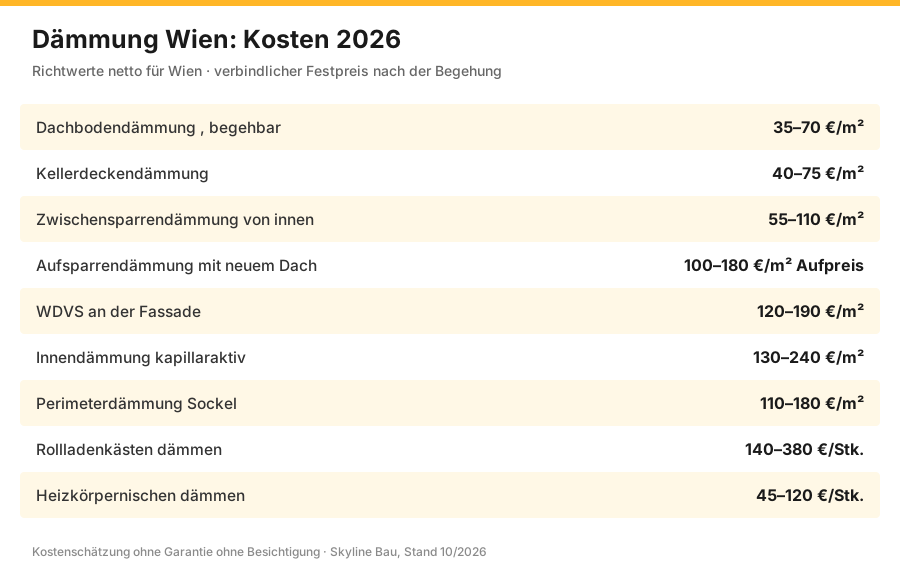
Insulation Vienna: insulation in Vienna costs 35 to 240 euros per square metre, depending on the building element. Loft €35–70/m², basement ceiling €40–75/m², façade with ETICS €120–190/m², internal insulation €130–240/m². Anyone starting with a limited budget begins at the top – not at the façade.
What insulation costs in Vienna – all building elements at a glance
Guide values net, as of 2026. The table also shows where insulation pays off fastest: at the top and bottom, not on the façade.
| Building component | Net price | Heat loss via this element | Payback |
|---|---|---|---|
| Loft insulation, walkable | €35–70/m² | 15–25 % | 5–10 years |
| Basement ceiling insulation | €40–75/m² | 6–12 % | 6–12 years |
| Between-rafter insulation from inside | €55–110/m² | 15–25 % | 10–18 years |
| Over-rafter insulation with new roof | €100–180/m² surcharge | 15–25 % | only worthwhile if the roof is due anyway |
| ETICS on the façade | €120–190/m² | 20–35 % | 10–18 years with subsidy |
| Capillary-active internal insulation | €130–240/m² | 20–35 % | 12–20 years |
| Perimeter insulation for the plinth | €110–180/m² | 3–6 % | usually part of other measures |
| Insulating roller shutter boxes | €140–380 each | local thermal bridge | 3–6 years |
| Insulating radiator niches | €45–120 each | local thermal bridge | 2–5 years |
| Window replacement, triple glazing | €750–1,800/pc | 10–20 % | 15–25 years |
Insulation materials compared
| Material | Lambda value | Price per m² at 16 cm | Characteristics |
|---|---|---|---|
| EPS white | 0,038–0,040 | 18–30 € | inexpensive, light, not vapour-permeable |
| EPS grey with graphite | 0,031–0,033 | 24–38 € | better insulating effect at the same thickness |
| Mineral wool | 0,035–0,042 | 28–48 € | non-combustible, vapour-permeable, good sound insulation |
| Wood fibre | 0,038–0,045 | 45–75 € | best summer heat protection, ecological |
| Cellulose, blown in | 0,038–0,042 | 22–40 € | fills cavities without joints, for timber structures |
| Phenolic (resol) foam | 0,021–0,025 | 70–110 € | half the thickness for the same effect, expensive |
| Calcium silicate | 0,045–0,065 | 60–95 € | capillary-active, for internal insulation in old buildings |
| Vacuum insulation | 0,006–0,008 | 150–280 € | extremely thin, pressure-sensitive, cannot be cut |
The lambda value indicates how well a material insulates – the smaller, the better. Graphite EPS at 0.032 achieves the same effect at 16 cm as white EPS at 20 cm. This is relevant wherever space is limited: internal insulation, reveals, property boundary.
Total around €94,400 net. Loft and basement ceiling account for €28,800 of this, i.e. less than a third – but already cover a considerable part of the savings potential. With a subsidy via an approved base renovation, €55,000 to €70,000 remain depending on the rate.
Where insulation is permitted in Viennese old buildings
| Building component | In a protection zone | Outside |
|---|---|---|
| Loft inside | always possible | always possible |
| Basement ceiling | always possible | always possible |
| Courtyard façade | usually possible | possible |
| Street façade | practically never with articulated façades | possible |
| Roof from outside | appearance is assessed | possible |
| Internal insulation | always possible, but demanding in terms of building physics | possible |
Responsibility lies with MA 19, and for listed buildings additionally with the Federal Monuments Office. This clarification belongs at the beginning: two to four months' lead time is normal, and it decides which measures belong in the cost estimate at all.
What does insulation in Vienna cost?
The price depends on the building element and the system. As a guide:
As of 2026 · net, excl. 20% VAT · guide values for standard build-ups — much is individual. Final price after site visit, in writing as a fixed price to ÖNORM B 2110.
which building element first?
Not every insulation measure brings the same benefit. The order by effect per euro:
Top floor ceiling
The cheapest and most effective first: heat rises. Insulating the top floor ceiling or the loft pays back fastest.
Basement ceiling
Also inexpensive and quick to carry out. It makes the ground-floor floor warmer and can often be done from below without much effort.
Façade (ETICS)
The biggest lever on heating costs, but also the most expensive measure. Worthwhile when the façade is being renovated anyway — and where the protection zone allows it.
Roof
Mandatory anyway when converting the loft. As between-rafter or over-rafter insulation, depending on the construction and whether work is done from inside or outside.
Insulation — in all 23 districts and the Vienna surroundings
We carry out insulation work throughout Vienna, as well as in Klosterneuburg and the surrounding area of Lower Austria. In protection-zone buildings, internal insulation is often the only permitted solution.
Internal insulation in protected old buildings
On Gründerzeit façades worth preserving, no external ETICS is allowed. That leaves internal insulation — demanding in terms of building physics, because the dew point shifts into the wall. Without a professional, vapour-permeable or capillary-active build-up, moisture threatens behind the insulation, followed by mould. This is the point at which internal insulation needs planning and is not a DIY-store product. We tailor the build-up to the wall and bring in a building physicist if required.
from energy performance certificate to façade
01 Site visit & analysis
We look at the building elements, check thermal bridges and the most sensible starting point. Free of charge.
02 Concept & subsidy
Which measure, which system, which subsidy — as a bill of quantities with a fixed price to ÖNORM B 2110.
03 Preparation
Check and repair the substrate, erect scaffolding. On the façade, a load-bearing substrate decides durability.
04 Applying the insulation
Bonding and anchoring insulation boards, reinforcing, rendering — or, for internal insulation, the professional wall build-up.
05 Detail junctions
Window reveals, plinth, eaves — this is where the details decide thermal bridges and airtightness.
06 Handover
Final check, documentation, documents for the subsidy.
Why Skyline Bau for your insulation in Vienna
We are the executing construction company and carry out insulation work with our own people. The advantage shows when insulation is part of a larger renovation: façade insulation and window replacement, roof insulation and loft conversion, basement ceiling and basement renovation interlock. Planned from a single source, scaffolding is not erected twice and walls are not opened twice.
- One contractual partner for insulation and the adjoining trades.
- Fixed price according to ÖNORM B 2110, in writing after the site visit.
- Planned in terms of building physics — especially for tricky internal insulation.
- Subsidy documents included.
- €3 million construction liability insurance.
Subsidies: what you should check
Thermal renovation is subsidised by the federal government and the City of Vienna — but the programmes and rates change constantly. What is almost always important: the application must be submitted before construction starts and the measure documented with evidence. Anyone who builds first and then thinks about the subsidy often goes away empty-handed. We supply the necessary documents and evidence; it is best to check the current subsidy rates directly with the City of Vienna and the federal government, as they change frequently.
How to recognise a reputable contractor
1. Is building physics taken into account?
Especially with internal insulation, the build-up decides moisture and mould. A reputable provider calculates this instead of simply gluing boards.
2. Are thermal bridges an issue?
Reveals, plinth, eaves — if they are not mentioned, the critical points will be botched.
3. Has ventilation been considered?
After airtight insulation without a ventilation concept, the risk of mould increases. This must be considered.
4. Does the system suit the existing building?
Not every ETICS fits every wall. The substrate and the existing façade determine the system.
5. Is the subsidy planned in?
Application before construction starts, evidence documented — a good provider thinks of this.
6. Do not confuse warranty and guarantee
Statutory 3 years under § 933 ABGB. Manufacturer guarantees on the system run separately.
When you do not need us
For insulating a single basement ceiling or the top floor ceiling, a specialised company is often sufficient — that is manageable. We are the right choice when insulation is part of a façade, roof or overall renovation and several trades need to be coordinated.
the individual measures
Insulation covers several building elements. What it includes:
The biggest lever on heating costs — ETICS or ventilated façade.
The external thermal insulation composite system in detail — build-up, systems, execution.
The cheapest effective measure — insulating the top floor ceiling.
Warmer floor on the ground floor, often easy to do from below.
Insulation, windows and building services in an overall concept.
The overview of all renovation services.
Whether private or commercial — we carry out insulation in Vienna on schedule and cleanly. Professional insulation in Vienna saves time, money and nerves.
what you should know
So that you know exactly what to expect, we answer the most important questions here — honestly and from the practice of a building contractor that does the work itself.
Which areas can be insulated?
The most important are: façade (external walls), roof and top floor ceiling, basement ceiling and the ground slab. Every insulated area reduces heat loss. Which measure has the greatest effect depends on the building — a package is often the most economical.
How much does insulation save on heating costs?
Professional insulation can noticeably lower the heating demand, because a large part of the heat is lost through uninsulated surfaces. Exactly how much depends on the initial condition and the measures. In addition, living comfort increases.
Which insulation is eligible for subsidies?
In Vienna, thermal insulation measures are eligible via THEWOSAN, for multi-occupancy buildings via base renovation. It is important to apply before awarding the contract. We clarify which subsidies are possible for your project.
What does insulation cost in Vienna?
The costs depend on area, surface, insulation material and thickness. The investment pays off through lower heating costs and is subsidised. After a site visit you receive a fixed-price offer.
New thermal insulation in Vienna: when the old insulation is no longer enough
Many Viennese houses from the 1970s to 1990s are already insulated – but with only four to six centimetres, which today is hardly more than a start. Anyone planning new thermal insulation there faces a different question than with an uninsulated old building: can the existing system stay and be doubled up, or does it have to come off?
Doubling up means gluing new boards onto the old insulation layer and fixing them with anchors through both layers into the load-bearing masonry. This saves demolition and disposal, but requires that the old render adheres firmly, the boards are not hollow and there is no moisture in the system. This is clarified by a tap test and one or two trial openings before a price can be serious. If the old system is waterlogged or detaching, it is removed. Note that older EPS may contain the flame retardant HBCD, which must be disposed of separately – a cost item that is often missing from offers. On both routes, the current fire protection requirements of OIB Guideline 2 apply to the new layer, even if the old insulation never met them. Details on the façade system can be found on the page on the external thermal insulation composite system.
Envelope first, then heating: why the sequence saves money
Anyone wanting to move away from gas thinks of the new heating first. In construction terms, the reverse order is usually cheaper. The heating load – the output a building needs on the coldest day – falls with every insulated surface. If the heat pump is designed before insulation, it is sized for a house that will no longer exist in that form after renovation: too big, too expensive to buy, with short running times in part-load operation.
Then there is the flow temperature. A heat pump works efficiently when the heating water does not have to be too hot. In an uninsulated Gründerzeit building, the existing radiators are often insufficient for this; after loft and basement ceiling insulation and new windows, they are often enough again. Whether this is the case is shown by a heating load calculation, not by gut feeling. That is why an overall roadmap makes sense that coordinates insulation, windows and heating replacement in time – even if the steps are spread over several years. What such a roadmap looks like is described under energy-efficient renovation.
Insulating in condominium ownership: what you decide alone and what you do not
In a building with condominium flats, the façade, roof, top floor ceiling and basement ceiling are common parts. Insulation there requires a resolution of the owners' association under the Condominium Act; it is usually financed from the reserve fund or via a levy according to shares. An individual owner can neither commission it alone nor block it alone if the majority agrees.
It is different inside: internal insulation of the external wall or an insulated wall lining concerns your own flat and can usually be carried out without a resolution. You should still coordinate it with the property management, because anchors and services go into the wall. With internal insulation, building physics decides success, not the insulation material alone. For the owners' meeting, a cost estimate per building element is worthwhile – often the basement ceiling is approved first, because it costs little and helps the ground-floor flats noticeably. More on this on the page on basement ceiling insulation.
Frequently asked questions about insulation in Vienna
What does insulation cost in Vienna?
That depends on the building element: façade insulation (ETICS) costs 120 to 180 euros per square metre, basement ceiling 30 to 60, top floor ceiling 25 to 50, roof insulation 60 to 120. Guide values for standard build-ups — the final price comes after a site visit.
Insulation in Vienna means for us: one contact, one contract, one fair price. That is how insulation in Vienna runs without surprises.
Which insulation brings the most?
Usually the top floor ceiling: cheap, quick and effective, because heat rises. The façade has the greatest effect on heating costs, but is the most expensive measure. The order by effect per euro is roof/top floor ceiling, basement ceiling, then façade.
External or internal insulation?
External is better in terms of building physics and usually cheaper, because the wall stays warm. Internal insulation is only used when external insulation is not allowed — for example on protected Gründerzeit façades. It is more demanding because the dew point shifts into the wall.
What is ETICS?
An external thermal insulation composite system: insulation boards are glued and anchored to the façade, reinforced and rendered. It is the most common façade insulation. A load-bearing substrate and careful execution of the detail junctions at windows and plinth are important.
Insulation in Vienna means for us: one contact, one contract, one fair price. That is how insulation in Vienna runs without surprises.
Why is internal insulation so tricky?
Because the dew point — the point at which water vapour condenses — shifts into the wall. Without a professional, vapour-permeable or capillary-active build-up, moisture collects behind the insulation and mould forms. That is why internal insulation needs building-physics planning.
What is a thermal bridge?
A point where heat escapes outwards faster than across the surface — such as projecting balconies, window reveals, eaves. At thermal bridges the wall cools down more on the inside, and that is where mould forms first. They must be considered with every insulation measure.
Can I insulate my Gründerzeit building externally?
Often not. Gründerzeit façades worth preserving, with stucco and articulation, may not be insulated externally in protection zones — that would destroy their appearance. That leaves internal insulation. Whether external insulation is allowed is clarified by MA 19.
Is insulation subsidised in Vienna?
Yes, thermal renovation is subsidised by the federal government and the City of Vienna. But rates and programmes change constantly. Almost always: apply before construction starts and document the evidence. It is best to check the current subsidy rates directly with the city and the federal government, as they change frequently.
In insulation in Vienna, experience and clean execution count. For insulation throughout Vienna and the surrounding area, you receive a transparent fixed-price offer.
Do I have to ventilate differently after insulation?
Yes. An airtight, well-insulated envelope keeps moisture in the room that previously escaped through leaks. Without deliberate ventilation or controlled residential ventilation, the risk of mould rises. A ventilation concept belongs with insulation.
Which insulation material is best?
There is no best, only the right one. Mineral wool is non-combustible and vapour-permeable, EPS inexpensive, wood fibre and calcium silicate good for internal insulation, aerogel thin where space is short. The choice depends on the building element, fire protection and building physics.
How thick does the insulation have to be?
This is set by OIB Guideline 6 via the required U-values. For the façade, 12 to 20 centimetres are usual depending on the insulation material. Thicker is not always better — beyond a certain point each additional centimetre brings little. The sensible thickness is calculated from the building element.
Does insulation pay for itself?
With inexpensive measures like the top floor ceiling often in a few years; with expensive façade insulation it takes longer. The most economical time is when the façade is being renovated anyway — then the insulation only bears the extra cost. With a subsidy, the payback period is shorter.
In insulation in Vienna, clean execution counts. For insulation throughout Vienna and the surrounding area, you receive a transparent fixed-price offer.
If you are planning insulation in Vienna, Skyline Bau is the right place: insulation in Vienna at a fixed price, professional and from a single source.
What has to be considered with basement ceiling insulation?
It is usually cheap and simple: insulation boards are fixed to the basement ceiling from below. Points to note are the clear height in the basement afterwards and the junctions with pipes and doors. A good starting point, because effective and without much effort.
Can you insulate during a loft conversion?
In a loft conversion, insulation is mandatory anyway — as between-rafter, under-rafter or over-rafter insulation. Which variant depends on the construction and whether work is done from inside or outside. Insulation and loft conversion are planned together.
What happens if insulation is done wrong?
The most common consequence is moisture and mould — especially with internal insulation without building-physics planning or ignored thermal bridges. Instead of saving energy, structural damage arises. That is why planning is more important than simply fixing the boards.
Can I combine façade insulation and window replacement?
Yes, and it even makes sense. New windows and insulation must join cleanly at the reveal so that no thermal bridge forms. Planned together, scaffolding is erected only once and the junction is right. Done separately, it often does not fit together.
Whether private or commercial — we carry out insulation in Vienna on schedule and cleanly. Professional insulation in Vienna saves time, money and nerves.
What is the U-value?
The thermal transmittance coefficient: it indicates how much heat escapes through a building element — the lower, the better insulated. OIB Guideline 6 specifies the maximum permissible U-values. It is the key figure by which the required insulation thickness is measured.
Does the façade have to be renovated before insulation?
The substrate must be load-bearing and clean. Loose render, cracks or damp areas are repaired beforehand, otherwise the ETICS will not hold. This preparation is part of the work and belongs in the offer — it decides durability.
Can an apartment building be insulated?
Yes, but it is a joint project: façade and top floor ceiling are common areas, so the owners' association decides. In addition there are often protection-zone requirements on the street façade. Courtyard façades are usually easier to insulate than the protected street side.
What is the difference between EPS and mineral wool?
EPS (polystyrene) is cheap and light, but combustible and vapour-tight. Mineral wool is non-combustible, vapour-permeable and sound-absorbing, but more expensive. For taller buildings, fire protection often requires mineral wool. The choice depends on fire protection, budget and building physics.
Insulation in Vienna means for us: one contact, one contract, one fair price. That is how insulation in Vienna runs without surprises.
Does insulation also help in summer?
Yes. Good insulation keeps the heat out in summer, not just the warmth in during winter. Roof insulation in particular counteracts the heating up of the top rooms. Heavy insulation materials with high thermal mass additionally delay heat input.
How long does insulation work take?
A basement ceiling or top floor ceiling is done in days. Complete façade insulation with scaffolding, fixing, reinforcing and rendering takes several weeks depending on size and weather — the render layers need drying time between work steps.
If you are planning insulation in Vienna, Skyline Bau is the right place: insulation in Vienna at a fixed price, professional and from a single source.
Can additional insulation be added to existing insulation?
In some cases yes, if the old insulation is firm and dry. Often, however, it makes more sense to replace old and thin with new and sufficient. What is possible is shown by the site visit — damp or loose old insulation has to come off.
What is a ventilated façade?
A construction with an air gap between the insulation and the façade cladding, which removes moisture. It is durable and favourable in terms of building physics, but more expensive than ETICS and needs a greater build-up thickness. A good solution where appearance and durability are the priority.
In insulation in Vienna, experience and clean execution count. For insulation throughout Vienna and the surrounding area, you receive a transparent fixed-price offer.
Who plans the insulation in terms of building physics?
In simple cases the executing company, in critical internal insulation a building physicist. We bring one in where necessary — better to calculate beforehand than to remove mould afterwards. This assessment is part of serious planning.
Do I need a permit for façade insulation?
Pure insulation often has to be notified but does not require a permit — provided it does not significantly change the appearance. In protection zones MA 19 has a say. With apartment buildings, the resolution of the owners' association is added. We clarify this before construction starts.
What does an energy performance certificate cost?
An energy performance certificate starts at about 250 euros, depending on the building. It shows the current energy condition and is needed anyway for subsidies and for a sale or rental. Before insulating, it helps to identify the most effective measures.
Does insulation help against mould?
Done correctly, yes: insulated walls are warmer on the inside, so less moisture condenses and mould forms less often. Done wrong — such as internal insulation without planning — it can actually cause mould. The difference lies in professional execution.
If you are planning insulation in Vienna, Skyline Bau is the right place: insulation in Vienna at a fixed price, professional and from a single source.
Do I get a warranty on the insulation?
Yes, the statutory warranty of 3 years under § 933 ABGB on the execution. Manufacturers give their own guarantees on the insulation system. The professional detail junctions are decisive for effectiveness — that is where the warranty becomes relevant in an emergency.
What is the most common expensive surprise when insulating?
A substrate that is worse than expected — damp or loose façade areas that only become visible when the scaffolding goes up. Because we work with a fixed price after a site visit, we consult you before additional costs arise; extra charges only for additionally commissioned services.
Where should I start if the budget is limited?
What does insulation cost in total for an apartment building?
How much heating cost do I really save?
What does the lambda value tell you?
What about summer heat protection?
Insulation: how thick should it be?
Can you insulate too much?
Why has mould appeared after insulation?
What are thermal bridges and why are they so important?
What does it cost to insulate roller shutter boxes?
What does insulating radiator niches achieve?
Is internal insulation dangerous?
Can I do the loft insulation myself?
Insulation: what subsidies are there?
Do I need an energy performance certificate?
Does insulation pay off at all?
What if the masonry is damp?
Can I do insulation and window replacement together?
Can old façade insulation from the 1980s simply be insulated over?
Should I insulate first or replace the heating first?
Does insulating the façade in a condominium building need a resolution?
Related services
Insulated? Final construction cleaning completes the job.
Insulation work leaves fibre dust and offcuts. Bling Premium Cleaning takes care of the final construction cleaning of the affected areas. More at bling-bling.at.
Send enquiry
Enquire directly here — fixed-price quote free of charge. Skyline Bau replies within 2 working days.
Ready for your insulation in Vienna?
Write to us directly on WhatsApp — send photos. Reply within 2 working days.
Note: Skyline Bau is the brand name of the construction and renovation division of Bling Bling GmbH and is not a separate legal entity. The sole contractual partner is Bling Bling GmbH. Bling Bling GmbH is a restricted construction trade business under § 99 GewO (Austrian Trade Regulation Act) and not a licensed master builder (Baumeister). Under § 99 (5) GewO, the title “Baumeister” is reserved for businesses licensed under § 94 no. 5 GewO. Regulated trades — master-builder services, structural engineering, gas and sanitary engineering, electrical engineering — are carried out exclusively by authorised, licensed partner companies.