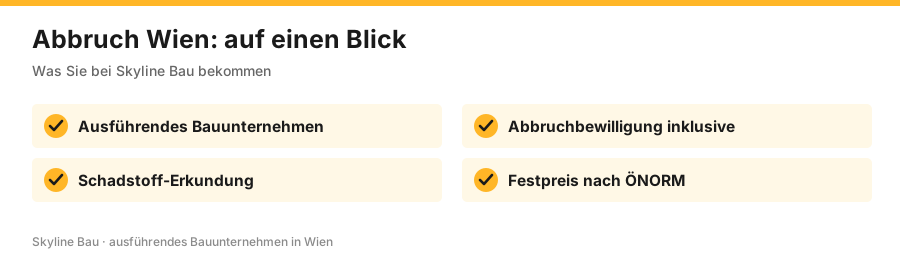
Demolition Vienna notified, separated by type and disposed of with proof.
Demolition Vienna: from the building contractor that does the work — not from an agent.
Demolition Vienna: demolition in Vienna costs 60 to 140 euros per square metre, a strip-out 70 to 150 euros. For complete demolition, allow 28 to 65 € per cubic metre of enclosed space. We take care of the demolition notification, hazardous substance survey, pre-construction survey of the neighbouring buildings and proof of disposal.
Demolition Vienna from a single source
Demolition Vienna refers to the professional dismantling of buildings, parts of buildings and structures. Demolition stands at the beginning of many construction projects: before a new building can be built, the existing one has to go; before a plot can be used anew, it has to be made ready for building. A professionally planned and legally secured demolition is therefore the first step in a whole chain of construction services.
Demolition is not simply tearing down. It touches on building law, the protection of neighbouring buildings, structural stability, the handling of hazardous substances and proper disposal. In the densely built-up city of Vienna, consideration for the surroundings comes on top — for neighbours, for traffic, for the protected townscape. Demolition therefore requires the professional responsibility of an authorised, licensed master builder partner, not an improvised solution.
Skyline Bau carries out demolition as the building contractor with its own construction team and its own machinery. We plan the dismantling, clarify the official approval, survey hazardous and problematic substances, carry out the demolition safely, separate the material by type and dispose of it in accordance with the Austrian Waste Management Act. You have one contract, a binding fixed price according to ÖNORM B 2110 and one contact person.
A reputable demolition starts with a dismantling concept and a survey of hazardous and problematic substances. Before the first machine arrives, the following is clarified: which building parts are demolished, in which order, with which equipment? Which hazardous substances are in the building — asbestos, old insulation materials, contaminated materials? Where does the material go? Only on this basis can a demolition be calculated reliably and carried out safely.
A key particularity is the demolition permit. In Vienna, demolition generally requires notification or a permit. Particularly important: since the 2018 amendment to the Vienna Building Code, buildings constructed before 1945 may only be demolished if MA 19 confirms that there is no public interest in their preservation. Skyline Bau handles this procedure.
Modern demolition is at the same time dismantling — a selective process that separates materials. Brick, concrete, metal, wood and plastic are separated so that they can be recycled instead of landfilled. This makes ecological sense and is economical, because material separated by type is cheaper to dispose of. Skyline Bau works according to this principle of selective dismantling.
We know the demolition situations — the inner-city old building in dense surroundings, the outbuilding that is to make way for a new build, the apartment building with Gründerzeit fabric. Skyline Bau plans every demolition individually and carries it out as a safe, clean and officially secured part of the construction project — on request up to making the plot ready for the subsequent new build.
Demolition is often the invisible first step that decides whether an entire construction project runs smoothly. If the demolition permit is delayed, unexpected hazardous substances turn up or the dismantling is poorly planned, the whole schedule starts to wobble. That is why Skyline Bau plans demolition thoroughly from the outset — with a dismantling concept, a hazardous substance survey and a clear path through the authorities — so that the subsequent building project can start on a reliable footing.
all services
Building demolition
Complete demolition of residential, commercial and ancillary buildings with construction machinery.
Partial demolition
Dismantling of individual parts of a building while maintaining the structural stability of the existing structure.
Interior demolition
Removal of interior walls, screeds and floor coverings — the strip-out of the building.
Hazardous substance removal
Survey and professional removal of asbestos and contaminated materials.
Selective dismantling
Separation of materials by type — brick, concrete, metal, wood and plastic kept apart.
Construction waste disposal
Professional disposal and processing of construction waste in accordance with the Waste Management Act (AWG).
Demolition permit
Handling of the official notification or permit, including the MA 19 review.
Site preparation
Making the plot ready for the subsequent new build — including excavation of the construction pit.
Building demolition and partial demolition with hazardous substance survey, selective dismantling and professional disposal, handling of the demolition permit including the MA 19 review — a building contractor with a network of licensed master builder partners, its own machinery, a fixed price according to ÖNORM B 2110, pre-construction survey of neighbouring buildings, statutory warranty of 3 years under § 933 ABGB.
Where not a whole wall needs to go but only an opening is required, drilling is the cleaner way: core drilling Vienna.
Demolition is often preceded by clearing the contents: house clearance Vienna.
Market guide prices in Vienna — demolition 2026
These values are the range within which the market moves. They come from publicly available cost breakdowns on specialist portals and guides. We quote them here so that you can put our quote in context — not to compare ourselves with them.
House demolition per m² of living space
€50 – 250/m²
Detached house — total project
10.000 – 30.000 €
Interior demolition / strip-out of an apartment
€40 – 90/m²
Construction waste disposal — skip
depending on waste fraction
Important for context: Ranges are not prices. Where you end up within the range depends on the condition of the building fabric — riser pipes, electrics, floor build-up, structure. You only see that after opening up. That is why we give you the price as a fixed price after the site visit and not beforehand as a range in a brochure.
What does demolition in Vienna cost?
The costs of demolition in Vienna depend on the size of the building, the construction method, whether there is a basement, hazardous substances, the location and accessibility. Reputable demolition companies do not calculate on the basis of square metres alone, but on the basis of a dismantling concept and a hazardous substance survey. After the site visit, Skyline Bau prepares a binding fixed-price quote according to ÖNORM B 2110.
As of 2026 · net · incl. construction waste disposal · hazardous substance removal and official fees are calculated separately · final price after site visit.
The cost range is determined above all by five factors: the size and construction method of the building, whether there is a basement that has to be excavated as well, the presence of hazardous substances such as asbestos, the location and accessibility of the site and the effort required for disposal. A detached building with good access is cheaper to demolish than an inner-city old building in dense, confined surroundings.
The construction method also has a major influence: a timber house can be dismantled fastest and most cheaply, a classic brick building lies in the middle range, and a reinforced concrete structure is the most laborious — the reinforcing steel has to be cut out of the concrete and separated by type. Skyline Bau inspects the property, assesses these factors honestly and calculates the fixed price completely — no bait offers, no extras.
A considerable cost item is disposal. The more cleanly the material is separated by type, the cheaper the disposal — mixed construction waste is expensive, separated fractions can be recycled. Material contaminated with hazardous substances such as asbestos requires separate, professional disposal and drives up costs. Skyline Bau shows the disposal costs transparently.
Hazardous substance removal and official fees are calculated separately because their scope is only known after the survey. Skyline Bau prepares the quote on the basis of the dismantling concept and the hazardous substance survey — so the fixed price is reliable and contains no nasty surprises that would later appear as extras with a mere per-square-metre estimate. This care is particularly important in demolition, because undetected hazardous substances or hidden building components can otherwise make a project considerably more expensive.
Complete or partial demolition?
Not every demolition concerns an entire building. A basic distinction is made between complete demolition and partial demolition — and the difference is significant both technically and legally.
Complete demolition is the full dismantling of a building down to ground level, often including basement and foundation. It is used when the existing building is to make way for a new build or is so damaged that renovation would be uneconomical. Complete demolition frees the plot for a new use.
Partial demolition is the dismantling of individual parts of a building while the rest of the structure is preserved. This may be a top floor to be removed, a side wing, a single storey or individual building components. The particular challenge of partial demolition is structural stability: the remaining part of the building must remain stable and load-bearing during and after the demolition. This requires precise structural planning — a task for the building contractor, coordinated with a network of licensed master builder partner companies.
A special variant is partial demolition in which the facade is retained for building law reasons while the building behind it is dismantled. This is often the case with protected Gründerzeit facades. Skyline Bau plans and carries out both types of demolition — complete and partial — and secures the structural stability of the existing building in partial demolition.
Demolition permit and MA 19 review
Demolition in Vienna is almost always an officially regulated process. Anyone who demolishes without the necessary approval risks serious consequences. Skyline Bau clarifies and handles the official procedure.
The Vienna Building Code regulates when demolition requires notification or a permit and which documents are required. Depending on the building and the scope, a demolition notification or a demolition permit from the building authority MA 37 is needed. Skyline Bau prepares the required documents and takes over communication with the authority.
Complete demolition outside protection zones is often exempt from a permit — but even for exempt projects there is a reporting obligation: the project must be reported in advance to the responsible building police, MA 37. Skyline Bau clarifies for each property whether a demolition permit, a demolition notification or a report is required.
Specifically: for complete demolition exempt from a permit, a notification of the start of demolition must be submitted to MA 37 before work begins — at least three days before the start of the works. The notification must be submitted by a licensed site manager (Bauführer); this is a classic task for a master builder company. If the building is in a protection zone or a building freeze has been imposed, demolition always requires a permit — regardless of the year of construction. Skyline Bau checks both at the start of every project and handles the notification of the start of demolition or the permit procedure as site manager.
A particularly important rule concerns old buildings: the 2018 amendment to the Vienna Building Code tightened the protection of Gründerzeit fabric. For buildings constructed before 1 January 1945, demolition in Vienna always requires a permit: they may only be demolished if MA 19 — architecture and urban design — confirms that there is no public interest in their preservation. This review is a central step in every old-building demolition in Vienna. Skyline Bau knows this procedure and handles it.
In addition there is the pre-construction survey: in dense surroundings, the adjacent buildings are recorded before demolition with photo and measurement documentation according to ÖNORM. This protects the client and the neighbours if there are later discussions about damage.
Skyline Bau arranges all official steps — notification or permit, MA 19 review, pre-construction survey — from the outset, so that the demolition proceeds with legal certainty. A legally sound, well-prepared demolition saves the client not only trouble with the authority but also possible delays that a procedure objected to after the fact would entail.
Hazardous substances and asbestos
Older buildings often contain materials that are now considered hazardous to health. Dealing with these hazardous substances is a separate, strictly regulated part of every demolition — and it must never be improvised.
Demolition is preceded by a survey of hazardous and problematic substances. The building is examined for dangerous substances: asbestos, old man-made mineral fibres, tar-containing materials, PCB-contaminated components and other contamination. Only when it is clear which hazardous substances are installed where can the demolition be planned safely.
The best-known hazardous substance is asbestos — for example in old Eternit roof sheets, in floor coverings or in insulation. Asbestos fibres are highly harmful when inhaled. Asbestos-containing materials must be removed in a controlled manner by a specialist company before the actual demolition, securely packed and properly disposed of as hazardous waste. This is done under strict protective requirements for the workers and the surroundings.
Skyline Bau takes hazardous substance removal into account in the demolition planning from the outset. The survey, professional removal and separate disposal of the hazardous substances are documented — as required by the Waste Management Act. This makes the demolition not only safe for the workers and the neighbourhood but also legally sound.
Hazardous substances are the most common reason for unexpected additional costs in demolition — but only if they are discovered too late. A thorough survey before the quote is prepared protects against this: Skyline Bau includes identified hazardous substances in the fixed price from the outset, instead of adding them later as an expensive surprise in the middle of the construction phase.
Dismantling instead of tearing down: separating materials
The term tearing down sounds like destruction — the modern technical term dismantling describes something else: an orderly process that separates materials. This difference is not just linguistic; it has tangible ecological and economic consequences.
In selective dismantling the building is not simply pushed over but taken apart in the reverse order of its construction. The various materials — brick, concrete, metal, wood, plastic, glass — are collected separately. Hazardous substances are removed beforehand. What remains are material fractions separated by type.
This separation pays off twice. Ecologically, because material separated by type can be recycled: construction waste is processed into recycled material, metal goes for reuse. Instead of ending up in landfill, the material returns to the material cycle. Economically, because separated fractions are considerably cheaper to dispose of than mixed construction waste — the disposal costs, a considerable part of the demolition costs, fall.
The Waste Management Act and the applicable recycling regulations require this separation by type anyway. Skyline Bau works consistently according to the principle of selective dismantling — properly documented, ecologically sensible and economical for the client.
Demolition in dense surroundings
Demolition on a greenfield site is a manageable task. Demolition in the densely built-up city of Vienna — wall to wall with the neighbours, on a busy street — is a completely different challenge.
The most important point is the protection of neighbouring buildings. In closed perimeter development, buildings often adjoin each other directly. The demolition must be planned so that the neighbouring building is not damaged — the structural stability of the adjacent structures must not be endangered at any time. The pre-construction survey documents the condition of the neighbouring buildings before work begins.
Then there is dust and noise protection. In inhabited surroundings, dust must be contained — for example by wetting and enclosure — and noisy work is scheduled in an orderly way. Site logistics are also demanding in confined locations: the removal of material, the positioning of the machines, the safeguarding of the pavement and traffic all have to be planned.
Skyline Bau has experience with demolition in dense locations — right up to the city centre. We plan the dismantling so that the neighbourhood is protected, dust is contained and the site is organised safely. Demolition in the city is precision work, not crude tearing down.
Traffic safety is also part of it: pavements, access routes and moving traffic must be safeguarded during the demolition works. Skyline Bau coordinates these measures with the responsible authorities and ensures that the demolition burdens the surroundings as little as possible — a standard that is not negotiable in the densely populated city.
Specifics
- Pre-1945 rule — since the 2018 amendment to the Building Code, buildings constructed before 1945 may only be demolished with MA 19 confirmation.
- Demolition permit — demolition in Vienna requires notification or a permit; Skyline Bau handles this.
- Hazardous substance survey — old buildings often contain asbestos and other contaminated materials.
- Dense surroundings — protecting directly adjacent neighbouring buildings is central.
- Pre-construction survey — photo and measurement documentation of the neighbouring buildings before demolition according to ÖNORM.
- Selective dismantling — separating materials by type for recycling and cheaper disposal.
- AWG 2002 — the handling of construction waste is documented in accordance with the Waste Management Act.
- Dust and noise protection — mandatory in inhabited surroundings, for example through wetting and enclosure.
- Partial demolition with facade retention — with protected Gründerzeit facades, the facade often remains standing.
- Site preparation — on request, the plot is prepared directly for the new build.
what comes before and after demolition
Demolition rarely stands on its own. Mostly it is the first step — or the last one before a fresh start. These services are directly connected to it:
House demolition is almost always followed by excavation — construction pit, foundation excavation, terrain adjustment. One trade, one site manager, no handover losses.
If, after demolition, the area is not to be built on but only levelled: grading, compaction, sub-base for paving.
A new foundation on the old plot. The structural design depends on what remained in the ground after the demolition — old basements, strip foundations, rubble.
Demolition and new build from a single source. One contractual partner for dismantling, excavation, foundation and shell construction — instead of four companies passing the delay to each other.
When the building is to remain standing and only everything inside is removed. Not a demolition — the shell is retained.
Partial demolition instead of house demolition: a wall, an extension, a roof. A different procedure, a different permit situation, a different price.
Demolition and house demolition in Vienna — in all 23 districts and the surrounding area
We carry out demolition and house demolition throughout Vienna, as well as in Klosterneuburg and the surrounding area of Lower Austria. Landfill fees and disposal routes differ depending on location — we show this separately in the quote.
how a demolition proceeds
A professional demolition follows a clear sequence. Anyone who knows the process also understands why a reputable demolition cannot happen overnight and why preparation carries so much weight.
It starts with the survey of the existing building and the dismantling concept. The building is inspected, the construction method recorded and the dismantling concept drawn up. The survey of hazardous and problematic substances runs in parallel. Only then follows the official procedure with demolition notification or permit and, for old buildings, the MA 19 review.
Before the actual demolition, the building is prepared: hazardous substances are removed, electricity, gas, water and district heating are professionally disconnected, loose furnishings and contents are removed. Often the interior demolition — the strip-out — follows before the load-bearing structure is demolished. This sequence allows better separation of materials.
The actual demolition of the load-bearing structure usually takes place from top to bottom, with excavators and demolition equipment, with dust suppression and protection of the neighbourhood. The resulting material is separated by type and removed. Finally, basement and foundation are excavated and the plot is made ready for building. Skyline Bau coordinates this entire sequence as one continuous project. This way the phases interlock without time and money being lost between the steps.
from demolition to site preparation
For most clients, demolition is not an end in itself — it is the first step towards a new building project. After the demolition, the plot should be handed over so that the new build can begin directly. This preparation is called site preparation.
Site preparation involves more than removing the old building. The foundation and basement of the existing building must be excavated, the construction pit prepared and the site levelled. Only when the plot is clear, level and clean is it truly ready for building.
If excavation is also required during demolition — for example because the new building will have a basement — the excavated material has to be treated separately. Above larger quantities, a chemical soil analysis by an accredited testing body is mandatory so that the material can be classified correctly and properly processed or landfilled. Skyline Bau coordinates this step as well.
The great advantage of having demolition and new build in one hand: there are no interface problems. Skyline Bau is a building contractor that works with licensed master builder partner companies and can take over the entire path — from demolition and site preparation to the finished new build. One contractual partner, continuous responsibility, a smooth transition from one phase to the next. The client does not have to mediate between a demolition company and a construction company — both tasks lie with Skyline Bau.
Demolition or renovation?
Every demolition is preceded by a fundamental question: is demolition followed by a new build worthwhile, or is renovating the existing building the better way? This decision should be made objectively and not hastily.
Demolition and new build make sense for a building whose fabric is so poor that renovation makes no economic sense — for example with serious structural damage, saturated fabric or a floor plan that cannot be sensibly adapted to today's requirements. Demolition can also be the right way if a new build significantly improves the use of the plot — more living space, better energy efficiency.
Renovation, on the other hand, is often favoured by economics: professional renovation is frequently cheaper than demolition and new build. With Viennese Gründerzeit houses there is also the legal and intrinsic value of the historic fabric — and the pre-1945 rule, which ties any demolition to the MA 19 review anyway.
Skyline Bau gives honest advice on this decision. As a building contractor working with a network of licensed master builder partner companies that carries out demolition as well as renovation and new builds, Skyline Bau has no interest in selling one solution or the other — but recommends the way that actually makes the most sense for the building, the plot and the client. This independence from a particular outcome is the real value of honest advice for the client.
Demolition Vienna for private clients, developers & businesses
Private clients
Demolition of the existing building as the first step towards building your own home — officially secured.
Developers & investors
Building demolition and site preparation for residential projects — including demolition permit and MA 19 review.
Commercial & industrial
Dismantling of commercial buildings and halls — with hazardous substance removal and disposal separated by type.
Partial demolition projects
Dismantling of individual parts of a building during renovation or conversion — with secured structural stability.
Typical demolition service packages in Vienna
- Site visit and preparation of the dismantling concept
- Survey of hazardous and problematic substances
- Handling of the demolition notification or permit
- MA 19 review for buildings constructed before 1945
- Pre-construction survey of neighbouring buildings according to ÖNORM
- Hazardous substance removal — asbestos and contaminated materials
- Interior demolition and strip-out
- Complete or partial demolition of the building
- Selective dismantling with separation of materials by type
- Professional construction waste disposal according to AWG
- Excavation of basement and foundation
- Making the plot ready for the new build
from concept to building-ready plot
Why Skyline Bau for your demolition in Vienna
- Building contractor doing the work — demolition with full technical and structural responsibility.
- Demolition permit included — Skyline Bau handles notification, permit and MA 19 review.
- Hazardous substance survey — asbestos and contaminated materials are surveyed in advance and professionally removed.
- Own machinery — short response times, no waiting for rented equipment.
- Selective dismantling — separating materials by type for recycling and cheaper disposal.
- Structural stability in partial demolition — the remaining structure stays structurally secured.
- Fixed price according to ÖNORM B 2110 — based on the dismantling concept and hazardous substance survey, without nasty surprises.
- Demolition and new build from a single source — from dismantling and site preparation to the finished new build.
- €3 million construction liability insurance.
- Subcontractor for the renovation of the Austrian Parliament 2022 — renovation work at the Parliament building, 1010 Vienna, in 2022.
House demolition: what really happens
House demolition is the most complex case of demolition. Unlike partial demolition or a strip-out, the entire building comes down — with everything legally attached to it. Anyone planning a house demolition in Vienna should know the process before comparing quotes. Because the price differences between providers almost never arise in the demolition itself, but in everything around it.
- Demolition permit. In Vienna, house demolition requires a permit under the Vienna Building Code. Submission to MA 37 is handled by the licensed master builder — under § 94 no. 5 GewO a building contractor is not allowed to do this itself. Expect a procedure lasting several weeks before the first excavator arrives.
- Survey of hazardous and problematic substances. Before every house demolition it must be checked whether asbestos, man-made mineral fibres, tar-containing adhesives or PCB are present. In buildings from the 1960s to 1980s this is the rule rather than the exception. Anyone who skips this step risks a construction stop — and disposal costs explode afterwards.
- Disconnecting the utilities. Electricity, gas, water and sewer must be professionally disconnected and deregistered before house demolition. This goes through the respective network operators and takes time. A house demolition with a gas line still connected is life-threatening.
- Neighbours and pre-construction survey. For house demolition in dense surroundings, the condition of the neighbouring buildings should be documented beforehand — with photos and, if there is a risk of vibration, with measurements. Without a pre-construction survey, you later bear the burden of proof for cracks that were already there.
- Separation by type. Concrete, brick, wood, metal and residual waste go to different landfills with different fees. The more cleanly material is separated during house demolition, the cheaper the disposal. This is the biggest lever in the quote — and the point where cheap providers later demand extra payments.
- Proof of disposal. You receive from us the proof of where the material has gone. This is not a courtesy but your protection: if construction waste from your house demolition is dumped illegally, it can come back to you.
A house demolition in Vienna costs very different amounts depending on building size, accessibility and contamination. This can only be stated reliably after a site visit. Anyone who offers you a house demolition as a lump sum over the phone has neither seen the property nor checked for hazardous substances.
Demolition, tearing down, strip-out, excavation: what is what?
The terms are often mixed up. For your quote, the difference amounts to several thousand euros.
House demolition
The entire building comes down, including the foundation. Requires a permit under the Vienna Building Code. The most complex case — hazardous substance survey, disconnection of utilities and pre-construction survey are part of it. Details above in this section.
Demolition (general)
Umbrella term. Can mean house demolition, partial demolition of individual components or dismantling. If a quote only says “demolition”, ask what exactly is meant.
Demolition works
Usually a synonym for demolition, in everyday language often used for partial demolition — a wall, an extension, a roof. More on our page demolition works Vienna.
Strip-out
The building remains standing; everything inside is removed — floors, walls, pipes, sanitary fittings. The shell remains. Not a house demolition. More on our page strip-out Vienna.
Excavation
Earthworks — construction pit, foundation excavation, terrain adjustment. Often follows house demolition directly. More on our page excavation Vienna.
Dismantling
Controlled demolition separated by type — component by component instead of with the wrecking ball. More expensive to carry out, often cheaper in disposal.
Vienna Building Code: before 1945 vs. after 1945
The central particularity in demolition is the distinction made by the Vienna Building Code according to year of construction:
- Buildings constructed before 1945: demolition is strictly regulated and requires a permit. MA 19 (architecture and urban design) must confirm that there is no public interest in preserving the townscape. Often very restrictive for Gründerzeit houses. Procedure takes 3–6 months.
- Buildings constructed after 1945: as a rule subject to notification (no permit required). Simplified procedure with the authorities.
- Notification of the start of demolition: the intended demolition must be notified to MA 37 3 days to 4 weeks in advance, depending on the age of the building and the extent of the intervention.
- Protection zone districts: additional requirements for buildings in protection zones (Innere Stadt, Mariahilf, Neubau, Josefstadt, Alsergrund and others).
- Hazardous substance assessment: for buildings constructed before 1990, testing for asbestos and PAH is mandatory. Special disposal if the result is positive.
Demolition costs 2026 (incl. house demolition)
- Large inner-city demolition of an apartment building in Vienna (300–800 m²): €80,000–350,000 depending on fabric and protection zones.
- Selective dismantling with separation by type (concrete/brick/metal/wood separated): +15–25 % surcharge. Reduces landfill costs and is standard.
- Asbestos disposal: €250–800/m² of affected area.
- Permit procedure MA 19/MA 37: own costs €2,500–8,000 for lawyers/experts (often higher in protection zone procedures).
- Duration: typically 1–2 weeks of active demolition work, plus 3–6 months' lead time for a protection zone permit.
Demolition methods compared
Mechanical with excavator
Standard. Excavator with demolition shears or pulveriser. Fastest method. For detached buildings.
Selective dismantling (separated by type)
Environmental standard 2026. Concrete, brick, steel and wood are separated — recycling and lower landfill costs. Vienna's underground railway excavation is already being processed into recycled concrete material (W24 report 03/2026).
Interior demolition / partial demolition
For existing buildings with only partial intervention (e.g. removing a wall). Requires a prior structural check.
Strip-out (interior)
The load-bearing structure is retained; only the interior fit-out is removed. Preparation for a complete renovation.
Blasting (rare in Vienna)
For very tall industrial buildings or bridges. Approval-intensive, strict requirements.
Wall sawing / diamond cutting
For precise openings in Viennese old buildings (doors, windows, stairs). Low vibration.
The legal and normative basis
- Vienna Building Code § 60 et seq. — demolition notification and permit.
- Old Town Preservation Act — protection of historic building fabric, especially protection zones.
- ÖNORM B 3151 — dismantling and hazardous substances in buildings.
- ÖNORM EN 16627 — sustainability of construction works (recycling rates).
- Waste Management Act (AWG) — disposal regulations.
- Landfill Ordinance — landfill categories.
- ÖNORM S 5730 — investigation of hazardous substances in buildings (asbestos, PAH, MMMF, PCB).
- Safety and health protection plan under the Construction Work Coordination Act (BauKG) for large demolitions.
How to recognise a reputable demolition provider
First — GISA number and trade licence. Ask for the GISA number and check it in the trade register. A house demolition in Vienna involves master builder services under § 94 no. 5 GewO — demolition permit and structural design. Ask which licensed master builder takes these on.
Third — routine with MA 19 and MA 37. Protection zone pre-check, notification of the start of demolition, hazardous substance assessment — all standard.
Fourth — selective dismantling as standard. Skyline Bau separates by type and uses the recycling system.
What does Skyline Bau do differently from referral portals?
A referral portal forwards your enquiry to companies and collects a commission for it — which is included in your price. You do not know in advance who will end up on your site. Skyline Bau is the building contractor that does the work: one contract, one contact person, one site manager. Master builder services under § 94 no. 5 GewO — demolition permit and structural design — are handled by our licensed master builder partner, whom we name to you before the contract is signed.
When is demolition exempt from a permit under the Vienna Building Code?
Complete demolition is exempt from a permit outside protection zones and areas with a building freeze if the building was constructed after 1 January 1945. Buildings constructed before 1 January 1945 require a permit with MA 19 confirmation (no public interest in preservation). Check the Vienna zoning plan at wien.gv.at/flaechenwidmung/public.
What is the difference between demolition and tearing down?
In the construction industry the meaning is almost identical: demolition = tearing down = systematically taking a structure apart. Technical nuance: demolition is more associated with controlled dismantling and recycling, tearing down more with complete removal. Our standard: structured demolition with the maximum recycling rate (65–88 %).
Who is allowed to carry out demolition?
Structurally relevant demolition work requires the professional responsibility of an authorised, licensed master builder partner (§ 94 no. 5 GewO). A pure interior strip-out without structural intervention is a free trade. As the building contractor, Skyline Bau coordinates licensed master builder partner companies + earthworks partners + specialist disposal partners.
Can Skyline Bau combine demolition with rebuilding?
Yes. Demolition, site preparation, excavation, foundation and shell construction run through one contract and one site manager with us. The advantage is not the price but the interface: if something comes to light during demolition that changes the foundation design, nobody has to mediate between two companies. Master builder services under § 94 no. 5 GewO — structural design and permit submission — are handled by our licensed master builder partner, whom we name to you before the contract is signed.
Skyline Bau acts as an executing building contractor. Regulated trades — in particular master-builder services (§ 94 no. 5 GewO), planning and structural engineering, electrical engineering (§ 94 no. 16 GewO), gas and sanitary engineering (§ 94 no. 25 GewO) and tiling (§ 94 no. 38 GewO) — are carried out exclusively by suitably authorised subcontractors and partner companies. Construction work is performed by trade businesses within the group of companies that hold a valid trade licence.
Exempt from a permit or not? Three questions decide
Whether your demolition in Vienna is exempt from a permit depends on three checkpoints. Only if all three apply is no permit required. The basis is the Vienna Building Code; the City of Vienna provides an information sheet on complete demolition.
- Is the property outside a protection zone? You can check this in the City of Vienna's zoning plan. Roughly speaking: districts 1 to 9 are largely protection zones, as are parts of 10 to 19.
- Is there a building freeze? Also shown in the zoning plan. If a building freeze is in force, demolition always requires a permit.
- Was the building constructed after 1 January 1945? For older buildings, demolition always requires a permit — MA 19 must confirm that there is no public interest in preservation.
If all three points apply, complete demolition is exempt from a permit — but not from notification: the notification of the start of demolition must still be submitted to MA 37 at least three days before work begins, by a licensed site manager. We clarify these checkpoints free of charge in the initial consultation.
Which provider suits which job?
The demolition market in Vienna is highly segmented. A company that demolishes garden sheds is not the same one that handles a house demolition in a densely built Gründerzeit block. That is not a judgement — they are different tasks requiring different equipment.
Small job
Garden shed, outhouse, single wall, small extension. This does not need a full-service building company or a demolition permit. An excavator company with a skip service is enough — and considerably cheaper. Anyone who obtains a complete quote here pays for structure they do not need.
Partial demolition in an existing building
A wall out, a roof off, an extension gone — while the building stands and is often still occupied. What counts here is dust protection, vibration control and the question of whether the wall is load-bearing. That is a structural topic, not an excavator topic.
House demolition
The entire building comes down. Requires a permit, a hazardous substance survey, utilities must be disconnected, neighbours need a pre-construction survey. This needs a company that knows the procedure and brings in the master builder for the submission.
Demolition with follow-on trades
If building follows the demolition — excavation, foundation, shell — one contractual partner for the whole chain is usually simpler. One contact person, one schedule, no interface between two companies passing the delay to each other.
Commercial and industrial demolition
Halls, workshops, commercial buildings. Here hazardous substances, contaminated soil and large quantities of material dominate. Disposal is the main cost block, not the demolition itself.
Where we work
Skyline Bau carries out demolition, house demolition and partial demolition in Vienna as the building contractor — with licensed master builder partner companies for permits and structural design. Based in 1210 Vienna. Construction liability insurance €3 million, proof of cover on request. For very small jobs we tell you honestly if an excavator company is the cheaper choice.
Vienna Building Code §§ 60–62 and the demolition procedure in detail
Demolition works are subject to the Vienna Building Code (BO für Wien) with clear procedural classes:
- Complete demolition exempt from a permit: outside protection zones and areas with a building freeze if the building was constructed after 1 January 1945. Check the Vienna zoning plan at wien.gv.at/flaechenwidmung/public.
- Buildings constructed before 1 January 1945: permit required with confirmation from the architecture and urban design department (MA 19) that there is no public interest in preserving the building.
- § 60 BO für Wien — demolition requiring a permit: for buildings in protection zones, structures subject to a building freeze and listed buildings. Procedure takes 3–6 months.
- § 62 BO für Wien — interior or partial demolition subject to notification: for structurally relevant interior demolition work, building notification to MA 37 (building police).
- § 62a BO für Wien — interior demolition exempt from a permit: for non-structural interior demolition (e.g. a pure strip-out without intervention in the load-bearing structure). No notification to the authorities required.
- MA 19 protection zone consultation: for addresses in protection zones (largely districts 1–9, parts of districts 10–19 in Vienna), consultation with MA 19 is mandatory. Confirmation that there is no public interest in preservation.
- Federal Monuments Office (BDA): for listed buildings, a BDA permit procedure is mandatory. Preserving original details is compulsory.
- Demolition permit decision: the demolition permit as an approval decision, with a 4-week objection period.
- Neighbour consent: where the boundary is affected, written neighbour consent is mandatory. Clarification of boundary distances.
- Building notification before the construction phase: at least 8 weeks before the construction phase for projects subject to notification.
- Completion notice § 128 BO für Wien: after demolition is finished, completion notice to MA 37.
- Lower Austrian Building Code for comparison: in Lower Austria, structures > 750 t must be registered + proof of stability for adjacent ground + clarification of utilities and disposal.
- Construction waste recycling regulations in Vienna: ÖNORM B 3151 construction waste, Recycled Building Materials Ordinance (RBV) 2015, recycling obligation for over 750 t of construction waste.
- Our support with the authorities: our site manager systematically handles the MA 19 consultation, building notification, neighbour consents and completion notice.
Hazardous substance survey before demolition: asbestos, PAH, PCB, MMMF
Demolition jobs require a systematic hazardous substance survey before the construction phase — no competitor describes this obligation in a structured way:
- Asbestos survey: buildings from the 1960s–1990s are often contaminated with asbestos (Eternit corrugated facade sheets, floor adhesives, pipe insulation).
- PAH survey (polycyclic aromatic hydrocarbons): tar coatings, parquet adhesives before 1970, bitumen seals.
- PCB survey (polychlorinated biphenyls): joint sealants 1960–1975, capacitor oils, coatings.
- MMMF survey (man-made mineral fibres): insulation materials before 2000 with old mineral fibre composition (biopersistent).
- Survey of indoor toxins (formaldehyde, lindane, pentachlorophenol): wood coatings 1960–1990, emissions from furniture.
- Hazardous substance register by expert partners: our network of experts. Survey costs €850–3,850 depending on the size of the property.
- Dismantling concept according to ÖNORM B 3151: hazardous fractions separated from construction waste fractions. Separate landfill class.
- Proof of disposal: electronic consignment note under AWG 2002 with electronic registration.
- Our hazardous substance management: Skyline Bau coordinates survey + tender + specialist disposal as a subcontract.
- Site protection: personal protective equipment (PPE), dust protection walls, filter systems for asbestos removal.
Interior demolition with tenants or a neighbouring business in the building
- Agreement with tenants: in occupied apartments, obligation to tolerate under § 8 (2) MRG. Rent reduction under § 1096 ABGB of 30–70 % during the demolition phase (typically 2–4 weeks).
- Alternative accommodation for a core renovation demolition: the landlord's obligation to provide alternative accommodation.
- Neighbouring business situation: for adjacent apartments / offices / shops, structural clarification for the safety of the neighbouring property.
- Vibration measurement: DIN 4150-3 measurements where a neighbouring business is affected. Our vibration monitoring as evidence.
- Noise protection hours: construction noise only Mon–Fri 07:00–19:00, Sat 08:00–15:00 according to noise protection rules. An exemption from MA 22 (environmental protection) is possible in special cases.
- Dust protection walls + air purification: low-dust interior demolition methods with HEPA filter units where a neighbouring business is affected.
- Advance information for neighbours: 4 weeks before the demolition phase, a notice in the stairwell + information to the neighbouring apartments + contact details of our site manager.
- Typical cost surcharge: 20–40 % additional costs in occupied surroundings (safety obligations, phased construction, vibration monitoring).
Bulk demolition for housing cooperatives and developer contracts
- Housing cooperatives: BUWOG, GESIBA, Sozialbau AG (RENOWATE project Arenberggasse for serial renovation), ÖSW, Neue Heimat. Bulk demolition in core renovation programmes.
- Developer new-build demolition: demolition of the existing building as a preliminary stage to a new-build contract. Skyline Bau works on developer contracts as a subcontractor or as general contractor including the new build.
- Bulk demolition contract size: 10–500 apartments in housing cooperative contracts. 1–20 detached houses in developer contracts.
- Our volume terms: volume discount of 10–22 % from 5 properties in the same contract.
- Owners' resolution for condominium bulk demolition (core renovation with strip-out): owners' meeting with a qualified majority for structural interventions.
- Special levy for condominium bulk projects: as a one-off payment or in an instalment model over 3–6 years.
- Usual terms with developers: fixed price according to ÖNORM B 2110 with a 30-40-30 payment plan.
- Our support at owners' meetings: our site manager presents the demolition concept with renovation options as an alternative.
Financing, payment plans and the Recycled Building Materials Ordinance
- Our standard payment plan for demolition: 40 % deposit when the order is placed, 30 % on completion of the main demolition, 30 % final payment on final acceptance including proof of disposal.
- Alternative payment plan for small jobs: 60 % deposit / 40 % final invoice.
- Recycled Building Materials Ordinance (RBV) 2015: recycled building materials must comply with limit values (Cd, Cr, Cu, Ni, Pb, Zn, PAH, hydrocarbons, chloride, sulphate).
- Share of recycled building material in our demolitions: 65–88 % recycling rate (concrete, brick, road building materials reused).
- Share of disposal costs: 25–40 % of the total demolition costs are for landfill, recycling and transport.
- Electronic consignment note (eNachweis): mandatory under AWG 2002, electronic registration. Skyline Bau provides the records as evidence.
- Tax advantage for landlord demolition: deductible as income-related expenses.
- 20 % input tax deduction for business contracts.
- Renovation loan terms 2026: effective interest rate 4.5–6.8 % depending on creditworthiness. The KIM Regulation 2025 applies.
- Our preparation for subsidies: for thermal insulation in connection with rebuilding, state subsidies are possible. Our site manager supports the application.
Three things you should ask for from every contractor.
What you receive from us before signing the contract
A lot is claimed in construction and little is proven. These three proofs are the difference between a promise and a commitment — and you should ask every contractor for them, not just us.
1. The GISA number
Ours: 37945732 (Bling Bling GmbH, construction trade business under § 99 GewO). Publicly searchable in GISA — checked in thirty seconds. A business that does not want to give you its number has a reason for it.
2. Proof of authorisation of the partner companies
For structural engineering (§ 94 no. 5), electrical work (§ 94 no. 16), gas/plumbing (§ 94 no. 25) and tiling (§ 94 no. 38) we use licensed companies. You receive their proof of authorisation before signing the contract — not on request, not later.
3. A fixed price according to ÖNORM B 2110
With a bill of quantities. It also states what is not included. Extra work only with your written consent — with photo documentation before work continues.
And what we document is something you normally never see: photos of the rough installation before the walls are closed. The waterproofing before tiling. Both disappear behind plaster and tiles — and both decide whether the property will still be watertight in twenty years. You receive the pictures at handover. Not on request.
What we do not promise.
Four things you hear elsewhere — but not from us
Trust does not come from someone promising everything. It comes from someone telling you where the limits are.
- “We are the cheapest.” — We are not. Anyone who ignores drying times, leaves out the waterproofing and does not price in disposal is cheaper. Until the final invoice.
- “It can be done in two weeks.” — Cement screed needs around 28 days to be ready for floor coverings. That is physics, not a matter for negotiation. Anyone who promises it anyway is working against the drying time — and in two years you will have hollow-sounding tiles.
- “I can tell you right away on the phone what it costs.” — No. What a renovation costs is decided by the condition behind the wall. You only see it after opening up. A price given over the phone is either too high — then we lose the job — or too low, and then the extra charges follow.
- “We do everything ourselves.” — We are not allowed to. Structural engineering (§ 94 no. 5), electrical work (§ 94 no. 16), gas/plumbing (§ 94 no. 25) and tiling (§ 94 no. 38) are regulated. Anyone who claims to do all of this themselves either holds four licences — or has a problem.
When you do not need us
Not every project needs a building contractor. During the site visit we will tell you honestly if we are the wrong choice for you — even if it costs us a job.
A single trade
If you only need a painter, you do not need a coordinator. Hire the painter directly — it is cheaper.
Mainly structural engineering and planning
If your project consists mainly of permit planning and structural calculations, go directly to a licensed master builder. A building contractor in between is one level too many.
Technically sound, just old
Copper pipes, waterproofing intact, no damp damage? Then a cosmetic refresh is enough. Save your money.
Why we say this: A customer we sold an unnecessary renovation to will not come back and will not recommend us. A customer we told honestly that their bathroom will last another ten years will call us in ten years — and in the meantime, when the riser pipes in the building are due for replacement.
Reference: Parliament building Vienna
- Parliament building Vienna 1010 — renovation 2022 — On the 2nd basement level of the Austrian Parliament building (Dr.-Karl-Renner-Ring 3), Skyline Bau carried out drywall, painting and filling work as well as floor upgrades. Regulated trades — electrical engineering (§ 94 no. 16 GewO) and tiling (§ 94 no. 38 GewO) — were carried out by licensed partner companies, coordinated by Skyline Bau. Client: W+R Schirmungstechnik GmbH. The reference letter dated 17.10.2022 certifies that the work was of high quality, on schedule and economical. View reference letter as PDF
- What this proves — In the Parliament building, nobody works according to a brochure. There are security requirements, access controls, tight time windows and an acceptance inspection that does not let any carelessness pass. Anyone who passes there can also handle a tenement building renovation with 30 households.
- And what it does not prove — It did not make us a licensed master builder. The regulated trades there were also carried out by authorised partner companies. That is not a weakness but the legal order — and we abide by it.
what you should know
So that you know exactly what to expect, we answer the most important questions here — honestly and from the practice of a building contractor that does the work itself.
What is the difference between demolition, tearing down and strip-out?
Demolition and tearing down mean the same thing: removing a building or part of a building. A strip-out, on the other hand, means removing only the interior — floors, walls, installations — while the load-bearing structure and facade remain standing. A strip-out is the first step before a core renovation; demolition makes room for a new build.
Do you need a permit for demolition?
In Vienna, demolishing buildings usually requires a notification or permit, especially in protection zones or for larger properties. Proper separation and disposal of construction waste is also mandatory. We take care of the demolition notification and proper disposal — registered and clean.
How does a demolition proceed?
First it is checked whether hazardous substances such as asbestos are present, then the strip-out follows, then the actual demolition and finally separation by type and disposal of the material. Professional demolition is controlled and low in dust — not simply “tearing everything down”.
What does demolition cost in Vienna?
The costs depend on size, construction method, accessibility, hazardous substances and the quantity to be disposed of. An interior demolition (strip-out) is cheaper than a complete building demolition. After a site visit you receive a binding fixed-price quote including disposal.
Demolition or strip-out: which service your project really needs
Many enquiries that reach us under the heading of demolition actually concern a building that is to remain standing. The difference is not just linguistic. In demolition, a structure disappears completely or in part, including the load-bearing structure, and the plot becomes free for something new. In a strip-out, the outer walls, floors/ceilings and roof are retained; what is removed is the fit-out: floors, partition walls, pipes, bathrooms. This results in different procedures, different equipment and a different risk. A building demolition goes through the building authority, needs a dismantling concept for the whole property and usually heavy equipment from outside. A strip-out takes place mainly from the inside, with small equipment, rubble chutes and a lot of manual work, often next to occupied apartments. Anyone who wants to keep their house and rebuild the inside is better served on our page about the strip-out of apartments and houses. This page is about dismantling entire buildings or clearly defined parts of buildings such as side wings, garages, courtyard buildings and extensions.
Wall openings in Viennese old buildings: small demolition, big impact
A wall opening is the smallest demolition imaginable, and yet one of the most delicate. In a Gründerzeit house, the main walls between the street and courtyard wings carry the timber beam floors of all the storeys above. If an opening is cut there, the load must first be supported and afterwards transferred via a new lintel or steel beam onto load-bearing supports. This is calculated by a structural engineer, not by the site manager's gut feeling. The process therefore follows a fixed sequence: survey of the wall, structural calculation, submission or notification to the building authority depending on the intervention, then propping with props, cutting instead of chiselling, installing the beam, packing it tight and only then removing the props. Cutting with a wall saw or wire saw creates less vibration than a chisel hammer, which protects the stucco and plaster in the neighbouring apartment. Non-load-bearing partition walls made of brick or gypsum planks are simpler, but old pipes often run through them too. For round openings in floors and walls there is core drilling as a separate, clean technique.
What a demolition company's quote should contain
Two quotes with a similar total can contain very different things. A demolition quote can only be checked once it breaks the work down into comprehensible items. These include site set-up with barriers, dust protection and, where applicable, use of the pavement or parking lane; the hazardous substance survey as a separate item; the actual dismantling broken down by building component; disposal by waste type in tonnes; and ancillary services such as sealing the sewer, disconnection of the house connections by the network operators and levelling at the end. If disposal is not stated as a quantity, the provider will later invoice according to weighbridge tickets, and that is exactly where most of the extras arise. Also pay attention to what is expressly excluded: foundations below ground level, basement ceilings, hazardous substance removal, reinstatement of fences. A reputable demolition company writes these limits in rather than leaving them open. Whether the price is right you can only see by comparing the items, not the total.
House demolition in the 22nd district: the typical situation in Donaustadt
In Donaustadt, i.e. district 1220, demolitions often concern post-war estate houses and detached houses on comparatively large plots that are making way for a replacement new build. Typical there are roofs and outbuildings with asbestos cement sheets that must be removed by authorised companies before dismantling, old cesspits or soakaways in the garden that have to be emptied and filled, and lightweight basement structures. Because the plots are usually easily accessible, work is done with an excavator and demolition shears, which makes dismantling faster than in the dense city centre. Here the effort shifts more towards separating the materials and towards the subsoil: before the new build on the cleared plot is planned, it should be clarified how deep old foundations reach and whether fill material lies in the ground.
Demolition in stages: when it makes sense
Not every building disappears in one go. Dismantling in stages makes sense if part of the property continues to be used, if a party wall to the neighbour first has to be secured or if the new build follows in sections. Each stage needs its own protection of the remaining building parts against weather and collapse. This increases the costs compared with a complete demolition, but allows business or residential use to continue.
Frequently asked questions about demolition in Vienna
What does demolition cost in Vienna?
What determines demolition costs?
What is the difference between complete and partial demolition?
Do I need a permit for demolition?
What applies to buildings constructed before 1945?
Is the building checked for hazardous substances beforehand?
How is asbestos disposed of?
What does selective dismantling mean?
Why is separating materials cheaper?
How long does demolition take?
Is the basement demolished too?
What is site preparation?
Does Skyline Bau protect the neighbouring buildings?
What is a pre-construction survey?
How is dust contained?
Can a facade be retained during demolition?
What is AWG 2002?
Do I need a soil analysis?
Does Skyline Bau also take on the new build?
Does Skyline Bau also do small demolitions?
Demolition: does Skyline Bau also work outside Vienna?
Demolition: is there a fixed price?
Demolition: what warranty does Skyline Bau give?
When does demolition make more sense than renovation?
What does demolition cost per cubic metre of enclosed space?
What does a strip-out cost per square metre?
How much does disposal cost in relation to demolition?
What does disposal cost by material?
What is a demolition notification?
How long does the permit procedure take?
What really applies to buildings constructed before 1945?
Which hazardous substances are checked before demolition?
What does the hazardous substance survey cost?
How is the neighbour protected?
What happens to the party wall with the neighbour?
Can individual building parts be preserved or reused?
How is dust bound on the site?
How are construction noise and working hours regulated?
May a load-bearing wall in my old-building apartment be broken through?
Who disconnects electricity, gas, water and sewer before house demolition?
How early should I plan a building demolition?
Can a demolition concern only an outbuilding or a garage?
Related services Skyline Bau
Related services
Demolished? The dust stays in the neighbouring rooms.
Demolition work also affects adjacent rooms and the stairwell. Bling Premium Reinigung takes care of rough and fine cleaning so that the burden on residents does not last longer than the works. More at bling-bling.at.
Send enquiry
Enquire directly here — fixed-price quote free of charge. Skyline Bau replies within 2 working days.
Ready for your demolition?
Write to us directly on WhatsApp — send photos and key details of the building. Reply within two working days.
Note: Skyline Bau is the brand name of the construction and renovation division of Bling Bling GmbH and is not a separate legal entity. The sole contractual partner is Bling Bling GmbH. Bling Bling GmbH is a restricted construction trade business under § 99 GewO (Austrian Trade Regulation Act) and not a licensed master builder (Baumeister). Under § 99 (5) GewO, the title “Baumeister” is reserved for businesses licensed under § 94 no. 5 GewO. Regulated trades — master-builder services, structural engineering, gas and sanitary engineering, electrical engineering — are carried out exclusively by authorised, licensed partner companies.