Mould remediation Vienna that removes the cause, not just the stain.
Mould remediation Vienna: from the construction company that does the work — not from an agent.
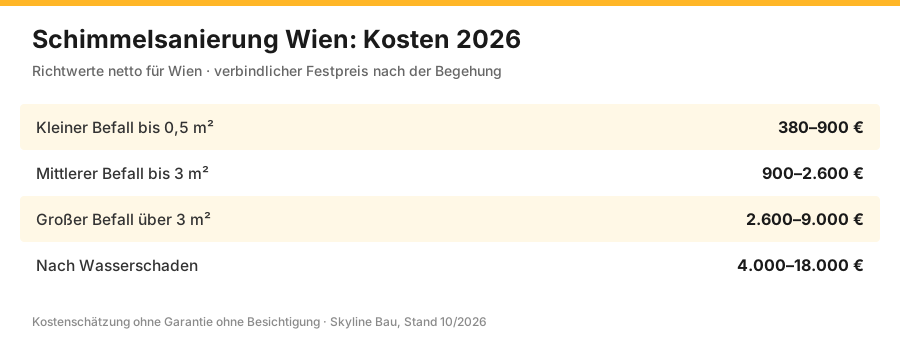
Mould remediation Vienna: mould remediation in Vienna costs €380 to €9,000, depending on the extent and cause. Small infestation up to 0.5 m² €380–900, medium up to 3 m² €900–2,600, large-scale €2,600–9,000. Every measure starts with tracing the cause, including moisture measurement.
What mould remediation costs in Vienna
Net guide prices, as of 2026, binding after a site visit and measurement. The price depends on the cause, not on the affected area. If the mould is the result of water damage, every remediation is preceded by building drying with a clearance measurement.
| Scope | What is done | Net price | Duration |
|---|---|---|---|
| Small infestation up to 0.5 m² | Remove, disinfect, sealing primer, paint | 380–900 € | 1–2 days |
| Medium infestation up to 3 m² | additionally remove plaster, containment | 900–2.600 € | 3–5 days |
| Large infestation over 3 m² | Contaminated zone, negative pressure, fine cleaning | 2.600–9.000 € | 1–3 weeks |
| After water damage | Drying, removal, remediation, reinstatement | 4.000–18.000 € | 3–8 weeks |
| With the cause fixed on the outside | additionally waterproofing, insulation or pipework | by effort | depending on the measure |
Unit prices
| Item | Unit | Net price | What is included |
|---|---|---|---|
| Site visit with moisture measurement | lump sum | free of charge in Vienna | Visual inspection, moisture measurement, photo record |
| Laboratory analysis of material sample | pcs | 120–280 € | Identification of the genus, written report |
| Indoor air measurement | pcs | 250–600 € | Spore concentration indoors compared with outdoors |
| Opening up building elements to find the cause | pcs | 180–650 € | Open, document, close temporarily |
| Leak detection if a burst pipe is suspected | lump sum | 300–900 € | Thermography or acoustic detection |
| Dust-tight containment with airlock | lump sum | 350–1.200 € | Plastic sheeting walls, airlock, negative pressure unit |
| Removing affected material | m² | 35–90 € | Wallpaper, plaster, insulation, drywall |
| Disinfecting the surface | m² | 12–28 € | Suitable product, contact time, follow-up treatment |
| Fine cleaning of the room | m² | 8–22 € | HEPA vacuum, wet wiping of all surfaces |
| Building drying | Month | 300–900 € | Equipment, electricity, weekly check |
| Sealing primer and renovation plaster | m² | 28–75 € | Insulating primer, renovation plaster to WTA if required |
| Lime or silicate paint | m² | 14–30 € | mineral, alkaline, vapour-permeable |
| Capillary-active internal insulation | m² | 130–240 € | for thermal bridges when nothing can be done on the outside |
| Check measurement after 12 months | pcs | 180–350 € | Moisture readings, visual inspection, report |
Total around €3,210 net. Without fixing the thermal bridge it would have been €1,420 – and the mould would have come back the following winter.
In overcrowded flats the mould only becomes visible once the rooms are cleared: House clearance Vienna.
The five causes and how to tell them apart
| Cause | Telltale signs | What helps |
|---|---|---|
| Thermal bridge | Mould on external corners, behind furniture, on window reveals; worse in winter | Insulation on the outside or capillary-active on the inside |
| Ventilation habits | Mould in several places, misted-up windows, damp laundry in the room | Shock ventilation, a ventilation system if required |
| Rising damp | horizontal tide mark in the plinth area, salt efflorescence | Horizontal barrier |
| Water damage | clearly bounded patch, grows quickly, often after an identifiable incident | Leak detection, repair, drying |
| Structural damage outside | Mould on one side of the wall, worse after rain | Repair the facade, roof, downpipe or waterproofing |
Mould remediation Vienna from a single source
Mould remediation Vienna covers all measures that permanently remove mould from indoor spaces — not just the visible growth, but also the cause that led to the moisture and therefore to the mould.
This is exactly where the decisive difference lies. Mould on the surface can often be wiped away — but without fixing the cause, it reliably comes back. Genuine mould remediation therefore draws a clear line between cleaning the infestation and the structural steps that prevent it from returning. Only both parts together make complete mould remediation.
Skyline Bau carries out mould remediation as the construction company doing the work, in cooperation with licensed master builder partner firms — and that is no coincidence. In the vast majority of cases, mould is the result of a structural problem: a thermal bridge, missing insulation, a leak, water damage. Removing it permanently is therefore a construction task. Anyone who wants to get rid of mould for good cannot avoid a structural solution.
For those affected this means: one point of contact who not only removes the mould but solves the structural problem behind it. Skyline Bau analyses the cause, fixes it properly, removes the infestation and restores the rooms — so that the mould does not come back. Four steps that together make a lasting solution. The mould disappears — and stays gone.
A central task of mould remediation is the cause analysis. Before anything is remediated, it must be clear why the mould developed — otherwise you treat the symptom and not the disease. Skyline Bau tracks down the cause and aligns the entire remediation with it. Without a clarified cause, any mould remediation remains patchwork.
An important point is health. Moulds release spores into the indoor air, which can affect the health of the occupants. Professional mould remediation is therefore more than a cosmetic matter — it makes the living spaces fully usable again. Health and quality of living are the end result of a good remediation.
Mould is a common problem in Vienna in particular: older building stock, ground-floor flats, dense housing and high humidity in winter create conditions in which mould forms especially easily. Skyline Bau knows the typical causes of mould from practice. This local knowledge helps to classify the problem correctly and quickly in the specific building.
We carry out mould remediation for owners, tenants and property managers in Vienna — from a limited infestation in a single flat to the structural remediation of a saturated part of a building. Skyline Bau analyses, fixes and restores — at a binding fixed price under ÖNORM B 2110.
This turns a recurring nuisance into a permanently solved matter.
all services
Cause analysis
Tracking down the structural cause of the mould.
Mould removal
Professional removal of affected material and cleaning.
Building drying
Technical drying of saturated building elements.
Thermal bridge remediation
Eliminating thermal bridges as a frequent cause of mould.
Waterproofing
Sealing leaks through which moisture penetrates.
Renovation plaster
Renovation plaster and impregnation against renewed growth.
Restoration
Restoring walls, plaster and surfaces.
Prevention
Measures and advice for preventing mould in the long term.
Mould remediation for flats, houses and period apartment buildings — from cause analysis through mould removal, building drying and thermal bridge remediation to reinstatement — a construction company doing the work in partnership with licensed master builder firms, general contractor, one fixed price under ÖNORM B 2110, cause fixed instead of just the symptom, 3-year warranty under § 933 ABGB.
What does mould remediation in Vienna cost?
The cost of mould remediation in Vienna depends above all on the extent of the infestation and on the cause — from a small surface infestation to mould that has penetrated deep into the building fabric. After the site visit, Skyline Bau prepares a binding fixed-price offer under ÖNORM B 2110.
As of 2026 · net · guide prices · extent of infestation, cause and depth of structural intervention determine the final price · binding price after the site visit.
The biggest influence on the price is the extent of the infestation. If only the surface is affected and the mould is limited to a small area, costs are at the lower end. If the mould has already penetrated the building fabric — plaster, masonry, insulation — the effort becomes considerably greater, because affected material has to be removed and replaced.
The real cost driver, however, is the cause. If there is a simple cause that can be fixed quickly, the remediation remains manageable. If, on the other hand, a structural defect lies behind it — a thermal bridge, missing insulation, moisture penetrating from outside — fixing it is part of the mould remediation. It is precisely this removal of the cause that keeps the mould away permanently. It is the real value of professional mould remediation.
A third point is the expert assessment. In disputed cases — for example under tenancy law — an independent expert can establish the cause. A documented determination of the cause creates clarity for everyone involved. Skyline Bau inspects the property, analyses the cause, calculates the remediation and quotes a binding fixed price — complete, including fixing the cause, with no surprises afterwards. This way the client knows before work begins what lasting mould remediation will cost.
what mould remediation is
The term mould remediation is often equated with simply removing mould stains. That falls short — and it is the most common reason why mould keeps coming back.
Mould remediation covers all measures that permanently remove mould from indoor spaces. The word "permanently" is decisive. Mould remediation consists of two parts: removing the visible growth and fixing the cause that led to the moisture and thus to the mould.
It is precisely these two parts that make the difference. Wiping the mould away or painting over it only treats the visible symptom. As long as the cause persists — the moisture that feeds the mould — it comes back. That is exactly why fixing the cause is the decisive part of mould remediation. Specialists therefore draw a clear distinction between cleaning the infestation and the structural or technical steps that prevent it from returning.
At its core, mould remediation is therefore a construction task. Where mould is involved, there is almost always a structural or building-physics problem to solve. Skyline Bau carries out mould remediation as a construction company working with licensed master builder partner firms — from tracking down the cause through fixing it to restoring the rooms. The entire mould remediation is thus in one expert pair of hands. The client has one point of contact instead of a series of separate firms.
why mould develops
Anyone who wants to get rid of mould permanently has to understand why it develops. Mould is no accident — it follows a simple building-physics logic.
Mould always develops when three things come together: moisture, cold and organic material. When damp walls, cool surfaces and a breeding ground such as wallpaper, plaster or dust meet, moulds thrive, multiply quickly and release more and more spores into the indoor air. Mould is therefore not fate, but the consequence of concrete conditions that can be remedied. The key to mould remediation lies in eliminating at least one of these factors — usually the moisture. Without moisture, mould has nothing to live on.
The most common structural cause is the thermal bridge. This is a point in a building element with lower insulating performance, through which a lot of heat escapes to the outside. The surface at this point cools down, the warm indoor air condenses there as moisture — and that is exactly where the mould starts. Missing or inadequate insulation has the same effect. It, too, creates cool wall surfaces on which moisture condenses.
Other typical causes are leaks through which moisture penetrates from outside, as well as water damage that has not been dried out properly. User behaviour — too little ventilation, too little heating — can also play a role, but is less often the sole cause. During the free site visit, Skyline Bau determines which cause applies in the specific case, because only the right diagnosis leads to lasting mould remediation.
As in medicine, the same applies to mould: the right diagnosis is half the cure.
why mould is a health issue
Mould remediation is not just a question of appearance. Mould in the home is a health issue — and that is the most important reason to take it seriously.
Moulds continuously release spores into the indoor air. These spores are invisible, float through the home and are inhaled with the air we breathe. Permanent contamination of the indoor air with mould spores can affect the health of the occupants — from headaches and irritation to respiratory problems. For this reason alone, mould should never be taken lightly.
The tricky thing is that mould does not always have to be visible. A musty smell in the rooms can be an early sign, even if no growth can be seen yet. Mould often grows out of sight — behind furniture, behind the plaster, in the insulation — before it appears on the surface.
The visible growth is therefore often smaller than the actual one. An expert site visit also uncovers hidden mould. Early signs such as stains or smells should therefore be taken seriously. Acting early keeps the damage and the remediation costs low.
That is precisely why professional mould remediation aims to ensure that occupants can use their rooms without restriction again — without worrying about their health. Skyline Bau removes the infestation professionally, seals off the affected areas during the work so that no spores spread, and fixes the cause. This keeps exposure during the remediation as low as possible. The end result is a healthy, safe home. That is exactly the goal of professional mould remediation.
fixing the cause as the core of the remediation
There is one sentence that sums up mould remediation: anyone who only removes the mould but not the cause has not remediated anything — they have only postponed the relapse.
The visible mould is the symptom. The cause is the moisture that feeds it. Mould remediation that merely wipes away or paints over the visible growth leaves the cause untouched — and so the mould reliably returns. Such a sham solution ends up costing twice — once for the cosmetics, once for the real remediation. Often in exactly the same place, sometimes hidden behind the fresh paint. A new coat of paint covers the mould but does not remove it.
Permanent removal therefore tackles the cause — and that is almost always structural in nature. If there is a thermal bridge, it has to be defused with proper insulation. If moisture penetrates from outside, the leak has to be sealed. If damp masonry lies behind it, damp-proofing may be necessary. Only when the source of moisture dries up is the mould deprived of its basis. From that moment on, mould is no longer a recurring problem.
This is exactly why mould remediation belongs in the hands of a master builder. Fixing the cause is a construction task — insulating, sealing, damp-proofing, repairing structural damage. Skyline Bau analyses the cause, fixes it properly as a construction company working with licensed master builder partner firms, and restores the rooms.
Only this combination of diagnosis and structural solution makes the remediation permanent. That is exactly what genuine mould remediation is. It is the difference between a cosmetic repair and genuine mould remediation. Only genuine remediation delivers what it promises.
Specifics
- Cause first — the structural cause is fixed, not just the infestation.
- Lasting instead of painting over — genuine remediation prevents a relapse.
- Viennese period buildings — older building fabric particularly favours mould.
- Ground-floor flats — a typical mould hotspot in Vienna.
- Thermal bridges — building defects as a frequent cause of mould.
- Health — mould spores pollute the occupants' indoor air.
- Construction task — mould remediation belongs in the hands of a master builder.
- General contractor — analysis, remediation and reinstatement from a single source.
- Fixed price under ÖNORM B 2110 — complete, including fixing the cause.
- Expert assessment — independent determination of the cause in disputed cases.
in all 23 districts of Vienna
We carry out mould remediation throughout Vienna. Every district has its own building stock: Gründerzeit buildings around the Gürtel, inter-war buildings in the outer districts, new builds in Donaustadt and Floridsdorf. What this means for your property is explained on the page for your district.
in all 23 districts and the surrounding area
We carry out mould remediation throughout Vienna — as well as in Klosterneuburg and the surrounding area of Lower Austria. Every Viennese district has its own building stock: Gründerzeit buildings around the Gürtel, inter-war buildings in the outer districts, new builds in Donaustadt and Floridsdorf. What this means for your property in Vienna is explained on the page for your district.
Process and duration
Professional mould remediation follows a clear process — and it does not begin with removing the mould, but with understanding the cause.
It begins with the site visit and cause analysis: Skyline Bau checks how far the mould has spread and tracks down the cause — thermal bridge, moisture ingress, water damage. This thorough survey is the basis for the entire remediation. Then the affected areas are sealed off so that the mould spores do not spread further during the work.
This is followed by the removal of the affected material, fixing the cause — the real core of the remediation — building drying where necessary, and reinstatement with renovation plaster and surfaces. Minor mould remediation is often done within a few days; extensive remediation with structural removal of the cause takes longer. The scope of fixing the cause has the greatest influence on the overall duration. Skyline Bau states the time frame bindingly in the fixed-price offer. This way the client knows from the outset when the rooms can be used again.
Mould in Viennese period buildings
Mould is one of the most common problems in Viennese flats — and that has to do with the particular features of the city. Anyone who renovates in Vienna knows the typical hotspots.
A first factor is the older building fabric. Many Viennese flats are located in Gründerzeit buildings that were constructed without modern insulation standards. Uninsulated external walls, thermal bridges at window reveals and building corners — all this creates cool surfaces on which moisture condenses. It is precisely at these cool spots that mould typically starts in Viennese period buildings.
A second factor is ground-floor flats. In Vienna they are a typical mould hotspot: moisture from the ground, cooler walls, often less sun. Added to this is dense housing — tightly built-up courtyards and streets in which the air circulates less well. Poor air circulation increases the moisture load in the rooms.
A third factor is the winter climate with high humidity. When moist winter air meets cool, poorly insulated walls, mould growth is inevitable. Skyline Bau knows these typical constellations from practice and aligns the mould remediation with the actual cause in the specific building — whether a period flat, a ground-floor flat or a period apartment building. This experience with buildings makes the diagnosis more accurate.
how to prevent mould in the future
The best mould remediation is the one that is never needed. After a remediation — and before one — it pays to know the factors that prevent renewed growth.
The first lever is correct ventilation and heating. Anyone who regularly airs rooms thoroughly and keeps them sufficiently warm significantly reduces humidity and the risk of mould. Moist air — for example from cooking, showering or drying laundry — should get outside quickly instead of condensing on cool walls. Regular short, intensive airing is more effective here than tilted windows.
The second lever is structural quality. Good insulation keeps the surfaces of external walls warm so that no moisture condenses there. Where thermal bridges exist, even the most exemplary ventilation will not help — this is where structural improvements are needed. Proper insulation is therefore the most effective long-term mould prevention. It works where ventilation alone is not enough.
The third lever is attentiveness: taking early signs such as small stains, a musty smell or misted-up windows seriously instead of overlooking them. The earlier a mould problem is recognised, the smaller and cheaper the remediation will be.
Attentiveness is therefore the simplest form of mould prevention. With every mould remediation, Skyline Bau also advises on how to avoid the infestation in future — because a lasting solution includes prevention. Good advice has an effect beyond the actual remediation.
Mould remediation Vienna for owners, tenants & property managers
Apartment owners
Lasting mould remediation of your own flat, with the cause fixed.
Tenants
Mould remediation of a rented flat, coordinated with the owner and the management.
Property management
Mould remediation of managed properties — one point of contact, one fixed price.
Tenement building owners
Structural mould remediation in Viennese period apartment buildings, protecting the building fabric.
Typical service packages for mould remediation in Vienna
- Site visit and assessment of the mould infestation
- Tracking down the structural cause
- Binding fixed-price quote according to ÖNORM B 2110
- Sealing off the affected areas against the spread of spores
- Professional removal of affected material
- Eliminating thermal bridges as a cause of mould
- Sealing leaks and points of moisture ingress
- Technical drying of saturated building elements
- Applying renovation plaster and impregnation
- Restoring walls, plaster and surfaces
- Advice and measures for mould prevention
- Handover of the remediated rooms at a fixed price
from cause analysis to handover
what matters when choosing
Anyone who commissions mould remediation wants one thing: for the mould to stay away. Whether that succeeds depends on choosing the right partner. A few characteristics help.
The first characteristic is a focus on the cause. A reputable firm does not first ask "How do we remove the mould?" but "Why did it develop?". Anyone who skips the cause analysis and goes straight to wiping or painting over delivers a sham solution. The cause analysis belongs at the start of every genuine mould remediation. Working carefully here spares you a relapse later.
The second characteristic is construction expertise. Because the cause of mould is almost always structural — thermal bridge, missing insulation, moisture ingress — you need a partner who can also fix these structural defects. A construction company doing the work in partnership with licensed master builder firms covers analysis and structural remediation from a single source; a pure cleaning company reaches its limits here.
The third characteristic is completeness: good mould remediation includes cause analysis, removal of the infestation, fixing the cause and reinstatement — as a coherent package, at a binding fixed price. Skyline Bau stands for exactly these three characteristics — focus on the cause, construction expertise and completeness. These three characteristics are how you recognise reputable mould remediation. This turns mould remediation into a lasting solution instead of a recurring building site. It is precisely this permanence that makes genuine remediation valuable.
Why Skyline Bau for your mould remediation in Vienna
- Construction company doing the work — the structural cause is fixed expertly.
- Cause instead of symptom — the mould is removed permanently, not just covered up.
- All steps from a single source — analysis, remediation, reinstatement.
- Understanding of building physics — thermal bridges and causes of moisture identified.
- Experience — familiar with the typical causes of mould in Vienna.
- Healthy rooms — the flat becomes fully usable again.
- Fixed price under ÖNORM B 2110 — complete, including fixing the cause.
- One point of contact — no back and forth between several firms.
- €3 million construction liability insurance.
- Subcontractor for the renovation of the Austrian Parliament 2022 — renovation work at the Parliament building, 1010 Vienna, in 2022.
How to recognise a reputable contractor
Mould is a symptom, not a cause. Anyone in Vienna who commissions mould remediation without clarifying the cause pays twice — the remediation does not last. Check the following points with every provider — including us.
1. Cause analysis before remediation
Mould is caused by moisture. Does it come from outside (facade, roof), from inside (ventilation, thermal bridge) or from a pipe leak? Mould remediation in Vienna without clarifying the cause is cosmetics — in six months it will be back.
2. Moisture measurement and report
Ask for measured values, not estimates. Wall moisture, indoor humidity, surface temperature. Professional mould remediation documents the initial condition.
3. Have thermal bridges checked
In Viennese Gründerzeit buildings, mould often appears in the same place: window reveal, external corner, behind furniture. These are thermal bridges. Anyone who does not address them is remediating the wall, not the problem.
4. GISA number and trade licence
Ask for the GISA number. If mould remediation in Vienna leads to interventions in the building fabric, master builder services under § 94 no. 5 GewO are involved — ask who will carry them out.
5. Spore protection during the work
Mould spores spread when material is removed. Dust protection walls, negative pressure, HEPA filters. Anyone who does not offer this carries the mould through the entire flat.
6. Do not confuse warranty and guarantee
The statutory warranty for immovable property is 3 years under § 933 ABGB. Note: it covers the workmanship, not your ventilation habits.
We answer these six questions without being asked. That is the minimum you should demand from every provider of mould remediation in Vienna.
The City of Vienna as the central advice centre
The official advice centre for mould issues is the City of Vienna — measures against mould growth (wien.gv.at/wohnen/massnahmen-gegen-schimmel). It clarifies: what to do in case of acute mould? Who bears the costs legally? Which remediation steps are recognised from the point of view of MA 50?
Plus the Mieterhilfeverein (tenants' aid association) with the important legal information: "The reasonable period for the landlord to remove mould in a rented flat is up to 4 weeks." Skyline Bau knows these regulations and supports both tenants and landlords with the remediation ahead of the legal clarification.
The three phases of professional mould remediation
- Phase 1 — investigating the cause: moisture measurement in the building element with a microwave moisture meter or the calcium carbide method (CM measurement), mould spore sample (adhesive tape method or airborne germ sampling with MAS-100), endoscopy of concealed cavities, thermal imaging to locate thermal bridges and condensation zones. Clarify the cause first — then remediate, otherwise the mould will be back within 6 months.
- Phase 2 — removal and remediation: affected material (wallpaper, plaster, drywall, chipboard, screed insulation layer) is removed within an air-tight containment — with negative-pressure sheeting and HEPA filters so that no spores get into other rooms. The substrate is disinfected with 70 per cent alcohol or quaternary ammonium compounds and then completely dried (adsorption dryer, 2–4 weeks).
- Phase 3 — prevention and reinstatement: reinstatement that is correct in terms of building physics, using mineral plasters (lime or silicate plaster instead of gypsum plaster — the pH value prevents mould growth), mould-inhibiting coatings (silicate paint or limewash) and, where internal insulation is needed, calcium silicate boards or mineral foam (capillary-active materials).
The most common causes of mould
- Thermal bridges in Viennese period buildings — internal corner of an external wall, window reveal, stucco junction. In winter a surface temperature below 12.6 °C → relative humidity 100 % → condensation → mould.
- Incorrect heating and ventilation — the most common dispute under tenancy law. Short intensive airing 5×3 min/day at an outdoor temperature of -5 °C instead of 1×30 min with the window tilted.
- Defective building fabric — leaky windows, defective gutters, cracked plaster junctions at sheet-metal transitions, leaking flat roofs.
- Water damage after a burst pipe — if drying was not done professionally, residual moisture remains in the screed/insulation layer and leads to mould after 3–9 months.
- Rising damp from the ground in Viennese Gründerzeit ground-floor flats — plinth walls without a horizontal damp-proof course.
- Driving rain exposure on strongly west-facing facades — defective external plaster lets precipitation penetrate.
- Retrofitted internal insulation with the wrong material — polystyrene instead of capillary-active calcium silicate board → condensation trap.
Who pays for mould remediation?
- The landlord / property management / owner pays: in the case of structural defects (thermal bridge, defective building fabric, leaking facade, defective pipes, rising damp). This is the situation in over 60 % of cases.
- The tenant pays: if incorrect heating or ventilation behaviour was demonstrably the cause. Expert assessment is required: without an expert's report (e.g. from Ing. Heinrich Pelka) no clear allocation of liability is possible.
- Building insurance covers it: if the mould developed as a result of insured tap water or fire damage.
- Household contents insurance covers it: movable contents (e.g. mould in the wardrobe, on furniture, in clothing).
- Mieterhilfeverein deadline: up to 4 weeks for the landlord's obligation to remediate, after which a rent reduction is possible.
The legal and normative basis
- Federal Environment Agency guideline "Schimmelpilzsanierung" — the Austrian federal standard for professional remediation.
- ÖNORM B 3151 — dismantling and hazardous substances in buildings.
- OIB Guideline 6 — thermal protection: U-value requirements to avoid condensation at thermal bridges.
- ÖNORM B 8110-2 — thermal protection in building construction, water vapour diffusion (Glaser method).
- Tenancy law § 1096 ABGB — tenant protection in the event of the landlord's irremediable delay in remediation.
- WHO recommendation "Indoor air quality: dampness and mould" — international reference for health assessment.
Why Skyline Bau for your mould remediation?
Firstly — remediation that is correct in terms of building physics instead of painting over. Skyline Bau fights the cause, not the symptom. Thermal bridges are eliminated with internal insulation made of capillary-active materials (calcium silicate, mineral foam), not with chemical fungicides on the surface.
Secondly — all follow-on trades from a single source. While pure mould specialists often only clean, Skyline Bau coordinates the complete reinstatement: drywall, plaster, painter, new plinth waterproofing and internal insulation if required. Fixed price under ÖNORM B 2110:2023.
Thirdly — insurance routine and a network of experts. We regularly work with experts on mould and moisture damage (e.g. Ing. Heinrich Pelka) and mould laboratories (e.g. ETCetera PP) when a quantitative assessment is required.
Fourthly — advising tenants and landlords. Skyline Bau helps to clarify the legal responsibilities before remediation — this avoids disputes and speeds up the insurance settlement.
Skyline Bau acts as an executing building contractor. Regulated trades — in particular master-builder services (§ 94 no. 5 GewO), planning and structural engineering, electrical engineering (§ 94 no. 16 GewO), gas and sanitary engineering (§ 94 no. 25 GewO) and tiling (§ 94 no. 38 GewO) — are carried out exclusively by suitably authorised subcontractors and partner companies. Construction work is performed by trade businesses within the group of companies that hold a valid trade licence.
what you should know
So that you know exactly what to expect, we answer the most important questions about mould remediation in Vienna here — honestly and from the practice of a construction company that does the work.
Why does mould develop in a flat?
Mould needs moisture. The causes: too little ventilation with too much moisture, thermal bridges on external walls, water damage or rising damp in the masonry. It is important to understand that mould is a symptom. Anyone who only paints over the black stains will have the problem back within a few weeks.
How is mould removed permanently?
The only sustainable way: fix the cause. We locate the source of moisture, eliminate it (for example through waterproofing, damp-proofing or fixing the thermal bridge), remove the affected area professionally and restore the surface. Only in this way does the flat remain permanently mould-free and healthy.
Is mould harmful to health?
Mould spores can irritate the respiratory tract, trigger allergies and cause more serious complaints in sensitive people. That is why mould — especially larger areas — should be removed professionally and with protective measures, not with a household remedy from the supermarket.
What does mould remediation cost?
The costs depend on the cause, the affected area and the measures required. A pure surface treatment is cheap but pointless if the cause remains. Genuine remediation including fixing the cause costs more, but solves the problem permanently. After a site visit you receive a fixed-price offer.
Mould removal Vienna: removal alone is not enough
Anyone searching for mould removal wants to get rid of the stain. But washing it off or painting over it only lasts until the wall gets damp again. That is why every mould removal with us begins with moisture measurement: condensation, rising damp or a pipe leak. Only then is the mould removed, the affected layer stripped out and the cause fixed – otherwise the mould comes back.
Having mould removed: how the day of the work actually goes
Many people looking for a firm to remove mould mainly want to know what to expect: how long will strangers be in the flat, what has to be cleared away, can you go back in straight afterwards? The answer depends on the area, but the process is almost always the same.
- Preparation by you: move furniture away from the affected wall or clear it out, take textiles out of the room, keep pets away. Open food does not belong in adjoining rooms.
- Separating: the work area is sealed off tightly from the rest of the flat with plastic sheeting and tape; for larger areas a unit runs that only extracts air to the outside.
- Removing instead of painting over: wallpaper, silicone joints, plaster that the mould has grown through or plasterboard are removed, packed into bags and sealed while still inside the separated area.
- Cleaning and drying: treat the substrate, measure residual moisture, wipe all surfaces in the room with a damp cloth and vacuum them.
- Reinstatement: only once the wall is dry, with vapour-permeable plaster and paint.
With a small infestation this is done in one to two days, and you can use the room again in the evening. If plaster has to come off, there is a drying period in between during which the room stays empty. What matters is that it is established beforehand why the spot became wet – otherwise the same day repeats itself next winter. If the moisture comes from the wall itself, damp-proofing of the masonry is often necessary.
Mould reports in Vienna: when they are worthwhile and who prepares them
A report is not necessary for every stain. It is worthwhile when responsibility is disputed – typically between tenant and landlord, between flat owners or vis-à-vis an insurer – when a purchase depends on it, or when health complaints are linked to the mould. It is prepared by an expert in building damage or building physics; for court proceedings, a sworn and court-certified expert is the usual choice.
A useful report answers three questions: where does the moisture come from, how big is the damage, and what is needed to fix it. For this, surface temperatures are measured, the moisture content of building elements is determined and indoor climate loggers are often installed for several weeks to show how the rooms were heated and ventilated. We are not experts in that sense, but we implement the recommendations of a report structurally and document the condition before and after the work. If you want the initial condition to be recorded independently, evidence preservation before construction starts helps.
Fighting mould in Liesing and the residential areas on the outskirts
In the 23rd district, but also in parts of Floridsdorf or Donaustadt, mould looks different from that in a Gründerzeit building. There are many post-war housing estate and detached houses here, often converted several times. Typical spots are roller shutter boxes without insulation, window reveals after airtight plastic windows have been fitted, the corner between an external wall and a concrete ceiling, and cellar rooms that have only later been used as a hobby room or guest room. The cellar is a special case: warm summer air condenses on the cool walls, which is why ventilating on hot days makes the problem worse. A lasting remedy there usually comes from a combination of thermal bridge remediation, adapted ventilation and, if necessary, cellar renovation.
Mould remediation in the Weinviertel – long courtyard houses, cellar lanes and loess soil
We also work on the edge of the Weinviertel, for example around Wolkersdorf or Mistelbach, and the houses there have their own causes of mould. Many old long courtyard houses and press houses are built of brick or clay directly on the ground, without a horizontal damp-proof course. Moisture rises in the masonry, the plaster in the plinth area stays permanently wet, and mould grows at the coolest spots of the inner wall. In cellars dug into the loess, high humidity is normal; it only becomes a problem when such a cellar is converted into a living space, party room or storeroom. Anyone who applies emulsion paint or puts plasterboard in front of the wall there merely shifts the problem behind the cladding. Lasting mould remediation therefore starts in the Weinviertel too with moisture measurement and the question of where the water comes from: from the ground, from the indoor air or from a leaking roof. Whether a location is still within our service area is clarified when you enquire. More about the surrounding area can be found on the page Construction company Lower Austria, and more about rising damp on the page Wall damp-proofing.
Frequently asked questions about mould remediation in Vienna
What does mould removal cost in Vienna?
What does mould remediation cost in Vienna?
What is mould remediation?
Is it enough to wipe the mould away?
Why does mould keep coming back?
How does mould develop?
What is a thermal bridge?
Is mould dangerous to health?
Why is mould so widespread in Vienna?
What determines the cost of mould remediation?
What role does Skyline Bau play in mould remediation?
What happens to affected material?
Does renovation plaster help against mould?
When should an expert be called in?
How is the spread of mould spores prevented?
Can I remove a small amount of mould myself?
Do ventilation and heating help against mould?
What is the difference from water damage remediation?
How long does mould remediation take?
Mould remediation: is there a fixed price?
Is mould particularly common in cellars?
Does Skyline Bau also fix insulation as the cause?
Mould remediation: does Skyline Bau also work outside Vienna?
Mould remediation: how do I get an offer?
What does mould remediation cost per square metre?
What does a laboratory analysis cost?
When do I actually need an analysis?
Can I remove small patches of mould myself?
Does chlorine cleaner help?
Why does mould grow on external corners?
Why is the mould behind the wardrobe?
How much humidity is normal?
How do you ventilate correctly?
How much moisture is produced in a household?
May I dry laundry in the flat?
Why did mould appear after the windows were replaced?
What is the dew point?
How is mould removed professionally?
What is containment?
Does the plaster have to come off?
What is renovation plaster and does it help against mould?
Which paint after the remediation?
Does anti-mould paint help?
What is capillary-active internal insulation?
Why can't you simply glue polystyrene to the inner wall?
Mould remediation: can I stay in the flat during the remediation?
Is mould harmful to health?
Who pays for mould remediation in a rented flat?
Can I sleep in the room again immediately after the mould has been removed?
As a tenant, do I have to report the mould to the landlord?
Does ozone treatment help against mould in the flat?
What belongs in a mould report?
Related services Skyline Bau
Related services
Mould removed? The fine cleaning is what counts.
After mould remediation, spores have to be removed from the room, not just from the wall. Bling Premium Cleaning takes care of the fine cleaning with filter units — that is part of the remediation, not something for afterwards. More at bling-bling.at.
Send enquiry
Enquire directly here — fixed-price quote free of charge. Skyline Bau replies within 2 working days.
Remove mould for good?
Write to us directly on WhatsApp — send the property, affected rooms and key details. Reply within two working days.
Note: Skyline Bau is the brand name of the construction and renovation division of Bling Bling GmbH and is not a separate legal entity. The sole contractual partner is Bling Bling GmbH. Bling Bling GmbH is a restricted construction trade business under § 99 GewO (Austrian Trade Regulation Act) and not a licensed master builder (Baumeister). Under § 99 (5) GewO, the title “Baumeister” is reserved for businesses licensed under § 94 no. 5 GewO. Regulated trades — master-builder services, structural engineering, gas and sanitary engineering, electrical engineering — are carried out exclusively by authorised, licensed partner companies.