Core drilling Vienna drilling instead of chiselling – clean, quiet, dimensionally accurate.
Core drilling in Vienna: from the contractor who does the work — not from an agent.
Core drilling in Vienna: a core hole costs €140 to €450 in Vienna, concrete cutting €120 to €380 per linear metre. Penetrations for ventilation, air conditioning, water, drainage and electrics – in brick, concrete and reinforced concrete, with water extraction, even in occupied flats.
Why we drill rather than chisel
There are two ways of making any penetration: breaking it out with a hammer or cutting it with a drill. Both work, but they differ in everything that has to be done afterwards.
| Feature | Core drilling | Chiselling with a breaker |
|---|---|---|
| Opening | perfectly round, smooth wall, dimensionally accurate | irregular, usually too large |
| Vibration | low, usually not critical in old buildings | high, transmitted into the masonry |
| Edge damage | none, the plaster stays intact | breakouts all round, plaster cracks |
| Dust | hardly any, none at all with wet drilling | a great deal, spreads throughout the flat |
| Noise | steady, moderately loud | impact noise, a burden for neighbours |
| Rubble | one drill core | rubble, bags, removal |
| Reinforcement in concrete | is cut through | gets in the way, has to be cut separately |
| Making good | usually just sealing the penetration | plastering, patching, painting |
| Time required | 30 to 90 minutes per hole | longer, with considerably more making good |
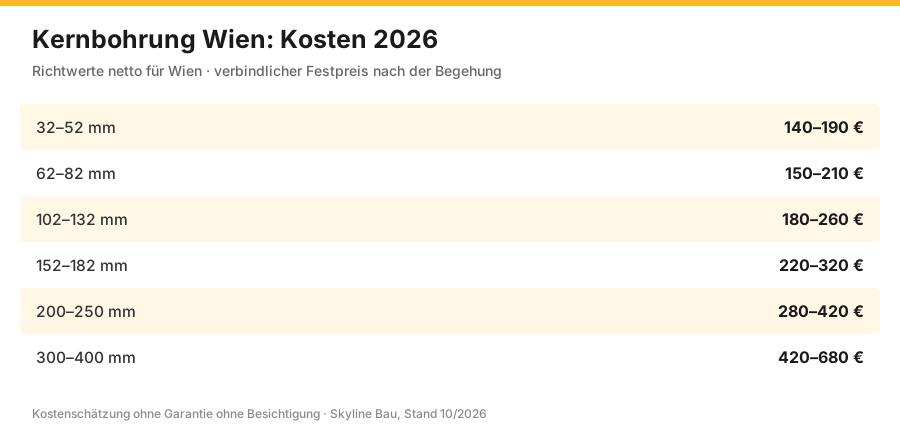
Core drilling in Vienna: costs 2026
Guide values net for Vienna, as of 2026. The price depends on three things: diameter, wall thickness and material. Reinforced concrete with dense reinforcement costs more than brick, because the bit advances more slowly and wear is higher.
| Diameter | Typical use | Brick, up to 30 cm | Reinforced concrete, up to 30 cm |
|---|---|---|---|
| 32–52 mm | cables, conduits, condensate pipe | 140–190 € | 170–240 € |
| 62–82 mm | air-conditioning pipework, electrics, small pipes | 150–210 € | 190–280 € |
| 102–132 mm | ventilation, water supply, fresh air intake | 180–260 € | 230–340 € |
| 152–182 mm | cooker hood, residential ventilation | 220–320 € | 280–420 € |
| 200–250 mm | extract air, sewer connection | 280–420 € | 350–560 € |
| 300–400 mm | drainage, large penetrations | 420–680 € | 520–880 € |
| over 400 mm | special cases, shafts | as measured | |
Concrete cutting and openings
| Service | Unit | Price net | Note |
|---|---|---|---|
| Wall saw, brick up to 25 cm | linear m | 120–210 € | cutting depth limited by blade diameter |
| Wall saw, reinforced concrete up to 25 cm | linear m | 180–320 € | depending on the degree of reinforcement |
| Wall saw, reinforced concrete 25–40 cm | linear m | 260–380 € | cut from both sides |
| Floor saw, screed and concrete | linear m | 28–65 € | for slots and cut-outs |
| Door opening, brick 25 cm | pc. | 650–1.400 € | without lintel and structural work |
| Door opening, reinforced concrete | pc. | 1.200–2.800 € | without lintel and structural work |
| Window opening | pc. | from €1,400 | depending on size and material |
| Disposal of drill cores | pc. | 0–45 € | small cores usually at no extra charge |
Surcharges that affect the price
| Circumstance | Why | Surcharge |
|---|---|---|
| Travel and set-up time | setting up the machine, stand, water and extraction | included in the prices above |
| Each additional hole on the same visit | the machine is already set up | 30 to 50% cheaper |
| Overhead drilling into the ceiling | water control and safety measures more complex | +20 to 40% |
| Dense reinforcement in reinforced concrete | slow feed rate, higher wear | +20 to 50% |
| Dry drilling with extraction | where no water may be used | +15 to 30% |
| Work outside business hours | operations cannot be interrupted | +15 to 35% |
| Confined location, no power supply | generator, extension cable, carrying by hand | based on effort |
Total around €610 net for three penetrations in one morning. Commissioned individually, it would come to about €690, because travel and set-up would be charged three times.
Total around €3,500 net. The cut itself is the smallest item – as with almost all openings in existing buildings, it is not the sawing that determines the price, but everything that is needed around it.
The methods at a glance
| Procedure | What for | Limits |
|---|---|---|
| Wet core drilling | standard: water cools, binds dust and flushes out the drilling slurry | water has to be extracted and collected |
| Dry core drilling with extraction | where no water may be used, for example in finished rooms | slower, more wear, limited diameters |
| Wall saw | straight cuts for door and window openings | cutting depth limited by blade diameter |
| Wire saw | very thick components, foundations | complex, a special case |
| Floor saw, joint cutter | slots and cut-outs in screed, concrete, asphalt | horizontal surfaces only |
| Stitch drilling | large openings where the saw cannot be applied | edges have to be trimmed afterwards |
In practice, which method is suitable is decided not by preference but by space: a wall saw needs room for the track and drive unit, a drill stand only needs its anchor points. In narrow shafts and recesses, stitch drilling is therefore often the only solution, even though the edge has to be trimmed afterwards.
Wet or dry: the practical decision
Wet drilling is the norm, because water cools the diamond segment and carries the drilling slurry out. The bit lasts longer and works faster, and practically no dust is produced. The price for this: water flows, and that water is grey and dirty.
| Situation | Recommendation | Precaution |
|---|---|---|
| Shell construction, basement, plant room | wet | water collection ring, wet vacuum, floor protection |
| Occupied flat, finished floor | wet with extraction ring | sheeting, wet vacuum directly at the drill, edge sealing |
| Parquet or sensitive flooring near the hole | dry with extraction | vacuum cleaner of the appropriate class, masking |
| Server room, food area, medical practice | dry with extraction | screening off, negative pressure where necessary |
| Overhead into the ceiling | wet with water collection ring | collection ring, covering underneath |
The most common nasty surprise with wet drilling is not the water at the drilling point, but the water that runs through the finished hole into the room behind it. That is why, before breaking through, we check what is on the other side and cover it or collect the water there – in neighbouring flats by arrangement.
Concrete cutting: the methods in detail
While core drilling produces round openings, straight cuts require other equipment. Which one is used depends on the thickness of the component and the space available.
| Device | Cutting depth | Typical use | What it requires |
|---|---|---|---|
| Angle grinder | up to about 12 cm | small cut-outs, finishing work | little space needed, lots of dust without extraction |
| Floor saw | up to about 30 cm | slots in screed, joints, cut-outs in the floor | level surface, water or extraction |
| Wall saw | up to about 40 cm, more if cut from both sides | door and window openings, ceiling cut-outs | track on the wall, space for the drive unit |
| Wire saw | practically unlimited | foundations, very thick components | room for the wire to run round, a special case |
| Stitch drilling | as for core drilling | where no saw can be applied | more time, edges need trimming |
In Vienna's existing buildings, the wall saw is the norm for openings, and stitch drilling is the fallback solution in corners and shafts. The wire saw is used almost exclusively for foundations and civil engineering structures – it is powerful, but complex to prepare.
A practical note on cutting: every cut runs beyond the opening at the corners, otherwise a remnant is left standing in the corner. This overcut is unavoidable and visible on the reverse side. Where it is a problem – for example with exposed concrete – the corner is instead taken out with drill holes and trimmed. This takes time and should be discussed beforehand, not complained about afterwards.
Before drilling: detecting cables and pipes
| Risk | Where it typically runs | How we rule it out |
|---|---|---|
| Electric cable | vertically above switches and sockets, horizontally below the ceiling | cable detector, observing installation zones |
| Water and heating pipes | next to risers, under window sills | detection, as-built drawings, test hole |
| Underfloor heating | entire floor area | thermal imaging or layout plan, otherwise no drilling |
| Reinforcement in reinforced concrete | close to the edges, two layers in slabs | rebar scanner, adjust the position |
| Tendons in slabs | in prestressed concrete slabs | never drill without drawings and structural approval |
| Chimney flues | in old internal walls | check the existing structure, relocate the position |
The penultimate point is the only one where we do not work at all without documentation: in slabs with tendons, a wrongly placed hole can impair the load-bearing capacity of the entire bay. Without drawings and approval, there is no drilling there, not even on verbal instruction.
When a structural assessment is needed
Not every opening is a structural issue, but the line does not run where most people assume.
| Project | Structural assessment needed? | Reasoning |
|---|---|---|
| Core hole up to about 200 mm in a brick wall | as a rule, no | little loss of cross-section, the load is distributed |
| Several holes side by side | yes, above a certain concentration | together they act like a slot |
| Hole in a load-bearing reinforced concrete wall | assessment advisable | reinforcement is cut through |
| Hole in a prestressed concrete slab | always | tendons must not be hit |
| Door opening in a load-bearing wall | always | lintel, bearings, load transfer |
| Window opening | always | lintel and parapet affected |
| Opening in a non-load-bearing partition | usually not | no load transfer |
You cannot tell from the outside whether a wall is load-bearing. In Vienna's old buildings, internal walls are often load-bearing even though they look thin, and in post-war buildings some solid walls are merely infill. That is why we clarify this before the offer – for openings through a licensed structural engineer who is named in the offer.
How a diamond core bit works
The bit consists of a steel tube with segments brazed or welded onto its end face. These segments contain industrial diamonds in a metal matrix. The bit does not hammer, it grinds: the diamonds remove the material, while the matrix wears away at a controlled rate and keeps exposing new diamonds.
This leads to a peculiarity that often comes as a surprise in practice: a bit can become blunt even though there is still segment left. This happens when the matrix wears more slowly than the material is removed – the bit then merely polishes. The remedy is a dressing stone or a pass through abrasive material. For you this is only indirectly relevant, but it explains why an experienced operator is twice as fast in the same wall.
| Material | Suitable bit | Feed rate | Special feature |
|---|---|---|---|
| Solid brick, lime mortar | soft matrix | brisk | the old-building standard in Vienna |
| Perforated brick | soft matrix | brisk but uneven | the bit can wander in the cavities |
| Unreinforced concrete | medium matrix | steady | cleanest holes |
| Reinforced concrete | hard segments for reinforcement | slow | reinforcement is cut through, higher wear |
| Natural stone, granite | special segments | very slow | cooling is decisive |
| Screed, asphalt | bit suitable for abrasive material | fast | high abrasion, the bit stays sharp |
The second point in this table is the reason for most crooked holes in Viennese flats: in perforated bricks, the bit finds little guidance between the chambers and can wander, especially when starting the hole. That is why it is started at reduced speed until the cut is established all the way round.
What makes for clean workmanship
- Drill stand properly anchored. Bolted or with a vacuum base, always with checked alignment. A wobbling stand produces an oval hole and damages the bit.
- Starting at reduced speed until the cut is established all the way round. This prevents breakouts in the plaster and stops the bit from wandering.
- Even feed. Too much pressure slows the bit down and overheats it, too little polishes. Both cost time and shorten the bit's service life.
- Controlled water management. The extraction ring sits tight against the wall, the vacuum runs at the same time, the floor stays dry.
- Far side secured before the core breaks through. Otherwise it falls into the neighbouring room along with the water.
- Edges checked and, where necessary, fitted with edge protection – especially for penetrations to the outside.
These six points sound like a matter of course, and they make all the difference between a hole after which the pipe simply has to be pushed through and one after which a painter has to come.
Holes in series: residential complexes and businesses
When the same penetration is needed several times in one building – for example when retrofitting residential ventilation, air conditioning or meter cables – the calculation changes fundamentally.
| Number of holes | Price per hole, Ø 100 mm brick | Why |
|---|---|---|
| 1 | 180–260 € | travel and set-up on one hole |
| 3 on the same visit | about €130–180 | set-up time is shared |
| 10 in the same building | about €95–140 | well-rehearsed routine, short distances |
| 25 and more | as measured | a day rate is usually cheaper than a unit price |
For property management companies, this means in concrete terms: it pays to collect holes rather than commission them individually over several months. Anyone who bundles the requests from several flats often pays half per hole – and the residents have one appointment instead of five.
Openings: when a hole turns into a conversion
As soon as an opening becomes larger than a service penetration, the task changes. It is then no longer about drilling, but about load transfer, lintels and reinstatement.
| Step | What happens | Who does it |
|---|---|---|
| Assessment | load-bearing or not, load path, lintel design | licensed structural engineer |
| Propping | temporarily taking the floor load | us |
| Lintel opening | slot for the lintel, in sections | us |
| Installing the lintel | steel beam or precast element, forming the bearings | us |
| Cutting out the opening | wall saw or stitch drilling below the lintel | us |
| Reveal and junctions | plastering, edges, junctions with floor and wall | us |
| Fire protection, if affected | fire stopping, tested system | specialist firm |
In Vienna's old buildings there is a second point: the bearings of the timber joist floor (Holztramdecke) often lie above the planned opening. A lintel then has to be positioned so that it does not affect these bearings – sometimes higher than planned, sometimes with a different cross-section. That is why the structural assessment comes before the offer and not after it.
Doing the sums
| Situation | Cheaper option | Why |
|---|---|---|
| One penetration in a finished flat | Core drilling | no making good, no dust, no painter |
| Several penetrations in the same building | combined appointment | set-up time is shared, up to half the price |
| Large opening in a shell construction | chiselling or stitch drilling | making good is needed anyway |
| Opening in a load-bearing wall | wall saw with structural assessment | clean edge, plannable lintel installation |
| Service slot in screed | Floor saw | faster and cleaner than chiselling |
| Unclear wall construction | test hole first | 30 minutes of certainty instead of damage |
The last line is the one that pays off most often: a small test hole costs a fraction of a repair and answers in half an hour what would otherwise be guesswork – wall construction, thickness, material, service lines.
Legal matters and responsibilities
Pure drilling and cutting work is clearly defined in terms of craft, but the responsibility for it is not always. We clarify three points before every job:
| Point | What applies | What we deliver |
|---|---|---|
| Intervention in the load-bearing structure | requires a structural assessment | structural engineer as partner firm, named in the offer |
| Owner's consent | required for rented and condominium flats if common parts are affected | advance notice, work only after approval |
| Penetration through fire compartments | tested fire stopping required | handled by an authorised specialist firm |
| Work on the facade and external wall | in protected zones, the appearance may be affected | checked before the works |
| Liability for hitting service lines | public liability insurance of the contractor | valid insurance, proof on request |
The second point in particular is regularly overlooked with air-conditioning units: the penetration to the outside and the outdoor unit on the facade affect common parts of the building. Without the consent of the owners' association, a problem arises there which the customer ultimately has to remove – regardless of who drilled the hole. We point this out before we start.
What you get at the end
- Dimensionally accurate opening with a smooth wall, in the agreed position and at the agreed fall.
- Cleaned work area, water taken up, drill core disposed of.
- Photos of the detection and of the finished hole on request – helpful if someone else works on the same wall later.
- Sealing of the penetration, if commissioned, stating the material used.
- Itemised invoice, so that with combined appointments it remains clear which hole was drilled where.
For specialist firms, we also keep a drilling log for each building: position, diameter, wall thickness, material, date. This saves half the clarification work on follow-up jobs in the same building.
How a core drilling job works
What happens to the opening afterwards is a matter of planning, not improvisation: a penetration to the outside needs a permanent seal against driving rain, and a penetration through a fire compartment boundary needs tested fire stopping. We carry out both or organise them through the relevant specialist firms.
What core holes are needed for
| Reason | Typical diameter | What matters |
|---|---|---|
| Split air-conditioning unit | 62–82 mm | fall to the outside so that condensate drains away |
| Cooker hood vented to the outside | 125–180 mm | position above the kitchen units, weather grille |
| Residential ventilation | 100–160 mm | sound and thermal insulation of the penetration |
| Heat pump, pipework to the outside | 100–200 mm | sealing, insulation of the pipes |
| Water and sewer connection | 150–300 mm | fall for the sewer pipe, watertight penetration |
| Electrics, conduits, data cables | 32–82 mm | bundling several pipes in one hole |
| Tumble dryer and extract duct | 100–125 mm | short runs, non-return flap |
| Anchoring railings and brackets | 32–62 mm | edge distance to the reinforcement |
| Test cores for expert reports | 50–100 mm | remove the core undamaged, document its position |
The last point is often overlooked: moisture measurements using the oven-drying method, concrete compressive strength tests or analyses of layer build-ups require drill cores that remain intact. This is a separate way of working – slow feed, careful catching, labelling with position and depth.
For plumbers, electricians and air-conditioning firms
- Fixed price list instead of an individual offer per hole, so you can give your customer a price straight away.
- Combined appointments: several flats or buildings on one day, which significantly lowers the price per hole.
- At short notice: where possible within a few working days, for combined appointments by arrangement.
- Clean handover: protection, extraction and cleaning are included, so you can carry on installing straight away.
- Detection included: we do not drill just because we are told to, we carry out detection first – that protects both sides.
- One contact person for all appointments, no changing crews.
For air-conditioning firms, the season is also decisive: between April and August, there is a shortage of drilling capacity, not of installation slots. Anyone who has a fixed partner during this period can sell more units than they could drill holes for themselves.
The most common mistakes
| Mistake | Why it happens | Consequence |
|---|---|---|
| Drilling without detection | time pressure, “there's never been anything there” | service line hit, water damage, many times the cost of the hole |
| No fall on air-conditioning and condensate pipes | hole drilled horizontally | water runs inwards instead of outwards |
| Drilled too close to the edge | position dictated by the furniture, not by the building component | edge breaks out, reinforcement hit |
| Far side not covered | nobody checked | drill core and water end up in the neighbouring room |
| Dry drilling without suitable extraction | vacuum not to hand | fine dust throughout the flat |
| Penetration not sealed | considered the installer's job | driving rain, draughts, insects |
| Fire compartment drilled through without fire stopping | issue not considered | defect at handover, rework |
| Several holes side by side without an assessment | looks like several small interventions | together like a slot, structurally relevant |
What we need from you to quote a price
Core drilling is one of the few cases in which we can calculate a price without a site visit – provided five pieces of information are available.
| Specification | Why it matters |
|---|---|
| Diameter and number | determines the core bit and the time |
| Wall thickness | drilling depth, an extension may be needed |
| Material: brick, concrete, reinforced concrete, hollow formwork blocks | determines feed rate and wear |
| Location: wall, ceiling, floor, height above ground | overhead work and height cost more |
| Access, electricity and water on site | without connections, a generator and tank are needed |
In practice, a photo of the spot with a tape measure next to it replaces half the description. From it we can see the material, the accessibility and usually also where service lines are to be expected.
Why we offer this
For us, drilling and cutting are not a separate line of business, but a by-product of what we do every day anyway: demolition, strip-out, openings, floor and concrete work. The equipment is there, the team knows how to use it, and the vehicles are out and about in Vienna.
For you, this has two consequences. First, we can come at short notice, because a hole can be fitted into existing routes. Second, if the hole turns into a bigger issue – an opening with a lintel, damaged plaster, an unexpected service line – you are not faced with a specialist confronted by a task they cannot cover, but with a construction company that carries out the rest as well. This is exactly the interface where many small jobs otherwise fall apart: the drilling firm is finished, the damage remains, and the customer goes looking for the next tradesperson. With us, the work continues within the same hour, with the same people, on the same invoice, and without you having to find a second firm.
When you do not need us
For a single small hole in a lightweight partition, a hole saw from a DIY store is enough. We come in when drilling into brick, concrete or reinforced concrete, when things have to stay clean, when several penetrations come together, or when the hole turns into an opening with a lintel and structural work.
How this differs from our other services
| Your project | Matching page |
|---|---|
| Removing a wall, changing the floor plan | Demolition |
| Stripping a flat back to the shell | Strip-out |
| Strengthening foundations or masonry | Foundation underpinning |
| Making a sewer connection | Sewer construction |
| Cracked warehouse and commercial floors | Industrial floor repair |
| Cutting joints in concrete and asphalt surfaces | Asphalt paving |
How much does core drilling cost? Why prices in Austria are so hard to compare
Anyone searching for prices online will find figures per hole, per centimetre of drilling depth, per diameter band or as a day rate. All of these models are common in Austria, but they cannot be compared side by side directly. A low price per centimetre looks cheap until travel, minimum charges, water extraction and disposal of the drilling slurry are added.
Two offers only become comparable when they describe the same hole: diameter, wall thickness, material, location and whether detection, protection of the surroundings and cleaning are included. Our prices in the table above are final prices per hole for these services, as net guide values between €140 and €450.
Ask three questions about every offer: is there a minimum charge, even if only one hole is needed? Is the detection of service lines included or an extra? Who provides electricity and water, and what does it cost if neither is available on site? With these answers, almost any offer can be converted into a price per finished hole.
Drilling in Gründerzeit masonry: thick walls, lime mortar and old chimney flues
The external and central spine walls of Viennese tenement buildings from around 1900 are often 60 centimetres thick or more on the lower floors. That is more than a standard bit can manage in one go. Drilling is then done with an extension, and the core comes out in sections. Because solid brick and lime mortar are soft, this goes quickly, but the core often crumbles and the hole has to be flushed out more frequently.
A special feature of these buildings is the chimney flues in the central spine walls. Many have been decommissioned, but some still carry flue gases from a gas boiler or a stove. A hole that hits an active flue is not a cosmetic flaw, but a safety problem. That is why, when drilling into central walls, we clarify in advance where flues run and, if in doubt, call in the chimney sweep. If the issue is the renovation or decommissioning of a flue, that is a separate matter; see chimney renovation.
Because of the wall thickness, the price here is above the values in the table, which apply up to 30 cm. A photo of the wall with a tape measure and a note of the storey on which the hole is to be drilled are usually enough for a binding price.
Holes through floor slabs: the flat below is part of the site
A vertical hole through a floor slab differs from a hole in a wall mainly in one respect: water and the drill core fall downwards. In a multi-occupancy building, there is usually someone else's flat underneath. We do not drill without access to that flat, because someone there has to hold the collecting container, protect the ceiling and secure the core before it breaks through.
That is why coordination with the property management and neighbours is part of the job, not something left until the drilling date. With timber joist floors, there is also loose fill between the floorboards and the ceiling, which trickles down when the slab is drilled through; here we often work dry with extraction or remove the fill locally beforehand. With reinforced concrete slabs, the rebar scanner checks whether main reinforcement is in the way.
Because a floor slab usually forms a fire compartment boundary, every penetration must be properly sealed afterwards. Where several service lines are routed through together, a rectangular cut-out made with a saw is often worthwhile instead of many individual holes. If power and data cables are to run through the new opening, we agree position and size in advance with the licensed electrical firm; more on this under electrical work.
Frequently asked questions about core drilling and concrete cutting in Vienna
Why does a hole wander in perforated brick?
What does it cost if ten identical holes are needed in one building?
Do I need the building's consent for an air-conditioning unit?
Why does the lintel come before the opening?
Is a test hole worthwhile?
Will I get documentation of the holes?
How much does core drilling cost in Vienna?
Why is the second hole cheaper?
What does concrete cutting cost per linear metre?
Do you drill or chisel?
How long does a hole take?
Can holes be drilled in an occupied flat?
What happens to the water?
Can it be done without water?
How do you avoid hitting a service line?
What if something is hit after all?
Can you drill into a floor with underfloor heating?
Do I need a structural assessment for a core hole?
What needs to be considered with prestressed concrete slabs?
How large can the hole be?
Can you also make door openings?
What does a window opening cost?
Do you work for plumbers and electricians?
How soon can you come?
What do I need to provide for an offer?
Do you also seal the penetration?
What happens to the drill core?
Can you take drill cores for expert reports?
How loud is it for the neighbours?
Do you need electricity and water on site?
Can several buildings be dealt with on one day?
What needs to be considered with facades that have external thermal insulation?
Can you drill through a central wall containing a chimney?
Why does drilling through a floor slab require access to the flat below?
How can I tell whether two offers for core drilling are comparable?
Related services
Hole finished? The rest of the flat should stay clean.
On request, our partner company Bling Premium Reinigung takes care of the detailed cleaning after the works. More at bling-bling.at.
Send enquiry
Enquire directly here — fixed-price quotation free of charge. Skyline Bau replies within 2 working days.
Ready for your core drilling in Vienna?
Write to us directly on WhatsApp — send photos. Reply within 2 working days.
Note: Skyline Bau is the brand name of the construction and renovation division of Bling Bling GmbH and not a separate legal entity. The sole contractual partner is Bling Bling GmbH. Bling Bling GmbH is a restricted building trade business under § 99 GewO (Austrian Trade Regulation Act) and not a licensed master builder (konzessionierter Baumeister). Under § 99 (5) GewO, the title „Baumeister“ (master builder) is reserved for businesses licensed under § 94 no. 5 GewO. Regulated trades — master builder services, structural engineering, gas and plumbing, electrical engineering — are carried out exclusively by authorised, licensed partner firms.