Floor renovation Vienna that starts with the build-up, not with the covering.
Floor renovation in Vienna: from the contractor who does the work — not from an agent.
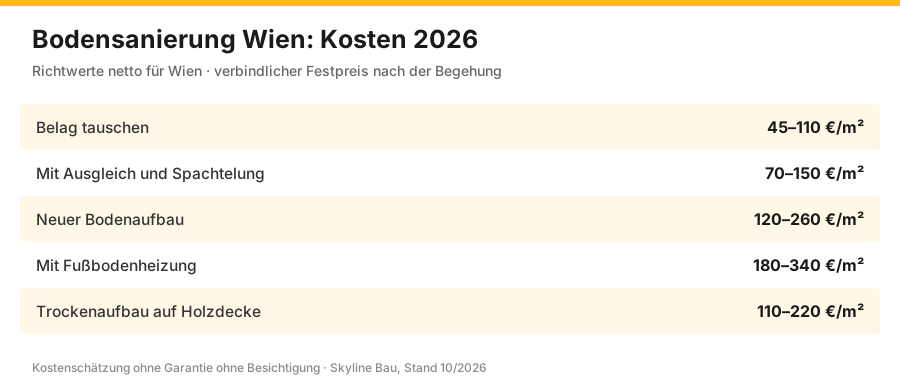
Floor renovation Vienna: a floor renovation in Vienna costs €45 to €340 per square metre. Replacing the covering €45–110/m², with levelling €70–150/m², a complete new build-up €120–260/m², with underfloor heating €180–340/m². What matters is the build-up underneath, not the covering on top.
Floor renovation in Vienna by Skyline Bau means professional workmanship, a single point of contact and a fixed price after an inspection. Anyone looking for floor renovation in Vienna gets every service from one source with us — clean, on schedule and with transparent costing.
What a floor renovation costs in Vienna
Guide prices net, as of 2026, binding after the site inspection. The price is decided by the build-up underneath, not by the covering on top.
| Scope | What is done | Price net | Duration |
|---|---|---|---|
| Replacing the covering | Old covering out, subfloor checked, new covering laid | 45–110 €/m² | 2–5 days |
| With levelling and skim coating | plus levelling compound and primer | 70–150 €/m² | 4–8 days |
| New floor build-up | Screed out, new insulation, screed, covering | 120–260 €/m² | 3–7 weeks |
| With underfloor heating | plus heating system, manifold and test log | 180–340 €/m² | 4–8 weeks |
| Dry build-up on a timber ceiling | Levelling fill, dry screed, covering | 110–220 €/m² | 1–3 weeks |
Unit prices
| Item | Unit | Price net | What is included |
|---|---|---|---|
| Removing the old covering | m² | 8–25 € | Parquet, laminate, carpet, adhesive residue |
| Chipping off old tiles | m² | 18–40 € | including the adhesive bed and disposal |
| Breaking out screed | m² | 18–45 € | Chiselling, insulation out, loading |
| Remove old fill | m² | 18–45 € | Timber beam ceiling, vacuuming, disposal |
| Skim coating the subfloor up to 5 mm | m² | 12–28 € | Primer, levelling compound, sanding |
| Levelling fill from 10 mm | m² | 22–45 € | bonded fill, screeded off |
| Cement screed incl. insulation | m² | 45–70 € | Edge strips, separating layer, screed |
| Self-levelling screed | m² | 55–80 € | very flat, ready for the covering sooner |
| Dry screed with levelling fill | m² | 60–95 € | for timber beam ceilings, walkable the next day |
| Water-based underfloor heating | m² | 70–140 € | Pipes, manifold, pressure test, heating-up log |
| Impact sound insulation | m² | 8–24 € | depending on requirements under ÖNORM B 8115 |
| Laying parquet | m² | 28–55 € | Labour without material, fully bonded |
| Sanding and sealing parquet | m² | 35–75 € | three sanding passes, seal or oil |
| Laying vinyl or laminate | m² | 18–38 € | Preparing the subfloor, laying, skirting |
| Laying tiles | m² | 55–110 € | adhesive, laying, grouting, silicone |
| Skirting boards | linear m | 12–28 € | Cutting, fitting, mitring |
| Shortening doors | pc. | 45–120 € | Removal, shortening, refitting |
| Disposal of building rubble | t | 18–35 € | separated by type, with proof of disposal |
Total around €23,200 net, which is €309/m². Simply replacing the covering on a sound subfloor would come to around €6,000 – the same room, a different scope of work.
For commercial, warehouse and gym floors with broken concrete a different process applies – cutting open, breaking out and recasting in steel-fibre concrete: industrial floor renovation.
Which build-up on which ceiling
| Build-up | Height | Weight | Suitable for |
|---|---|---|---|
| Cement screed with insulation | 10–14 cm | approx. 100 kg/m² | Concrete ceilings, load-bearing subfloor |
| Self-levelling screed with insulation | 8–12 cm | approx. 90 kg/m² | flattest surface, ready for flooring sooner |
| Dry screed with levelling fill | 5–8 cm | 40–50 kg/m² | Timber beam ceilings, limited height |
| Dry screed with underfloor heating | from 5 cm | 45–55 kg/m² | Period building where heating is wanted |
| Levelling and floor covering only | 2–4 cm | 15–25 kg/m² | when the height would otherwise not suffice |
Floor coverings compared
| Covering | Material per m² | Laying per m² | Properties |
|---|---|---|---|
| Solid parquet | 55–160 € | 28–55 € | can be sanded many times, very durable |
| Engineered parquet | 35–110 € | 22–45 € | can be sanded once or twice, quicker to lay |
| Vinyl, click or glued | 22–70 € | 18–38 € | waterproof, works well over underfloor heating |
| Laminate | 12–45 € | 16–30 € | inexpensive, cannot be repaired, sensitive to moisture |
| Tiles, porcelain stoneware | 25–80 € | 55–110 € | hardest surface, ideal over underfloor heating |
| Cork | 35–90 € | 22–45 € | warm underfoot, dampens impact sound |
| Linoleum | 30–75 € | 25–50 € | natural base, very hard-wearing |
| Restoring terrazzo | — | 90–220 € | Sanding, filling and sealing the existing floor |
Over underfloor heating, the thermal resistance is what counts: tiles and thin vinyl conduct best, thick solid parquet and cork hold the heat back. This needs settling before the covering is chosen, because it affects the flow temperature and therefore the heating costs.
What does floor renovation in Vienna cost?
The price depends heavily on the chosen build-up and on the condition of the subfloor. As a guide for Vienna:
As of 2026 · net, excl. 20% VAT · guide prices for standard build-ups — much depends on the individual case. Final price after the site inspection, in writing as a fixed price under ÖNORM B 2110.
the build-up is what matters
A floor is never just the visible covering. Underneath lies a build-up, and that is what determines sound insulation, warmth and durability.
- Checking the subfloor — Before any covering goes down, the subfloor has to be load-bearing, level and dry. A new floor on damp or cracked screed will not last.
- Screed as the base — Cement screed is the standard; anhydrite-based flowing screed levels out faster and is well suited to underfloor heating. Which one fits depends on the build-up height and the drying time.
- Impact sound insulation — In a Viennese tenement building (Zinshaus) with timber beam ceilings, sound insulation is the central issue. A decoupled insulating layer decides whether the neighbours hear every step.
- Build-up height in period buildings — Old floors are rarely level, and the build-up height is limited. Levelling is often needed before the new build-up goes in — otherwise the doors will no longer fit at the end.
- The right covering — Parquet, vinyl, tiles, microcement — every covering has its place. Tiles in the bathroom, wood in the living areas, robust vinyl where use is heavy. The choice determines comfort and service life.
Floor renovation — in all 23 districts and the surrounding area
We renovate floors throughout Vienna, as well as in Klosterneuburg and the surrounding area of Lower Austria. In the Gründerzeit housing stock (buildings from 1848–1918), the build-up on timber beam ceilings is the most common issue.
which covering for which room?
Parquet & solid wood
Warm, high-quality and the first choice for living areas. It can be sanded down several times and lasts for decades. More sensitive to moisture — unsuitable for bathrooms.
Vinyl & luxury vinyl flooring
Robust, moisture-resistant and easy to care for. Good for heavily used areas and over underfloor heating. Visually close to wood or stone.
Tiles & large formats
For bathroom, kitchen and entrance. Waterproof and durable, but they need a level, load-bearing subfloor and bonded waterproofing in wet areas.
Microcement & exposed screed
Seamless and modern, for a loft look. Demanding to install — this covering does not forgive cracks, so the subfloor has to be right.
from survey to handover
01 Site visit & measurement
We check the subfloor, moisture, build-up height and the connecting heights to doors and adjoining rooms. Free of charge.
02 Planning & quotation
Build-up, insulation, covering — as a bill of quantities with a fixed price under ÖNORM B 2110.
03 Preparing the subfloor
Removing the old covering, repairing or renewing the screed, levelling, drying. The invisible but decisive part.
04 Laying the covering
Professional laying with the necessary perimeter joints and transitions. With wood and tiles, craftsmanship is what counts here.
05 Handover
Final cleaning, inspection, care instructions. You receive the details of the covering and its care for warranty purposes.
Why Skyline Bau for your floor renovation in Vienna
We are the contractor carrying out the work and do the screed, levelling and covering with our own people. Where a regulated trade is involved — such as tiling under § 94 no. 38 GewO (Austrian Trade Regulation Act) or underfloor heating as part of the building services — we coordinate licensed partner firms. You have one contracting partner, one fixed price and one warranty.
- One contracting partner for subfloor and covering — no interface between the screed layer and the floor layer.
- Fixed price under ÖNORM B 2110, in writing after the site visit.
- Experience with timber beam ceilings and the sound insulation issues in tenement buildings.
- €3 million construction liability insurance and work in occupied properties.
How to recognise a reputable provider
1. Is the subfloor checked?
A quote without checking moisture and flatness is guesswork. That is exactly where cracks and bulging appear later.
2. Is the build-up described?
Insulation, screed, impact sound, covering — every layer should be listed in the quote, not just “new floor”.
3. Are drying times planned in?
Screed needs time. Laying the covering too early traps moisture — and the floor warps. A reliable schedule reflects this.
4. Have the connecting heights been considered?
Doors, transitions, adjoining rooms — if the build-up height is planned wrongly, the doors jam at the end. This belongs in the survey.
5. Who lays the tiles?
Tiling is a regulated trade under § 94 no. 38 GewO. Ask for the name of the authorised firm.
6. Do not confuse the warranty
By law 3 years under § 933 ABGB (Austrian Civil Code). Manufacturers’ guarantees on the covering are something different and run separately.
Floor renovation in Viennese period buildings
The Gründerzeit building has its own issues. The timber beam ceiling flexes and transmits sound, old floors are rarely level, and the build-up height is tight. A heavy cement screed is often not possible on a timber ceiling — dry screed or a lightweight build-up is used instead. Anyone who ignores this and simply chooses the heaviest build-up overloads the ceiling. That is why the first step is to check what the ceiling can carry.
When you do not need us
To be honest: for sanding and re-oiling an existing parquet floor, call a floor layer or parquet specialist directly — that is a craft of its own and usually cheaper. We are the right choice when the whole build-up has to be renewed, screed and insulation are part of it, or the floor renovation is part of a larger renovation.
what is included
The floor is connected to the rest of the interior works. What goes with it:
The screed is the base under the covering — cement or flowing screed, depending on the build-up.
A floor renovation is the ideal moment to retrofit underfloor heating.
For bathroom and kitchen — by licensed partners under § 94 no. 38 GewO.
Dry screed and lightweight build-ups for period ceilings that cannot take much weight.
The floor is part of almost every apartment renovation.
The overview of all renovation services.
what you should know
So that you know exactly what to expect, we answer the most important questions here — honestly and from the practice of a construction company that carries out the work itself.
When is a floor renovation necessary?
Signs include: an uneven or sunken floor, cracks in the screed, creaking or loose coverings, moisture rising from below. The causes may be damaged screed, moisture or an unsuitable subfloor. The subfloor has to be put right before the new covering goes down.
What does a floor renovation involve?
Depending on the condition: removing the old covering and screed, levelling or renewing the subfloor, waterproofing or insulation where needed, new screed and the new floor covering. A level, load-bearing subfloor is the prerequisite for a lasting result.
With floor renovation in Vienna, experience and clean workmanship count. For floor renovation anywhere in Vienna and the surrounding area, you receive a transparent fixed-price quote.
If you are planning a floor renovation in Vienna, Skyline Bau is the right place: floor renovation in Vienna at a fixed price, done professionally and from one source.
Can an uneven floor be levelled?
Yes — an uneven floor can be straightened with a levelling compound or a new screed. Larger differences in height or moisture call for more. We assess the subfloor and choose the right method.
What does a floor renovation cost?
The costs depend on the area, the condition, the work required and the new covering. After an inspection you receive a fixed-price quote.
Removing old coverings, sealants and floor protection: the underestimated first step
Before a new floor can be created, the old one has to go – and that is often more laborious than it looks. Under carpets there are fully bonded foam backings, under laminate sometimes an older plastic covering, on screeds old coatings, sealants or a floor protection layer glued down during an earlier building project. Each of these layers has to come off far enough for the new adhesive or levelling compound to bond to a firm, clean subfloor.
There are three tools for this: stripping coverings with a floor stripper, grinding with a diamond disc for adhesive residue and thin layers, and milling for thicker coatings. A small test area shows which method is right. In buildings from before 1990, samples are taken first, because some adhesives and tiles from that period may contain harmful substances – special rules then apply to sealing off the area and disposal. For let apartments in period buildings, it is worth asking for the removal to be a separate item in the quote. That way you see what the removal actually costs and are not just comparing laying prices.
The right sequence: when the floor’s turn comes in a renovation
A new floor is quickly damaged if other trades are still working afterwards. That is why a fixed sequence has proven itself in apartment renovations:
- Services running in the floor – heating, electrical conduits, water – are laid and tested before the screed.
- Screed or dry screed follows, then drying until it is ready for the covering.
- Walls are skimmed and at least primed while the floor is not yet finished.
- Only then does the covering go down, followed lastly by skirting boards, doors and the final coat of paint.
Laying the covering too early risks paint splashes, scratches from ladders and moisture from screed that is not quite dry. Planning the underfloor heating too late means doing the screed twice. For the build-up under the covering, see screed laying; for warm floors, see underfloor heating.
Just one room instead of the whole apartment: when a partial renovation is enough
Not every instance of damage calls for complete renewal. If only the hallway is worn or the children’s room has been affected by a small water leak, a single room can be renovated without touching the rest of the apartment. The transitions are then the critical point. Different build-up heights at the door threshold can be bridged with transition profiles, but only within narrow limits before a trip edge is created. With parquet, a repair is only inconspicuous if the same wood and the same finish are still available; otherwise the new section looks like a patch. In period buildings with timber beam ceilings there is the added fact that every opening allows a look at the beam ends – an opportunity worth taking, even if only one room is otherwise planned.
Frequently asked questions about floor renovation in Vienna
What does a floor renovation in Vienna cost?
That depends on the build-up: repairing and grinding screed costs €20 to €50 per square metre, a new screed with insulation €50 to €160, parquet €120 to €250, a complete build-up with underfloor heating €180 to €350. Guide prices for standard situations — the final price follows the site inspection.
What is the most important thing in a floor renovation?
The subfloor. A new covering is only as good as what lies beneath it. If the screed is damp, cracked or uneven, even the finest floor will not last. That is why checking moisture, flatness and load-bearing capacity comes first.
Which floor covering is the best?
There is no best one, only the right one. Parquet is warm and high-quality for living areas, vinyl robust and moisture-resistant for heavily used areas, tiles waterproof for bathroom and kitchen. The use of the room decides, not the price alone.
What needs to be considered with a timber beam ceiling in a period building?
It cannot carry any weight you like. A heavy cement screed is often not possible on an old timber ceiling — dry screed or a lightweight build-up is used instead. The ceiling also flexes and transmits sound, which makes impact sound insulation particularly important.
What is impact sound insulation and why does it matter?
A decoupling layer under the screed that prevents footsteps from being transmitted as structure-borne sound into the apartment below. In a Viennese tenement building with timber ceilings, it is the difference between living quietly and arguing with the neighbours.
Screed or dry screed — which is better?
It depends on the situation. Wet cement screed is strong and inexpensive, but takes weeks to dry and is heavy. Dry screed made of boards is light, can be walked on immediately and is ideal for period ceilings that cannot take much weight — but it costs more.
How long does screed need to dry?
As a rule of thumb, cement screed needs about one week per centimetre of thickness, so several weeks for a typical build-up. Flowing screed is faster. If the covering is laid too early, moisture is trapped and the floor warps. This time belongs in the construction schedule.
Can the old floor be left in place?
Sometimes, but often not. If the old covering is firmly bonded and level, it can serve as a subfloor. If the existing floor is loose, damp or uneven, it has to come out. The site inspection decides — botching it on top always comes back to haunt you.
What needs to be considered regarding the build-up height?
In period buildings it is often tight. Every layer — insulation, screed, covering — costs height. If this is planned wrongly, the doors jam at the end or trip edges appear at the transitions to adjoining rooms. That is why the connecting heights are recorded during the survey.
Does a new floor need insulation?
Usually, yes. Impact sound insulation against noise, thermal insulation downwards for floors above unheated rooms or soil. Which type and how thick depends on the room below. Without any insulation, a floor transmits noise and is cold on the ground floor.
Can underfloor heating be retrofitted?
Yes, a floor renovation is the ideal moment. There are wet, dry and milled systems with different build-up heights. Which one fits depends on how much height is available and whether the screed is being renewed anyway.
What does laying parquet cost in Vienna?
Including material and laying, parquet comes to about €120 to €250 per square metre, depending on the type of wood and the finish. The laying price alone is lower; the material makes the biggest difference. Solid wood and elaborate laying patterns are at the upper end.
Can parquet be sanded?
Solid wood and thicker multi-layer parquet, yes – even several times. That is the big advantage: instead of replacing it, the floor is sanded and re-oiled or varnished. Thin engineered parquet tolerates this only to a limited extent or not at all — once it is worn, it has to be replaced.
Is vinyl a good choice?
In many situations, yes. Modern luxury vinyl flooring is robust, moisture-resistant, easy to care for and can be laid over underfloor heating. Visually it comes close to wood or stone. In heavily used areas and rented apartments it is often the most practical solution.
What is microcement?
A thin, seamless trowelled coating for a modern, continuous look. It looks good but is demanding to apply — the subfloor has to be completely crack-free and stable, otherwise every crack shows through. Not a covering for DIY enthusiasts.
If you are planning a floor renovation in Vienna, Skyline Bau is the right place: floor renovation in Vienna at a fixed price, done professionally and from one source.
What needs to be considered with tiles in the bathroom?
In wet areas, bonded waterproofing is needed under the tiles — a sealing layer directly beneath the adhesive. Without it, water penetrates through the joints into the build-up. This is the most common hidden defect in bathroom floors. Tiling itself is a regulated trade under § 94 no. 38 GewO.
How noisy is a floor renovation for the neighbours?
Removing the old covering and chiselling work are loud; the laying itself hardly at all. In an occupied tenement building we announce the noisy phases and observe the quiet hours. A rough schedule belongs in the quote.
Can I stay in the apartment during the floor renovation?
For individual rooms often yes; for a complete renovation with new screed, rather not — because of the drying times and because the floor cannot be walked on. We clarify this in advance in the schedule.
How long does a floor renovation take?
A single room with a covering replacement is finished within days. If new screed is added, the drying times determine the process — it then takes several weeks, much of which is waiting for the screed to dry.
What is levelling and when is it needed?
A levelling compound that makes an uneven subfloor flat. It is almost always needed in period buildings, because old floors have waves and differences in height. Without levelling, every unevenness shows through in the new covering — especially with thin vinyl.
What happens if the screed is damp?
Then no impermeable covering may go on top. Residual moisture under parquet or vinyl leads to mould and bulging. The moisture is measured before laying — if it is too high, drying has to continue. This measurement is mandatory, not an extra.
Can a floor over underfloor heating be renovated?
Yes, but the covering has to be suitable and the heat transfer must not be blocked. Thick solid wood boards or the wrong insulation make the heating inefficient. When choosing a covering over underfloor heating, the thermal resistance is the decisive criterion.
What does just sanding parquet cost?
Considerably less than a full renovation — that is a separate trade for a floor layer or parquet specialist. If your parquet is merely dull or scratched, sanding and re-oiling is the right and inexpensive route. You do not need a construction company for that.
When is a construction company worth it rather than a floor layer?
When the whole build-up has to be renewed — screed, insulation, levelling — or when the floor renovation is part of a larger renovation involving several trades. For simply replacing the covering on a good subfloor, the specialist floor layer is the better choice.
Who lays the tiles for you?
A licensed tiler, our partner firm, because tiling is a regulated trade under § 94 no. 38 GewO. We prepare the subfloor and coordinate; the tiles themselves are laid by the authorised firm, which we name in advance.
What is a perimeter joint and why does it matter?
The gap between the screed or covering and the wall. Floors move — they expand with temperature and moisture. Without a perimeter joint, the floor presses against the wall and bulges. It is later hidden by the skirting board, but it is technically indispensable.
Can different coverings be combined?
Yes, that is common — tiles in the bathroom, wood in the living room, vinyl in the hallway. What matters are clean transitions and build-up heights that match, so that no trip edges appear. This belongs in the planning, not in improvisation on site.
What needs to be considered in a rented apartment?
Robustness and ease of care come first, together with good impact sound insulation. Vinyl and hard-wearing engineered parquet are often the economical choice here. Structural changes to the build-up require the owner’s consent.
Do I get a warranty on the floor?
Yes, the statutory warranty of 3 years under § 933 ABGB on the workmanship. Manufacturers sometimes give their own guarantees on the material. Correct care and compliance with the manufacturer’s instructions are important for the warranty — you receive the details at handover.
What happens if damage becomes visible when the floor is opened?
It happens in period buildings — rotten beams, old moisture damage, surprising build-ups. Because we work with a fixed price after the site inspection, we consult you before any additional costs arise. Supplements only for work that you commission in addition.
What does a floor renovation cost per square metre?
What does the price really depend on?
Does the old screed have to come out?
How can I tell whether the screed is still sound?
What does ‘ready for covering’ mean and why is it so important?
How long does drying take?
How much build-up height do I need?
What if the doors no longer fit?
How much can a timber beam ceiling carry?
Why does my period floor creak?
Can an old floorboard floor be preserved?
Can terrazzo be restored?
How often can parquet be sanded?
Which covering over underfloor heating?
Can I retrofit underfloor heating in a period building?
What applies to impact sound?
What is a sound bridge?
What about asbestos in the old floor build-up?
Can I continue living there during the work?
How much dust and noise is generated?
How do you remove old carpet adhesive from screed?
At what point in the construction sequence is the new floor laid?
Can I choose a different floor build-up in a single room?
Related services
New floor? The initial care determines how long it lasts.
New floors need a professional initial clean and, depending on the covering, initial care treatment. Bling Premium Reinigung takes care of this — for parquet, vinyl, tiles and stone, each with the right method. More at bling-bling.at.
Send enquiry
Enquire directly here — fixed-price quotation free of charge. Skyline Bau replies within 2 working days.
Ready for your floor renovation in Vienna?
Write to us directly on WhatsApp — send photos. Reply within 2 working days.
Note: Skyline Bau is the brand name of the construction and renovation division of Bling Bling GmbH and not a separate legal entity. The sole contractual partner is Bling Bling GmbH. Bling Bling GmbH is a restricted building trade business under § 99 GewO (Austrian Trade Regulation Act) and not a licensed master builder (konzessionierter Baumeister). Under § 99 (5) GewO, the title „Baumeister“ (master builder) is reserved for businesses licensed under § 94 no. 5 GewO. Regulated trades — master builder services, structural engineering, gas and plumbing, electrical engineering — are carried out exclusively by authorised, licensed partner firms.