Foundation underpinning Vienna when the house starts to crack.
Foundation underpinning Vienna: from the building contractor that does the work — not from an agent.
Foundation underpinning Vienna: strengthening a foundation in Vienna costs 900 to 2,800 euros per running metre. Underpinning in sections €1,200–2,800/rm, ground stabilisation by injection €450–1,400/rm, crack injection €180–450/rm. Structural engineering and a condition survey are always included.
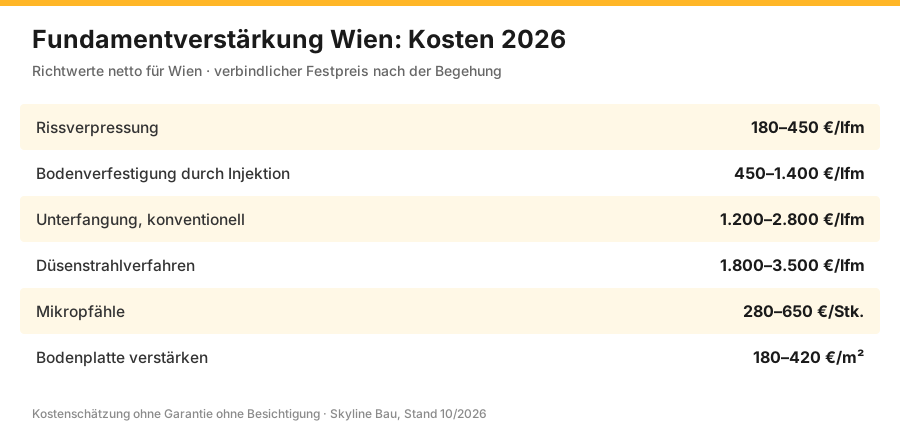
Foundation underpinning Vienna: costs 2026
Net guide values, as of 2026, binding after ground investigation and structural assessment.
| Method | What it helps against | Net price | Construction time |
|---|---|---|---|
| Crack injection | Cracks without ongoing movement | €180–450/rm | 2–5 days |
| Ground stabilisation by injection | loose or washed-out subsoil | €450–1,400/rm | 1–2 weeks |
| Underpinning, conventional | foundations too shallow or overloaded | €1,200–2,800/rm | 3–8 weeks |
| Jet grouting | confined conditions, high groundwater | €1,800–3,500/rm | 2–5 weeks |
| Micropiles | Load transfer into deeper load-bearing strata | €280–650 each | 2–6 weeks |
| Strengthening the floor slab | Settlement inside, basement floor | €180–420/m² | 2–4 weeks |
Preliminary work and ancillary costs
| Item | Unit | Net price | What is included |
|---|---|---|---|
| Soil investigation | lump sum | 1.800–5.000 € | Core drilling, laboratory values, geotechnical report |
| Structural assessment and design | lump sum | 1.500–6.000 € | Survey of existing structure, calculation, construction drawings |
| Condition survey of neighbouring buildings | lump sum | 800–3.500 € | Photos, crack record, assessment by an expert |
| Installing and evaluating crack monitors | pcs | 120–350 € | Plaster tell-tales or dial gauges, readings over weeks |
| Vibration measurement | Month | 450–1.200 € | with sensitive neighbouring buildings |
| Submission to MA 37 | lump sum | 1.200–4.000 € | via a licensed partner company |
| Excavation inside, by hand | m³ | 90–180 € | no machinery possible, removal in buckets |
| Dewatering with high groundwater | Week | 600–2.200 € | Pumps, wellpoints, discharge |
| Waterproofing after underpinning | m² | 250–500 € | surfaces in contact with soil, while they are open anyway |
| Reinstating surfaces | lump sum | by effort | Screed, plaster, floor, courtyard |
Total around €55,000 net. The share of preliminary work seems high – but without it you would be working blind, and incorrectly applied underpinning makes the settlement worse instead of stopping it.
How to tell that the foundation is the problem
Not every crack is foundation damage. These signs point to movement in the subsoil – the last three mean immediate action is needed.
- Diagonal cracks above window and door corners, usually at an angle of about 45 degrees. The classic settlement crack.
- Cracks that taper or widen towards the top. The direction shows where the building is sinking.
- Cracks across several storeys that run continuously. A plaster crack ends at the floor slab; a settlement crack does not.
- Doors and windows jam even though nothing about them has changed – especially if it gets worse over months.
- Sloping floors that can be shown with a spirit level and were not sloping before.
- Cracks wider than 2 mm that keep opening. This is no longer something to just observe.
- Building parts that have separated, offsets in the facade, gaping joints at extensions.
- Cracks after construction work next door. Excavation, a building pit or piling next door – immediate documentation counts here.
The methods in detail
Underpinning to ÖNORM B 4433
The foundation is excavated underneath in sections and the void filled with concrete so that it bears deeper and wider. Work is done in sections of 1.0 to 1.5 m, never continuously – every second or third section first, the ones in between after curing. This is the safest and most durable solution and at the same time the most elaborate.
Ground stabilisation by injection
A resin or cement suspension is injected into the subsoil via lances, compacting and consolidating the ground. Suitable for loose, washed-out or low-bearing subsoil if the foundation itself is sound. Much faster and cheaper than underpinning, but not effective in every soil – the investigation decides.
Jet grouting
The soil is cut open at high pressure and mixed with cement suspension; load-bearing columns are created under the foundation. Possible even in confined conditions and with high groundwater. Technically demanding and more expensive, but often the only solution in densely built-up locations.
Micropiles
Slender piles are driven through the soft layers into load-bearing ground and take over the load. Sensible when the load-bearing stratum lies deep and underpinning would be too elaborate. Can also be done from inside, with small equipment.
Crack injection
Cracks in masonry or concrete are fitted with injection packers and filled with resin or cement grout to restore structural continuity. This restores the bond – but only if the movement has come to a standstill. Applied to an active settlement crack, it tears open again next to the injection.
Five special features of Viennese ground
1. Gründerzeit foundations are shallow
Many Viennese tenement buildings stand on strip foundations of rubble stone or rammed concrete, often only 60 to 100 cm deep and without reinforcement. They were designed for the load of the time – not for additional storeys, heavier floors or a neighbouring building pit.
2. The subsoil changes over short distances
Vienna lies on Danube gravel terraces, Tegel clay and made ground – sometimes varying within a single plot. A building can stand on gravel at the front and on made ground at the back. That is exactly what causes uneven settlement, and that is exactly why the ground investigation is not negotiable.
3. Old war damage and infill
In parts of the city, bomb craters and basement rooms were filled with rubble. These fills settle over decades. The finding then appears as settlement without any recognisable trigger.
4. Building pits in the neighbourhood
An excavation next to a Gründerzeit building removes lateral support from the foundation. That is why a condition survey before a neighbouring construction site starts is your most important evidence – photos and a crack record with date, ideally by an expert.
5. No room for machinery
Inside the building, excavation is done by hand and removed in buckets, €90 to €180 per cubic metre. The same applies in a courtyard without vehicle access. This is why earthworks account for such a large share of inner-city underpinning.
How foundation underpinning works
Neighbours and liability
- A condition survey before construction starts is mandatory, not optional. Without it, it cannot later be established which crack is new – and if in doubt, the client is liable.
- The neighbour must be informed when work is done near the boundary. For interventions that affect their land, their consent is required.
- Vibration measurement with sensitive neighbouring buildings, €450 to €1,200 per month. It protects both sides.
- Construction liability insurance of at least €3 million. For foundation work in closed development, this is not a formality – ask to see the policy before work starts.
- If the neighbouring construction site was the trigger, document immediately: photos with date, crack monitors, written notification to the client and site manager. The earlier, the more reliable.
The eight most expensive mistakes with foundation damage
- Filling cracks and waiting. The crack comes back, and time works against the building.
- Underpinning without a ground investigation. The wrong method in the wrong soil makes the settlement worse.
- Working continuously instead of in sections. The most serious execution error of all – the building loses its bearing.
- No condition survey at the neighbours. Every existing crack will later be attributed to you.
- Crack injection with active movement. The crack opens again next to it.
- Dewatering underestimated. With high groundwater the pit fills up and excavation becomes impossible.
- Waterproofing not done at the same time. The surfaces are open – digging a second time costs many times as much.
- No follow-up check. Without measurement after six and twelve months, there is no proof that the movement has been stopped.
Who we work for
Tenement building owners
Settlement in Gründerzeit buildings, often as part of a basic renovation. Structural engineering, method and reinstatement from one source.
Property management companies
Documented condition survey, verifiable bill of quantities for the owners' meeting, monitoring with records.
Homeowners
Cracks after settlement, an extension or a neighbouring construction site – from observation to a permanent solution.
Before conversion or adding a storey
When the building gets heavier, the foundation becomes an issue. Inspection and strengthening before planning, not afterwards.
When you do not need us
A hairline crack in the plaster that has not changed for years is not foundation damage – that is plastering work. If you are unsure, install crack monitors and observe for four to eight weeks; that costs a few hundred euros and answers the question. And if a building pit is being dug next door right now, what you need first is a condition survey, not a building contractor – only when something moves does it become our job.
Frost depth in Austria: why some foundations are too shallow
A foundation must lie deep enough that the ground beneath it does not freeze in winter. Freezing water in the ground expands, lifts the foundation and lets it sink again when it thaws – a little unevenly every year. In Vienna, frost-free founding starts at around 80 cm, in exposed locations on the outskirts rather at 1.0 to 1.2 m; in higher regions of Austria the frost depth reaches considerably deeper. With the large tenement buildings this is rarely the problem, because basements and masonry reach deep anyway. At risk are the small building parts: later-added verandas, conservatories, garages, basement stairs and garden walls, which were often founded only 40 or 50 cm deep. The typical damage is a crack exactly at the joint between old building and extension that widens in winter and narrows in summer. Injection does not help here; only deepening the extension's foundation to frost-free depth does. How a new foundation is founded correctly from the start is explained under foundations.
Classifying foundation subsidence and building settlement correctly
That a building settles is not unusual at first. Every new building sinks by a few millimetres in the first years without harm. Building settlement only becomes critical when it is uneven: one corner sinks more than the other, the building twists, and the stresses are released in diagonal cracks above window and door corners. Whether foundation subsidence is still ongoing or has finished can only be measured. For this, measuring bolts are set in the facade and levelled over months, supplemented by crack monitors at the conspicuous spots.
The causes are usually known in Vienna. Tegel clay soils in the west and south shrink in dry summers and swell again when wet; large trees close to the building draw additional water from the ground. Leaking sewers wash fine material out from under the foundation. And a building pit next door or a lowering of the groundwater changes the load conditions from outside. Only once the cause is established does the choice of method make sense – otherwise you strengthen a foundation that will give way again in a year for the same reason.
Lifting or stabilising a foundation: what is possible and what it costs
Many owners want the subsided building to stand straight again. Lifting a foundation is technically possible, but only within limits and not sensible for every building. With injections of expanding resin, the ground under the foundation is compacted; with minor settlement, the foundation can be lifted by a few millimetres to centimetres, controlled by laser measurement during the work. Larger corrections are only possible with jacks bearing on new micropiles and are correspondingly elaborate. With an old brick building, caution is required: the masonry has adapted to the deformation over decades, and pushing it back too quickly creates new cracks.
In most cases, therefore, the goal is not lifting but stabilising: the movement should stop, and the cracks are closed afterwards. For ground strengthening by injection we calculate a net guide value of €450 to €1,400 per running metre, micropiles at €280 to €650 each; expert reports, structural engineering and measurement monitoring are added. Whether lifting is worthwhile in addition to stabilisation is decided by the measurement – and by whether doors jam and floors slope or only plaster cracks. If the reason for the settlement lies in damp basement masonry, basement renovation belongs in the planning right away.
Frequently asked questions about foundation underpinning in Vienna
How much does foundation strengthening cost?
How much does underpinning a whole building cost?
Why is the preliminary work so expensive?
How do I recognise a settlement crack?
From what crack width does it become critical?
What are crack monitors?
How long do I have to observe?
What is underpinning?
Why is the work done in sections?
Can I stay in the building during the work?
What is ground stabilisation?
What is jet grouting?
What are micropiles?
Does crack injection alone help?
Do I need a structural engineer?
Foundation underpinning: do I need a building permit?
What is a ground investigation?
Why is my building settling at all?
Can a leaking sewer be the cause?
What should I do if a building pit is being dug next door?
Who is liable if the neighbouring construction site caused the damage?
Does my insurance pay?
Foundation underpinning: who pays in condominium ownership?
Foundation underpinning: who pays in a rented building?
How long does underpinning take?
Can work be done in winter?
What happens if something moves during the work?
Is there a follow-up check?
Can I then add a storey or convert the loft?
Is waterproofing done at the same time if digging is under way anyway?
Foundation underpinning: does Skyline Bau carry out the work itself?
Foundation underpinning: is there a fixed price?
Foundation underpinning: how quickly can I get an appointment?
Can a subsided building be lifted again?
How deep must a foundation lie in Austria to be frost-free?
How much does it cost to stabilise a foundation?
Can trees cause building settlement?
Related services
Foundation strengthened? Basement handed over clean.
Underpinning work leaves dust and material residue in the basement. Bling Premium Cleaning takes care of the deep cleaning after completion. More at bling-bling.at.
Send enquiry
Enquire directly here — fixed-price quote free of charge. Skyline Bau replies within 2 working days.
A new bathroom — without surprises
We check pipes, floor build-up and electrics on site. Then you get the price. Not the other way round.
Legal note: Skyline Bau is the brand name of the construction and renovation division of Bling Bling GmbH and is not a separate legal entity. The sole contractual partner is Bling Bling GmbH — a restricted construction trade business under § 99 GewO, GISA number in the legal notice. It is not a licensed master builder.
Under § 99 (5) GewO, the title “Baumeister” (master builder) is reserved exclusively for businesses licensed under § 94 no. 5 GewO. Regulated trades — master-builder services (§ 94 no. 5), electrical engineering (§ 94 no. 16), gas and sanitary engineering (§ 94 no. 25), tiling (§ 94 no. 38) — are carried out exclusively by authorised, licensed partner companies. On request, you receive their proof of authorisation before signing the contract.
Note: Skyline Bau is the brand name of the construction and renovation division of Bling Bling GmbH and is not a separate legal entity. The sole contractual partner is Bling Bling GmbH. Bling Bling GmbH is a restricted construction trade business under § 99 GewO (Austrian Trade Regulation Act) and not a licensed master builder (Baumeister). Under § 99 (5) GewO, the title “Baumeister” is reserved for businesses licensed under § 94 no. 5 GewO. Regulated trades — master-builder services, structural engineering, gas and sanitary engineering, electrical engineering — are carried out exclusively by authorised, licensed partner companies.