Pool construction Vienna the basin is the smaller part.
Pool construction in Vienna: from the contractor who does the work — not from an agent.
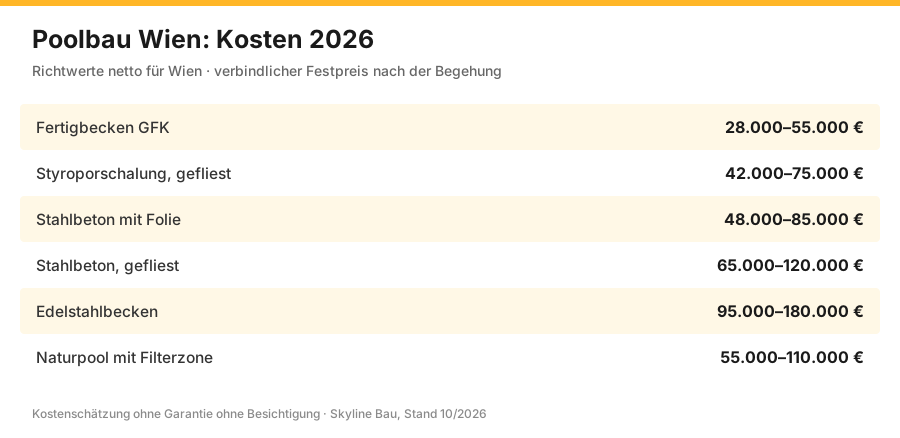
Pool construction Vienna: a pool in Vienna costs €28,000 to €120,000. GRP prefabricated basin €28,000–55,000, reinforced concrete with liner €48,000–85,000, tiled €65,000–120,000. The equipment, cover and surrounding area account for more of this than the basin itself.
What a pool costs in Vienna
Guide prices net, as of 2026, binding after the site inspection. The prices apply to the finished basin including equipment, excluding landscaping.
| Type of construction | What is included | Price net | Construction time |
|---|---|---|---|
| GRP prefabricated basin | Excavation, bedding, installation, equipment | 28.000–55.000 € | 3–6 weeks |
| Polystyrene formwork blocks, tiled | Excavation, formwork blocks, concrete, tiles | 42.000–75.000 € | 8–14 weeks |
| Reinforced concrete with liner | Excavation, reinforcement, concrete, lining | 48.000–85.000 € | 10–16 weeks |
| Reinforced concrete, tiled | plus tiled finish | 65.000–120.000 € | 12–20 weeks |
| Stainless steel basin | Custom-made to measurements | 95.000–180.000 € | 14–22 weeks |
| Natural pool with filter zone | additional regeneration area | 55.000–110.000 € | 10–18 weeks |
Unit prices and ancillary work
| Item | Unit | Price net | What is included |
|---|---|---|---|
| Ground investigation | lump sum | 1.800–5.000 € | Bearing capacity, groundwater, buoyancy |
| Structural design | lump sum | 1.200–4.500 € | Basin walls, uplift protection |
| Excavating the basin pit | m³ | 28–95 € | loosening, loading, removal |
| Excavation support | m² | 180–650 € | where space is tight or there are neighbouring buildings |
| Dewatering | Week | 600–2.200 € | with a high water table |
| Base slab of the basin | m² | 180–380 € | reinforced, according to structural design |
| Reinforced concrete basin walls | m² | 220–420 € | Formwork on both sides, reinforcement, concrete |
| Waterproofing and liner | m² | 65–150 € | Fleece, PVC or butyl liner, welding |
| Tiled finish inside the basin | m² | 150–380 € | frost-resistant, with bonded waterproofing |
| Equipment shaft or plant room | lump sum | 4.500–18.000 € | Structure, drainage, electrics, ventilation |
| Filter system with pump | lump sum | 2.800–9.500 € | Sand filter or glass filter, pipework |
| Pool heat pump | lump sum | 3.500–12.000 € | Unit, connection, electrics |
| Cover, below-floor roller shutter | lump sum | 8.500–24.000 € | Pit, drive, slats |
| Counter-current swim system | pc. | 4.500–14.000 € | Built-in unit, pump, controls |
| Coping stones | linear m | 120–380 € | Natural stone or concrete, laid |
| Paving the surrounding area | m² | 110–260 € | Sub-base, fall, drainage |
| Electrical connection and equipotential bonding | lump sum | 2.500–8.000 € | through a licensed partner firm |
Total around €113,500 net. What stands out: at €34,700, the basin itself is less than a third. Equipment, cover and the surrounding area make up the larger part – and these are exactly what is missing from the cheap quotes people compare against.
What many people only add up afterwards
| Item | Costs | Why it comes up |
|---|---|---|
| Surrounding area and drainage | 110–260 €/m² | without them you are standing in soil |
| Plant room or equipment shaft | 4.500–18.000 € | the filter and pump need a dry place |
| Electrics and equipotential bonding | 2.500–8.000 € | mandatory, via a licensed firm |
| Cover | 8.500–24.000 € | halves the heating costs, prevents dirt |
| Running costs for electricity and water | €900–2,600 per season | Pump, heating, top-up water |
| Chemicals and maintenance | €400–1,200 per season | Care, winterising, reopening |
| Disposing of backwash water | according to tariff | discharge into the sewer must be notified |
What does a pool in Vienna cost?
The price depends heavily on the construction method, size and equipment. As a rough guide:
As of 2026 · net, excl. 20% VAT · guide prices — much depends on the individual plot and specification. Final price after the site inspection, in writing as a fixed price under ÖNORM B 2110.
which construction method?
Liner pool
A masonry or concrete basin with a welded-in liner. Less expensive, flexible in shape, and the liner can be renewed after many years. The proven standard for a garden pool.
GRP prefabricated basin
A ready-made basin of glass-fibre reinforced plastic that is installed in one piece. Short construction time, smooth surface — but crane access has to be possible, and the shape is fixed.
Tiled concrete basin
The highest-quality and longest-lasting option, free in shape and size. More involved and more expensive, but durable for decades. The first choice for demanding projects.
Overflow or skimmer
The skimmer draws off water at the surface — simpler and less expensive. The overflow channel drains the water all the way round — visually more refined, technically more complex and more expensive.
Pool construction — throughout Vienna and the surrounding area
We build pools throughout Vienna, as well as in Klosterneuburg and the surrounding area of Lower Austria. In the densely built-up city, access to the garden is often the central question.
from excavation to the first swim
01 Planning & site inspection
Location, size, construction method, equipment — and the decisive question: can the machinery get into the garden? Free of charge.
02 Excavation & basin pit
The pit is dug out and the excavation secured. Where space is tight in the city, this is often the most demanding step.
03 Basin shell
Casting and waterproofing the concrete, or installing the prefabricated basin. This is where the watertight, load-bearing basin is created.
04 Equipment & pipework
Filter, pump, skimmer or overflow, supply lines, electrical connection by the licensed partner.
05 Interior finish
Welding in the liner or laying tiles, coping stones, connection to the terrace.
06 Commissioning
Filling, setting up the water treatment, instruction. Then the pool is ready.
Why Skyline Bau for your pool construction in Vienna
We are the contractor carrying out the work and build the basin pit, the shell and the surroundings ourselves. The electrical work for the pool equipment is a regulated trade under § 94 no. 16 GewO (Austrian Trade Regulation Act) and is handled by our licensed partner. You have one contracting partner for earthworks, shell, equipment and surroundings — instead of four firms blaming each other when something does not fit.
- One contracting partner from the pit to the first swim.
- Fixed price under ÖNORM B 2110, in writing after the site visit.
- Experience with tight plots — where the excavator cannot get in, the solution is what counts.
- €3 million construction liability insurance.
How to recognise a reputable provider
1. Has the access been checked?
Without clarifying how the excavator and materials get into the garden, every quote is guesswork. In the city this is the most expensive unknown.
2. Is the equipment included in the quote?
A basin without filter, pump and cover is not a pool. These items belong in the bill of quantities, not in a supplement.
3. Who does the electrical work?
The pool equipment requires an authorised electrical engineer under § 94 no. 16 GewO — with special protective measures around water. Ask for the name of the firm.
4. Is the waterproofing described?
A concrete basin is only as watertight as its waterproofing. How is it waterproofed, and with which system? This belongs in the quote.
5. What about the surroundings?
Terrace, coping stones, pipework, backfilling — the pool does not end at the edge of the basin. Clarify what is included.
6. Do not confuse the warranty
By law 3 years under § 933 ABGB (Austrian Civil Code). Manufacturers’ guarantees on the liner or equipment run separately.
Does a pool in Vienna need a permit?
That depends on the size and design. Smaller basins in Vienna often only have to be notified rather than approved; larger ones and those with extensive excavation may require a permit. Property boundaries, distances and the discharge of the pool water must also be taken into account. We clarify this before construction starts — depending on the scope, a partner firm holding a master builder’s licence (Baumeister) handles the structural parts and those that must be submitted for approval.
When you do not need us
For an above-ground pool or a small prefabricated pool for self-installation, you do not need a construction company — a specialist pool retailer supplies those. We are the right choice when an in-ground pool is to be built with earthworks, shell, equipment and terrace connection, coordinated from one source.
what is included
A pool is a construction project involving several trades. What belongs together:
The basin pit is earthwork — excavation, shoring, removal.
The basin needs a load-bearing, level base — the same care as with a foundation.
The pool equipment requires an authorised electrical engineer with special protective measures.
The terrace around the pool — slip-resistant, with a fall away from the basin.
For the tiled basin — by licensed partners under § 94 no. 38 GewO.
The overview of all construction services.
what you should know
So that you know exactly what to expect, we answer the most important questions here — honestly and from the practice of a construction company that carries out the work itself.
What types of pool are there?
The most common are the solid concrete pool (individual, long-lasting, any shape), the liner pool and the prefabricated basin (GRP). The concrete pool offers the most design freedom and lasting value, but is more involved. Which one fits depends on budget, plot and wishes.
What does pool construction involve?
More than the basin: excavation and earthworks, the basin itself, the equipment (filter, pump, heating), waterproofing, pipework and the surround. As the contractor carrying out the work, we coordinate all trades — from excavation to the finished basin.
Does a pool need a permit?
That depends on size, location and building regulations. Smaller pools often only have to be notified, larger ones require a permit. Distances to property boundaries also play a part. We clarify the requirements before building begins.
What does a pool cost in Vienna?
The costs depend on the type of construction, size, equipment and landscaping. A solid concrete pool is an investment, but long-lasting and individual. After an inspection you receive a fixed-price quote.
Pool building permit in Vienna: what the authority actually checks
Most questions about a pool building permit in Vienna revolve around the size of the basin. That matters, but it is not the only deciding factor. The Vienna Building Code (Bauordnung für Wien) distinguishes between projects that are exempt from approval, those that must be notified and those that require a permit, and a small basin can be exempt. Exempt, however, does not mean free of rules: even an exempt basin has to comply with the zoning and development plan. If that plan designates your garden as “to be laid out as a garden” (gärtnerisch auszugestalten), a concrete basin with a terrace all round is not automatically permitted.
Beyond that, we check four points before any planning. First: what is being built apart from the basin? A masonry plant house, a retaining wall on a slope or a roof structure are separate structures and can trigger a submission to the building authority (MA 37), even if the basin itself does not need one. Second: is the plot in a protected zone or an allotment garden area, where special rules apply? Third: where does the water go when emptying and backwashing – into the sewer, a soakaway or onto your own land? Fourth: how close does the basin come to the property boundary? This clarification takes a morning with the plan and the zoning. Anyone who skips it risks an order to remove a finished basin. Parts that require submission are handled by our authorised planning partners.
Building a pool in the 21st, 22nd, 13th and 18th districts: what the location dictates
Whether a pool will be straightforward is often already clear from the address. North and east of the Danube, in Floridsdorf and Donaustadt, the ground is usually gravelly and easy to dig. Excavating the swimming pool goes quickly there, but in many locations the groundwater is high. Anyone planning a pool in the 22nd district (1220) should know the water level before the basin depth: an empty concrete basin in groundwater floats up if no uplift protection has been allowed for. During construction, dewatering is then added, which can cost €600 to €2,200 net per week. The same applies to gardens near the Danube in the 21st district.
The west is quite different. Anyone planning pool construction in the 13th district, Hietzing, or the 18th district, Währing, often has a sloping site, mature trees and access through a narrow front garden. On a slope, a ground step forms behind the basin that has to be retained. Trees whose root zone touches the pit fall under the Vienna Tree Protection Act (Wiener Baumschutzgesetz) – felling or intervening in the root area may require a permit, and that comes before the excavator. If no machinery can get into the garden, material is lifted over the house or the work is done with mini excavators and a conveyor belt. That is feasible, but it changes the construction time and price more than the choice between liner and tiles. The excavation itself is described on the page excavation for basin pits.
Having a pool set up or built in: where the line is
Between the above-ground pool from a specialist retailer and the cast concrete basin, there is a middle class that people often ask about: steel-wall or prefabricated basins that owners in Vienna want to have built in, fully or partly sunk into the ground. These basins also need a level, load-bearing base – usually a reinforced base slab – and backfilling that does not push the basin in. With partly sunk basins, part of the wall remains free-standing, and the water pressure acts there without any counter-pressure from the soil. Anyone who only wants to have a pool set up should therefore at least have the base checked: 30 m³ of water weighs 30 tonnes, and a basin on an old terrace slab or on filled garden soil settles unevenly. For such projects we take care of the sub-base, the service trenches to the equipment shaft and the connection to the terrace. For the trafficable area around it, see paving.
Frequently asked questions about pool construction in Vienna
What does a pool cost in Vienna?
An in-ground garden pool usually costs between €30,000 and €80,000 or more — depending on the construction method, size and equipment. A liner pool starts at around €25,000; a tiled concrete basin costs considerably more. In Vienna, access to the plot is often the biggest cost factor. The figure becomes reliable after the site inspection.
Which pool construction method is the best?
It depends on your expectations and budget. Liner pools are inexpensive and flexible, GRP prefabricated basins are quick to build, and tiled concrete basins are the longest-lasting and highest-quality option. For the classic garden pool, the liner pool is the proven standard.
What is the difference between a skimmer and an overflow?
The skimmer draws off water at one point on the surface — simple and inexpensive. The overflow channel drains the water all the way round over the edge of the basin — visually more refined because the water comes right up to the edge, but technically more complex and more expensive.
How long does it take to build a pool?
From the pit to the first swim usually a few weeks, depending on the construction method and the weather. A prefabricated basin is quicker; a tiled concrete basin takes longer because the concrete has to cure and the waterproofing has to dry. Earthworks with difficult access extend the process.
Does a pool in Vienna need a building permit?
That depends on the size and design. Smaller basins often only have to be notified rather than approved; larger ones with extensive excavation may require a permit. Distances to the property boundary and the discharge of the water must also be taken into account. We clarify this before construction starts.
What is the problem with tight plots?
Access. In the densely built-up city, a standard excavator often cannot get into the garden. That calls for compact machinery, transporting material along narrow paths or even a crane over the house. This is the point that decides feasibility and price — and it has to be clarified before the quote.
Who does the electrical work on the pool?
A licensed electrical engineer, because this is a regulated trade under § 94 no. 16 GewO. Special protective measures apply around water — equipotential bonding, special residual current devices. We coordinate the authorised firm; it carries out the electrical work.
Liner or tiles in the basin?
A liner is less expensive, quickly installed and can be renewed after many years — the practical standard. Tiles are higher quality, longer lasting and allow free design, but are more expensive and more involved. Both need a professionally waterproofed concrete base.
How is a concrete basin waterproofed?
A concrete basin is not watertight on its own — it needs professional waterproofing, either as a liner, as bonded waterproofing under tiles or as a special coating. This is the critical point: a poorly waterproofed basin loses water and has to be dug up.
What does it cost to run a pool?
Ongoing costs include water, electricity for the pump and heating, chemicals and winterising. A heat pump for heating the pool lowers heating costs considerably compared with electric heating. A good cover reduces heat loss and evaporation — it pays for itself in operation.
Can a pool be heated?
Yes, usually with a heat pump, less often via solar absorbers or a heat exchanger connected to the house heating. The heat pump is the cheapest to run. A cover is important — without one you end up heating the garden as well.
What is a pool cover and why does it matter?
A cover — roller cover, slats or a fixed enclosure — keeps heat in the basin, reduces evaporation and keeps dirt out. It saves heating and cleaning costs and is also a safety issue when there are children in the household.
How deep should a pool be?
For a family pool for swimming and splashing about, 1.35 to 1.50 metres throughout is usually enough. Deeper basins for diving need more excavation and water and cost more to run. The depth should match the actual use, not the dream image.
Where does the pool water go when it is emptied?
This is a legal matter: water containing chlorine or salt may not simply go into the sewer or the ground. It has to be dehalogenated and the discharge agreed with the sewer operator. We plan this in — it is a frequently overlooked point.
Salt water or chlorine?
Salt electrolysis produces the disinfectant from salt in the water itself — a more pleasant swimming experience and less handling of chemicals, but a higher purchase cost, and salt attacks some materials. Classic chlorine is cheaper to buy but requires more ongoing handling.
What needs to be considered for the terrace around the pool?
The surface has to be slip-resistant and suitable for wet conditions, and the fall has to lead away from the basin. Natural stone, special pool slabs or WPC are common. Because terrace and basin belong together, we plan them together — otherwise the heights and connections do not match.
Can a pool be built in the courtyard of a tenement building?
In principle yes, but it is demanding: the courtyard is a common area, so a resolution of the owners’ association is required. Added to that are access, the structural situation above rooms below and the water discharge. It is a project with many parties involved — feasible, but planning-intensive.
How is the pool got through the winter?
The water level is lowered, the pipes drained, the equipment winterised and the basin covered. If this is neglected, freezing water bursts pipes and damages the basin. The instructions for this are part of the handover.
What is an equipment shaft?
An accessible room or shaft next to the pool that houses the filter, pump and controls. It has to be dry, ventilated and easy to reach. Its position needs to be planned from the outset — it is difficult to change afterwards.
How long does a pool last?
A well-built tiled concrete basin lasts for decades. With liner pools, the liner is the wearing part — it lasts many years and is then renewed without the basin itself having to be touched. The equipment has a shorter service life and is serviced and replaced along the way.
Can I have an existing pool renovated?
Yes. Common issues are a new liner, re-tiling, renewing the equipment or sealing leaks. The site inspection shows whether renovation is worthwhile or a new build makes more sense — with an old basin that has been repaired several times, a new build can be cheaper.
Who builds the pool — and who the equipment?
We build the basin pit, shell and surroundings as the contractor carrying out the work. The electrical work is carried out by a licensed electrical engineer, and the pool equipment is connected professionally. We coordinate all trades and remain your contracting partner.
What does the pool equipment cost?
Filter, pump, pipework and basic equipment start at around €8,000; with a heat pump, salt electrolysis and an automatic cover, considerably more. The equipment is not the place to save money — an undersized pump will not keep the water clean.
Is a GRP prefabricated basin quicker to build?
Yes, considerably. The basin arrives finished and is set in one piece into the prepared pit — that saves weeks compared with a cast concrete basin. The prerequisite, however, is that a crane can lift the basin over the house or plot into place.
What is the most common expensive surprise in pool construction?
Access and the ground. If the machinery cannot get into the garden, or the excavation hits rock, old foundations or groundwater, the costing changes. That is why the site inspection, checking these points before the fixed price, is so important.
Can I build the pool in stages?
To a limited extent. The basin itself has to be completed in one go. What can be split up are the surroundings — the terrace, a roof structure or a heat pump can follow later. We discuss this during planning so that the preparations are already in place.
Does the pool need its own meter or connection?
The equipment needs a separate, adequately sized electrical circuit with the prescribed protective measures. The water connection for filling and the discharge also have to be planned in. For the electrics, the licensed electrical engineer takes care of this.
How loud is the pool equipment?
A modern pump is quiet; a heat pump makes a noise similar to an air-conditioning unit when running. That is why its placement matters — not directly beneath the neighbour’s bedroom window. We plan this in to avoid trouble.
Do I get a warranty on the pool?
Yes, the statutory warranty of 3 years under § 933 ABGB on the construction work. Manufacturers give their own guarantees on the liner, equipment and fittings. Professional winterising and care are important for the warranty — you receive the details at handover.
What happens if the excavation hits groundwater?
Then the water has to be kept out during construction and the basin secured against uplift — an empty basin can literally float up when the groundwater is high. This is manageable, but it has to be known before the quote. That is why we check the ground during the site inspection.
Why are some quotes so much cheaper?
Which type of construction is right?
Pool construction: do I need a building permit?
What if the groundwater level is high?
Why shouldn’t I empty the pool in winter?
How much space do I need?
What happens if there is no access for machinery?
Where does the equipment go?
Which filter system makes sense?
Is a heat pump worth it?
Do I need a cover?
What are the running costs?
What to do with the backwash water?
How long does construction take?
When should I start?
What is a natural pool?
Who does the electrical work?
What do I need to consider with regard to the neighbours?
Can an existing pool be renovated?
Pool construction: what documentation do I receive?
Pool construction: how quickly do I get a quote?
Does a roofed pool need its own submission?
What does excavating the basin for a garden pool cost?
Is a pool allowed in an allotment garden in Vienna?
Related services
Pool finished? Basin and surroundings handed over clean.
Before the first filling, the basin is cleaned, along with the surrounding area after the building work. Bling Premium Reinigung takes care of both — and, on request, the ongoing cleaning of the outdoor areas. More at bling-bling.at.
Send enquiry
Enquire directly here — fixed-price quotation free of charge. Skyline Bau replies within 2 working days.
Ready for your pool in Vienna?
Write to us directly on WhatsApp — send photos. Reply within 2 working days.
Note: Skyline Bau is the brand name of the construction and renovation division of Bling Bling GmbH and not a separate legal entity. The sole contractual partner is Bling Bling GmbH. Bling Bling GmbH is a restricted building trade business under § 99 GewO (Austrian Trade Regulation Act) and not a licensed master builder (konzessionierter Baumeister). Under § 99 (5) GewO, the title „Baumeister“ (master builder) is reserved for businesses licensed under § 94 no. 5 GewO. Regulated trades — master builder services, structural engineering, gas and plumbing, electrical engineering — are carried out exclusively by authorised, licensed partner firms.