Garden wall Vienna founded 80 cm deep, otherwise the frost lifts it.
Garden wall Vienna: from the building contractor that does the work — not from an agent.
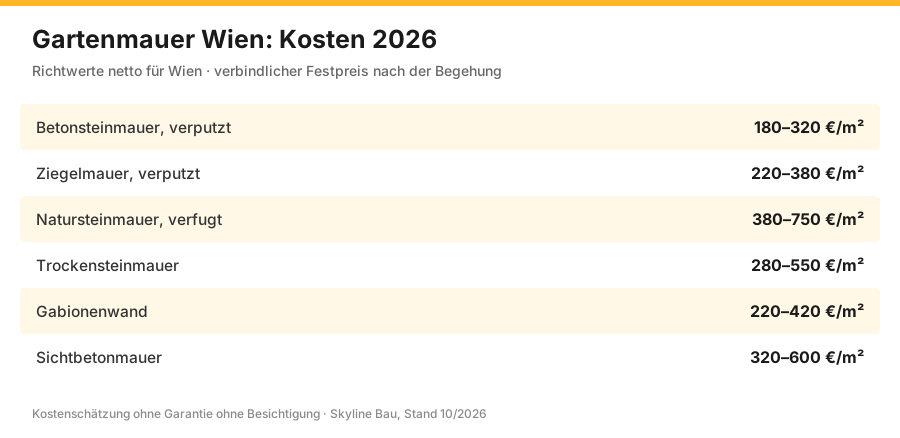
Garden wall Vienna: a garden wall in Vienna costs 180 to 750 euros per square metre of visible face. Rendered concrete block €180–320/m², brick €220–380/m², natural stone €380–750/m², gabions €220–420/m² – each including foundation.
What a garden wall costs in Vienna
Net guide values, as of 2026, binding after a site visit. Prices are per square metre of visible face, including foundation.
| Construction type | What is included | Net price | Sensible height up to |
|---|---|---|---|
| Concrete block wall, rendered | Foundation, formwork blocks, reinforcement, render | €180–320/m² | 2.0 m |
| Brick wall, rendered | Foundation, masonry, coping, render | €220–380/m² | 1.8 m |
| Natural stone wall, pointed | Foundation, stone, mortar, joints | €380–750/m² | 1.8 m |
| Dry stone wall | without mortar, frost protection, drainage | €280–550/m² | 1.2 m |
| Gabion wall | Foundation, baskets, stone filling | €220–420/m² | 2.0 m |
| Fair-faced concrete wall | Formwork, reinforcement, concrete, surface | €320–600/m² | 2.5 m |
Unit prices and ancillary services
| Item | Unit | Net price | Why it is needed |
|---|---|---|---|
| Frost-free strip foundation | lin. m | 140–320 € | at least 80 cm deep, otherwise frost lifts it |
| Excavation for the foundation | m³ | 28–95 € | Loosening, loading, removal |
| Reinforcement | kg | 4,50–9,00 € | with formwork blocks and fair-faced concrete |
| Drainage behind the wall | lin. m | 45–120 € | mandatory with a change in ground level |
| Backfilling with gravel | m³ | 28–65 € | Drain water, reduce earth pressure |
| Wall coping | lin. m | 45–160 € | Concrete, natural stone or sheet metal, with drip edge |
| Render on both sides | m² | 35–75 € | Primer, render, paint |
| Movement joint | pcs | 120–320 € | every 6 to 10 m, otherwise the wall cracks |
| Structural calculation | lump sum | 800–3.500 € | from 1.5 m height or with a change in ground level |
| Submission to MA 37 | lump sum | 1.200–4.000 € | if a permit is required |
| Condition survey on the neighbouring property | lump sum | 800–3.500 € | for work directly on the boundary |
| Installing a gate or door | pcs | 900–4.500 € | Pillars, fittings, optional drive |
Total around €33,300 net for 35 m² of visible face, which is €951/m² or €1,514 per running metre. The reason for the high value: with a change in ground level it is no longer a garden wall but a retaining wall – with structural engineering, drainage and a corresponding foundation.
Garden wall or retaining wall
| Criterion | Garden wall | Retaining wall |
|---|---|---|
| Task | Privacy screen, enclosure | holds back soil |
| Load | Self-weight, wind | additionally earth pressure and water pressure |
| Structural engineering required | from about 1.5 m height | always |
| Foundation | Frost-free strip foundation | designed, often with a heel or L-shape |
| Drainage | not required | mandatory |
| Price per m² | 180–750 € | 350–900 € |
The most common and most expensive mistake: a wall that retains a change in ground level is built and calculated as a garden wall. Earth pressure acts constantly and increases sharply when wet – without a designed foundation and drainage, the wall tips over after a few years. Details on retaining wall Vienna.
How much does a garden wall in Vienna cost?
The price depends on material, height and length. As a guide per running metre:
As of 2026 · net, excl. 20 % VAT · guide values depending on height and material. Final price after a site visit, in writing as a fixed price under ÖNORM B 2110.
which construction type?
Natural stone wall
The highest-quality variant, built with mortar or as a dry stone wall. Durable and valuable, but the most expensive and elaborate version. An eye-catcher that lasts for decades.
Concrete wall
Built from formwork blocks or cast in concrete, then rendered or clad. Solid, versatile and economical — the most common choice for a classic garden wall.
Gabions
Wire baskets filled with stones. Quick to build, inexpensive, good stability and a modern look. Also ideal as a retaining wall on slopes or as noise protection.
Privacy screen & enclosure
Low wall with a top section, combined with a fence or planting. The property boundary defined cleanly and permanently.
Garden walls — in all 23 districts and the surrounding area
We build garden walls throughout Vienna, as well as in Klosterneuburg and the surrounding area of Lower Austria.
the foundation decides
The most common mistake with garden walls is a foundation that is too shallow or missing. What counts:
- Frost-proof founding — In Vienna the foundation goes about 80 cm deep to get below the frost line. If it is higher, frost lifts the wall and it cracks.
- Load-bearing subsoil — On soft or made ground, a wider foundation or soil improvement is needed, otherwise the wall settles unevenly.
- Height needs structural engineering — From a certain height the wall becomes a structurally relevant construction, especially if it retains soil. Then a design calculation is needed.
- Drainage — A wall that retains soil needs backfilling with drainage. Otherwise backed-up water and frost press against the wall from behind.
- Property boundary & neighbour law — Height, location and distance to the property boundary must be observed; high walls may require a permit. We clarify this in advance.
from excavation to the finished wall
01 Site visit & planning
Height, length, material, alignment, subsoil and the question of the property boundary. Free of charge.
02 Quote
Material, foundation, execution — as a bill of quantities with a fixed price under ÖNORM B 2110.
03 Foundation
Excavation below the frost line, formwork, reinforcement, concreting. The invisible but decisive part.
04 Building the wall
Bricklaying, concreting or setting gabions — with the chosen material and clean workmanship.
05 Finishing
Coping, render or cladding, backfilling with drainage, connection to the terrain.
Why Skyline Bau for your garden wall in Vienna
We are the executing building contractor and build foundation and wall with our own people. The advantage shows when the wall is part of a larger outdoor project: garden wall, paving and retaining wall interlock and often lie in the same excavation. Planned from one source, the terrain fits together at the end.
- One contractual partner for foundation, wall and the adjacent outdoor work.
- Fixed price according to ÖNORM B 2110, in writing after the site visit.
- Frost-proof foundation — the point at which most garden walls fail.
- €3 million construction liability insurance.
How to recognise a reputable contractor
1. Is the foundation described?
Depth, width, reinforcement — without details of the foundation the offer is guesswork. That is exactly where durability is decided.
2. Has frost depth been considered?
A foundation above the frost line lifts in winter. A serious offer founds frost-proof.
3. Is drainage included for retaining walls?
A wall that holds soil needs backfilling and drainage. Without it, water pushes the wall away.
4. Is the property boundary clarified?
Location, height, neighbour law — this must be clarified before construction starts, not afterwards.
5. Does the material suit the height?
High walls need the right structural design. Anyone who simply builds higher without calculating risks it tipping over.
6. Warranty named correctly
Statutory 3 years under § 933 ABGB on the workmanship.
Does a garden wall in Vienna need a permit?
That depends on the height. Low boundary walls are usually permit-free; higher walls and those on the street front may be subject to notification or a permit. Neighbour law also plays a role: height and distance to the property boundary are regulated. For retaining walls that take up changes in ground level, structural design is added — for greater heights a licensed master-builder partner incorporates the structural engineering. We clarify this before construction starts.
When you do not need us
For a few metres of low dry stone wall in a flower bed or a ready-made fence system, you do not need a construction company — that is landscape gardening. We are the right choice when a permanent, frost-proof founded wall is to be built, the wall retains soil or is part of a larger outdoor project.
what it includes
A garden wall is part of the outdoor area. What is connected:
When the wall holds soil — with earth pressure, structural engineering and drainage.
Wall and paving often lie in the same excavation and fit together in height.
The frost-proof foundation is the heart of every durable wall.
Before the foundation comes the excavation to below the frost line.
Base wall with fence on top — the combination for privacy and boundary.
The overview of all construction services.
what you should know
So that you know exactly what to expect, we answer the most important questions here — honestly and from the practice of a building contractor that does the work itself.
What types of garden walls are there?
Common are masonry walls (concrete or natural stone), fair-faced concrete walls, gabions (stone baskets) and rendered walls. The choice depends on appearance, function (privacy, enclosure, slope retention) and budget. A load-bearing, frost-free foundation is always important.
Does a garden wall need a foundation?
Yes — a stable wall needs a frost-free foundation, otherwise it lifts and cracks in frost. The higher the wall, the more important the foundation. We found it professionally so that the wall stays straight and crack-free for good.
Is a permit needed for a garden wall?
That depends on height and location. Low walls are often permit-free; higher enclosures may be subject to notification or a permit, especially at property boundaries. We clarify the requirements in advance.
How much does a garden wall in Vienna cost?
The costs depend on length, height, material and foundation. A gabion wall is calculated differently from a rendered concrete wall. After a site visit you receive a fixed-price offer.
Custom garden wall at the property boundary: concrete, stone or Corten steel
A wall at the property boundary usually has to do three things at once: provide privacy, a clear boundary and as little maintenance as possible. Which construction type fits depends less on taste than on length, height and subsoil.
Concrete and masonry are the most robust solution for long, high sections. They can be built exactly to size, including recesses, niches for bins or an opening for the garden gate. Natural stone looks more upmarket but requires more handwork and therefore more budget. Corten steel is weathering structural steel that forms a dense rust layer and hardly corrodes further beneath it. The elements are made to measure by a metalwork firm; the structural part is the continuous, frost-free foundation with properly set anchors, on which they stand plumb and true.
One point often overlooked with Corten steel: in the first years, rust-brown water runs off with the rain and permanently stains light paving, render or stone slabs. A gravel strip at the foot of the wall solves this. Regardless of material, the following applies at the boundary: before building, the course of the boundary should be established. If in doubt, a survey helps, and if the wall stands exactly on the boundary, a written agreement with the neighbour is needed.
Garden walls for private and public areas: what differs
In your own garden, stability, appearance and good relations with the neighbour count above all. It is different as soon as the wall borders a public area – a pavement, street or a passage in a residential complex.
- Location on the street: on the street front, the provisions of the development plan apply, for example on the building line and permitted enclosures. Whether notification or a permit from MA 37 is required is clarified in advance.
- Construction time on public land: if the pavement has to be used for scaffolding, material or lorries, a separate permit and barriers are required.
- Robustness: walls along paths and car parks get driven into, painted and climbed on. A higher concrete base, an impact-resistant coping and an easy-to-clean surface pay off here.
- Communal areas: in owner-occupied complexes the owners' association decides, and with changes in ground level fall protection in accordance with the OIB guidelines must be planned in.
If the wall holds back soil, it is no longer an enclosure but a retaining wall with its own structural engineering and drainage.
Natural stone wall by the mason: what drives the price
The range of €380 to €750 per m² of visible face for natural stone is explained by three factors. The first is the stone itself: local rubble stone is cheaper than sawn, dimensionally accurate blocks. The second is the laying method: a mortared wall with a concrete core goes faster than a fair-faced wall in which every stone has to fit on both sides. The third is access, because natural stones are often set individually, and every metre of carrying distance costs time. The frost-free foundation is already included in the net guide values, as is the coping that keeps water away from the wall core.
Frequently asked questions about garden walls in Vienna
How much does a garden wall in Vienna cost?
Depending on the material per running metre: a gabion wall costs €150 to €300, a rendered concrete wall €200 to €400, a natural stone wall more. Plus the frost-proof foundation at €80 to €150 per metre. The final price depends on height and subsoil.
Why is the foundation so important?
Because a garden wall without a load-bearing, frost-proof foundation cracks, sinks or tips over after the first winter. The foundation is the invisible part where most garden walls fail — saving here will certainly backfire.
How deep does the foundation have to be?
In Vienna about 80 centimetres, to get below the frost line. If the foundation is higher, freezing water in the ground lifts the wall and it cracks. For high or retaining walls, deeper and wider may be necessary.
Which type of wall is best?
It depends on purpose and budget. Natural stone is the highest quality and most expensive, concrete solid and economical, gabions inexpensive, quick and structurally sound. For a plain property boundary, concrete or gabion is often enough; for an eye-catcher, natural stone.
What are gabions?
Wire baskets filled with stones. They are quick to build, inexpensive, have good stability thanks to their self-weight and a modern look. Particularly suitable as a retaining wall on slopes or as privacy and noise protection.
Does a garden wall need a building permit?
That depends on the height. Low boundary walls are usually permit-free; higher ones and those on the street front may be subject to notification or a permit. The distance to the property boundary is also regulated. We clarify this before construction starts.
What needs to be considered with a retaining wall?
A wall that holds back soil must take the earth pressure and needs backfilling with drainage so that no water builds up behind it. From a certain height, a structural design is necessary. That is more than a mere privacy wall.
How high may a garden wall be?
There are limits under building and neighbour law that depend on location and development regulations — at the property boundary often lower than inside the plot. Higher walls also need appropriate structural design. We clarify the permissible height in advance.
What happens without a frost-proof foundation?
Water in the ground freezes in winter, expands and lifts the foundation unevenly — the wall cracks or tips over. That is the classic damage on cheaply built garden walls and can only be avoided by founding deep.
Can a wall be built on a slope?
Yes, it then usually becomes a retaining wall that takes up the change in ground level. This requires a stronger foundation, taking up the earth pressure and drainage behind the wall. Gabions or reinforced concrete are well suited.
How long does it take to build a garden wall?
A manageable wall is finished in a few days, although the foundation concrete has to cure before the wall goes on top. Length, material and subsoil determine the duration — natural stone takes longer than a gabion wall.
Do I have to clarify anything with the neighbours?
With a wall at the property boundary, neighbour law must be observed — height, location and sometimes consent. If the wall stands exactly on the boundary, it affects both sides. We point out the issues; reaching agreement with the neighbour is up to you.
Can a garden wall be rendered or clad?
Yes. A concrete wall is often rendered or clad with natural stone, clinker brick or slabs. This combines the inexpensive, solid concrete construction with a high-quality appearance. You choose the surface; the load-bearing construction stays the same.
How much does a natural stone wall cost?
Natural stone is at the upper end, from about €350 per running metre upwards, depending on stone, height and whether it is mortared or dry-laid. The high price comes from the material and the elaborate handwork. In return it is durable and a real eye-catcher.
Is a gabion wall structurally safe?
Yes, thanks to its high self-weight, a professionally set gabion wall is very stable and is also suitable as a retaining wall. A load-bearing, level base is important, and for greater heights the correct sizing of the baskets.
Does a low wall also need a foundation?
Yes, if it is to last. Even a low masonry wall needs a frost-proof strip foundation, otherwise frost lifts it. Only loosely laid dry stone walls in a bed can do without — everything with mortar needs a foundation.
Can wall and fence be combined?
Yes, that is common: a low base wall with a fence or privacy screen on top. The wall provides the stable, defined base, the top section the height and privacy. Both are planned together so that foundation and top section match.
What is a dry stone wall?
A wall of layered natural stones without mortar, held together by skilful placing of the stones. It looks natural and provides a habitat for plants and animals, but has a limited height and requires experience to build.
How is a retaining wall drained?
A drainage layer of gravel with a drain pipe is installed behind the wall to carry water away. This prevents water from building up behind the wall, which would otherwise build pressure and freeze in winter. This backfilling is mandatory for retaining walls.
Can an old garden wall be repaired?
Often yes. Cracks, subsided areas or weathered render can be repaired as long as the foundation still bears. If the foundation is the problem, a new build usually makes more sense. The site visit shows what is possible.
What is the difference between a garden wall and a retaining wall?
A garden wall stands free and separates or encloses; a retaining wall holds back a change in ground level or soil. The retaining wall must take the earth pressure, is structurally more demanding and needs drainage. We build both; the execution differs.
Which material lasts longest?
Built professionally, all variants last a long time. Natural stone and reinforced concrete are the most durable; gabions are also very long-lasting as long as the wire baskets are corrosion-protected. The foundation always decides the service life, not just the visible material.
Can a garden wall be built in winter?
Only to a limited extent in frost, because concrete and mortar should not set at sub-zero temperatures. Excavation and preparation are possible; concreting and bricklaying are better moved to frost-free periods. We plan this into the schedule.
How wide does the foundation have to be?
That depends on the height, weight and subsoil of the wall — as a rule of thumb somewhat wider than the wall itself, considerably more for high or retaining walls. On soft ground it becomes wider to distribute the load. The exact width results from the planning.
Do I get a warranty on the garden wall?
Yes, the statutory 3-year warranty under § 933 ABGB on the workmanship. Because we found frost-proof and build professionally, typical damage such as settlement or frost spalling is not to be expected in the first place.
Can I have the garden wall and paving done together?
Yes, and that makes sense. Wall, paving and landscaping often lie in the same excavation and fit together in height if they are planned together. From one source you avoid interfaces and the garden is all of a piece.
What is the most common expensive surprise in wall building?
The subsoil. If the excavation hits rock, rubble or soft, made ground, the foundation and the calculation change. Because we work with a fixed price after a site visit, we check the subsoil beforehand and clarify anything additional before it is commissioned.
How much does a garden wall cost per square metre?
How much does a wall cost per running metre?
Why does a wall need movement joints?
What is the wall coping for?
From what height do I need structural engineering?
Garden wall: do I need a building permit?
How close may I build to the property boundary?
What needs to be clarified with the neighbour?
When is it a retaining wall?
Why do I need drainage?
What is a dry stone wall?
Are gabions a good solution?
Which natural stone suits Vienna?
Can the wall be greened?
How long does a garden wall take?
Can masonry work be done in winter?
How long does a garden wall last?
Can a leaning wall be straightened?
Do you also build short walls?
Does a Corten steel wall last as a property boundary?
What is different about a wall on the street front compared with the garden?
What does the price of a natural stone wall depend on most?
Related services
Wall finished? Mortar residue and surroundings.
After masonry work, mortar residue remains on paving and adjacent surfaces. Bling Premium Cleaning takes care of cleaning the surroundings. More at bling-bling.at.
Send enquiry
Enquire directly here — fixed-price quote free of charge. Skyline Bau replies within 2 working days.
Ready for your garden wall in Vienna?
Write to us directly on WhatsApp — send photos. Reply within 2 working days.
Note: Skyline Bau is the brand name of the construction and renovation division of Bling Bling GmbH and is not a separate legal entity. The sole contractual partner is Bling Bling GmbH. Bling Bling GmbH is a restricted construction trade business under § 99 GewO (Austrian Trade Regulation Act) and not a licensed master builder (Baumeister). Under § 99 (5) GewO, the title “Baumeister” is reserved for businesses licensed under § 94 no. 5 GewO. Regulated trades — master-builder services, structural engineering, gas and sanitary engineering, electrical engineering — are carried out exclusively by authorised, licensed partner companies.