Painting work Vienna walls that still look good after ten years.
Painting work Vienna: from the construction company that does the work — not from an agent.
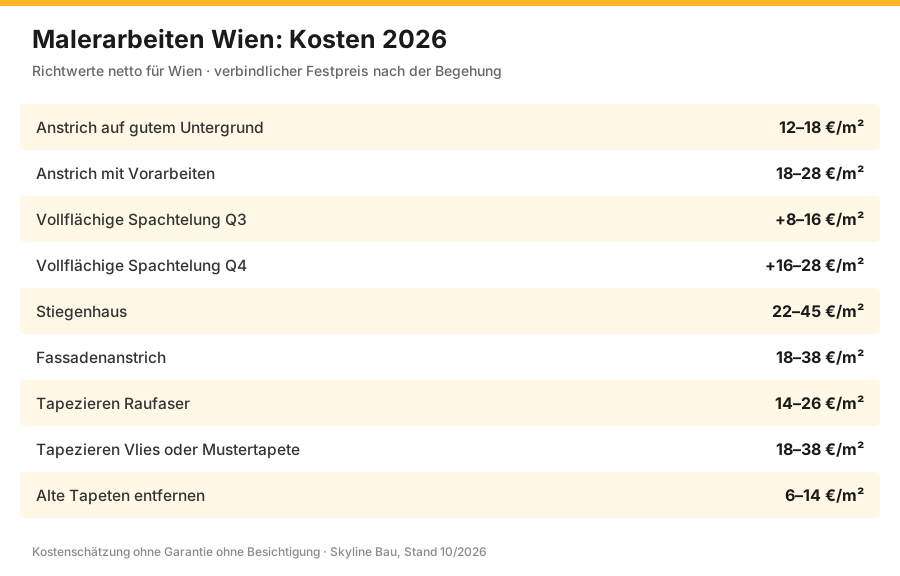
Painting work Vienna: painting in Vienna costs 12 to 28 euros per square metre of wall area. Simple coat €12–18/m², with filling and preparation €18–28/m², staircase €22–45/m². Exterior facade €18–38/m² plus scaffolding. Net, 2026 guide values.
Painting work Vienna: costs 2026
Net guide values, as of 2026, binding after measurement. The range is explained almost entirely by the condition of the substrate.
| Service | What is included | Net price |
|---|---|---|
| Coat on a good substrate | Covering, priming, two coats | €12–18/m² |
| Coat with preparation | additionally filling, sanding, repairing | €18–28/m² |
| Full-surface filling Q3 | Surface filled and sanded throughout | +€8–16/m² |
| Full-surface filling Q4 | for gloss paints and grazing light | +€16–28/m² |
| Stairwell | Scaffolding, height surcharge, barriers | €22–45/m² |
| Facade painting | Cleaning, priming, two coats | €18–38/m² |
| Hanging woodchip wallpaper | Preparing the substrate, pasting, painting | €14–26/m² |
| Hanging non-woven or patterned wallpaper | Pattern-matched, material provided by client | €18–38/m² |
| Removing old wallpaper | Soaking, stripping, cleaning the substrate | €6–14/m² |
| Trowel technique, lime plaster look | multi-layer, smoothed | €60–140/m² |
| Stucco Veneziano | three to five layers, polished, waxed | €120–260/m² |
| Painting stucco mouldings | Profile painting, cutting in edges | €18–45/lin. m |
| Cleaning and supplementing stucco | Exposing, casting, supplementing | €90–260/lin. m |
| Painting doors and frames | Sanding, priming, two coats of lacquer | €120–320/pc |
| Painting radiators | Derusting, anti-rust primer, radiator paint | €85–190/pc |
| Painting windows inside | Box-type windows more elaborate | €140–420/pc |
| Mould remediation as preparatory work | Removing, disinfecting, blocking primer | €25–70/m² |
| Nicotine or soot blocking | Insulating primer, otherwise it bleeds through | €8–18/m² |
| Covering, protection, final cleaning | Sheeting, masking tape, final cleaning | €180–650 lump sum |
Total around €7,620 net. With smooth walls without stucco and without lacquering, it would be around €3,000 – the same room, different effort.
Roof coating and exterior painting
A roof coating is not cosmetics but corrosion protection. On metal roofs and galvanised surfaces the coating lasts ten to fifteen years, after which rust starts at the edges. On tiles, on the other hand, a coating achieves little — there the covering itself has usually reached the end of its life.
| Area | Build-up | Net price |
|---|---|---|
| Metal roof, good condition | cleaning, priming, two top coats | €18–28/m² |
| Metal roof with rust | derusting, anti-rust protection, primer, two coats | €28–42/m² |
| Facade, smooth render | cleaning, deep primer, two coats of silicone resin paint | €16–24/m² |
| Facade with cracks | additionally reinforcing, repairing, skim-coating | €24–32/m² |
| Exterior timber, fences and cladding | sanding, primer, glaze or opaque paint | €22–38/m² |
On top of the prices per square metre comes access. Up to about eight metres we work from scaffolding; above that and where access is poor, by rope access — for a single gable wall this is often cheaper than scaffolding for two days.
The season also plays a role: exterior painting needs at least five degrees and dry surfaces throughout the entire drying time. Between November and March we would therefore rather cancel exterior appointments than push them through in borderline weather.
Why the substrate determines the price
Paint costs little. Two thirds of the effort lies in what happens beforehand. These six substrates are the ones we find most often in Viennese period buildings.
- Old distemper. Common in Gründerzeit buildings up to the 1960s. It cannot be painted over – modern emulsion paint dissolves it and peels off together with the substrate. It has to be washed off, €8 to €18/m².
- Oil paint on the dado. Common in staircases and kitchens. It has to be sanded and treated with a bonding primer, otherwise nothing will adhere to it.
- Woodchip wallpaper in several layers. Three to five layers on top of each other are not unusual. Removal costs €6 to €14/m², but is almost always the right thing to do.
- Nicotine and soot. Without an insulating primer, the discolouration bleeds through any top coat – even through three coats. Blocking primer €8 to €18/m².
- Damp and water stains. First eliminate the cause, then let it dry, then seal. Anyone who paints over a damp patch will see it again in four weeks.
- Cracks in period-building plaster. Hairline cracks are filled over, moving cracks are reinforced with mesh tape. The difference decides whether the crack comes back.
Which paint for what
| Paint type | Material price per m² | Property | Suitable for |
|---|---|---|---|
| Emulsion paint | 0,60–1,80 € | inexpensive, good coverage, film-forming | Living spaces on modern substrates |
| Silicate paint | 1,80–4,00 € | mineral, highly vapour-permeable, mould-inhibiting | Period buildings, rooms exposed to moisture, basements |
| Lime paint | 1,50–3,50 € | highly alkaline, regulates humidity | historic rooms, vaults |
| Silicone resin paint | 2,20–4,50 € | water-repellent and vapour-permeable | Facades, bathroom, kitchen |
| Latex paint | 1,80–4,00 € | washable, satin finish | Staircase, commercial premises, children’s room |
| Clay paint | 3,00–6,00 € | regulates room humidity, matt | Bedrooms, ecological fit-out |
In Viennese period buildings the same rule applies as on the facade: the more the substrate is exposed to moisture, the more vapour-permeable the paint must be. Silicate paint on old lime plaster is almost always the better choice than emulsion – it silicifies with the substrate instead of forming a film.
Opacity and wet scrub resistance: the two figures that count
Every paint tin shows two classes. Opacity 1 to 4, where 1 is the best – a class 1 paint covers in two coats, a class 3 paint needs three. Wet scrub resistance 1 to 5, where 1 is scrub-resistant and 5 not washable. For living spaces class 2 to 3 makes sense, for staircases and kitchens class 1 to 2. A cheap class 3 paint with three coats ends up more expensive than a good one with two.
Trowel techniques and decorative surfaces
Smooth filling Q3 and Q4
The surface is filled and sanded over its entire area so that no lap marks remain visible. Q3 for satin paints, Q4 for gloss paint and rooms with grazing light through large windows. Surcharge €8 to €28/m².
Lime plaster look
Applied in several layers, lively across the surface, matt and vapour-permeable. €60 to €140/m². Suits period rooms well and is compatible with historic plaster.
Stucco Veneziano
Three to five wafer-thin layers of lime filler, smoothed and waxed, with a sense of depth. €120 to €260/m². Demanding craftsmanship and not sensible in every room – usually one wall as an accent.
Concrete look and microcement
Seamless surface, also for bathrooms and kitchens. €90 to €200/m². Needs an absolutely flat, crack-free substrate – in period buildings that means preparatory work.
Painting in Viennese period buildings: what matters
Stucco
Stucco ceilings and mouldings are the reason why period apartments are so sought-after. When painting, they are not simply rolled over: profiles are traced with a brush, edges cut in cleanly, and profiles painted over many times are exposed if necessary. €18 to €45 per linear metre for painting, €90 to €260/lin. m for cleaning and supplementing missing parts.
Ceiling heights over three metres
Viennese Gründerzeit apartments have 3.20 to 4.00 m. That means scaffolding or platforms instead of ladders, longer working hours and more wall area per square metre of floor. For the same apartment size, there is 30 to 50% more area to paint than in a new build.
Box-type windows
A box-type window has two sash levels, reveals and often twenty layers of paint. Painting the inside takes considerably longer than with a modern window: €140 to €420 per window, depending on condition and whether it has to be stripped.
Dippelboden and dust
Sanding creates fine dust that settles throughout the apartment. We work with extraction on the sander, dust-protection walls and airlocks. That is not a luxury – without these measures the client is still cleaning weeks later.
Staircases in occupied buildings
There, work is done in sections, one side always remains passable, handrails last. Residents must be able to get through at all times, including prams and rollators. Working hours on weekdays, notice in the staircase two weeks in advance.
Process
The eight most common mistakes
- Emulsion paint on distemper. Peels off over large areas after two weeks.
- Painting without primer. An absorbent substrate takes up the paint unevenly, the result becomes patchy.
- Painting over water stains. They bleed through – first eliminate the cause, dry, seal.
- Only filling over moving cracks. Without mesh tape the crack comes back.
- Cheap paint with poor opacity. Three coats instead of two, more expensive in the end.
- Lacquering before sanding. Dust in fresh lacquer can no longer be removed.
- Rolling over stucco. Profiles fill up and the detail is lost – irretrievably.
- Acceptance under artificial light. Lap marks only show in the grazing light of daylight.
How to check a painting quote
Who we paint for
Property management companies
Staircases, basements, common areas – in sections in the occupied building, with advance notice and clear escape routes.
Private clients
Apartment after renovation or before moving in. Clear price after measurement, clean site, final cleaning included.
Landlords
Apartment between two tenancies, fast and documented. Photos before and after the work for the handover.
Commercial premises and medical practices
Evenings and weekends so that business does not stop. Low-emission paints with low VOC content.
When you do not need us
If you want to paint a room and have the time, do it yourself – material costs €80 to €200, and with a good substrate it is easily doable. Call us when the substrate is unclear: old distemper, damp patches, cracks, nicotine, stucco. That is where it is decided whether the paint lasts ten years or two. And if a renovation is coming up anyway, the painting belongs at the end of that project, not before it.
Roof coating and exterior painting
Painting the outside of a house is not the same as decorating inside: outside, preparation determines durability, and preparation is the larger part of the work.
| Service | What is included | Net price per m² |
|---|---|---|
| Roof coating, metal roof | Cleaning, derusting, primer, two top coats | €22–42/m² |
| Roof coating, tiled or concrete roof | Cleaning, primer, coating, moss removal | €18–35/m² |
| Facade painting | Cleaning, closing cracks, primer, two coats | €16–32/m² |
| Plinth and splash zone | Renovation plaster, sealing coat | €28–55/m² |
| Scaffolding | Erection and dismantling, standing time up to four weeks | €12–22/m² per month |
| Timber surfaces, balconies, fences | Sanding, priming, glaze or lacquer | €24–48/m² |
We carry out painting and decorating work in all 23 Viennese districts, inside and out, individually or as part of a renovation.
Wallpapering in Vienna: woodchip, non-woven and patterned wallpaper
Wallpaper has never completely disappeared from Viennese apartments. In many period buildings there are still several layers of paper wallpaper under the paint, and in newer apartments woodchip is common because it covers small cracks. The same applies to wallpapering as to any paint job: the result depends on the substrate. Old layers are soaked and stripped, loose spots are filled, absorbent surfaces primed. Only then is the paper hung.
Which wallpaper for what? Woodchip is inexpensive, robust and is painted over; it forgives uneven walls. Non-woven wallpapers can be stripped dry later, tear less with settlement cracks and are a good base for repainting later. Patterned and designer wallpapers need a very flat substrate and precise pattern matching, otherwise every joint shows. As net guide values from our price table: woodchip €14 to €26/m² including painting, non-woven or patterned wallpaper €18 to €38/m² excluding material, removing old wallpaper €6 to €14/m².
Repairing the wall: when paint alone is not enough
Hollow-sounding plaster, flaking around sockets, fine crazing over the whole surface – a new coat of paint does not help here. The wall needs repair first. Small damage is closed with filler. With crazing, a reinforcing mesh is embedded and skimmed over so that the cracks do not come through again after one winter. Where the interior plaster is hollow over large areas, it has to be knocked off and reapplied.
In period buildings the choice of material is important. Lime plasters on brick masonry are not compatible with dense gypsum fillers in thick layers; this can lead to flaking. We handle smaller plaster repairs as part of the painting work, larger re-plastering via authorised partner companies. If the cause is moisture, damp-proofing comes first, otherwise the new plaster is damaged again in a short time – more on this under wall damp-proofing.
Sponge techniques and Stucco Veneziano in Viennese period buildings
Decorative surfaces are in demand above all in period apartments, for example in the Innere Stadt or in Landstraße, where high rooms, stucco and double doors provide the setting. A colour sponging technique is the lighter option: a glazing paint is applied over a base colour with a sponge, cloth or brush to create a lively, cloudy surface. It is cheaper than trowel techniques but requires a steady hand so that no lap marks are visible.
Stucco Veneziano goes further: several thin layers of lime filler are smoothed, polished and waxed. The effect is elegant, but the surface is only as good as the substrate beneath it. With old walls with cracks, the wall is therefore repaired first and then filled. For bathrooms with splash water, other systems are more suitable, which we describe on the page on bathroom renovation.
Stucco Veneziano in Viennese apartments: what the building dictates for the technique
Whether a Venetian trowel technique succeeds is decided less by the district than by the wall beneath. Nevertheless, the districts shape which walls we encounter and therefore how much preparation is needed. A lime filler in wafer-thin layers forgives no unevenness: every dent, every hairline crack and every old paint residue shows after polishing. That is why every job begins by tapping and checking the plaster and with a sample area on which you approve the colour shade and degree of gloss.
Gründerzeit: Landstraße and Wieden
Anyone who wants Stucco Veneziano for an apartment in 1030 Vienna usually has a Gründerzeit building with rooms over three metres high and lime plaster, often painted over with distemper or emulsion. Before the trowel layers go on, this old paint has to come off, otherwise the lime will not adhere. It is similar in Wieden, the 4th district (1040): here there are often apartments with stucco ceilings whose edges are masked cleanly when working on the wall. The ceiling height requires a mobile scaffold, because a surface must be trowelled without interruption, otherwise lap marks remain visible.
Villas and interwar buildings: Hietzing and the 19th district
In Hietzing, i.e. 1130 Vienna, and in the 19th district with Grinzing, Sievering and the Cottage quarter (1190), we tend to work in villas, cottage houses and renovated interwar buildings. There the walls have often already been repaired with gypsum plaster or plasterboard. Lime filler only adheres to these with a suitable primer, and on plasterboard we recommend full-surface filling beforehand so that the board joints do not show through. In large living rooms with window fronts, grazing light falls flat across the wall – that is exactly where the quality of the smoothing is most visible, which is why we create the sample area in daylight.
Where the technique makes sense and where it does not
Lime filler is vapour-permeable and slightly alkaline, which inhibits mould and makes the surface pleasant for living rooms, hallways and staircases in detached houses. In a shower without additional protection, on the other hand, it is out of place, because standing water attacks the wax layer. Behind the cooker and sink, a soap or wax seal is usually sufficient, refreshed after a few years. Small knocks from the vacuum cleaner or scratches from furniture can be repaired, but a repaired spot often remains slightly visible with a high gloss. For heavily used surfaces we therefore recommend a more matt finish.
On timing: each layer of lime needs several hours to a day to set, and longer with high humidity in autumn. A wall in a period room is therefore rarely finished in one day; with preparation, trowel passes, polishing and waxing it takes three to five working days. During this time the room should not be heated strongly or filled with furniture, so that each layer dries evenly and no stains form.
The prices from our table above apply as net guide values; substrate preparation is added depending on condition. If the old plaster is hollow or damp, masonry repair is needed first. Anyone renewing the entire apartment at once will find the process under Old-Building Renovation.
Frequently asked questions about painting work in Vienna
What does painting work in Vienna cost?
What does it cost to paint a 60 m² apartment?
How do you calculate the wall area?
What does a painter cost per hour?
Why are some quotes so much cheaper?
How long does it take to paint an apartment?
Can I stay in the apartment during the work?
What is distemper and why is it a problem?
How do I recognise distemper?
Does old wallpaper have to come off?
What to do about water stains on the ceiling?
What helps against nicotine discolouration?
What to do about mould on the wall?
Which paint for allergy sufferers?
What does VOC content mean?
What do opacity and wet scrub classes mean?
Silicate paint or emulsion paint?
How long does an interior paint job last?
How many coats are needed?
What is the difference between Q3 and Q4?
What does a staircase cost?
Does the staircase remain passable during the work?
What does painting a facade cost?
Is the stucco painted too?
Can lost stucco be replaced?
What does it cost to paint doors?
Can radiators be painted?
What does it cost to paint box-type windows?
What does wallpapering cost?
What is a trowel technique?
What is Stucco Veneziano?
Does the concrete look work in the bathroom too?
Does the furniture have to go?
How much dust is produced?
Is final cleaning included?
Can painting be done in winter?
Do you also work evenings and weekends?
When is the work accepted?
What if I do not like the colour?
Painting work: what warranty is there?
Do you also do individual rooms?
Do you also paint after a renovation?
Painting work: who carries out the work?
Painting work: is there a fixed price?
Painting work: how quickly do I get a quote?
Are there subsidies for painting work?
Can I buy the paint myself?
Woodchip or non-woven wallpaper – which is the better choice?
What helps against cracks that reappear after painting?
What is the difference between a sponge technique and Stucco Veneziano?
Related services
Painted? Paint splashes and tape residue remain.
After painting work, splashes remain on floors, windows and fittings, as well as tape residue. Bling Premium Cleaning takes care of the final construction clean including glass cleaning. More at bling-bling.at.
Send enquiry
Enquire directly here — fixed-price quote free of charge. Skyline Bau replies within 2 working days.
Ready for your painting work in Vienna?
Write to us directly on WhatsApp — send photos of the rooms and wall surfaces to be painted. Reply within two working days.
Note: Skyline Bau is the brand name of the construction and renovation division of Bling Bling GmbH and is not a separate legal entity. The sole contractual partner is Bling Bling GmbH. Bling Bling GmbH is a restricted construction trade business under § 99 GewO (Austrian Trade Regulation Act) and not a licensed master builder (Baumeister). Under § 99 (5) GewO, the title “Baumeister” is reserved for businesses licensed under § 94 no. 5 GewO. Regulated trades — master-builder services, structural engineering, gas and sanitary engineering, electrical engineering — are carried out exclusively by authorised, licensed partner companies.