Roof renovation Vienna before the stain appears on the ceiling.
Roof renovation Vienna: from the construction company that does the work — not from an agent.
Roof renovation Vienna: renovating a roof in Vienna costs 180 to 320 euros per square metre of roof area. With over-rafter insulation €280 to €450/m², flat roof €150 to €300/m². Included are stripping, roof underlay, battens, covering, sheet-metal work and disposal. Construction time 2 to 5 weeks.
Roof renovation Vienna: costs 2026
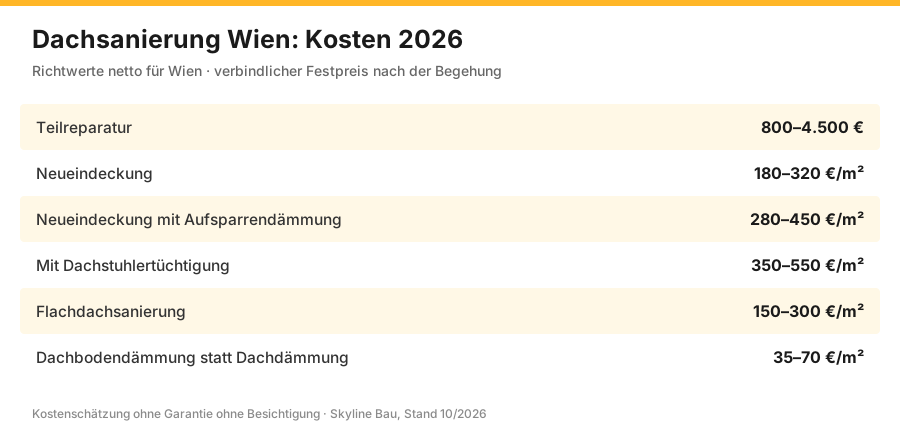
Net guide values, as of 2026, binding after a site visit. What matters is whether only the covering is replaced or whether insulation, roof truss and sheet-metal work are added.
| Scope | What is done | Net price | Construction time |
|---|---|---|---|
| Partial repair | individual tiles, a valley, a connection | 800–4.500 € | 1–3 days |
| Re-roofing | Stripping, underlay, battens, covering | €180–320/m² | 2–4 weeks |
| Re-roofing with over-rafter insulation | additionally 24–30 cm of insulation above the rafters | €280–450/m² | 3–5 weeks |
| With roof truss strengthening | Strengthening rafters, splicing beam ends | €350–550/m² | 4–7 weeks |
| Flat roof renovation | Renewing the build-up, falls, outlets | €150–300/m² | 1–3 weeks |
| Attic floor insulation instead of roof insulation | walkable, if no conversion is planned | €35–70/m² | 2–5 days |
Unit prices, so you can check a quote
| Item | Unit | Net price | What is included |
|---|---|---|---|
| Stripping and disposing of the old covering | m² | 18–40 € | Stripping, loading, container, certificate |
| New battens and counter-battens | m² | 14–28 € | Impregnated timber, fixing |
| Vapour-permeable roof underlay | m² | 9–22 € | Laying, overlaps, bonding |
| Supplying and laying clay roof tiles | m² | 65–120 € | Material, laying, storm clips |
| Laying concrete roof tiles | m² | 48–85 € | Material, laying, ridge roll |
| Standing-seam titanium zinc | m² | 140–260 € | Double standing seam, substructure |
| Over-rafter insulation 24 cm | m² | 100–180 € | Insulation boards, vapour retarder, counter-battens |
| Between-rafter insulation from inside | m² | 55–110 € | Insulation, vapour retarder, installation zone |
| Half-round gutter incl. brackets | lin. m | 45–110 € | Titanium zinc, gutter brackets, fall |
| Downpipe | lin. m | 40–90 € | Pipe, clamps, connection to the drain |
| Forming a valley | lin. m | 60–140 € | Valley flashing, connections on both sides |
| Re-flashing a chimney head | pcs | 600–2.200 € | Flashing, connection, render |
| Replacing roof windows | pcs | 1.200–2.600 € | Removal, window, sealing, interior lining |
| Building a new dormer | pcs | 8.000–25.000 € | Structure, covering, window, flashing |
| Snow guard | lin. m | 35–80 € | Brackets, guard, installation |
| Strengthening rafters, splicing a beam end | pcs | 180–600 € | Timber, fasteners, structural specification |
| Scaffolding | m²/month | 12–22 € | Erection and dismantling, standing time, safety net |
| Weather-protection roof over the scaffolding | lump sum | 15.000–40.000 € | where the use below is sensitive |
Total around €67,300 net, i.e. €280/m² of roof area. In a base renovation (Sockelsanierung) of the building, the roof is partly eligible for subsidies – and the scaffolding is needed for the facade anyway.
If there is a roof terrace above the living space instead of a roof surface, a different build-up applies – see Terrace Renovation Vienna.
How to tell that your roof is due
- Damp patches in the attic after rain or snowmelt, especially at valleys and chimneys.
- Daylight in the roof space where there should be none.
- Displaced, broken or missing tiles – usually after a storm, often unnoticed.
- Moss and growth in the interlocks, which holds back water and soaks the tiles.
- Rust streaks on gutters, valleys and flashings: the sheet-metal work has reached the end of its life.
- Sagging roof surfaces or eaves – a sign of damaged rafters or beam ends.
- Render flaking off the chimney head, the classic entry point for water.
- Covering older than 50 years. Even without visible damage, its service life has been reached.
Roof covering materials compared
| Material | Price per m² | Service life | Suitable for |
|---|---|---|---|
| Clay roof tiles | 65–120 € | 60–80 years | Pitched roofs from 22°, standard in Viennese period buildings |
| Concrete roof tile | 48–85 € | 40–60 years | cheaper but heavier – check the structure |
| Standing-seam titanium zinc | 140–260 € | 50–80 years | low pitch, conservation zone with historic metal roofing |
| Standing-seam aluminium | 120–210 € | 40–60 years | light, good for a weak roof truss |
| Slate | 180–350 € | 80–100 years | listed buildings, elaborate laying |
| Bitumen shingle | 35–70 € | 20–30 years | Outbuildings, garage, garden shed |
In Viennese period buildings the choice is rarely free: pitch, roof truss statics and, in conservation zones, MA 19 impose restrictions. A heavy concrete tile on a Gründerzeit roof truss designed for clay tiles is not a saving but a structural problem.
The build-up of a renovated pitched roof
Six special features of Viennese roofs
1. The Gründerzeit roof truss was not built for residential use
It carries the covering and snow, nothing more. As soon as insulation, conversion or a heavier material is added, the structure must be checked. Typical findings: rotten rafter ends at the eaves where water has penetrated for decades, and connections to the wall plate that were never intended for tensile forces.
2. Conservation zone and MA 19
Large parts of the Gründerzeit stock lie in conservation zones. There, every change visible from public space is assessed: material, colour, pitch, dormers, roof windows, solar systems. Considerably more is possible on the courtyard side than towards the street. Two to four months of lead time must be planned in.
3. Narrow streets, no storage space
Inner-city sites have no space. Material arrives just in time, rubble goes down the chute into the container, parking lanes need a permit from MA 46. In streets with trams or cycle paths, every delivery becomes a matter of scheduling. Anyone who does not plan this loses weeks.
4. Occupied apartments below the site
Work is carried out in sections, and every opened area is closed rainproof in the evening. Where the use below is sensitive – freshly renovated apartments, medical practices – a weather-protection roof over the scaffolding is added. That costs €15,000 to €40,000, but is cheaper than water damage over three floors.
5. Many old chimneys
Viennese period buildings often have four to eight chimney heads on the roof, many of them unused. Each one is a potential leak. Chimneys that are no longer needed can be taken down below the roof – that saves money in every future renovation. Active chimneys need approval from the chimney sweep.
6. Asbestos in the existing structure
Corrugated Eternit sheets on side roofs, courtyard canopies and garages almost always contain asbestos up to 1990. Sampling before construction starts costs €800 to €2,500, disposal €300 to €700 per tonne. Anyone who strips without investigation risks the site being shut down.
Flat roofs: different rules
A flat roof is not a flat pitched roof but a component in its own right. Leaks almost always arise at details, not across the surface.
- Fall of at least 2%. Standing water accelerates the ageing of any waterproofing and freezes in winter.
- Outlets and emergency overflows. A blocked outlet without an emergency overflow floods the roof – 10 cm of backed-up water means 100 kg per square metre.
- Upstand heights. At least 15 cm above the top of the finish at rising components, less at doors with a drainage channel.
- Choice of material. Two-layer bitumen is robust and easy to repair, single-layer synthetic membrane is lighter and quicker, liquid plastic for complicated connections and penetrations.
- Penetrations for ventilation, antennas and cables are the most common leak points. Each needs an integrated sleeve, not a silicone joint.
- Green roofs extend the life of the waterproofing but need a root-resistant layer and a structural check – an extensive green roof weighs 80 to 150 kg/m² when saturated.
How a roof renovation runs
The eight most expensive mistakes in roof renovations
- Saving on the sheet-metal worker. The tiled area is rarely the problem. Cheap connections cost the whole roof in five years.
- No roof underlay. Saves €9 to €22/m² and lets wind-blown snow onto the insulation.
- No counter-battens. Without ventilation, moisture stays in the build-up and the insulation loses its effect.
- Heavier material without a structural check. Concrete tiles on a roof truss designed for clay tiles.
- Keeping old gutters because the roof is new. The scaffolding is up once – anyone who replaces the gutter later pays for it twice.
- Insulating without a vapour retarder. The surest way to blackened rafters within two winters.
- Adding photovoltaics to the old roof later. In a few years everything has to come off again.
- Chimney head not included. The classic entry point for water – and the place nobody likes to rework later.
How to check a roofing quote
Subsidies and who pays
| Case | Who pays or subsidises | Basis |
|---|---|---|
| Rented building, roof damaged | Landlord, from the rent reserve | Maintenance obligation under § 3 MRG |
| Reserve not sufficient | Refinancing via increased main rents | Procedure under § 18 MRG |
| Condominium ownership | Owners’ association, from the reserve fund | The roof is a common part |
| Thermal improvement | Grant from the City of Vienna | THEWOSAN, proof via energy performance certificate |
| Roof as part of a building renovation | up to 40% of eligible costs | Sockelsanierung via wohnfonds_wien |
| Storm damage | Building insurance, from wind force 8 | Report before repair, photos |
In all subsidy cases, the application must be submitted and approved before construction starts. Anyone who starts beforehand loses the entitlement completely.
Who we renovate roofs for
Property management companies
Roof as part of a base renovation, coordinated with facade and scaffolding. Verifiable bill of quantities, weekly photo reports, coordination with residents.
Tenement building owners
Roof first, always. A leaking roof destroys fabric on every floor below – and is the prerequisite for any later attic conversion.
Homeowners
Re-roofing with insulation, roof windows and photovoltaics in one go. Clear price, clear construction time, no double scaffolding costs.
After storm damage
Emergency sealing within 24 hours, photo documentation for the insurer, then the permanent repair.
When you do not need us
If only a few tiles have slipped and the surface is otherwise intact, a roofer with an aerial work platform for a few hundred euros is enough. If the building is getting a base renovation in two years anyway, the roof belongs in that and should not be awarded as a separate measure – otherwise the scaffolding goes up twice.
And if the attic is to be converted, plan both together: awarding roof and conversion separately is the most expensive option. We tell you that during the site visit, even if it postpones a job for us.
Roof repair or roof renovation of a period building
Not every leaking roof needs re-roofing. A roof repair – individual tiles, a valley, a connection – costs €800 to €4,500 and is done in one to three days. In period buildings, for example in Liesing, Döbling or the Gründerzeit districts, as roof renovators we first check the roof truss and beam ends. If the covering has reached the end of its life, re-roofing follows at €180 to €320/m².
Roof renovation of period buildings in Liesing (1230): what characterises the roofs there
The 23rd district is architecturally divided in two. In the old village centres of Atzgersdorf, Mauer, Rodaun, Inzersdorf and Kalksburg stand one- to two-storey houses from the 19th and early 20th centuries, often with steep gable roofs, courtyard extensions and roof trusses that have been added to over generations. Alongside these are villas on the edge of the Vienna Woods and many estate houses from the interwar and post-war periods. Anyone planning a roof renovation for a period building in Liesing therefore rarely encounters a standard roof. Often several coverings are combined on one house: plain tiles on the main house, corrugated sheets on the outbuilding, metal on the dormer. The timber structure tends to be small-scale, and beam ends or eaves purlins are located where water ran over a defective gutter for decades. Before covering, we therefore check the roof truss bay by bay. A second point is the location on the slope towards the Vienna Woods: more wind and more snow than in the densely built centre call for storm clips on every tile and adequately sized snow guards above footpaths and driveways.
Roof refurbishment, roof renewal, re-roofing: three terms, three scopes
The terms are used interchangeably in everyday speech, but they should not be in a quote. A roof refurbishment usually means repairing the existing covering: replacing broken tiles, re-bedding or dry-fixing ridge and hip, resealing connections to chimney and wall, cleaning and aligning gutters. The fabric remains and the intervention is manageable. In re-roofing, the old covering comes off, battens and roof underlay are rebuilt, the new covering follows, and the roof truss remains unchanged. Roof renewal goes further and also includes insulation, reinforced rafters where necessary and new sheet-metal parts. The net guide values on this page are €180 to €320/m² for re-roofing, €280 to €450/m² with over-rafter insulation, and a lump sum of €800 to €4,500 for smaller repairs. Anyone who wants to know what re-roofing costs in Austria should always ask which of these three scopes is meant. Many cheap figures refer only to tiles and battens, without sheet-metal work, scaffolding and disposal.
Flat roof repair: when patching is enough and when it is not
A leaking flat roof on a garage, extension or courtyard wing can often be repaired locally if the damage is clearly limited: an open seam, a detached parapet flashing, a blocked outlet. Then the area is exposed, dried and covered with a suitable membrane. It becomes more difficult when water has already run into the insulation. Saturated insulation boards practically no longer dry out under a tight waterproofing, lose their effect and put a load on the ceiling below. A moisture measurement or a small test hole shows how far the water has spread. If a large part of the surface is affected, rebuilding with falls and new outlets is cheaper in the long run than the third repair in five years. For roof terraces above living spaces, it is worth looking at renovating terraces and roof terraces, because finish, waterproofing and drainage are interconnected there.
Having a roof covered in Vienna: what must be clarified before the first batten
Before a roof is re-covered, three questions arise. First, the structure: a heavier concrete tile on an old, slender roof truss can be too much. Second, the use of the attic in the coming years, because anyone who wants to convert later should choose the insulation layer correctly now, otherwise work is done twice. Third, the chimney: unused flues can be taken down, used ones need new flashing and often a report from the chimney sweep. The answers feed directly into material, build-up and price. When choosing the insulation, a comparison with insulating the top floor ceiling helps, which is often sufficient for an unoccupied attic.
Frequently asked questions about roof renovation in Vienna
What does a roof renovation cost per square metre?
What does it cost to renovate a 200 m² roof?
What does re-roofing alone without insulation cost?
How can I tell that my roof needs renovating?
Can individual tiles be replaced instead of re-roofing?
Which material suits a Viennese roof?
What does a metal roof cost compared with a tiled roof?
What is a roof underlay and why is it important?
Over-rafter or between-rafter insulation?
What U-value should the renovated roof achieve?
What does attic floor insulation cost in comparison?
Why is sheet-metal work so important?
What does a new gutter cost?
What happens to the chimney?
Do I need snow guards?
Can my roof truss carry today’s snow load?
What to do about asbestos in the existing roof?
What applies to the roof in conservation zones?
Do I need a building permit for the roof renovation?
Can I add a photovoltaic system at the same time?
Can I retrofit roof windows?
What does a flat roof renovation cost?
How long does a roof renovation take?
Will it rain into the building during the work?
Can a roof be covered in winter?
What about storm damage and insurance?
What subsidies are there for roof renovation?
How often should a roof be maintained?
Who pays for the roof renovation in a rented building?
Roof renovation: who carries out the work?
What does a partial roof repair cost?
What does scaffolding cost and how long does it stay up?
What are storm clips and do I need them?
Why are counter-battens needed?
What happens to damaged rafter ends?
Can the roof be insulated without re-covering it?
Which is better: insulating the roof or the attic floor?
How much does roof insulation save in heating costs?
Does it get hot under an insulated roof in summer?
What does a dormer cost?
Can I green the roof?
What needs to be considered when combining a green roof and photovoltaics?
How is the roof sealed in an emergency after a storm?
What to do about water damage from a leaking roof?
How long does a professional roof renovation last?
What does roof maintenance include?
Can I do the roof and facade at the same time?
Who carries out the roofing and sheet-metal work?
How does a roof refurbishment differ from re-roofing?
Can a flat roof be repaired only in places after water has got in?
What should be particularly considered with old roofs in Mauer, Rodaun or Atzgersdorf?
Related services
Roof finished? The attic and surroundings need cleaning.
Roof work leaves dust in the attic and material in the surroundings. Bling Premium Cleaning takes care of the deep cleaning and cleaning of the surroundings after the scaffolding is dismantled. More at bling-bling.at.
Send enquiry
Enquire directly here — fixed-price quote free of charge. Skyline Bau replies within 2 working days.
Ready for your roof renovation in Vienna?
Write to us directly on WhatsApp — send photos of the roof and visible damage. Reply within two working days.
Note: Skyline Bau is the brand name of the construction and renovation division of Bling Bling GmbH and is not a separate legal entity. The sole contractual partner is Bling Bling GmbH. Bling Bling GmbH is a restricted construction trade business under § 99 GewO (Austrian Trade Regulation Act) and not a licensed master builder (Baumeister). Under § 99 (5) GewO, the title “Baumeister” is reserved for businesses licensed under § 94 no. 5 GewO. Regulated trades — master-builder services, structural engineering, gas and sanitary engineering, electrical engineering — are carried out exclusively by authorised, licensed partner companies.