House clearance Vienna cleared, disposed of, handed over broom-clean.
House clearance in Vienna: from the building company that does the work — not from a broker.
House clearance in Vienna: clearing a flat in Vienna costs 45 to 85 euros per square metre, or 480 to 880 euros per skip. Clearing, sorting, removal and disposal with proof of disposal – for property managers, deceased estates, owners and tenants.
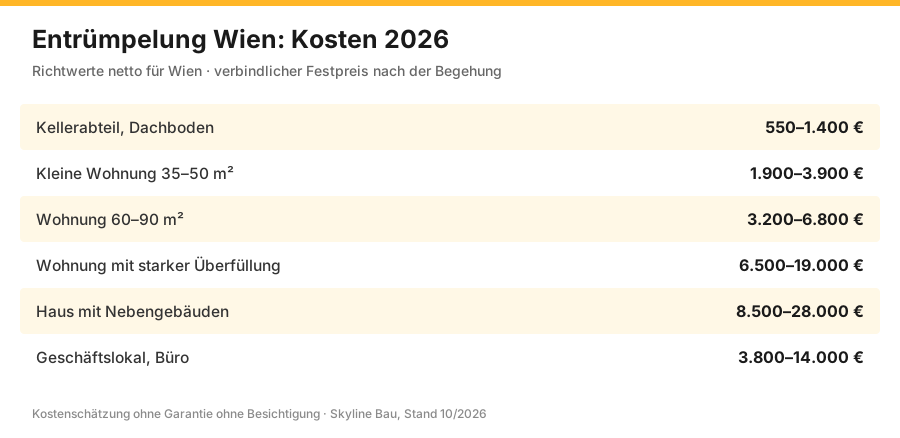
House clearance Vienna: costs 2026
| Property | Scope | Price net | Duration |
|---|---|---|---|
| Cellar compartment, loft | 5–15 m³ | 550–1.400 € | half a day |
| Small flat 35–50 m² | normally furnished | 1.900–3.900 € | 1 day |
| Flat 60–90 m² | normally furnished | 3.200–6.800 € | 1–2 days |
| Severely overfilled flat | Hoarding situation | 6.500–19.000 € | 2–5 days |
| House with outbuildings | Cellar, loft, garage, garden | 8.500–28.000 € | 3–8 days |
| Shop premises, office | Fittings, stock, equipment | 3.800–14.000 € | 1–4 days |
How the price is made up
| Item | Unit | Price net | Share of total price |
|---|---|---|---|
| Clearance crew labour | hour and person | 58–78 € | 40–55 % |
| Skip for mixed waste, 7 m³ | pc. | 480–690 € | 20–35 % |
| Skip for bulky waste, 10 m³ | pc. | 620–880 € | – |
| Small van per load | Trip | 260–450 € | cheaper than a skip for small quantities |
| Carrying without a lift | Storey | Surcharge 8–15% | per storey |
| Long carrying distance over 30 m | lump sum | 250–600 € | Inner courtyards, passageways |
| Separate disposal of hazardous materials | by type | from €120/unit | Paints, oils, batteries, fluorescent tubes |
| Old electrical appliances | pc. | 0–65 € | fridges and freezers cost more |
| Broom-clean handover | lump sum | included in the price | – |
| Final clean instead of broom-clean | m² | 4–7 € | via our partner company |
Why two quotes can differ so much
| Factor | Low cost | High cost | Difference |
|---|---|---|---|
| Storey and lift | Ground floor or lift up to the door | fourth floor without a lift | up to 60% more |
| Parking spot for the vehicle | directly in front of the building | 50 m away, one-way street, no loading allowed | 250–600 € |
| Composition | Furniture, household goods, sortable | Mixed waste, hazardous materials, special waste | significant |
| Condition | accessible, orderly | overfilled, soiled, protective equipment required | factor of 2 to 4 |
| Time window | freely selectable | fixed date, weekend | 15–35 % |
| Valuables | none, everything goes | Review and handover agreed | more time, but value offset possible |
The third and fourth points explain why an inspection is genuinely necessary for a house clearance and not merely a courtesy: over the phone, nobody can tell whether a flat is "full" or whether the clutter has reached floor-to-ceiling. The difference between the two is several days and several thousand euros.
Deceased estates: the most common reason
A large share of house clearances in Vienna follows a death. For the bereaved, this is emotionally and organisationally demanding, and there are particular points worth knowing.
| Topic | What applies | How we handle it |
|---|---|---|
| Timing of the clearance | only after the probate proceedings (Verlassenschaftsverfahren) have concluded or with the consent of all heirs | we only clear after written authorisation |
| Personal papers | Documents, photos and letters may be important | are collected separately and handed over, not disposed of |
| Valuables | Jewellery, cash and savings books often turn up unexpectedly | find report, separate handover, recorded on request |
| Returning the flat | deadline is running, often from the end of the month | schedule accordingly, broom-clean handover |
| Landlord and property management | want condition and date agreed in advance | we handle the coordination on request |
A two-stage approach has proven itself in practice: first the relatives walk through the flat and mark what is to stay. Then we clear everything else. It takes a day longer and saves the phone calls that would otherwise come later.
Hoarder flats and severely overfilled properties
This is the most demanding case, and it differs from a normal clearance in almost every respect.
| Difference | Normal clearance | Severely overfilled |
|---|---|---|
| Access | Rooms accessible | clear walkways before work can begin |
| Protective equipment | Gloves | respiratory protection, protective suit, sometimes full protective gear |
| Vermin | rare | common, pest control before or after the clearance |
| Odour | not an issue | ozone or odour neutralisation afterwards |
| Building fabric | unchanged | floors, plaster and screed often damaged |
| Duration | 1–2 days | 2–5 days |
| Price | 45–85 €/m² | 110–260 €/m² |
With these properties, the work rarely ends with the last skip. Usually floors, wall junctions and sanitary areas are so damaged that repairs follow – and that is exactly where a clearance company stops and we can carry on: screed out, substrate repaired, new bathroom, surfaces restored. See flat refurbishment.
What happens to the material
Disposal is regulated in Vienna, and anyone who takes it seriously sorts on site rather than at the disposal site.
| Material | Route | Cost effect |
|---|---|---|
| Waste wood, uncoated furniture | Waste wood recycling | cheaper than mixed waste |
| Metal, iron | Scrap dealer | sometimes revenue rather than cost |
| Paper, cardboard | Waste paper | low cost |
| Old electrical appliances | Collection point, take-back scheme | free to minimal |
| Refrigeration and air-conditioning units | separate disposal because of the refrigerant | €35–65 per unit |
| Hazardous materials | Hazardous waste collection point | from €120 per unit |
| Rubble from strip-out work | separated, with proof of disposal | 85–180 €/t |
| Remaining household goods | Mixed waste | most expensive route |
For property managers and deceased estates, we supply the proof of disposal together with the invoice. This is more than a formality: anyone who has a flat cleared and cannot show where the material went has nothing to fall back on if questions are asked.
Value offset: when it pays off
Occasionally a flat contains items that have real value – antiques, high-quality furniture, tools, collections. There is only one reputable way to deal with this: the value is assessed together and deducted from the price in writing before the clearance begins.
- Joint review, not by us alone. Whatever is offset is stated in the quote.
- Offset as a deduction, not as a vague promise. A "we'll settle that later" is no basis.
- Realistic expectations: used furniture has practically no market value in Vienna; the exceptions are genuine antiques and designer pieces.
- Documents and keepsakes are never sold off but always handed over.
- Items found such as cash or jewellery belong to the client, not to the clearance company – we record this in writing.
If you receive a quote promising a large value offset across the board, ask which items are actually meant. In practice, it often comes to nothing, and the price was calculated that way from the outset.
How much material there really is
Most misjudgements in house clearance concern the volume. What looks like very little in a flat fills a skip surprisingly quickly. These figures help with estimating but do not replace an inspection.
| Contents | Volume | Equivalent to |
|---|---|---|
| Two-door wardrobe | about 1.5 m³ | one fifth of a 7 m³ skip |
| Complete living room | 6–9 m³ | one full skip |
| Kitchen with appliances | 4–6 m³ | plus old electrical appliances separately |
| Bedroom | 4–7 m³ | mattresses take up a lot of volume |
| Cellar compartment, normally filled | 5–10 m³ | often more than expected |
| Loft | 8–20 m³ | decades of accumulation |
| Flat 70 m², normally furnished | 18–28 m³ | three to four skips |
| Flat 70 m², severely overfilled | 40–80 m³ | six to eleven skips |
The last row explains the price range better than any description: between a normally furnished and a severely overfilled flat of the same size lies two to three times the volume – and with it, the disposal costs, labour time and trips.
A second point that is regularly underestimated: bulky, light items cost more than heavy, compact ones. A skip is charged by volume, not by weight. An old sofa, a slatted bed base and three mattresses fill half a skip and weigh next to nothing. That is why we dismantle things during clearance wherever it is quick – it saves real money, because one skip fewer is needed.
Skip or small van
There are two ways of taking the material away, and the dividing line is at around ten cubic metres.
| Option | When it is cheaper | Prerequisite | Costs |
|---|---|---|---|
| Small van, several loads | up to about 10 m³ | disposal site within reach | €260–450 per trip |
| Skip 7 m³ | from about 7 m³ | space to place it, permit if required | 480–690 € |
| Skip 10 m³ | for larger quantities | more space needed | 620–880 € |
| Roll-off skip exchanged several times | houses, hoarder properties | permanent placement space | per exchange |
In Vienna's densely built-up districts, the problem is often the space to put a skip, not the price. If no space is available, we work with vans in several loads – which is cheaper for small quantities anyway and avoids the permit needed to place a skip on public land.
What to clarify before clearance day
- Who is commissioning the work? Owner, property management, heir or tenant – the commission must come from the authorised person and be in writing.
- What is staying? Go through everything together beforehand, mark items or put them in one room. Anything not marked will be cleared.
- Access and keys: Who unlocks, who can be reached, is there a second key for the cellar?
- Parking spot: Apply for a no-stopping zone, clarify courtyard access – can the lift be used?
- Power and lighting: In empty flats, the electricity supply has often been disconnected – without light, we do not work in the cellar.
- Inform the neighbours: A notice in the building prevents most complaints, especially when the stairwell is in use all day.
- Follow-on work: If the flat is to be refurbished afterwards, we plan both in one go.
The penultimate point costs nothing and saves the most trouble. A clearance blocks the stairwell for hours, and anyone who turns up unannounced will have the first complaint lodged with the property management within an hour.
Price examples from practice
Total around €4,700 net, which works out at €69/m². Documents and photos were collected separately and handed over to the relatives.
Total around €12,400 net, which works out at €229/m². This was followed by refurbishment – screed, bathroom and painting – because the building fabric had been damaged after years under the accumulated clutter.
Why clearance and refurbishment belong together
After a clearance, you see for the first time what condition the flat is really in. In most cases, one of three pictures emerges: everything is fine and only painting is needed. Or the floors and bathroom have reached the end of their service life. Or there is damp and mould damage that was previously hidden behind furniture.
Anyone who only starts looking for a building company at that point loses two to six weeks. Anyone who commissions the clearance from a company that also carries out refurbishment gets an assessment at the same appointment and can move straight on. For property managers, this is the real reason to award both together – not the price of the clearance, but the time in between.
| Findings after clearance | Typical follow-on work | Order of magnitude |
|---|---|---|
| Walls yellowed, floor usable | Painting, silicone, minor repairs | 60–110 €/m² |
| Floor worn out, doors worn | New floors, doors, fittings | 110–220 €/m² |
| Bathroom and kitchen outdated | Upgrade with plumbing and tiles | 220–350 €/m² |
| Damp or mould | identify the cause, remediate | depending on findings |
| Screed damaged | Renewing the build-up | 120–220 €/m² |
Special cases that change the process
| Case | What is different | How we proceed |
|---|---|---|
| Flat still occupied, partial clearance | clear only certain areas | joint marking, written list, photos beforehand |
| Pets kept over many years | odour in screed and plaster | remove surfaces rather than paint over them, neutralisation |
| Water damage before the clearance | soaked material, risk of mould | dry first, then clear, see water damage restoration |
| Fire damage | soot on all surfaces, special waste | protective equipment, separate disposal, photo documentation for the insurer |
| Collections and archives | the value may lie in the quantity | review with the client, handover instead of disposal |
| Listed building | built-in fixtures may be protected | clarify before removal what has to stay |
| Clearance with access only via the courtyard | no vehicle access, long carrying distances | small equipment, temporary storage in the courtyard, more staff |
The third case is the most common reason for queries: after water damage, people want the soaked furniture gone quickly. Technically, the correct order is the reverse – measure and dry first, then clear, because otherwise the moisture stays in the screed and plaster and the subsequent renovation is built on a wet substrate.
Environment and proof: what lies behind disposal
In Austria, waste management is regulated, and commercial clearances are subject to documentation requirements. For you as the client, this means two things: you receive confirmation of where the material went, and you can be certain it was not dumped on the edge of town.
- Separation at source. Waste wood, metal, paper, electrical items and hazardous materials are separated during clearance, not only at the disposal site.
- Registered disposal partners. Material is delivered to authorised waste handlers, not to whoever is cheapest.
- Proof of disposal with the invoice. Quantity, type, receiving facility – the relevant document for property managers and deceased estates.
- Reuse before disposal. Anything usable that the client releases goes to social organisations rather than into the skip.
- No temporary storage in the stairwell. This sounds obvious, yet in practice it is the most common cause of complaints during clearances.
The fourth point is worth asking about: social supermarkets and charitable organisations in Vienna are happy to accept well-kept furniture, household goods and tools. It costs nothing extra, reduces the number of skips and, after a death, is a more comforting thought for many relatives.
What you get at the end
- Cleared, broom-clean property, with a final clean by our partner company on request.
- Photos before and after the clearance, suitable for property management, landlord or probate proceedings.
- Proof of disposal stating quantity, type and receiving facility.
- Record of items found, if valuables or documents have turned up.
- Assessment of the condition: what needs doing after the clearance, with an indication of scale – so you can carry on planning straight away.
- Itemised invoice, not a lump sum without a breakdown.
The penultimate point is the one other clearance companies cannot deliver, because they do not build. For property managers, it is often worth more than a few per cent off the clearance price: on the same day, you know whether the flat can be let again in two weeks or whether a bathroom and a floor stand in the way.
Who has properties cleared – and why
The occasions vary widely, and they lead to different requirements in terms of process and documentation.
| Client | Typical occasion | What matters |
|---|---|---|
| Relatives | Deceased estate | handling of documents, photos and keepsakes, sensitivity in the process |
| Property manager | Return of the flat, eviction | deadline, documentation, seamless transition to refurbishment |
| Owner | Sale or new letting | speed, broom-clean handover, predictable costs |
| Tenant | Moving out, relocation | date for handing back, what stays and what goes |
| Businesses | Closing a site, conversion | data storage media, equipment, business operations, proof of disposal |
| Adult representation (Erwachsenenvertretung) | Move into care | valuables, written record, coordination with the court |
The last case calls for particular care: under adult representation, the representative is accountable. We therefore always work with photo documentation, a record of items found and proof of disposal here – not because we are suspicious, but because the client has to present these documents.
Scheduling: what is realistic
| Step | Duration | What delays it |
|---|---|---|
| Arrange inspection | 1–5 working days | access, keys, availability |
| Quotation | 1–2 working days | queries about scope and approvals |
| Apply for a no-stopping zone | several working days' notice | processing time, so submit early |
| Clearance | 0.5–5 days | volume, storey, condition |
| Subsequent refurbishment | 1–4 weeks | scope, material availability |
If you have to hand back a flat at the end of the month, you should start with the inspection at least three weeks beforehand. That sounds generous, but it is not: the no-stopping zone, finding a date with everyone involved and clarifying what is to stay usually take two weeks together – the clearance itself is the shortest part.
How to recognise a reputable quote
House clearance is a sector with major differences in quality. These seven points separate a reliable quote from a figure given over the phone:
- Inspection before the price. Anyone who names a fixed price without an inspection either calculates very high or charges extra on clearance day.
- Itemised breakdown: labour, skips, disposal, surcharges. A lump sum without a breakdown cannot be compared.
- Proof of disposal promised. Anyone who does not offer it should explain where the material goes.
- Handling of items found agreed in writing. Valuables and documents belong to the client – this belongs in the quote, not in a matter of trust.
- Protective measures included: covering the stairwell, lift and doors.
- Clear final condition: broom-clean or professionally cleaned – a difference of several hundred euros.
- Insurance: valid public liability insurance, with proof on request.
A quote that contains all of this looks more extensive and is often above the cheapest price. On the final bill, it regularly turns out cheaper, because the items listed there come as extra charges from the other company on clearance day – and by then there is no bargaining position left, because the crew is already standing in the stairwell.
What the clearance does not include
To avoid misunderstandings, here are the limits: we clear and dispose of household goods, furniture, fittings and stored items. Not included is the dismantling of permanently installed elements such as kitchens, sanitary fittings or floors – that is strip-out work and is calculated separately, usually as part of the refurbishment. Also not included are pest control, data media destruction and the storage of items; we organise all of these on request through the appropriate specialist firms.
This distinction is not small print but the reason our quotes for severely overfilled properties remain realistic: there, the clearance moves seamlessly into strip-out work, and anyone who puts both into one lump-sum price without having seen it is calculating blind.
Reducing costs: what actually helps
With house clearances, there are few genuine levers – and some that achieve nothing. What really works:
| Measure | Effect | Effort for you |
|---|---|---|
| Apply for a no-stopping zone in good time | shorter carrying distances, fewer hours | one application with notice |
| Sort in advance what is easy to sort | paper, metal, electrical items stacked separately | a few hours |
| Pass on usable items | less skip volume | organise collection |
| Bundle several properties | travel and set-up time are shared | coordinate dates |
| Keep the date flexible | schedule the clearance for a quieter week | none |
| Clearance and refurbishment together | no second call-out, no vacancy in between | one decision |
What achieves little, on the other hand, is carrying away a few boxes yourself beforehand. The price depends on the total volume and the number of trips, not on the last five per cent. Anyone who spends two days clearing by themselves and still needs three skips afterwards has invested time and saved hardly any money.
To be honest, the same applies to trying to negotiate the price without changing the scope: in a clearance, labour and disposal fees are the two big blocks, and neither is really negotiable. Realistically, the price moves through the points in the table above – or not at all.
House clearance and refurbishment in one contract
For property managers and owners, this is the real reason to have a clearance done by a building company rather than a pure clearance firm. The process then looks like this:
The time saved lies between steps two and four. If a contractor for the refurbishment is only sought after the clearance, it usually takes two to six weeks in Vienna before work starts – inspections, quotes, finding dates. When both are awarded together, work begins the day after the clearance.
Calculated for a 60-square-metre flat with a monthly rent of 900 to 1,300 euros, this means: four weeks saved equal roughly one month's rent. That is usually more than the difference between the cheapest and the most thorough clearance quote. This is why we calculate clearance and refurbishment together from the start and show both parts separately, so you can see what goes where.
The process
The point most often underestimated in Vienna is the no-stopping zone. Without a reserved space in front of the building, the vehicle stands fifty metres away and every trip takes three times as long. The application needs notice, which is why it belongs in the scheduling and not on clearance day.
For property managers
When flats are returned, estates are settled or evictions take place, what counts is not the lowest price per square metre but predictability. What we offer for this:
| Service | What this means |
|---|---|
| Fixed terms | price list by property size and condition, without an individual quote for each flat |
| Inspection within five working days | with a framework agreement, also on the day of return |
| Clearance and refurbishment from a single source | cleared, refurbished, handed over broom-clean or professionally cleaned |
| Documentation | Photos before and after the clearance, proof of disposal |
| Record of items found | for valuables and documents |
| One contact person | for all properties, including several at once |
The third point is the real difference compared with a pure clearance firm: after the clearance, it is usually clear that floors, paintwork or the bathroom need renewing. If a second company has to be found for this, weeks go by – and every week of vacancy costs around 225 to 325 euros in rent for a 60-square-metre flat.
Eviction and court-ordered clearance
Court-ordered clearances follow their own procedures. In construction terms, the work is the same; in organisational terms, it is not.
- Date set by the bailiff, not by our calendar.
- Duty of safekeeping: items often may not be disposed of immediately but must be put into storage – this is the biggest difference in the costing.
- Recording of the cleared inventory, usually with photographs and in list form.
- Lock replacement at the same appointment, so the flat is secured.
- Billing to the client, not to the previous occupant.
Because storage has a major effect on the price, we clarify beforehand whether items are to be stored or disposed of. This is usually set out in the eviction order and is not at the discretion of the company carrying out the work.
Common mistakes
| Mistake | Why it happens | Consequence |
|---|---|---|
| Commissioning a lump sum by phone | it has to be quick | price does not match the volume, extra charges on clearance day |
| Throwing everything into mixed waste | separating takes time | highest disposal fee, often several hundred euros more |
| No no-stopping zone arranged | gets forgotten | long carrying distances, longer duration, surcharge |
| Clearing before the heirs' status is settled | pressure from the tenancy deadline | legal risk for everyone involved |
| Throwing away documents along with everything else | treated as waste paper | loss of papers that are needed later |
| Not covering the stairwell | saves ten minutes | scratches and damage, disputes with the management |
| No photos before the clearance | nobody thinks of it | impossible to prove later what was there |
| Clearance without planning what comes next | refurbishment awarded later | weeks of vacancy between the two steps |
What we carry out ourselves
| Service | Execution |
|---|---|
| Clearing, carrying, loading, transport | our own staff and vehicles |
| Separation and disposal with proof | handled by us via authorised waste handlers |
| Removal of permanently installed elements | carried out by us as part of the refurbishment |
| Refurbishment after the clearance | carried out by us, regulated trades via partners |
| Pest control | authorised specialist firm, coordinated by us |
| Final clean | partner company from the cleaning sector |
| Storage in eviction cases | storage partner, costs shown transparently |
This division is set out in every quote. For you, the contact person stays the same, even if two other firms are involved along the way – coordination is part of the service and is not charged separately.
Scope
| Your project | Matching page |
|---|---|
| Refurbishing a flat after clearance | Flat refurbishment |
| Stripping a flat back to the shell | Strip-out |
| Demolishing buildings or parts of buildings | Demolition |
| Clearing and converting shop premises | Converting commercial premises |
| Clearing and drying after water damage | Water damage restoration |
| Mould in the cleared flat | Mould remediation |
When you do not need us
For a single sofa or two boxes, the city's bulky waste collection or a small transport service is enough. We are worth it from a full cellar compartment upwards, for flats, for deceased estates that need documentation, and whenever building work is to follow the clearance.
Flat clearance in Vienna: estimating the costs yourself in advance
Whether a clearance is likely to land at the lower or upper end of the price range can be estimated fairly well with three questions, before anyone comes round.
- How full is the flat? Normally furnished means: wardrobes, beds, kitchen, clothing, a filled cellar. For this, the net guide values of €45 to €85 per m² apply. If rooms are filled to the ceiling or can only be walked through on narrow paths, expect €110 to €260 per m², because everything is sorted by hand and carried far more often.
- How far is it to the vehicle? Third floor without a lift, a long courtyard or a passageway the lorry cannot get through – these are the items that set the prices of two otherwise identical flats apart.
- Is there anything that has to be disposed of separately? Fridges and freezers, paints, batteries, rubble from earlier renovations, or files that must be destroyed with proof of destruction.
An example: a 70 m² flat, normally furnished, on the second floor with a lift, costs around €3,200 to €6,000 on these figures. Without a lift and with a long carrying distance, it will be more; with few contents, or if relatives collect some items themselves beforehand, less. That is exactly why we look at the flat before giving a fixed price – photos of all rooms including the cellar are enough for an initial estimate.
Applying for a no-stopping zone for a house clearance in Vienna
In most densely built-up districts, the parking space in front of the building is the real bottleneck on clearance day. If the lorry is parked three buildings down, the carrying time doubles. The solution is a temporary no-stopping zone, applied for at the municipal department responsible for traffic organisation, MA 46.
Three points matter. First, the lead time: the application has to be processed and the signs put up in good time before the appointment, so that vehicles parked there anyway may be removed. So plan for two weeks rather than two days. Second, the length: it depends on the vehicle and, for a skip, also on the placement area and room to manoeuvre. Third, the time: the application covers the period actually needed, and for clearances lasting several days, each day.
If there is a loading zone nearby or the vehicle can drive into the courtyard, a no-stopping zone is sometimes unnecessary. We clarify this at the inspection so you do not submit an application you do not need.
Clearance at the end of a tenancy: what counts at handover
Anyone handing back a rented flat generally has to return it cleared; what happens to built-in items such as the kitchen or wardrobes is governed by the tenancy agreement or an arrangement with the landlord. Clarify this in writing before the clearance, otherwise a kitchen the next tenant would have taken over ends up in the skip – or it stays put and you are charged for it later.
On handover day, a report with photos of every room, the meter readings and the complete handover of keys all help. If it turns out after clearing that walls, floors or doors have suffered, a refurbishment of the flat can follow directly, before the handover date falls through.
Frequently asked questions about house clearance in Vienna
What volume does a normal flat have?
Why does bulky cost more than heavy?
Skip or van – which is cheaper?
What happens if there is water damage before the clearance?
Can usable items be donated?
Are items stored temporarily in the stairwell?
Will I get an assessment of the flat's condition?
What needs to be considered where pets have been kept for years?
Do you also clear parts of occupied flats?
What does it cost to dispose of fridges and freezers?
How much does a flat clearance cost in Vienna?
Why do quotes differ so much?
Do you charge by the cubic metre or a flat rate?
Is disposal included in the price?
What happens to valuables that are found?
Are documents and photos thrown away?
When can a property be cleared after a death?
Can you offset the value of valuable items?
How long does a clearance take?
Do I need a no-stopping zone?
Is the stairwell protected?
What does broom-clean mean?
Can you also clear hoarder flats?
What should be done about vermin?
Do you also handle evictions?
Do you also clear shop premises and offices?
Will I receive proof of disposal?
Can clearance and refurbishment be commissioned together?
How quickly can you come?
Do you also work outside Vienna?
What does it cost to clear a 70 m² flat in Vienna?
How far in advance does a no-stopping zone have to be applied for in Vienna?
Do I have to remove the kitchen when handing back a rented flat?
Related services
Cleared? Then all that is missing is the final clean.
After the clearance, our partner company Bling Premium Reinigung takes care of the final clean – windows, bathroom, kitchen, floors, ready for handover. More at bling-bling.at.
Send enquiry
Enquire directly here — fixed-price quotation free of charge. Skyline Bau replies within 2 working days.
Ready for your house clearance in Vienna?
Write to us directly on WhatsApp — send photos. Reply within 2 working days.
Note: Skyline Bau is the brand name of the construction and renovation division of Bling Bling GmbH and not a separate legal entity. The sole contractual partner is Bling Bling GmbH. Bling Bling GmbH is a restricted building trade business under § 99 GewO (Austrian Trade Regulation Act) and not a licensed master builder (konzessionierter Baumeister). Under § 99 (5) GewO, the title „Baumeister“ (master builder) is reserved for businesses licensed under § 94 no. 5 GewO. Regulated trades — master builder services, structural engineering, gas and plumbing, electrical engineering — are carried out exclusively by authorised, licensed partner firms.