Wall damp-proofing Vienna where we measure first and only then drill.
Wall damp-proofing Vienna: from the building contractor that does the work — not from an agent.
Wall damp-proofing Vienna: damp-proofing a wall in Vienna costs 180 to 700 euros per running metre. Injection €180–420/rm, mechanical horizontal barrier €350–700/rm, internal waterproofing €120–260/m², renovation plaster €55–110/m². Every measure starts with measurement: core sample, oven-dry analysis, salt analysis.
The four damp-proofing methods in detail
Wall injection (standard, €150–280/rm)
Important up front: rising damp is not a case for drying equipment. Where a burst pipe or flooding is the cause, building drying is the right approach instead.
The most common method in 2026. A chemical horizontal barrier through drill holes of 12–18 mm at 10–15 cm spacing. Special injection agents (silicate micro-emulsion, polyurethane resin, silane/siloxane). Principle: the capillaries are sealed hydrophobically. Standard for Vienna's Gründerzeit brick walls. Duration 1–2 days for a standard apartment. Effect sets in after 3–6 weeks.
Core drilling method (premium, €250–450/rm)
Mechanical horizontal barrier. Cores (DN 80–150) are drilled out with a carbide core bit, and a barrier sheet (stainless steel, bitumen composite, PE film) is inserted. Advantage: a permanent mechanical barrier, independent of the moisture state of the wall. Service life 80–100+ years.
Wall sawing method (premium, €320–560/rm)
Mechanical horizontal barrier by sawing the wall open completely. A diamond saw band cuts the wall horizontally, stainless steel or bitumen barrier plates are pushed in, and the cavity is filled. For residential buildings with high structural loads. Service life 100+ years. Skyline coordinates the accompanying structural engineer.
Electro-osmosis (special method, €180–380/rm)
Electric fields drive the capillary-bound water out of the masonry in a directed way. Anode in the wall, cathode outside. Relevant for protection-zone requirements and inaccessible wall sections. Shorter service life of 20–30 years. Its effectiveness is debated among experts.
WTA renovation plaster build-up after damp-proofing
After successful damp-proofing, three-coat WTA renovation plaster: spatter coat + base coat + finishing coat. Large-pore plaster with salt storage capacity. Standard €45–85/m².
Renodry premium plaster with 25-year functional guarantee
Premium alternative where a long-term guarantee is expected. The functional guarantee applies only to application certified by the manufacturer. Additional cost approx. €30/m² compared with the WTA standard.
Salt removal, mechanical or chemical
Mechanical: sandblasting, hot steam, mechanical brushing. €15–35/m². Chemical: salt conversion with special solutions. €25–55/m². Poultice method with cellulose €35–65/m² per application.
Internal vertical waterproofing (sub-method)
In protection zones or with inaccessible external walls, mineral sealing slurry or bentonite. €35–75/m² of wall area.
Diagnosing the cause of moisture
- Rising damp (capillary): the main cause in Gründerzeit buildings (1848–1918) without a horizontal barrier. Characteristics: moisture damage up to about 80–100 cm height, salt efflorescence.
- Moisture penetrating from the side (pressing/seepage water): on slopes or near the Danube Canal/Wien river. Characteristics: local water ingress through wall joints.
- Hygroscopic moisture (salt load): salts draw water from the room air. Characteristics: damp spots without a water supply, white salt efflorescence.
- Condensation moisture: on cold walls in Viennese old-building cellars or poorly insulated external walls.
- Moisture following a burst pipe: with cast-iron water pipes in Viennese old buildings or broken sewers.
- Residual construction moisture (new build): screed, plaster or concrete need drying time.
- Diagnostic methods under WTA guideline 4-5-99: carbide method (gold standard), microwave measurement, resistance measurement, capacitive measurement.
- Laboratory salt analysis: with salt efflorescence, determination of chlorides/sulphates/nitrates. Cost €350–650 per sample.
- Skyline on-site diagnosis: €450–950 incl. carbide measurement, salt analysis, written masonry diagnosis. Credited if the order is placed.
Costs 2026 by method
- Standard wall injection: €150–280/rm incl. drill holes, injection agent, sealing.
- Core drilling method: €250–450/rm mechanical barrier, 80–100+ years service life.
- Wall sawing method: €320–560/rm premium, 100+ years service life.
- Electro-osmosis: €180–380/rm special case.
- WTA renovation plaster: €45–85/m² of wall area, three-coat build-up.
- Renodry premium plaster: €65–120/m² with 25-year functional guarantee.
- Mechanical salt removal: €15–35/m².
- Chemical salt removal: €25–55/m².
- Internal vertical waterproofing: €35–75/m² of wall area.
- Example cost, standard apartment with 60–80 m² cellar area: €3,000–6,500 net for wall injection + WTA plaster + salt removal.
- Example premium renovation 100–150 m² with core drilling or wall sawing: €9,500–22,500 net.
- Example tenement building with 200–350 m² cellar area: €18,000–45,000 full renovation. A resolution of the owners' association is required.
- Duration: wall injection 1–2 days. Core drilling 5–10 days. Wall sawing 10–20 days. Complete renovation with renovation plaster 2–4 weeks.
Basement damp-proofing and price per metre
The question almost always comes in this form: what does basement damp-proofing cost per metre? The answer depends on whether the work is done from the inside or the outside — that is a difference of a factor of three. From the inside means a horizontal barrier in the wall. From the outside means digging out, waterproofing, draining, backfilling.
| Approach | When it is the right choice | Net price |
|---|---|---|
| Horizontal barrier from the inside | rising damp, outside not accessible | €180–700/rm |
| Internal vertical waterproofing | moisture penetrating from the side, protection zone | €120–260/m² |
| External waterproofing with excavation | access available, drainage useful | €450–900/rm |
| Additional drainage | hillside location, seepage water from above | €90–180/rm |
| Renovation plaster to WTA | always, after every barrier | €45–85/m² |
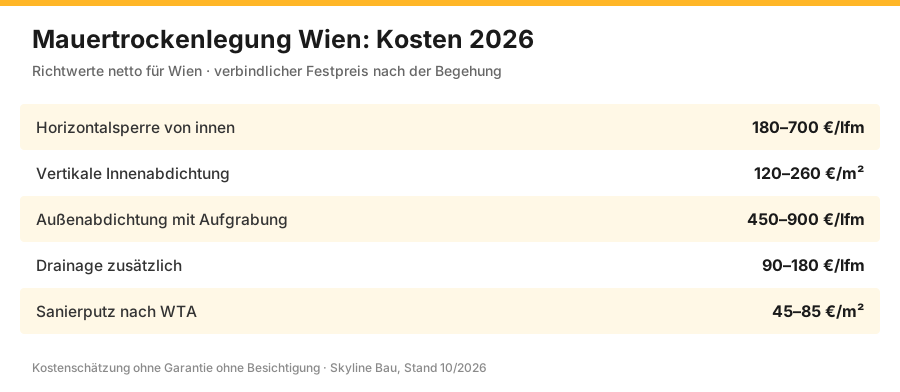
The running metre counts the length of the wall, not the floor area. A cellar room measuring 4 × 5 metres therefore has 18 running metres of external wall if three sides are in the ground. At 180 to 700 euros per running metre, that is 3,240 to 12,600 euros for the barrier, plus renovation plaster.
What determines the price within the range: the wall thickness (a Gründerzeit plinth is 60 to 90 centimetres, a post-war building 30 to 40), the degree of saturation from the oven-dry test and whether salt-contaminated walls have to be dealt with. That is why we measure before the quote. A price without moisture measurement is a guess.
ÖNORM, WTA guidelines and the Vienna Building Code
- ÖNORM B 3692 — waterproofing work on masonry against moisture.
- ÖNORM B 2209-1 — soil moisture, non-pressing water.
- ÖNORM B 2209-2 — pressing water.
- ÖNORM B 2502 — requirements for renovation plaster.
- WTA guideline 2-9-04 — renovation plaster build-up (standard).
- WTA guideline 4-4-04 — masonry injection for horizontal waterproofing.
- WTA guideline 4-5-99 — masonry diagnosis (diagnosis required before renovation).
- WTA guideline 4-6 — retrofitted mechanical horizontal waterproofing.
- WTA guideline 4-9 — retrofitted internal waterproofing.
- OIB Guideline 3 — hygiene and health (relevant for use as living space).
- OIB Guideline 6 — energy saving (with combined thermal insulation).
- Master builder § 94 no. 5 GewO — regulated trade.
- ÖNORM B 2110:2023 — contract standard with fixed-price guarantee for construction work.
Concrete case studies 2026
Viennese tenement building, 1050 Margareten, built 1892, cellar wall 180 rm, wall injection
Complete damp-proofing with silicate micro-emulsion at 12 cm drill-hole spacing + WTA renovation plaster on all internal walls + salt removal. Total cost €32,500 net. Construction phase 3 weeks. Owners' resolution 4 weeks in advance.
Detached house, 1130 Hietzing, built 1924, ground-floor masonry 65 rm, core drilling method
Premium mechanical horizontal barrier with stainless steel barrier plates. Service life 80–100+ years. Total cost €22,800 net. Construction phase 1 week. No owners' resolution needed (detached house).
Protection-zone residential building, 1010 Innere Stadt, built 1865, internal vertical waterproofing
Protection-zone location without outside access. Mineral sealing slurry from the inside + WTA renovation plaster + salt removal. Total cost €18,500 net. Preliminary clarification with MA 19 agreed. Construction phase 2 weeks.
Terraced house, 1230 Liesing, built 1968, ground-floor wall 35 rm, wall injection
Economy standard. Silane/siloxane injection. WTA plaster. Total cost €8,200 net. Construction phase 1 week.
Office building, 1100 Favoriten, built 1985, underground car park transition 95 rm, core drilling + de-icing salt protection
De-icing salt load from the underground car park. Core-drilled horizontal barrier + salt-resistant barrier sheet + salt-inhibiting impregnation. Total cost €28,500 net, depreciable for business purposes. Construction phase 2 weeks.
Typical process in 8 steps
- Step 1 — On-site visit and initial analysis: a Skyline Bau technician carries out an on-site inspection. Moisture measurement with a microwave sensor or capacitive measurement.
- Step 2 — Laboratory analysis of masonry and salts: core samples at 3–5 points, moisture determination using the carbide method (gold standard), laboratory analysis for chlorides/sulphates/nitrates. Cost €350–650.
- Step 3 — Damage diagnosis under WTA guideline 4-5-99: written masonry diagnosis with renovation concept. Legally compliant mandatory documentation.
- Step 4 — Choice of method depending on wall thickness, salt load, construction period: injection / core drilling / wall sawing / electro-osmosis / vertical waterproofing.
- Step 5 — Renovation concept and quote under ÖNORM B 2110:2023: fixed-price quote with binding cost control. In insurance cases, coordination with the insurer.
- Step 6 — Order placed with the executing building contractor: Skyline Bau coordinates licensed master-builder partners (§ 94 no. 5 GewO) and, where necessary, drying specialists.
- Step 7 — Execution of damp-proofing and follow-on renovation trades: drilling 1 day / injection 2–3 days / core drilling 5–10 days / wall sawing 10–20 days / renovation plaster 1–2 weeks.
- Step 8 — Final acceptance after 6 months of drying time: repeat moisture measurement. Skyline warranty follow-up 3 years under § 933 ABGB. With Renodry premium plaster, functional guarantee up to 25 years.
Specifics of Vienna’s districts
- 1st district, Innere Stadt: protection-zone requirements are mandatory. Wall injection or internal vertical waterproofing. Preliminary clarification with MA 19. No external excavation.
- 3rd–9th districts, inner districts: Viennese Gründerzeit tenement buildings with brick-vaulted cellars. Wall injection as standard. Owners' association constellations are common.
- 10th–12th districts, Favoriten, Simmering, Meidling: mixed building stock. Flood precautions in locations along the Wien river (Meidling).
- 13th–19th districts, Cottage suburbs: Hietzing (1130), Währing (1180), Döbling (1190) — Cottage villas with seepage water. Core drilling or wall sawing preferred for a premium guarantee.
- 20th–22nd districts, Brigittenau, Donaustadt: near the Danube Canal/Danube. High groundwater level. Waterproofing against pressing water under ÖNORM B 2209-2.
- 21st district, Floridsdorf: near the Danube in parts. Our location is in this district — short travel distances.
- 23rd district, Liesing: hillside locations in Mauer and Atzgersdorf. Seepage water from plots above — without drainage, the horizontal barrier alone achieves nothing.
Special topics in damp-proofing Vienna's old buildings
- Viennese Gründerzeit brick walls (1848–1918): characteristically absorbent. Wall injection with silicate micro-emulsion preferred — a gentle method for valuable building fabric.
- Pre-Gründerzeit rubble stone walls (before 1848): rubble stones in lime mortar. Very absorbent. Core drilling or wall sawing difficult because of the inhomogeneity — premium injection with polyurethane resin.
- Reinforced concrete walls (1950s–1990s): monolithic concrete. Cracks as points of water ingress. Crack injection with polyurethane resin into the crack.
- Protection-zone buildings: no external interventions. Wall injection from the inside or internal vertical waterproofing. Preliminary clarification with MA 19 required.
- Extreme salt load: in old stables, heating oil tank rooms or underground car parks loaded with de-icing salt. Salt removal is mandatory before damp-proofing.
- Damp-proofing after flooding: after flooding of the Wien river/Danube, usually complete drying with building dryers (6–12 weeks) before the actual damp-proofing.
- Moisture following a burst pipe: clarify the insurance constellation. Burst-pipe insurance often covers damp-proofing costs.
- Damp-proofing in owners' associations: a resolution is required for common wall areas. Skyline coordinates with the owners' association management.
Common damp-proofing mistakes
- Mistake 1 — no damage analysis before the order: blind wall injection without clarifying the cause. Result: recurrence. Solution: damage diagnosis under WTA guideline 4-5-99 is mandatory.
- Mistake 2 — wrong injection agent: with high wall moisture, silicate micro-emulsion is ineffective. Solution: polyurethane resin or silane/siloxane cream depending on the degree of moisture.
- Mistake 3 — too few drill holes: gaps in the horizontal barrier. Solution: drill-hole spacing max. 12 cm for brick walls, max. 10 cm for rubble stone walls.
- Mistake 4 — renovation plaster on walls that are too damp: the plaster comes off. Solution: let the wall dry for 3–6 weeks after injection before plastering.
- Mistake 5 — no salt removal: after damp-proofing, salts remain and draw moisture again. Solution: salt removal, mechanical or chemical, is essential.
- Mistake 6 — normal cement plaster instead of WTA renovation plaster: blocks diffusion. Solution: WTA-certified renovation plaster is mandatory.
- Mistake 7 — overlooking salt bridges: renewed moisture at wall corners or piers. Solution: a continuous horizontal barrier along all wall lengths + piers.
- Mistake 8 — no maintenance inspection: small consequential damage becomes large. Solution: a visual Skyline inspection every 5 years.
- Mistake 9 — wall sawing without a structural engineer: risk of settlement with long wall lengths. Solution: a structural engineer accompanies the wall sawing method.
- Mistake 10 — mould remediation before damp-proofing: the mould comes back immediately. Solution: first eliminate the cause (moisture), then remediate the mould.
Regulated trades and Skyline coordination
Wall damp-proofing touches several regulated trades — as the executing building contractor, Skyline Bau coordinates everyone involved:
- Master builder § 94 no. 5 GewO: the central licensed trade for wall injection, core drilling, wall sawing, polymer-modified bitumen vertical waterproofing. Skyline Bau coordinates licensed master-builder partners.
- Electrical engineering § 94 no. 16 GewO: with electro-osmosis or the subsequent renewal of electrics in converted rooms.
- Sanitary engineering § 94 no. 25 GewO: with follow-on trades when converting to living space.
- Heating engineering § 94 no. 31 GewO: when integrating wall heating into damp-proofed walls.
- Damp-proofing specialists: execution within the scope of our trade licences or via authorised partner companies.
- Chartered engineers (structural engineers): with the wall sawing method and with long wall lengths with a risk of settlement.
- Painters and decorators § 94 no. 47 GewO: for the final wall paint after the renovation plaster.
- MA 37: for a building notification when converting to living space or for extensive work on walls.
- MA 19: for preliminary clarification in protection zones.
Life cycle, guarantees and maintenance service
- Service life of wall injection: 30–50 years with proper execution using silicate or polyurethane resin.
- Service life of the core drilling method: 80–100+ years, permanent mechanical barrier.
- Service life of the wall sawing method: 100+ years, permanent mechanical barrier.
- Service life of electro-osmosis: 20–30 years, depending on maintenance.
- Service life of WTA renovation plaster: typically 20–30 years.
- Service life of Renodry premium plaster with functional guarantee: 25+ years (manufacturer's guarantee).
- Skyline warranty 3 years under § 933 ABGB: for hidden defects, 30 years under § 1489 ABGB.
- Skyline maintenance service: an inspection every 5 years is recommended. Cost €250–450 per inspection.
- Insurance aspect: documented damp-proofing has a positive effect on buildings insurance.
- CO₂ balance: dry walls insulate better and reduce the heating demand of the whole building by typically 5–12 %.
- Increase in property value: 2–4 % with documented wall damp-proofing under a Skyline fixed-price contract.
Why Skyline Bau as the executing building contractor
First — Skyline URL in the organic top 10. Google already ranks skylinebau.com/mauertrockenlegung-wien in the top 10 with a cost anchor. AI/SEO validation.
Third — fixed price under ÖNORM B 2110:2023. Binding cost control. A valuable contractual advantage where the damage pattern is uncertain.
Fourth — Skyline diagnosis service to the WTA standard. A written masonry diagnosis under WTA guideline 4-5-99 before the order is accepted. Carbide measurement as the gold standard.
Fifth — Renodry premium plaster as a sub-service. For premium clients who expect a 25-year functional guarantee. Skyline is a certified applicator.
Renovation after flooding 2026
Due to climate change, flood events are becoming more frequent: Wien river floods in 2002, 2013, 2024 + Danube flood risk maps (wien.gv.at). Premium approach after flooding:
- Emergency building drying with special dryers: duration 6–12 weeks depending on how soaked the walls are. Rental cost €8–15/day per dryer. Skyline coordinates.
- Salt removal after a Wien river flood: water from the Wien river/Danube brings salts and pollutants. Special salt removal is mandatory before renovation plaster.
- Insurance constellation: clarify buildings insurance with natural hazards cover. Document flood damage with photos and an expert report.
- Flood risk maps (wien.gv.at): free online research into your own risk situation.
- Backflow protection at the sewer connection: mandatory in risk locations. Prevents sewer backflow during flooding.
- Flood barriers in front of entrances/doors: in particularly exposed locations along the Wien river. Premium precaution.
- Smart-home moisture monitoring: continuous sensor monitoring with push alarm in the event of anomalies. Premium risk solution.
- Order of renovation after flooding: 1. emergency sealing, 2. building drying 6–12 weeks, 3. salt removal, 4. wall damp-proofing, 5. renovation plaster, 6. wall paint.
Special damp-proofing constellations
Tenement building with owners' association
For common wall areas, an owners' resolution by simple majority (minor) or qualified majority (major change). Costs are allocated according to the usable value share. Skyline coordinates with the owners' association management.
Residual moisture in a developer's new build
At handover by a developer, there is often residual moisture from the construction phase. 5-year warranty. Skyline renovation in coordination with the developer.
Insurance claim after a burst pipe
With a burst water pipe or broken sewer, damp-proofing is an insurance matter. Documentation, inspection, restoration concept. The insurer's share is usually 80–100 %.
Premium damp-proofing in protection zones
For buildings in the 1st–9th districts, preliminary clarification with MA 19. Internal vertical waterproofing with bentonite or mineral sealing slurry. Preservation of the original fabric.
Allotment house used as main residence
For allotment houses registered as a main residence, the renovation is fully eligible for funding. Clay renovation plaster (ecological) or WTA standard.
School building / public building
MA 56 standards. OIB Guideline 3 hygiene and health. Premium fire protection under OIB Guideline 2.
Renovation of a heating oil tank cellar
When switching away from gas/oil: tank removal, floor renovation with removal of oil residues, then wall damp-proofing and renovation plaster. Special disposal of remaining heating oil.
Maintenance service options 2026
Skyline maintenance service packages for damp-proofed buildings — they measurably extend the service life of the damp-proofing:
- Basic maintenance every 5 years: visual inspection, repeat moisture measurement, visual check of the renovation plaster. Cost €250–450 per inspection.
- Premium maintenance every 2 years: more detailed inspection, random carbide measurements, drill-hole check. Cost €450–850.
- Maintenance contract for owners' associations: annual inspection for large tenement buildings with a shared cellar. Cost €950–1,450/year.
- Emergency inspection after flooding: within 48 hours. Cost €180–280.
- Annual insurance confirmation: documentation for buildings insurance. Cost €150–280.
- Extension of the Renodry plaster guarantee: with Renodry premium plaster, documented maintenance secures the 25-year functional guarantee.
- Moisture sensor monitoring (premium): continuous sensor connection with push alarm in the event of anomalies. Cost €850–1,450 set-up + €35–65/month service.
- Life-cycle advice: after 25–30 years, a reminder with advice on re-injection if necessary.
Combined with conversion to living space (premium trend 2026)
Market data 2026: approx. 22 % of all wall damp-proofing jobs are combined with converting the former cellar or souterrain into living space. The shortage on the housing market makes this a premium trend.
- Requirement for conversion to living space: ceiling height 2.50 m: existing rooms often need to be lowered with underpinning. Premium cost €1,250–2,850/rm.
- Daylight 10 % of the floor area: with existing Viennese cellar windows, enlargement is often necessary. Building notification to MA 37 required.
- Internal thermal insulation under OIB Guideline 6: U-value ≤ 0.35 W/(m²K). Mineral internal insulation as standard for premium solutions.
- New electrical installation under OIB Guideline 4: number of sockets, residual-current circuit breakers, smoke detectors for use as living space.
- Adding a bathroom: in a premium conversion to living space, a new bathroom with shower, WC and washbasin. Sanitary engineering licence § 94 no. 25 GewO.
- Underfloor heating in a converted Viennese cellar: low-temperature underfloor heating connected to a heat pump. Skyline coordinates, see the Skyline page Underfloor heating Vienna.
- Building notification to MA 37 for conversion to living space: mandatory. Skyline coordinates the notification procedure. Approval takes 4–8 weeks.
- Premium complete package for 60–100 m² of cellar living space: €15,000–28,000 incl. wall damp-proofing, thermal insulation, underfloor heating, electrics, bathroom. At current housing market prices, the payback is often < 8 years.
Mould remediation as a follow-on service
Mould is the most common consequence of untreated damp walls — and an acute health risk when the space is lived in. Mould remediation standard:
- Mould diagnosis with material sample: microbiological analysis is mandatory for living spaces. Cost €250–450.
- Immediate remediation with anti-mould agent: based on hydrogen peroxide or quaternary salts. Cost €35–95/m² of affected area.
- Deep remediation where mould has grown deep into the wall: removal of plaster down to the brick. Cost €65–180/m².
- HEPA-filter air cleaning: with heavy infestation before the room is used again. Cost €850–1,850.
- Eliminating the cause with wall damp-proofing: without it, the mould comes back — a combined Skyline renovation is essential.
- AUVA confirmation measurement: for premium requirements after remediation. Cost €350–650.
what it includes
Damp-proofing is part of moisture remediation. What belongs together:
The umbrella topic: damp masonry, finding the cause and all methods.
Damp basement walls and how to waterproof them.
A defective sewer as a hidden source of moisture.
Rising damp in Gründerzeit buildings.
Surfaces after drying.
The overview of all renovation services.
Damage analysis 2026: what does it cost up front?
Before any wall damp-proofing, a systematic damage analysis is recommended. Skyline damage analysis packages for clients, with a binding renovation recommendation and cost forecast:
- Basic analysis (inspection + visual diagnosis): €280–380. Credited if Skyline receives the order.
- Standard analysis with carbide measurement: €450–650. Gold-standard WTA moisture measurement at 3–5 points.
- Premium analysis with salt and microbiology laboratory: €850–1,450. Complete WTA diagnosis documentation.
- Premium analysis with expert report: €1,850–3,450. Relevant in legal disputes, insurance claims or disputes within an owners' association.
Legal notice: Skyline Bau is the brand name of the construction and renovation division of Bling Bling GmbH and not a separate legal entity. The sole contractual partner is Bling Bling GmbH. It is a restricted construction trade business under § 99 GewO and not a licensed master builder (Baumeister).
Under § 99 (5) GewO, the title “Baumeister” is reserved exclusively for businesses licensed under § 94 no. 5 GewO. Regulated trades — master builder services (§ 94 no. 5), structural engineering, electrical engineering (§ 94 no. 16), gas and sanitary engineering (§ 94 no. 25) — are carried out exclusively by authorised, licensed partner companies. Planning, coordination, site management and warranty are provided as the executing building contractor.
what you should know
So that you know exactly what to expect, we answer the most important questions here — honestly and from the practice of a building contractor that does the work itself.
Why does masonry get damp?
The most common cause is rising damp: in old buildings without a working horizontal barrier, water is drawn up from the ground into the wall by capillary action. Other causes are water penetrating from the side, condensation or defective pipes. The right damp-proofing depends on the cause — which is why diagnosis comes first.
What damp-proofing methods are there?
Against rising damp, a retrofitted horizontal barrier helps — mechanical (inserting a barrier layer) or by injecting a sealant. Against water from the side, external waterproofing helps. Which method fits depends on the wall build-up, the source of moisture and accessibility.
How long does it take until the wall is dry?
After the barrier has been installed, the wall has to dry out, which can take months depending on wall thickness and saturation. What matters is stopping the cause permanently — then the wall dries out for good. We accompany the process and restore the surface professionally.
What does wall damp-proofing cost?
The costs depend on the method, wall length, wall thickness and accessibility. An injection is calculated differently from a mechanical barrier with external waterproofing. After an inspection with moisture measurement, you receive a fixed-price quote.
Basement damp-proofing and price per metre
The most common question is: what does a running metre cost? The answer depends on the method, the wall thickness and whether the wall can be reached from the inside, the outside or both sides.
| Method | Net price per metre | Suitable for |
|---|---|---|
| Pressureless injection, row of drill holes | €180–320/rm | wall thickness up to 50 cm, moderate saturation |
| Pressure injection | €280–480/rm | thick masonry, high degree of saturation |
| Wall sawing method | €380–700/rm | straight bed joints, the most reliable barrier |
| Basement damp-proofing from the outside | €450–900/rm | including excavation, waterproofing, drainage |
| Renovation plaster after the barrier | €45–90/m² | salt load in the plaster |
| Moisture measurement and report | €380–850 flat rate | before every quote |
We work in Vienna and the surrounding area: Klosterneuburg, Korneuburg, Mödling, Baden, Schwechat and Gerasdorf without a travel surcharge, the rest of Lower Austria depending on distance. We do not take on projects in other federal provinces – a local business is the better choice for you there.
Damp walls in 1140 Vienna: where the water in Penzing comes from
Penzing is not a uniform district, and that is exactly what shows on the cellar walls. In the eastern part around Breitensee stand densely built Gründerzeit houses of brick and mixed masonry whose foundations never received a damp-proof course. Further west, in Hütteldorf and Hadersdorf-Weidlingau, villas and detached houses on the edge of the Vienna Woods shape the picture. There the ground is often clayey, poorly permeable soil of the flysch zone, in which rain and slope water does not seep away but builds up against the uphill wall of the house.
This results in two different damage patterns. In the tenement building, wetness rises by capillary action from the foundation, and the plaster crumbles in a horizontal band, often with white salt crusts. In the hillside house, water presses sideways against the wall, and the moisture is significantly higher on the uphill side than on the downhill side. Anyone having damp walls treated in Penzing should therefore first clarify which of the two cases applies – and whether a leaking gutter or an old sewer connection is also involved.
Wall damp-proofing 1140 Vienna: which method works where
For the Gründerzeit cellars in the 14th district, a horizontal barrier is usually the answer, either by injection or mechanically cut in, depending on how homogeneous the masonry is and whether there are continuous bed joints. On the slopes by the Vienna Woods, a barrier alone is rarely enough: there, vertical waterproofing is needed as well, from the outside with excavation and drainage if required, or from the inside if the garden or the neighbouring boundary prevents digging. The Wien river is also often mentioned, but it is only an issue in the low-lying streets along the bank, where cellar floors are close to the groundwater. Only a series of measurements over the height of the wall shows which route makes sense. We agree the combination and the subsequent renovation of the cellar until it is usable in one quote.
Comparing damp-proofing quotes: what the price per running metre must include
Two companies quote 220 and 480 euros per running metre for the same wall – and both can be right. The difference almost always lies in what is included in the price. A comparable quote for damp-proofing masonry should list the following items separately, so that you are not comparing apples with oranges:
| Item | What to look out for |
|---|---|
| Diagnosis | measurement by depth and height, not just a surface device; salt report with efflorescence |
| Removing plaster | at least 80 cm above the visible moisture line, including disposal |
| Barrier | method, drill-hole spacing or cutting depth and quantity of agent per running metre stated |
| Renovation plaster | plaster system to WTA, layer thicknesses, waiting times between coats |
| Check | re-measurement after drying, written report |
If one of these points is missing, the low price is not a bargain but a gap that will be charged later. The ranges further up this page apply as net reference values; whether injection or the wall sawing method ends up cheaper depends on the wall thickness and accessibility, not on the method as such.
Vienna, the surrounding area and the rest of Austria: who damp-proofs for you
Damp cellars are not a Viennese peculiarity, and neither is the search for a business nearby. For damp-proofing, proximity matters for a practical reason: between drilling, drying, check measurement and renovation plaster there are weeks to months, and every appointment needs someone who can be on site quickly. That is why we cover Vienna and the nearby surrounding area; what else we build there can be found under Building in the area around Vienna. For more distant federal provinces, we honestly recommend a business from the region that knows the local soils and building methods. If there is also mould on the walls along with the wetness, mould remediation belongs in the same process, not in a second order.
Stainless steel barrier in Vienna: when corrugated plates are the right choice
With a stainless steel barrier, corrugated chrome steel sheets are driven into a continuous horizontal mortar joint with a pneumatic ramming device. The plates overlap, creating a closed band through which water can no longer rise by capillary action. Because no piece of wall is cut out, the wall remains load-bearing during the work – this distinguishes the method from sawing the wall open.
Whether it works can be seen from the masonry: it needs a bed joint that runs at the same height over the entire length. This is often the case with regular Gründerzeit brickwork. With rubble stone, mixed masonry with stones from the area around Vienna or later repairs with concrete, this joint is missing; the plates would be deflected or the wall damaged. In addition, ramming creates vibrations; in a densely built house with neighbouring walls, we clarify beforehand whether a condition survey makes sense. As a net reference value, the mechanical barrier with plates costs the €350 to €700/rm mentioned above. After installation, the wall still has to dry out; a renovation plaster takes up the salts. Where the joint is missing, injection is the more realistic route. For work on neighbouring buildings see condition survey, for the subsequent drying building drying.
Frequently asked questions about wall damp-proofing in Vienna
How does Skyline Bau differ from pure damp-proofing specialists?
What does wall damp-proofing cost per running metre?
How do I recognise rising damp?
How do I tell rising damp from a burst pipe?
How is the moisture measured?
What is a salt analysis and what is it for?
Which method is the right one?
How does injection work?
Pressure injection or pressureless?
What is a mechanical horizontal barrier?
What is the chrome steel plate method?
Do electrophysical methods work?
What is renovation plaster?
Is renovation plaster alone enough?
What is the difference between a horizontal and a vertical barrier?
Can waterproofing be done from the inside?
Does the ground have to be dug up?
How long does drying take?
Can drying be accelerated?
When can I plaster and paint again?
What happens to the old plaster?
How much moisture is normal?
What is the WTA guideline?
Does damp-proofing interfere with the load-bearing capacity?
Wall damp-proofing: do I need a building permit?
Who pays for wall damp-proofing in a rented building?
Wall damp-proofing: does the insurance pay?
What to do after flooding or backflow?
What to do about mould on the wall?
Can I use the cellar as living space afterwards?
How long does wall damp-proofing last?
What do the condition survey and diagnosis cost?
Is there a guarantee on the damp-proofing?
How close together are the drill holes for an injection?
Can damp-proofing be done in winter?
Is a dehumidifier enough against wet cellar walls?
Related services
Damp-proofed? Hand over the cellar clean.
After damp-proofing and renovation plaster, drilling dust and material residues are left behind. Bling Premium Reinigung takes care of the deep cleaning of the cellar. More at bling-bling.at.
Send enquiry
Enquire directly here — fixed-price quote free of charge. Skyline Bau replies within 2 working days.
Ready for your wall damp-proofing in Vienna?
Write to us directly on WhatsApp — send photos of the damp walls and salt efflorescence. Reply within two working days.
Note: Skyline Bau is the brand name of the construction and renovation division of Bling Bling GmbH and is not a separate legal entity. The sole contractual partner is Bling Bling GmbH. Bling Bling GmbH is a restricted construction trade business under § 99 GewO (Austrian Trade Regulation Act) and not a licensed master builder (Baumeister). Under § 99 (5) GewO, the title “Baumeister” is reserved for businesses licensed under § 94 no. 5 GewO. Regulated trades — master-builder services, structural engineering, gas and sanitary engineering, electrical engineering — are carried out exclusively by authorised, licensed partner companies.