Work at height Vienna no scaffolding, no weeks of standing time.
Work at height in Vienna: from the contractor who does the work — not from an agent.
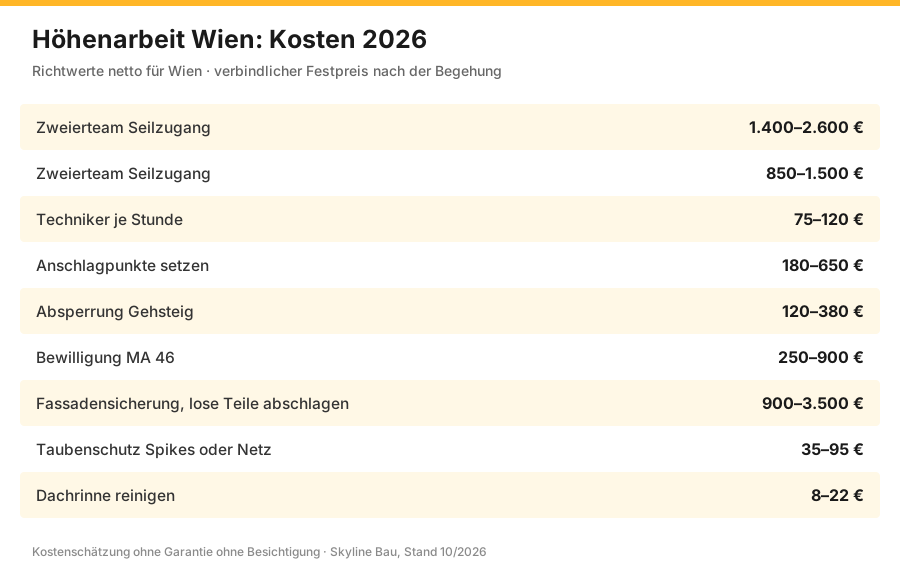
Work at height in Vienna: rope access work costs €1,400 to €2,600 per day for a two-person team. For localised work on facades, roofs and glass, it is often cheaper than scaffolding, which costs €8 to €25 per square metre per month and stands for weeks.
Work at height in Vienna: costs 2026
Guide prices net, as of 2026, binding after a site visit. Materials and disposal are added depending on the task.
| Service | Unit | Price net | What is included |
|---|---|---|---|
| Two-person rope access team | Day | 1.400–2.600 € | two technicians, ropes, anchor devices, safety system |
| Two-person rope access team | half a day | 850–1.500 € | for short jobs, minimum call-out |
| Technician per hour | h | 75–120 € | for additional hours during an ongoing job |
| Installing anchor points | pc. | 180–650 € | if no tested points are available |
| Pavement cordon | Day | 120–380 € | barriers, signage, banksman |
| MA 46 permit | lump sum | 250–900 € | application and fee for using the pavement |
| Facade securing, knocking off loose parts | lump sum | 900–3.500 € | tapping, knocking off, disposal, condition report |
| Pigeon deterrent spikes or netting | linear m | 35–95 € | material and installation at height |
| Gutter cleaning | linear m | 8–22 € | leaves, sludge, checking the downpipe |
| Glass cleaning at height | m² | 6–18 € | exterior, including frames |
Rope, aerial work platform or scaffolding
| Access | Costs | Strengths | Limits |
|---|---|---|---|
| Rope access | €1,400–2,600/day | fast, no standing time, inner courtyards accessible | localised work, heavy loads difficult |
| Aerial work platform | €480–1,200/day | fast, can carry materials | needs a set-up area and vehicle access, limited height |
| Facade scaffolding | €8–25/m² per month | work over large areas, several trades | erection and dismantling, permit, weeks of standing time |
| Suspended platform | depending on the project | long facade frontages | set-up is elaborate |
Total approx. €6,100 net. Scaffolding for the same facade, with erection and dismantling, permit and minimum standing time, would come to €9,000 to €16,000 – for securing work that is done in two days.
What work at height is used for
- Facade securing following an official complaint. Loose render, cornices and stucco elements are tapped and secured before they fall onto the pavement. The owner is liable for this.
- Localised facade repairs. Individual window surrounds, cracks, sheet metal flashings – without scaffolding for the entire frontage.
- Gutters and downpipes. Cleaning, repair, replacement of individual parts, including in inner courtyards with no vehicle access.
- Pigeon deterrents. Spikes and netting on cornices, windows and in inner courtyards.
- Glass and light wells. Cleaning and sealing of large glazed areas and rooflights.
- Inspection and condition report. Documenting the condition of the facade, chimney stack or roof junctions before a decision is made on renovation.
How a job is carried out
When rope access, when scaffolding, when an aerial work platform
The decision is not a matter of preference but of four questions: how long will the work take, how much material has to go up, what is access like from below, and will several trades be working one after another in the same place.
| Question | Favours rope access | Favours scaffolding |
|---|---|---|
| Duration of the work | hours to a few days | Weeks |
| Quantity of material | tools and small materials | pallets, insulation, render |
| Access from below | no set-up area needed | pavement or courtyard is occupied |
| Number of trades | one trade, localised | several, one after another |
| Inner courtyard, light well, confined location | usually the only option | often impossible to erect |
| Urgency | Deployment within days | lead time for permit and erection |
| Costs for a short job | considerably cheaper | erection and dismantling dominate |
| Costs for renovation over a large area | uneconomical | clearly cheaper |
What makes work at height in Vienna special
| Situation | Why it is common here | Solution on the rope |
|---|---|---|
| Narrow inner courtyards in Gründerzeit buildings (built 1848–1918) | no room for scaffolding or an aerial work platform | abseiling from the roof, access via the roof hatch |
| Pavement with heavy pedestrian traffic | closure is expensive and difficult to obtain | short cordon only below the work area |
| Party walls without access | neighbouring property cannot be entered | abseiling from your own roof edge |
| Cornices and stucco elements | loose parts above public land | tapping, securing, writing a condition report |
| Low-pitched roof surfaces | fall edge without a railing | protection via rope, no scaffolding needed |
| Pigeon infestation on cornices | widespread in dense urban areas | cleaning and deterrent system in one job |
The most common reason for a short-notice job is suspected loose facade elements. If render on a cornice visibly sounds hollow or a piece falls onto the pavement, a hazardous situation arises for which the owner is answerable. What counts then is not the most attractive solution but the fastest: cordon off, tap, remove loose parts, write a condition report – and afterwards decide calmly whether to renovate or put up scaffolding.
Safety: how work on the rope is done
Rope access is not climbing but a regulated working method with two independent systems. Anyone hanging from just one rope is doing it wrong.
| Element | Function | Rule |
|---|---|---|
| Working rope | carries the technician during work | its own anchor point |
| Safety rope | arrests the fall if the working rope fails | second, independent anchor point |
| Anchor points | connection to the building | tested and documented, assessed as load-bearing |
| Edge protection | protects the rope at wall edges | at every change of direction |
| Second person | supervision, rescue, ground safety | never work alone |
| Rescue plan | recovery from the rope | defined before work begins, equipment on site |
| Drop protection for tools | prevents objects from falling | every tool tethered |
| Ground cordon | protects passers-by | always below the work area |
| Prerequisite | What is required |
|---|---|
| Technician training | rope access qualification, refreshed regularly |
| Fitness | occupational health fitness for work at height |
| Equipment | inspected personal protective equipment, documented inspection intervals |
| Supervision | competent person on site |
| Risk assessment | for each job, in writing |
| Insurance | Public liability insurance with cover for work at height |
After the job, the documentation is part of the work: which anchor points were used, which area was cordoned off, what was found and what was done. For the owner, these documents are proof that they have fulfilled their duty to secure the building – and, if damage occurs, the difference between orderly handling and a liability problem.
Weather and season
| Condition | Impact | Approach |
|---|---|---|
| Wind | not permitted from moderate wind speeds upwards | postpone the job, decided at short notice |
| Thunderstorm | stop work immediately | descent, securing the area |
| Frost | icing on edges and ropes | only to a limited extent, material work usually not possible |
| Heat | strain on the technicians, hot facade | early hours of the day, shorter jobs |
| Wet conditions | slippery surfaces, rendering work not possible | inspection and cleaning work often still possible |
Because the wind decides at short notice, we plan work-at-height jobs with a fallback date. Cancellation happens at the latest on the morning of the job, and a date postponed due to the weather costs nothing. What remains plannable in Vienna: inspections and cleaning can be carried out almost all year round, while rendering and coating work only makes sense between roughly April and October.
Roof inspection on the rope
Steep Viennese roofs cannot be walked on without fall protection, and that is precisely why they are rarely inspected – until water is standing in the attic storey. An inspection on the rope provides the same information as walking the roof, without scaffolding and without risk.
| Area | What is checked | What it prevents |
|---|---|---|
| Roof covering | displaced, cracked or missing tiles | water penetrating the structure |
| Ridge and hip | mortar, clips, seating | being torn off in a storm |
| Valleys and junctions | sheet metal, seals, dirt | the most common leak on a pitched roof |
| Chimney and penetrations | flashing, render, cracks | moisture in the attic |
| Roof windows | flashing frames, seals | water stains in the reveal |
| Gutters, hoppers, downpipes | blockages, brackets, corrosion | overflow down the facade |
| Snow guards and safety hooks | fixing, completeness | roof avalanches onto the pavement |
| Attic from the inside | incoming daylight, water marks, condition of the timber | shows where water actually gets in |
| Service | Scope | Price net |
|---|---|---|
| Roof inspection with photo report | half a day, one roof | 850–1.500 € |
| Minor repair of the covering in the same job | individual tiles, small parts | material plus hourly rate |
| Inspection after a storm with immediate securing | as required | 900–2.800 € |
| Retrofitting or fixing snow guards | per linear m | 45–120 € |
The best-value time is late summer, together with gutter cleaning. Doing both in one job saves a second call-out and a second cordon, and whatever is found can still be fixed before winter. If the covering has reached the end of its life over large areas, the path leads to a roof renovation anyway – and the inspection then provides the basis for the quotation.
Facade inspection: the findings from above
Most facade damage on Viennese period buildings cannot be assessed from the pavement. Only up close does it become clear whether render is hollow, whether cracks go all the way through and whether cornices are still firm.
| Test | How it is done | What it shows |
|---|---|---|
| Tapping the rendered surfaces | systematically, area by area | hollow spots, detachments |
| Measuring cracks | crack gauge, photo with scale | width, course, movement |
| Cornices and window hoods | checking for firmness and water run-off | risk of falling, moisture ingress |
| Sheet metal and junctions | seating, corrosion, watertightness | the most common point of water entry |
| Joints and window junctions | condition of the sealing | moisture in the reveal |
| Fixings | cables, lights, awnings, aerials | loose parts, corrosion at the anchor |
| Photo documentation for each bay | numbered, with location | basis for quotation and resolution |
Work we carry out on the rope
| Work | Typical scope | Price net |
|---|---|---|
| Facade condition report with photo documentation | one frontage, one day | 1.400–2.600 € |
| Knocking off and securing loose render | depending on findings | 900–3.500 € |
| Localised render repairs at height | per spot | 280–950 € |
| Sealing and reworking cracks | per linear m | 28–75 € |
| Straightening sheet metal flashings and copings | per linear m | 45–140 € |
| Cleaning gutters and downpipes | per linear m | 8–22 € |
| Fitting pigeon deterrents | per linear m | 35–95 € |
| Removing pigeon droppings, disinfecting the surface | per m² | 28–85 € |
| Glass and facade cleaning | per m² | 6–18 € |
| Installing lights, signs, cameras | per item | 180–650 € |
| Tree care and pruning at height | per job | based on effort |
| Emergency and storm call-outs, securing loose parts | per job | 900–2.800 € |
What does not make sense on the rope: full-area external thermal insulation, re-rendering large surfaces, window replacement, work with heavy materials. That is where scaffolding comes in, and we say so even when the client explicitly asks for rope access – a job that takes twice as long on the rope as with scaffolding is the worse deal for both sides.
Pigeon deterrence: the underestimated long-term solution
| System | What for | Durability |
|---|---|---|
| Stainless steel spikes | cornices, window sills, narrow ledges | 10–20 years |
| Netting | inner courtyards, light wells, niches, balconies | 8–15 years |
| Tension wires | narrow edges, visually discreet | 8–15 years |
| Electric systems | listed facades | more maintenance-intensive |
Permits and cordons in Vienna
| Point | When needed | Lead time |
|---|---|---|
| Use of the pavement for a cordon | as soon as public land is occupied | usually 1–3 weeks |
| Keeping a short-stay parking zone clear | for vehicle and material transport | 1–2 weeks |
| Consent of the community of owners | anchor points on common parts | depending on the property management |
| Access via the neighbouring roof | if it cannot be reached otherwise | written consent |
| Notification for work above traffic areas | depending on scope and location | case by case |
| Monument protection | interventions in protected historic fabric | clarify before execution |
How a job is carried out
| Step | What happens | Duration |
|---|---|---|
| 1. Enquiry with photos | assessment without a preliminary visit if the images are usable | 1 day |
| 2. Access check | roof hatch, anchor points, cordon area, height | usually by phone or with a plan |
| 3. Quotation | daily or half-day rate, additional services, permit | 1–2 working days |
| 4. Preparation | permit, notice in the building, appointment with the property management | 1–3 weeks, immediately in case of danger |
| 5. Day of the job | cordon, set-up, risk assessment, work | half a day to a full day |
| 6. Documentation | photos, condition report, description of the measures | 1–3 days afterwards |
| 7. Next steps | quotation for the repair, if necessary | depending on findings |
Step one works surprisingly well: three usable photos – overall view, detail, a view from above or from the neighbouring window – are enough in most cases for a reliable assessment. This saves the preliminary visit, which would otherwise cost half a day in itself.
Price examples from practice
Total approx. €4,230 net, completed in two days. The condition report found 22 per cent hollow spots on the street frontage – the basis for the resolution on localised repairs instead of a full renovation.
Total approx. €8,970 net. The annual cleaning the building had commissioned until then cost €1,900 – the investment pays for itself after about five years and lasts ten to twenty.
Storm and emergency call-outs
After every major storm in Vienna, the same damage patterns recur. Knowing what to expect means you can react faster – and the consequential damage is usually greater than the initial damage.
| Damage pattern | Danger | First measure |
|---|---|---|
| Dislodged roof tiles or sheet metal parts | falling onto the pavement or courtyard | cordon off, remove, close the gap temporarily |
| Torn-off sheet metal coping on the cornice | water penetrating the facade | cover temporarily, then replace professionally |
| Loose facade element, stucco, render | personal injury | tap, remove, condition report |
| Damaged aerial, awning, light | falling parts | dismantle or secure |
| Blocked or torn-off gutter | water running down the facade | clear it, renew the brackets |
| Tree against the facade or roof | further damage if the wind picks up again | cutting back or removal at height |
The same applies to insurance as for any other damage: photograph before changing anything, record the date and time, document the first measures. We supply the photo report with the job because it is produced during the work anyway – and because a storm damage claim without pictures usually triggers queries.
What work at height costs over the years
For a property management's budget planning, the daily rate is not what matters, but how much work at height a building needs each year.
| Property | Usual services per year | Costs net per year |
|---|---|---|
| Small residential building, one street frontage | gutter cleaning, visual inspection | 400–900 € |
| Tenement building with courtyard | gutters, courtyard side, pigeon check | 900–2.200 € |
| Tenement building with cornices and stucco | plus facade inspection on a rotating basis | 1.600–3.800 € |
| Corner building with two street frontages | larger areas, more cordoning | 2.200–5.000 € |
| After a storm or hail | call-out as required | €900–2,800 per event |
What you can prepare
- Send photos: overall view, detail, and if possible a view from above or from the neighbouring window. This usually replaces the preliminary visit.
- Clarify roof access: keys for the roof hatch or attic door, contact person on the day of the job.
- Mention existing anchor points: if tested points exist from earlier work, together with the inspection records.
- Think about the cordon area: where are cars parked, where does the pavement run, is there courtyard access as an alternative?
- Inform residents: put up a notice two days beforehand, especially if windows need to stay closed.
- Date with a fallback day: the wind decides at short notice, and a second date within the same period saves weeks.
- Have earlier reports ready: old expert reports and photos show what is new.
How to recognise a reputable firm
| Feature | Good workmanship | Warning sign |
|---|---|---|
| Rope systems | two independent systems, separate anchor points | one rope, improvised fixing |
| Anchor points | tested, assessed, documented | old hook on the chimney |
| Cordon | always below the work area, with signage | “it'll be fine, just watch out” |
| Tools | every item tethered | loose tools on the harness |
| Team | never alone, rescue plan in place | a single person on the rope |
| Equipment | inspection records available, harnesses within their service life | no information on inspection |
| Documentation | condition report and photo report after the job | verbal report |
| Advice | says when scaffolding is cheaper | sells rope access at any cost |
Working with other trades
| Situation | How it works |
|---|---|
| An electrician needs access to a facade light | we bring the specialist to the spot safely secured, or install according to their specifications |
| A sheet metal worker has to inspect flashing | joint job, one cordon day for both |
| An expert wants to see the facade up close | accompaniment on rope access, or photo and video documentation to their specifications |
| The property management needs figures for the owners' meeting | condition report with the percentage of damaged area and a cost framework |
| Cleaning company for glass and facade | a partner company takes over, we provide the safety system |
The second point saves the most: a cordon day costs a permit, set-up and waiting time. If the sheet metal worker, the electrician and our technicians work on the same day, this is incurred once instead of three times. That requires coordination, and that is exactly what we take on when the contract runs through us.
Special cases
| Case | Special feature | Approach |
|---|---|---|
| Listed facade | stucco, historic surfaces | gentle methods, coordination before work starts |
| Church tower, chimney, silo | no load-bearing roof surface above | installing our own anchor points, structural assessment |
| Industrial plant in operation | ongoing production, restricted areas | job outside operating hours |
| Above railway or road infrastructure | third-party operators with their own rules | coordination and approval before the date |
| Glass roof or rooflight | not walk-on safe | load distribution, securing from above |
| Photovoltaics on the roof | system live, sensitive modules | isolation of the system, defined walking areas |
In all of these cases, the same principle applies as with any work at height: first it is clarified what the safety system will be anchored to, and only then does work begin. Where there are no load-bearing anchor points, they are installed and documented – at €180 to €650 per point, this is a small share of the job and at the same time the part where no corners are cut.
The most common mistakes
- Scaffolding for two days' work. Erection and dismantling including the permit cost more than the entire rope access job.
- Reported loose parts left as they are. From the moment it is reported, the defect is known – if damage occurs, that is the worst possible starting position.
- Cleaned only, no pigeon deterrent. The same cleaning every one to two years instead of a solution for ten.
- Facade condition report from the pavement. Hollow spots cannot be detected from below, and the cost estimate is based on guesswork.
- No fallback date planned. If it is windy, the job is cancelled, and the next free day is three weeks later.
- Anchor points used without testing. Old rings and hooks on the roof are not tested anchor points.
- Cordon skipped to save money. Not cheaper but impermissible – and, if damage occurs, a threat to the firm's existence.
- Gutters only after the water damage. Cleaning costs a fraction of the facade repair that results from the overflow.
- No condition report requested. Without documentation, there is no proof that the building was secured.
Points two and seven are connected and concern the same duty: anyone who owns a building must ensure that nobody is harmed by it. Documented, dated securing work is the simplest proof of this that exists.
For property managers
| Reason | What makes sense | Frequency |
|---|---|---|
| Gutters and outlets | cleaning and visual inspection | once or twice a year |
| Facade inspection on the street frontage | tapping the accessible areas, condition report | every 3–5 years |
| Cornices and window hoods | firmness test | every 3–5 years, immediately after a storm |
| Pigeon deterrents | checking for gaps and damage | annually |
| After a storm or hail | Visual inspection of roof and facade | as required |
| Before the owners' meeting | condition report with a cost framework for the resolution | as required |
How this differs from our other services
| Situation | Matching service |
|---|---|
| Localised work at height, short job | Work at height, this page |
| Renovating the facade over a large area | Facade renovation |
| Applying external thermal insulation | ETICS |
| Re-roofing or renovating the roof | Roof renovation |
| Repairing balconies and railings | Balcony renovation |
| Individual repairs in and on the building | Small repairs |
| Recording the condition before neighbouring construction work | Condition survey |
When you do not need us
If the entire facade is being renovated, insulated or painted, scaffolding is more economical – several trades work at the same time, and the standing time is spread over a large area. Rope access is the tool for the localised, the urgent and the hard to reach.
What counts as work at height – and which protection comes first
Work at height is any activity where someone could fall: on roofs, on facades, in light wells, on canopies, on masts or in shafts. What matters is not the type of work but the fall edge. The Austrian Employee Protection Act (ArbeitnehmerInnenschutzgesetz) and the Construction Workers Protection Ordinance (BauV) require this hazard to be assessed and eliminated or controlled before work begins.
A fixed order of priority applies. First come solutions that protect everyone without the individual having to do anything: railings, scaffolding, safety nets, work platforms. Only if this is technically impossible or disproportionate is work carried out with personal fall protection equipment – and rope access is the most demanding form of this. That is why rope access is not a substitute for every scaffold, but the right choice for short, localised work where scaffolding would involve more effort and risk than the job itself.
For you as the client, this means: a reputable quotation explains why this particular access method was chosen. If that justification is missing, the risk assessment behind it is usually missing too.
The rope access technician: training, fitness and equipment
A rope access technician needs three things, all of which must be verifiable. First, training in levels, as provided by internationally established systems such as IRATA or FISAT: newcomers work under the supervision of a more experienced colleague, and responsibility for planning and rescue lies with the highest level on site. Second, medical fitness, because hanging in a harness puts strain on the circulation, and dizziness at a height of twenty metres is no small problem. Third, equipment that is inspected at least once a year by a competent person and documented with an inspection card – harness, ropes, descenders, karabiners.
Feel free to ask for this evidence before placing an order. Anyone who can provide it will do so without fuss. The work itself also calls for craftsmanship: on the rope, technicians render, point, straighten sheet metal or clean glass, and the result has to be just as clean as from scaffolding. Any larger damage revealed in the process is then remedied by a facade renovation with the appropriate access.
Work at height in Vienna: what typically comes up depending on the building
Vienna's building stock dictates the tasks fairly precisely. On Gründerzeit tenement buildings, it is cornices, window hoods and stucco whose loose parts must be secured before they fall, plus gutters and outlets in narrow inner courtyards that neither an aerial work platform nor a crane can reach. Where a party wall stands exposed after a demolition, cracks, loose bricks and vegetation are a constant issue until the gap is built on again.
With post-war residential estates, it is more often about balcony parapets, joints between precast elements and sheet metal copings on the flat roof. On office buildings with glass facades, it is cleaning, seals and the replacement of individual elements. If the roof inspection reveals more than a few slipped tiles or a leaking junction, a planned roof renovation is the more economical route than repeated individual call-outs. Work at height in Vienna is therefore often the first step: it clarifies what is really broken before any decision about scaffolding is made.
Frequently asked questions about work at height in Vienna
How much does work at height cost?
When is rope access cheaper than scaffolding?
When does an aerial work platform make more sense?
How safe is rope access?
Why always two technicians?
What are anchor points?
Does the pavement have to be closed off?
Who is liable for loose facade elements?
What happens during facade securing?
Can repairs also be carried out?
How much do pigeon deterrents cost?
Do you also clean gutters?
Work at height: do I need a permit?
Do you work in all weathers?
How quickly can you come?
Do you also work in inner courtyards?
Work at height: who pays in a condominium?
Work at height: what documentation do I receive?
Is work at height a regulated trade?
How long does a job take?
How much does scaffolding cost by comparison?
How much does a facade condition report cost?
Do I need a permit for the cordon?
What happens if it is windy?
Do your technicians work alone?
What if there are no anchor points?
Can you come at short notice if something is about to fall?
Are pigeon deterrents worth it compared with repeated cleaning?
How often should gutters be cleaned?
Do you also carry out the subsequent renovation?
What legally counts as work at height?
What training does a rope access technician need?
Why isn't every job at height done on the rope?
Related services
Clean the facade or glass afterwards?
Our partner company Bling Bling Premium Reinigung takes care of facade, glass and final builders' cleaning. Find out more at bling-bling.at.
Send enquiry
Enquire directly here — fixed-price quotation free of charge. Skyline Bau replies within 2 working days.
Ready for your work at height in Vienna?
Write to us directly on WhatsApp — send photos. Reply within 2 working days.
Note: Skyline Bau is the brand name of the construction and renovation division of Bling Bling GmbH and not a separate legal entity. The sole contractual partner is Bling Bling GmbH. Bling Bling GmbH is a restricted building trade business under § 99 GewO (Austrian Trade Regulation Act) and not a licensed master builder (konzessionierter Baumeister). Under § 99 (5) GewO, the title „Baumeister“ (master builder) is reserved for businesses licensed under § 94 no. 5 GewO. Regulated trades — master builder services, structural engineering, gas and plumbing, electrical engineering — are carried out exclusively by authorised, licensed partner firms.