Old-building renovation Vienna that renews everything except the character.
Old-building renovation Vienna: from the construction company that does the work — not from an agent.
Old-building renovation Vienna: renovating a period building in Vienna costs 900 to 1,800 euros per square metre for an apartment and 1,000 to 2,500 euros per square metre of usable floor area for an entire building. Timber beam ceilings, box-type windows, stucco and pipes without as-built drawings determine the effort – not the fittings.
Old-building renovation Vienna from a single source
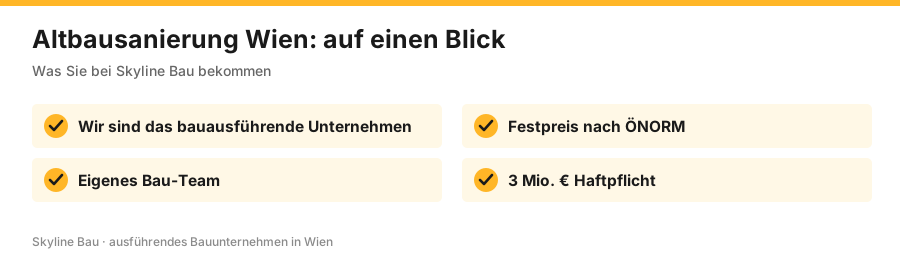
Renovating a Viennese period building brings many trades together — and that is exactly where the challenge lies. We are the construction company carrying out the work and coordinate the entire process, from stripping out to handover ready for occupation.
- One contracting party — you commission one company; we bring all trades together and are responsible for the process.
- Regulated work via partners — structural engineering and master-builder services (§ 94 no. 5 GewO), electrics (§ 94 no. 16), gas/plumbing (§ 94 no. 25) and tiling (§ 94 no. 38) are handled by licensed partner companies.
- Done ourselves — stripping out, drywall, screed, waterproofing and painting are done by our own people.
- Fixed price under ÖNORM B 2110 — in writing after the site visit, traceable item by item.
- Experience with Gründerzeit buildings — timber beam ceilings, old electrics, conservation zones: we know the typical Viennese period-building issues.
Market guide values in Vienna — old-building renovation 2026
These values are the range within which the market moves. They come from publicly available cost breakdowns on specialist portals and guides. We quote them here so that you can put our quote in context — not to compare ourselves with them.
Lower market range Austria
€800 – 1,200/m²
Viennese apartment block / Gründerzeit
€950 – 1,500/m²
With gutting renovation and components before 1945
€1,000 – 2,000/m²
Period apartment in Vienna — complete project
100.000 – 200.000 €
Our own experience is above this. For renovating an entire Gründerzeit building while occupied, we calculate €1,500 to €2,000/m² of usable floor area without an attic conversion, and €2,000 to €3,000/m² for a general renovation of an empty building. The market ranges above come from guides and often reflect individual apartments or partial renovations, not a complete building with facade, roof, risers and common areas.
Important for context: Ranges are not prices. Where you end up within the range depends on the condition of the building fabric — riser pipes, electrics, floor build-up, structure. You only see that after opening up. That is why we give you the price as a fixed price after the site visit and not beforehand as a range in a brochure.
What does old-building renovation in Vienna cost?
The price depends heavily on the scope — from individual trades to a gutting renovation. As a guide:
As of 2026 · net, excl. 20% VAT · guide values — in a period building much lies behind the plaster. Final price after site visit, in writing as a fixed price under ÖNORM B 2110.
Specifics
Viennese period buildings have particular features that shape every renovation. This is what we pay attention to:
- Timber beam ceilings — The typical Viennese period ceiling flexes, transmits sound and cannot carry any weight you like — this determines the floor and ceiling build-up.
- Old electrics — Classic TN-C earthing (Nullung), too few circuits, no RCD protection — in period buildings the electrics almost always have to be completely renewed, via the licensed partner.
- Scaled-up pipes — Water and waste pipes are often at the end of their service life and are replaced as part of the renovation.
- Conservation zone & box-type windows — In conservation zones, the facade and historic box-type windows often have to be preserved — MA 19 has a say here.
- Moisture in the base — Rising damp on the ground floor is a common period-building issue and must be clarified before the interior fit-out.
- Occupied apartment block — Renovation while the building is in use requires process planning, dust protection and communication with residents.
Old-building renovation Vienna for homeowners, property managers & owners’ associations
Apartment owners
From a single apartment to a gutting renovation. We coordinate all trades and provide a fixed price under ÖNORM B 2110 — one contact person instead of many separate firms.
Property managers & owners’ associations
For renovations of common areas — facade, roof, risers — we provide the documentation for the owners’ resolution and coordinate the licensed partners.
Developers & investors
Anyone buying a period building to renovate wants to know beforehand what is structurally possible. We provide reliable fixed prices with a survey of the existing structure; the structural assessment is made by the master-builder partner.
from plan to handover
01 Site visit
We look at the existing building and check the fabric, moisture and existing technology. Free of charge.
02 Quote
All trades as a bill of quantities with a fixed price under ÖNORM B 2110.
03 Planning & coordination
Schedule, coordination of trades, necessary submissions via the master-builder partner.
04 Execution
Our people and the licensed partners work to a coordinated plan.
05 Handover
Acceptance, test reports of the regulated trades, documentation.
Complete or partial renovation?
The first question in any old-building renovation in Vienna is always: complete renovation or partial renovation? Both have their place — the choice depends on the condition of the fabric, the budget and the goal. A partial renovation focuses on individual rooms or trades, such as a new apartment in a period building, a new bathroom or new heating. It costs between 400 and 700 euros per square metre and makes sense when the main structure is still sound and individual defects are to be remedied in a targeted way.
A medium renovation additionally includes the bathroom and kitchen, electrics and window replacement — it costs 700 to 1,000 euros per square metre. A complete renovation or comprehensive base renovation renews the entire building including building services, thermal renovation, roof and facade — the costs are 1,000 to 2,500 euros per square metre. For a classic Viennese apartment block with 1,000 m² of usable floor area, a complete renovation therefore costs between one and two and a half million euros net.
Skyline Bau advises openly on which depth of renovation makes sense for your property. With a period building, a base renovation is often worthwhile because it bundles all measures — scaffolding, site setup and dealings with the authorities are needed anyway. The synergies are considerable, and combining it with subsidies becomes easier.
Subsidies from wohnfonds_wien and the Sanierungsscheck
Anyone renovating a period building in Vienna should consider subsidies from the very beginning — the public sector covers a considerable part of the costs. Two schemes are central. The most important is the Sockelsanierung (base renovation) of wohnfonds_wien: it supports comprehensive renovations of period buildings and apartment blocks with renovation loans and non-repayable grants. Anyone comprehensively renovating a Viennese Gründerzeit building cannot ignore this subsidy — it is the central pillar of old-building renovation in Vienna.
The second scheme is federal funding: the federal Sanierungsscheck supports thermal building renovation and the replacement of fossil heating systems — for example switching from a gas boiler to a heat pump, connecting to district heating or insulating the facade. Both schemes can be combined — wohnfonds_wien for renewing the fabric, the Sanierungsscheck for thermal renovation and building services. In total, savings of up to 40 per cent compared with an unsubsidised project are realistic.
Skyline Bau plans the old-building renovation with this combination in mind from the start — the measures are coordinated so that they actually meet the subsidy criteria. This is part of our planning service as the construction company carrying out the work and costs nothing extra.
Increase in value through attic conversion, lift and loggia
An old-building renovation preserves the fabric — and with the right extensions it becomes an increase in value. Three levers are particularly effective in Viennese period buildings: the attic conversion, the addition of a lift and the subsequent addition of loggias or balconies. Each individual measure noticeably increases the value; combined with the base renovation, a period building in need of renovation becomes a high-quality, modern residential building with a new market value.
The attic conversion is the strongest lever for increasing value: an unused attic becomes new apartments at new-build level, often with terraces and views. These top-floor apartments achieve top prices on the market. The addition of a lift is the second big lever — retrofitting a lift considerably upgrades the upper floors and makes the building barrier-free. The addition of loggias and balconies completes the trio: an apartment with outdoor space is worth significantly more than one without. Skyline Bau builds all three as a construction company that does the work itself, with a network of licensed master-builder partner firms.
the trades involved in an old-building renovation
A comprehensive old-building renovation is an interplay of many trades. Anyone who understands which works come together also understands why coordination under one general contractor is worth so much. For a Viennese Gründerzeit building, these typically include: structure and load-bearing system (timber ceiling repair, masonry strengthening), roof (covering, insulation, sheet-metal work), facade (stucco restoration, thermal renovation), windows (restoring box-type windows or replacing them in line with conservation-zone requirements), building services (electrics, heating, plumbing), interior fit-out (drywall, screed, tiles, painting).
Often added are riser replacement (renewing the vertical risers for water, waste water and gas), wall damp-proofing (against rising damp), mould remediation in damp corners and hazardous-substance remediation for asbestos or old lead paints. Skyline Bau coordinates all these trades under one fixed price under ÖNORM B 2110 — one contract, one contact person, one schedule and budget. The client does not have to work through a dozen separate contracts.
Why Skyline Bau for your old-building renovation in Vienna
- Parliament building Vienna 1010 — renovation 2022 — On the 2nd basement level of the Austrian Parliament building (Dr.-Karl-Renner-Ring 3), Skyline Bau carried out drywall, painting and filling work as well as floor upgrades. Regulated trades — electrical engineering (§ 94 no. 16 GewO) and tiling (§ 94 no. 38 GewO) — were carried out by licensed partner companies, coordinated by Skyline Bau. Client: W+R Schirmungstechnik GmbH. The reference letter dated 17.10.2022 certifies that the work was of high quality, on schedule and economical. View reference letter as PDF
- Hands-on construction company — Skyline Bau is the brand of Bling Bling GmbH, a restricted construction trade business under § 99 GewO. Not a licensed master builder. Structural engineering, preparation of plans and MA 37 submissions are handled by licensed master-builder partner firms that we coordinate. You receive their proof of authorisation.
- Realistic prices from 1,150 euros per square metre of interior painting — Skyline Bau calculates honestly from the start, in writing, after a site visit.
- Flexible structural-engineering model — you bring your own structural engineer and we build to their plans — or Skyline Bau commissions an external partner engineer and passes on the costs transparently.
- ÖNORM B 2110 in stages — never continuous excavation — always a construction schedule according to the standard. Weekly photo documentation, with levelling report.
- Weekly photo documentation — weekly online photo status — for the client, property manager, owners’ meeting, insurer. Archived for 10 years.
- Pre-construction survey of neighbouring buildings — photo and dimensional documentation of all adjacent buildings before work starts — protects against unjustified damage claims.
- Lightning protection under OIB 6 — where external lightning protection exists, down conductors and test joints are reconnected — no gaps in protection.
- Fixed price ÖNORM B 2110 — lump-sum price agreed in writing — remains the same even with a longer construction period or rising material prices. Penalty agreement for delays €80–150 per working day.
- €3 million construction liability insurance — consequential damage to neighbouring buildings is covered.
- Warranty under the ABGB — 3 years on construction work under § 933 ABGB. Bling Bling GmbH is liable for the overall work as the construction company carrying it out, including the work of the licensed partner companies.
- Experience with Viennese period buildings — from the Gründerzeit apartment block with 30 units to the detached house. Reference list on request.
Special subsidies for owners of period buildings
- Raus aus Gas Wien — up to €5,250 per apartment for switching heating systems, combinable with the federal boiler replacement scheme of up to €17,500. This often adds up to €20,000–22,000 in total subsidies per residential unit when switching to a heat pump or district heating.
- THEWOSAN Wien — grants for thermal renovation (windows, facade) of up to 35% of costs, max. €12,000.
- Barrier-free conversion Vienna — subsidy for apartment adaptations such as level-access showers, wider doors and threshold removal, up to €7,500.
- wohnfonds_wien Sockelsanierung — up to 40% for comprehensive apartment-block measures.
- Wohnservice Wien — central information and application office. wien.gv.at.
Special topics in Viennese period buildings that renovators need to know
- Box-type windows — the Viennese Gründerzeit standard. Refurbishment (restoring the timber frames, new fittings) is usually cheaper than complete replacement and often mandatory in conservation zones. For complete replacement: faithful reproduction by joinery workshops (cost €1,500–3,500 per window).
- Herringbone parquet / Kastenboden — historic floor coverings. Restoration by sanding, sealing, waxing or oiling. Oak herringbone is being laid new again today (€80–160/m²).
- Stucco ceilings — the heritage of salon culture. Restoration by traditional plasterers, reproduction of missing elements using silicone moulds. Costs €80–250/m² depending on complexity.
- Wall damp-proofing — Viennese Gründerzeit buildings often suffer from rising damp. Solutions: chemical injection, mechanical barrier, electro-osmosis. Costs €200–400 per linear metre of wall.
- Classic TN-C earthing (Nullung) — old electrics with screw fuses and fabric-insulated cables. Complete replacement is mandatory in a riser replacement — new distribution boards with residual-current circuit breakers under ÖVE/ÖNORM E 8001.
- Gas boiler replacement — Vienna strongly subsidises switching. Alternatives: heat pump (air-to-air, air-to-water, brine-to-water), district heating connection (very common and easy in Vienna), pellet heating.
- Courtyard access galleries (Pawlatschen) — a typical feature of Viennese apartment blocks, needing renovation where timber, steel structures or glazing are involved.
Why Skyline Bau for your Viennese period building?
First — preserving charm, living in modern comfort. Skyline Bau coordinates with joiners, plasterers and flooring specialists — the original fabric remains, the building services become modern.
Second — routine in conservation zones. For projects requiring MA 19 involvement, we handle the process without you having to worry about it.
Third — all subsidy schemes combined. Raus aus Gas + THEWOSAN + barrier-free + Sockelsanierung — for a Viennese period apartment, public funding often covers 30–40% of the costs.
Fourth — subcontractor on the Parliament renovation 2022. A national reference at one of the most important historic buildings.
Skyline Bau acts as an executing building contractor. Regulated trades — in particular master-builder services (§ 94 no. 5 GewO), planning and structural engineering, electrical engineering (§ 94 no. 16 GewO), gas and sanitary engineering (§ 94 no. 25 GewO) and tiling (§ 94 no. 38 GewO) — are carried out exclusively by suitably authorised subcontractors and partner companies. Construction work is performed by trade businesses within the group of companies that hold a valid trade licence.
Viennese Gründerzeit building fabric and typical renovation challenges
- Viennese Gründerzeit buildings 1848–1918: exposed brick walls, timber beam ceilings (wooden beams with an infill of gravel/clay), box-type windows, stucco facades, original parquet.
- Interwar buildings 1918–1945: solid brick, some concrete ceilings, often already renovated.
- Structural design of timber beam ceilings: wooden beam ceilings with infill. A structural check by an authorised, licensed master-builder partner is mandatory for new imposed loads.
- Susceptibility to moisture on the ground floor: base moisture due to rising damp. Retrofitting a horizontal damp-proof course €145–285 per linear metre.
- Thermal bridges at facade junctions: cold-corner remediation with internal insulation €65–125/m².
- Box-type window renovation vs. window replacement: preserving original box-type windows is mandatory in conservation zones. Window renovation with additional seals €850–1,850 per window. Complete replacement possible outside conservation zones.
- Preserving stucco: original stucco must be preserved in conservation zones and listed buildings. Restoration costs €45–180 per linear metre.
- Preserving original parquet: existing herringbone parquet and plank floors. Sanding and new lacquer €35–95/m². Replacement laying for missing parts €145–280/m².
- Ceiling heights of 3.00–3.80 m in Viennese period buildings: Reddit example 3.20 m. Advantage: living-space volume; disadvantage: heating costs if not insulated.
MA 19 conservation zones and Federal Monuments Office procedures
- MA 19 consultation mandatory: for addresses in conservation zones (most of districts 1–9, parts of districts 10–19). MA 19 confirmation as a prerequisite for the building procedure.
- Federal Monuments Office (BDA) procedure: for listed period buildings. BDA approval is mandatory before the construction phase. Preservation of original details is compulsory.
- Preserving the original facade in a conservation zone: preserving stucco, preserving box-type windows, restoring original doors.
- Preserving original interiors in listed buildings: original parquet, stucco ceilings, tiled stoves. Prior clarification with the BDA is mandatory.
- Heritage grant from the BDA: up to 30% of the construction costs for listed buildings.
- Window rules in conservation zones: preservation of original box-type windows or replica glazing approved by MA 19. No standard plastic windows.
- Listed box-type window renovation: €1,850–4,500 per box-type window with original restoration.
- MA 19 lead time: 6–12 weeks for consultation and confirmation before the construction phase.
- BDA lead time: 3–6 months for the approval procedure.
- Skyline Bau support with the authorities: our site manager systematically accompanies the MA 19 consultation and the BDA procedure. Initial advice in the first consultation is free of charge.
The sequence of a Viennese old-building renovation in 14 phases
- Phase 1 — Viennese survey of the existing building with an expert partner: structural analysis, moisture measurement, analysis of existing electrics, photo documentation of the fabric, heritage check.
- Phase 2 — MA 19 preliminary clarification and BDA enquiry: for conservation zones or listed buildings. 6–12 weeks lead time.
- Phase 3 — New floor plan design preserving original details: balancing modern living comfort with heritage requirements.
- Phase 4 — Preparing the planning application: for projects requiring a permit. Prepared by a civil engineer (Ziviltechniker). Costs €1,850–6,850.
- Phase 5 — Skyline fixed-price quote under ÖNORM B 2110:2023.
- Phase 6 — Owners’ resolution or owner’s order: for Viennese apartment blocks, a wohnfonds_wien subsidy application.
- Phase 7 — Clearing the apartment: furniture out. Alternative accommodation for 12–24 weeks in a gutting renovation.
- Phase 8 — Stripping out while preserving original details: careful recovery of original elements. Photo documentation before demolition.
- Phase 9 — Moisture remediation and horizontal damp-proof course: drying the base, injection barrier.
- Phase 10 — Structural adjustments: new non-load-bearing walls; structurally relevant changes with an authorised, licensed master-builder partner.
- Phase 11 — Rough installation (electrics/plumbing/heating): underfloor heating possible, integration of a tiled stove as an Old Vienna element.
- Phase 12 — Screed + drying phase of 4–8 weeks.
- Phase 13 — Finishing with restoration of original details: stucco restoration, box-type window refurbishment, original parquet refurbishment.
- Phase 14 — Final acceptance and BDA follow-up inspection: for listed buildings. Skyline Bau warranty 3 years under § 933 ABGB. For hidden defects, up to 30 years under § 1489 ABGB.
Renovating a Viennese period building with tenancies
- MRG § 3 landlord’s maintenance obligation: the landlord of a Viennese apartment block must carry out maintenance renovations.
- MRG § 8 (2) tenant’s duty to tolerate: for useful improvements.
- MRG § 18 right to increase rent: landlord’s entitlement for useful improvements. Advice from MA 25 is possible.
- MRG § 4 renovation obligation for listed buildings: maintenance obligation especially for conservation zones and BDA-listed properties.
- ABGB § 1096 right to reduce rent: 40–70% during the gutting renovation phase (typically 12–20 weeks).
- Landlord’s obligation to provide alternative accommodation: if the apartment is completely uninhabitable during construction.
- Construction noise hours: Mon–Fri 7:00 to 19:00, Sat 8:00 to 15:00 under noise protection law.
- Advance notice to neighbours: 4 weeks before the construction phase. Notice in the staircase.
- Typical cost surcharge for occupied buildings: 20–40% additional costs.
- Skyline Bau bulk renovation of apartment blocks: bulk order for owners’ associations with integration of wohnfonds_wien subsidies.
Subsidies 2026 for old-building renovation in Vienna
- City of Vienna subsidy application for thermal and energy renovation: according to wien.gv.at, municipal subsidy for thermal renovation.
- wohnfonds_wien renovation subsidy: for renovating Viennese apartment blocks subject to the MRG.
- BDA heritage grant: up to 30% of the construction costs for listed buildings.
- FSW barrier-free subsidy: up to €6,000 for adaptations suited to age or disability.
- Boiler replacement bonus 2026: up to €4,500 when switching to a heat pump or district heating.
- Thermal insulation subsidy: state subsidy possible for ETICS renovation, but often restricted in conservation zones (internal insulation as an alternative).
- Window replacement subsidy 2026: for triple glazing with a U-value below 1.1; in conservation zones only with MA 19 approval.
- Federal Sanierungsbonus programme: stopped as of 02.02.2026.
- MA 25 housing subsidy: for first-time buyers with first-occupancy renovation.
- Skyline Bau subsidy preparation: our site manager supports the preparation of the application. Initial advice in the first consultation is free of charge.
- Hauskunft Wien: neutral advisory institution.
- Klima- und Innovationsagentur Wien: advice for innovative renovation projects.
Financing, payment schedule and tax advantages
- Our standard payment schedule for old-building renovation: 30% deposit on placing the order, 40% interim payment on completion of the rough installation, 30% final payment on final acceptance.
- Alternative payment schedule for gutting renovations: 20/25/25/30% four-phase plan for orders over €200,000.
- Renovation loan 2026: effective interest rate 4.5–6.8% depending on creditworthiness. Term 5–25 years.
- KIM Regulation 2025: 40% equity share, max. 35-year loan term, 40% debt-to-income ratio.
- ERP loan: interest-subsidised loan for climate-relevant renovations.
- Tax advantage for landlords renovating an apartment block: deduction as income-related expenses under § 16 EStG.
- Tax advantage for owner-occupiers: special expenses for energy-efficient renovations under § 18 EStG.
- Tax advantage for listed buildings: depreciation under § 8 (2) EStG.
- 20% input VAT deduction for business clients.
Three things you should ask for from every contractor.
What you receive from us before signing the contract
A lot is claimed in construction and little is proven. These three proofs are the difference between a promise and a commitment — and you should ask every contractor for them, not just us.
1. The GISA number
Ours: 37945732 (Bling Bling GmbH, construction trade business under § 99 GewO). Publicly searchable in GISA — checked in thirty seconds. A business that does not want to give you its number has a reason for it.
2. Proof of authorisation of the partner companies
For structural engineering (§ 94 no. 5), electrical work (§ 94 no. 16), gas/plumbing (§ 94 no. 25) and tiling (§ 94 no. 38) we use licensed companies. You receive their proof of authorisation before signing the contract — not on request, not later.
3. A fixed price according to ÖNORM B 2110
With a bill of quantities. It also states what is not included. Extra work only with your written consent — with photo documentation before work continues.
And what we document is something you normally never see: photos of the rough installation before the walls are closed. The waterproofing before tiling. Both disappear behind plaster and tiles — and both decide whether the property will still be watertight in twenty years. You receive the pictures at handover. Not on request.
What we do not promise.
Four things you hear elsewhere — but not from us
Trust does not come from someone promising everything. It comes from someone telling you where the limits are.
- “We are the cheapest.” — We are not. Anyone who ignores drying times, leaves out the waterproofing and does not price in disposal is cheaper. Until the final invoice.
- “It can be done in two weeks.” — Cement screed needs around 28 days to be ready for floor coverings. That is physics, not a matter for negotiation. Anyone who promises it anyway is working against the drying time — and in two years you will have hollow-sounding tiles.
- “I can tell you right away on the phone what it costs.” — No. What a renovation costs is decided by the condition behind the wall. You only see it after opening up. A price given over the phone is either too high — then we lose the job — or too low, and then the extra charges follow.
- “We do everything ourselves.” — We are not allowed to. Structural engineering (§ 94 no. 5), electrical work (§ 94 no. 16), gas/plumbing (§ 94 no. 25) and tiling (§ 94 no. 38) are regulated. Anyone who claims to do all of this themselves either holds four licences — or has a problem.
Old-building renovation — in all 23 districts and the surrounding area
We renovate period buildings throughout Vienna, as well as in Klosterneuburg and the Lower Austrian surrounding area — with a focus on Gründerzeit buildings and apartment blocks.
Most of this work concerns multi-unit buildings. If you want to have an entire apartment block (Zinshaus) renovated and not just one apartment in it, different figures and a different process apply: €1,500 to €3,000 per square metre of usable floor area, subsidies via wohnfonds_wien, and construction usually while the building is occupied. The details of apartment-block renovation are on a separate page.
the individual trades
An old-building renovation brings many trades together. On the individual areas:
The individual apartment — from the bathroom to a gutting renovation.
The old electrics are renewed by licensed partners under § 94 no. 16 GewO.
Internal insulation in protected period buildings where external ETICS is not permitted.
New build-up on the timber beam ceiling with impact sound insulation.
Renovating or replacing box-type windows — they must be preserved in conservation zones.
The overview of all renovation services.
When you do not need us
Not every project needs a building contractor. During the site visit we will tell you honestly if we are the wrong choice for you — even if it costs us a job.
A single trade
If you only need a painter, you do not need a coordinator. Hire the painter directly — it is cheaper.
Mainly structural engineering and planning
If your project consists mainly of permit planning and structural calculations, go directly to a licensed master builder. A building contractor in between is one level too many.
Technically sound, just old
Copper pipes, waterproofing intact, no damp damage? Then a cosmetic refresh is enough. Save your money.
Why we say this: A customer we sold an unnecessary renovation to will not come back and will not recommend us. A customer we told honestly that their bathroom will last another ten years will call us in ten years — and in the meantime, when the riser pipes in the building are due for replacement.
what you should know
So that you know exactly what to expect, we answer the most important questions about old-building renovation in Vienna here — honestly and from the practical experience of a construction company that does the work.
What does an old-building renovation in Vienna cost?
Depending on scope and condition, an old-building renovation in Vienna costs roughly between 800 and 2,500 euros per square metre. A gentle renovation that preserves the fabric is at the lower end, a gutting renovation with new pipes, electrics and floor plan at the upper end. Gründerzeit buildings with stucco, box-type windows and timber beam ceilings require special skills — in return, the charm that makes a Viennese period building is preserved.
Renovate or demolish — which is worthwhile?
With a Gründerzeit building, renovation is almost always the better choice: the fabric is usually solid and durable, demolition is often not even permitted (conservation zone) and a new build is more expensive. A professional renovation also preserves the value and the historic townscape. Only in the case of severe structural damage can a new build make more sense — a structural survey clarifies this.
What needs to be considered with conservation zones and listed buildings?
Many Viennese Gründerzeit buildings are in a conservation zone (MA 19) or listed. Then the facade, windows and often the appearance are protected — changes require approval. We clarify the requirements with the authorities before construction starts so that there are no surprises, and align windows and facade with the specifications.
What subsidies are there for old-building renovation?
In Vienna there are base renovation (Sockelsanierung) subsidies via wohnfonds_wien, THEWOSAN for thermal measures and “Raus aus Gas” for heating replacement. The nationwide Sanierungsbonus is paused as of 2026. We check which funds can be combined for your property in the free initial consultation — it is important to apply for subsidies before awarding the contract.
Old-building renovators in Vienna: who does what
Anyone looking for an old-building renovator ends up with developers, general contractors, master builders and craft businesses. The differences are large – above all on the question of who is liable and who actually builds.
| Provider | What they do | Who they suit |
|---|---|---|
| Developers | buys, renovates and sells – or renovates in its own name | Buyers of fully renovated apartments |
| General contractor | takes on all trades with one contract and one warranty | Owners who want one contact person – see General Contractor Vienna |
| Construction company with its own crew | builds itself and coordinates authorised partner companies | Old-building renovation of an apartment or house at a fixed price |
| Individual tradespeople | one trade | small repairs, if you coordinate yourself |
Planning an old-building renovation – this is how it begins: advice and site visit, a survey of the existing structure with findings on ceilings, moisture and pipes, then a cost framework and subsidy check, and only after that planning and submission. Anyone who starts with the floor plan before the existing structure has been checked often plans twice.
Old-building renovation near you: we renovate period buildings in all 23 Viennese districts – 1010 Innere Stadt, 1020 Leopoldstadt, 1030 Landstraße, 1040 Wieden, 1050 Margareten, 1060 Mariahilf, 1070 Neubau, 1080 Josefstadt, 1090 Alsergrund, 1100 Favoriten, 1110 Simmering, 1120 Meidling, 1130 Hietzing, 1140 Penzing, 1150 Rudolfsheim-Fünfhaus, 1160 Ottakring, 1170 Hernals, 1180 Währing, 1190 Döbling, 1200 Brigittenau, 1210 Floridsdorf, 1220 Donaustadt, 1230 Liesing – as well as in Klosterneuburg and the area around Vienna.
Renovating an old house: when the old building is a detached house
“Althaussanierung” (renovating an old house) often does not mean the Gründerzeit apartment block, but an older detached or estate house from the interwar period or from the decades after 1945. In Vienna, such houses are mainly found on the outskirts, for example in Floridsdorf, Donaustadt, Liesing or Hietzing. The tasks differ significantly from a stucco period building: instead of timber beam ceilings and risers for many households, it is about a basement without a functioning horizontal damp-proof course, electrics with too few circuits, a barely insulated roof and often an old boiler that needs replacing. On top of that come extensions from later decades that were rarely connected cleanly to the original structure – cracks and damp patches later appear at these joints.
A sequence from bottom to top and from outside to inside has proven itself: first clarify moisture and load-bearing structure, then the roof and building envelope, then pipes and heating, and finally the surfaces. Anyone who starts with the new bathroom and only then dries out the walls pays for parts of the work twice. How we tackle an entire house from basement to ridge is described on the page on house renovation in Vienna. If the basement is wet, damp-proofing the masonry usually comes first. Whether converting the roof space at the same time pays off is something we look at during the site visit.
Frequently asked questions about old-building renovation in Vienna
How do I find a good old-building renovator in Vienna?
Is a developer or a general contractor better for an old-building renovation?
What does an old-building renovation in Vienna cost?
What does it cost to renovate a 100 m² period apartment?
What makes a period building more expensive than a new build?
What is a timber beam ceiling and why does it matter?
What is a Dippelboden?
Can box-type windows be preserved?
What about the stucco on the ceiling?
How do you deal with crooked walls?
What hazardous substances are found in Viennese period buildings?
What does the electrical installation cost in a period building?
Do the risers need to be renewed as well?
How is the floor built up in a period building?
Can underfloor heating be installed in a period building?
What needs to be considered with gas boilers?
What is a category upgrade?
What subsidies are there in 2026?
Old-building renovation: when does the subsidy application have to be submitted?
What does a conservation zone mean for my renovation?
Old-building renovation: do I need a building permit?
How long does an old-building renovation take?
Old-building renovation: can I stay in the apartment during the renovation?
What needs to be considered with rented apartments?
How do I deal with neighbours and the property manager?
Old-building renovation: what happens with hidden damage?
Who does the structural engineering and submission?
Is an attic conversion worthwhile as part of the renovation?
What increases the value the most?
Renovate or demolish?
Old-building renovation: is there a fixed price?
Old-building renovation: what warranty is there?
Glossary & technical terms
The typical Viennese period ceiling made of wooden beams. It flexes, transmits sound and has limited load-bearing capacity — decisive for the floor and ceiling build-up.
The historic double window. In conservation zones it often has to be preserved and can be renovated rather than replaced.
An area with a townscape worth preserving. Visible changes to the facade must be coordinated with MA 19.
Moisture that rises from the ground into the masonry — a common period-building issue that is clarified before the interior fit-out.
The Austrian standard for construction contracts — governs change orders, deadlines and warranty.
Complete renovation down to the shell — electrics, pipes, floors, bathrooms, often with a change of floor plan.
The trade regulation provision for the regulated master-builder trade. Structural engineering and planning applications are reserved for master builders.
The statutory warranty of 3 years on construction work. Manufacturers’ guarantees run separately.
Comparison of options
| Option | When it makes sense |
|---|---|
| Partial renovation | When only individual areas are renewed — a bathroom, the electrics, the floors. Cheaper and faster. |
| Gut renovation | When the fabric is fundamentally renewed — down to the shell, often with a change of floor plan. |
| Renovation in stages | When the budget or occupancy requires step-by-step implementation — planned in a coordinated way. |
Reference projects
Apartment in an apartment block, Innere Stadt
Gutting renovation of a Gründerzeit apartment with new electrics and new pipes via the licensed partners, floors and bathroom from a single source.
Gründerzeit facade, Ottakring
Facade renovation in the conservation zone in coordination with MA 19, preserving the historic articulation.
Bathroom and riser renovation, Wieden
Renewal of the bathroom and supply pipes in an occupied apartment block, coordinated with plumbing and tiling partners.
Related services Skyline Bau
Related services
Period building renovated? We get the fine dust out.
After an old-building renovation, dust sits in joints, window rebates and radiator niches — where a broom cannot reach. The final construction clean is handled by our partner company Bling Premium Cleaning, including glass cleaning and removal of adhesive residue and paint splashes. More at bling-bling.at.
Send enquiry
Enquire directly here — fixed-price quote free of charge. Skyline Bau replies within 2 working days.
Ready for your old-building renovation in Vienna?
Write to us directly on WhatsApp — send photos. Reply within 2 working days.
Note: Skyline Bau is the brand name of the construction and renovation division of Bling Bling GmbH and is not a separate legal entity. The sole contractual partner is Bling Bling GmbH. Bling Bling GmbH is a restricted construction trade business under § 99 GewO (Austrian Trade Regulation Act) and not a licensed master builder (Baumeister). Under § 99 (5) GewO, the title “Baumeister” is reserved for businesses licensed under § 94 no. 5 GewO. Regulated trades — master-builder services, structural engineering, gas and sanitary engineering, electrical engineering — are carried out exclusively by authorised, licensed partner companies.