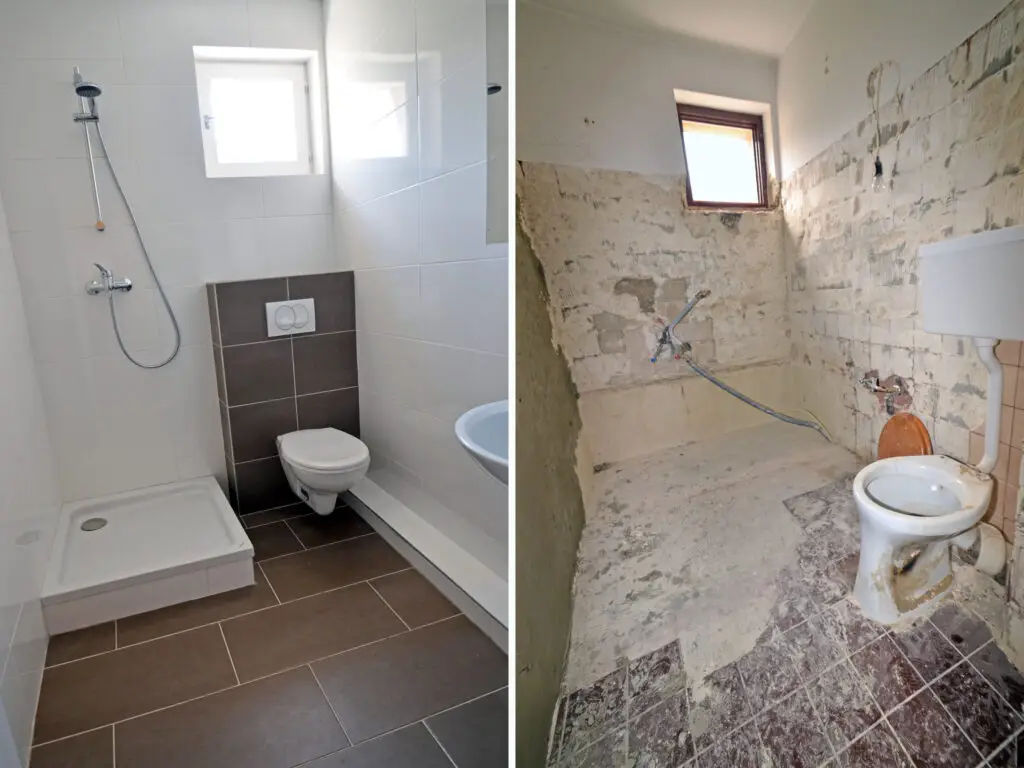
Bathroom renovation Vienna the bathroom that lasts longer than the financing.
Bathroom renovation Vienna: from the construction company that does the work — not from an agent.
Bathroom renovation Vienna: a complete bathroom renovation in Vienna costs between 9,800 and 32,000 euros net at Skyline Bau. Partial renovation from €7,000, complete bathroom in an existing building €14,000–22,000, period building with riser replacement €22,000–32,000. Construction time 12 to 18 working days. Strip-out, drywall, screed, waterproofing, tiling and painting are done by our own people.
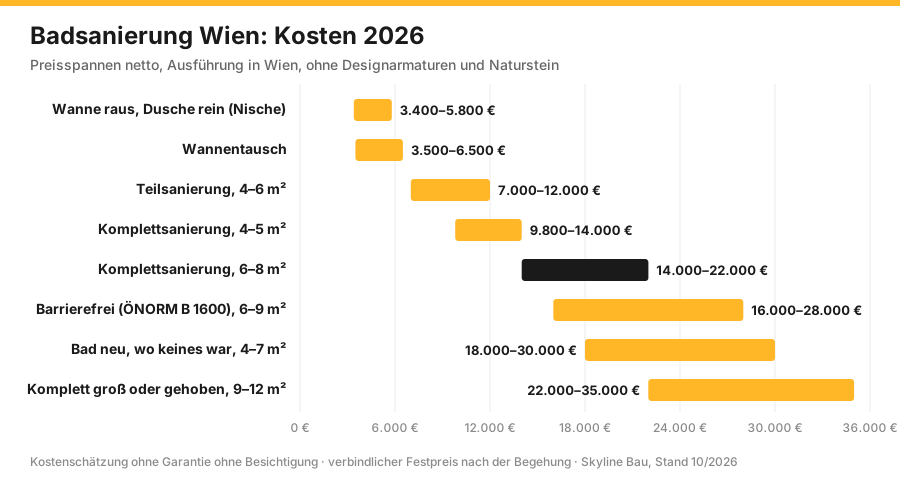
Bathroom renovation Vienna: costs 2026
The figures below are contractor prices for Vienna, as of 2026, net, without special requests such as designer taps or natural stone. The price becomes binding after a site survey, because in period buildings the condition behind the wall decides more than a third of the cost.
| Scope | Bathroom size | Net price | Construction time |
|---|---|---|---|
| Bathtub replacement, tiled splashback completed | any | 3.500–6.500 € | 3–5 working days |
| Partial renovation: new shower, new floor, new fixtures | 4–6 m² | 7.000–12.000 € | 8–12 working days |
| Complete renovation, small | 4–5 m² | 9.800–14.000 € | 12–16 working days |
| Complete renovation, medium | 6–8 m² | 14.000–22.000 € | 15–20 working days |
| Complete renovation, large or high-end | 9–12 m² | 22.000–35.000 € | 18–25 working days |
| Barrier-free renovation to ÖNORM B 1600 | 6–9 m² | 16.000–28.000 € | 15–22 working days |
| New bathroom where there was none before | 4–7 m² | 18.000–30.000 € | 20–30 working days |
Bathroom renovation Vienna cost calculator: a rough estimate for your bathroom in 30 seconds
Choose the scope, the size and what is added. The calculator uses the same Vienna prices as the tables on this page. Result: a range net and gross including construction time – as a cost estimate without guarantee and without a site visit. You get the fixed price after the survey.
Cost estimate without guarantee and without a site visit. Included: demolition, disposal, installation, electrics, waterproofing to ÖNORM B 3407, screed, tiling, fitting, painting. Not included: materials of your choice such as sanitary fixtures and tiles above standard, natural stone. Anything not listed is not included. Our general terms and conditions form part of every quotation.
Unit prices, so you can check a quote
A lump-sum price without line items cannot be checked. These unit prices are the yardstick against which you can measure any Viennese quotation.
| Item | Unit | Net price | What is included |
|---|---|---|---|
| Complete bathroom demolition incl. disposal | lump sum | 1.200–2.600 € | Tiles, screed, fixtures, skip, proof of disposal |
| Wall opening with lintel | pcs | 800–2.400 € | Structural calculation, steel lintel, making good |
| New plumbing installation, 4 fixtures | lump sum | 2.800–5.200 € | Cold, hot, waste water, pre-wall, pressure test |
| Pre-wall installation in drywall | lin. m | 190–340 € | Stud frame, cistern module, moisture-resistant boarding |
| New electrical installation in the bathroom | lump sum | 900–2.200 € | Dedicated RCD, cables, boxes, mirror and ceiling light |
| Screed incl. insulation | m² | 45–80 € | Cement or flowing screed, edge strips |
| Bonded waterproofing to ÖNORM B 3407 | m² | 38–55 € | Two coats, sealing tape, sleeves, corners |
| Wall tiling | m² | 55–95 € | Adhesive, laying, grouting, silicone |
| Floor tiling, large format | m² | 65–110 € | Levelling, buttering-floating, grouting |
| Building a level-access shower | lump sum | 1.400–3.200 € | Drain, fall, waterproofing, shower channel |
| Made-to-measure glass shower screen | pcs | 800–2.600 € | 8 mm toughened safety glass, fittings, installation |
| Fitting sanitary fixtures | pcs | 180–420 € | WC, washbasin, bath, tap, each without material |
| Towel radiator incl. connection | pcs | 450–950 € | Valves, connection pipes, bleeding |
| Underfloor heating in the bathroom | m² | 70–140 € | Hot water or electric, controls |
| Extractor fan with run-on and humidity sensor | pcs | 320–780 € | Unit, cable, core drilling, external grille |
| Painting ceiling and remaining wall | m² | 12–28 € | Filling, priming, two coats |
| Site set-up, dust protection, final cleaning | lump sum | 450–1.100 € | Staircase protection, dust lock, fine cleaning |
Total around €16,600 net, without high-end sanitary materials. Mid-range sanitary fixtures add another €2,000 to €4,000 and are usually bought directly by the client.
What the price really depends on
The gap between €9,800 and €22,000 is not arbitrary but comes down to seven concrete factors. If you know them, you can steer the costs instead of suffering them.
- Condition of the risers. Lead pipes, galvanised steel or a 50-year-old gas line turn a bathroom renovation into a pipework project. Connecting to a decaying riser is burning money – in that case the riser renovation should come first.
- Ceiling build-up. A timber beam ceiling or Dippelboden ceiling means: no heavy wet build-ups, particularly careful waterproofing, often strengthening of the ceiling. A concrete ceiling is the simpler case.
- The layout stays or moves. If the WC and bath stay where they are, you save €1,500 to €4,000. If the WC moves two metres, the waste pipe needs a new fall, often with a 20 cm deep pre-wall.
- Level-access shower. The drain needs build-up height. In a period building with a thin ceiling this becomes a channel along the wall or an extra-flat drain – technically solvable, but not free of charge.
- Tile format. 30 × 60 cm is standard. 120 × 120 cm looks better but costs 30 to 50% more to lay, because the substrate and flatness have to be prepared differently.
- Accessibility. Fourth floor without a lift in a narrow lane: material and rubble go via the stairs, plus a parking lane permit from MA 46. That is €600 to €1,800 for logistics alone.
- Time pressure. If you have a fixed deadline, you pay for parallel work. If you allow three weeks of buffer, you get the better price.
Where you can save without regretting it later
Saving is good, saving in the wrong place is expensive. This split has proven itself over more than ten years of Viennese period buildings.
Sensible savings
Tile format 30 × 60 instead of large format. Standard sanitary ceramics instead of a designer range. Keep the existing position of WC and bath. Shower screen in a standard size instead of a custom-made one. Keep the bath and only re-enamel it if it is intact.
False economies
Leaving out the waterproofing or using a product without a test certificate. Connecting to old pipes. Mounting directly on old masonry without a pre-wall. Doing without a dedicated RCD. Cutting the ventilation and hoping the tilted window will do. Silicone joints as a substitute for sealing tapes.
Expensive later
Tiling over tiles: saves €800 today and costs many times that at the next water damage, because nobody knows what lies underneath. The same goes for concreting over inspection openings – sooner or later someone has to get to the riser.
Getting subsidies
Barrier-free conversions and the replacement of old heating systems are eligible for subsidies. If you combine the bathroom renovation with a basic refurbishment (Sockelsanierung) of the building, part of it is subsidised through wohnfonds_wien.
Bathroom renovation at a fixed price
For us, fixed price means: after the survey there is a sum in the contract that only changes if you change something yourself. That requires someone to have been in the bathroom beforehand and looked into the wall – without a survey every fixed price is a guess.
| Included in the fixed price | Not included, because not visible beforehand |
|---|---|
| Demolition, disposal, dust protection | Pollutants in the adhesive or screed |
| Water and waste water installation in the bathroom | Replacement of the riser in the shaft |
| Bathroom electrics according to protection zones | New supply cable from the distribution board if the cross-section is insufficient |
| Waterproofing, tiles, sanitary fitting | Timber beam ceiling that only proves rotten after demolition |
| Pre-wall, drywall, painting | Work outside the bathroom |
| Final cleaning and handover | Furniture and decoration that you buy yourself |
What you should check when comparing: is the waterproofing listed as a separate item with the standard in the quotation, or does it not appear at all? Is disposal calculated by tonnage? Are sanitary items named with type and price or only as a lump sum? If one of these points is missing, the cheap price will later become more expensive than the expensive one.
Bathroom renovation in Vienna by district
What a bathroom costs depends more on the building than on the district. Still, there are patterns we encounter again and again in certain areas — and which you should know in advance.
- 1220 Donaustadt and 1210 Floridsdorf: a lot of stock from the sixties to the eighties. Solid ceilings, bundled risers, a lift in the building — these are the least complicated bathrooms and usually in the lower third of the price range. Our base is in the 21st district.
- 1110 Simmering and 1100 Favoriten: council housing and residential estates. Here the consent of the property management for work on the riser is the first step, not the last.
- 1230 Liesing: terraced and detached houses. A frequent wish: a level-access shower on the upper floor — possible, but it needs build-up height, which is often lacking in prefabricated houses.
- 1030 to 1090, Gründerzeit stock: timber beam ceilings. A level-access shower almost always needs a new floor build-up here, and the bathroom is often a small room converted later without a window. Both push the price up.
- 1010 Innere Stadt: protection zone, narrow access, deliveries in time slots. Expect a surcharge for site logistics, not for the construction work itself.
- 1130, 1180, 1190: larger bathrooms, higher fit-out standard, often two bathrooms in one order.
We renovate bathrooms in all 23 districts and in the surrounding area of Lower Austria. The survey is free of charge throughout Vienna, and we name the fixed price afterwards.
Bath out, shower in: the small bathroom project
Not every bathroom needs a complete renovation. The most common wish in Vienna is replacing the bathtub with a shower – often because stepping over the edge of the bath has become a problem.
| Option | What happens | Duration | Net price |
|---|---|---|---|
| Shower in the bath recess | Bath out, shower tray in, new tiles in the recess area | 3–5 working days | 3.400–5.800 € |
| Level access in the recess | additionally open the floor build-up, lower the drain, waterproof | 6–9 working days | 5.900–9.400 € |
| Bath stays, the step-in becomes lower | Door in the bath or replacement with a shallow bath | 2–4 working days | 2.600–4.800 € |
| Complete bathroom | everything new including plumbing, electrics, tiles | 12–18 working days | 14.000–22.000 € |
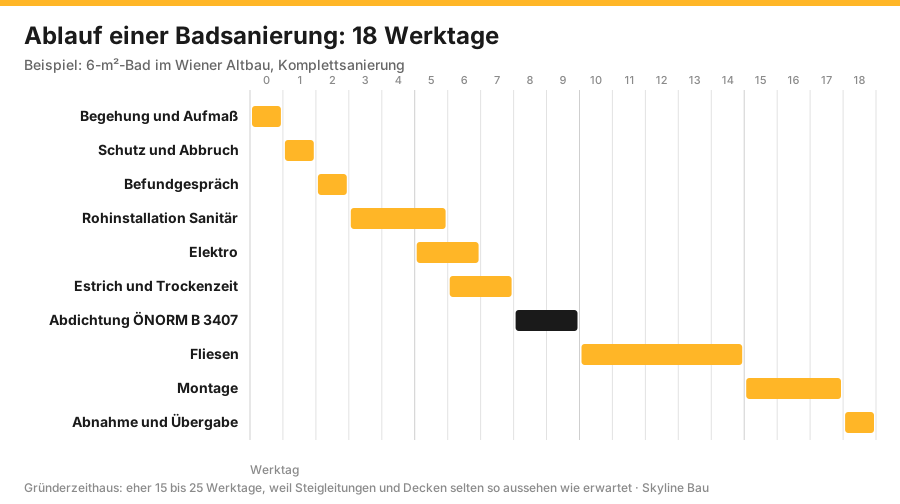
The course of a bathroom renovation, day by day
This is how an average 6 m² bathroom in a Viennese period building goes. The order is not arbitrary: each step requires the one before to be dry, watertight and checked.
Construction time: what is realistic
| Scope | Net construction time | With drying times | Bathroom usable from |
|---|---|---|---|
| Bathtub replacement | 3–4 days | 4–5 days | Day 5 |
| Partial renovation | 6–8 days | 8–12 days | Day 12 |
| Complete renovation 6 m² | 11–14 days | 15–20 days | Day 18–20 |
| Barrier-free with layout change | 14–18 days | 18–25 days | Day 22–25 |
| New bathroom without existing one | 18–22 days | 22–30 days | Day 28–30 |
If you live without a second WC in the flat, you should plan a solution for the time without a bathroom. On request we provide a site toilet or stagger the work so that the WC remains usable until the last third – this costs two to three days more but makes living there bearable.
The waterproofing decides whether the bathroom lasts 5 or 30 years
Tiles are not watertight. Joints even less so. What makes a bathroom watertight lies invisibly underneath: the bonded waterproofing in combination with the tile covering, regulated in ÖNORM B 3407. It is the only component that can no longer be checked after completion – and the most common point where shoddy work is done in Vienna.
What the standard requires
- Exposure classes. The standard distinguishes by water exposure. A bathroom in residential construction usually falls under moderate exposure, the shower zone itself under high exposure. This determines how far up the waterproofing must be taken and which product is permitted.
- Areas. Floor over the full area, wall in the splash zone at least 20 cm above the shower head, with a level-access shower the entire shower area plus 20 cm to the sides, behind the bath at least 20 cm above the rim of the bath.
- Details. Corners, junctions and pipe penetrations are the weak points. That is where sealing tapes and prefabricated sleeves belong – not more sealing compound, but the system-tested component.
- Layer thickness. Two layers, applied crosswise, at the wet film thickness specified by the manufacturer. A single thin coat looks the same and does not hold.
- System consistency. Primer, sealing compound, tapes and adhesive must come from one tested system. Mixing three manufacturers costs you the warranty in the event of damage.
How to recognise missing or poor waterproofing
In the finished bathroom you cannot see it. Beforehand you can: if the quotation does not have a separate item "bonded waterproofing to ÖNORM B 3407", it is very likely not calculated. If the site goes straight from screed to tiles without a day with blue or grey compound in between, it was skipped. And if someone explains that "the tiles seal anyway", you should end the conversation.
Level-access shower in a period building: what works and what does not
The most common wish in Viennese bathroom renovations and at the same time the most technically demanding. The decisive factor is the available build-up height between the structural ceiling and the finished floor.
| Drain system | Required build-up height | Advantage | Limit |
|---|---|---|---|
| Vertical point drain | from 120 mm | Inexpensive, high drainage capacity | Needs a vertical connection downwards, rarely possible in period buildings |
| Horizontal point drain | from 90 mm | Connection in the same plane, usual in existing buildings | Fall in four directions needed, visible with large formats |
| Shower channel along the wall | from 95 mm | Fall in one direction only, ideal for large tiles | More expensive, wall junction must be waterproofed |
| Extra-flat drain | from 65 mm | Rescue for thin build-ups | Lower drainage capacity, maintenance more important |
| Super-flat shower tray, 25 mm | from 70 mm | Safe, inexpensive, fast | Not fully level, a small step remains |
In a Gründerzeit building there are often only 8 to 12 cm between the Dippelboden ceiling and the finished floor. Then the vertical point drain is ruled out, leaving a channel, a flat drain or a super-flat tray. If you want to open the ceiling to create space, you need a structural engineer – and must bear in mind that someone else's flat lies below.
Fall: 1.5 to 2 per cent, no more and no less
Too little fall means standing water and limescale rings. Too much fall means that shower stools and walkers tip over and large-format tiles break. In practice it is 1.5 to 2% towards the drain. With a channel one plane is enough; with a point drain the tile has to slope in four directions – from 60 × 60 cm this becomes visible, from 90 × 90 cm it usually looks unattractive. Hence: large format plus channel, small format plus point drain.
Tiles: format, joint, slip resistance
The tile determines appearance, cleaning effort and safety. Three decisions are more important than the colour.
Format
Large format looks calm and has fewer joints, but requires a very flat substrate. From 60 × 120 cm, buttering-floating is a must: adhesive on the substrate and on the back of the tile, otherwise voids form that later lead to cracks. A small 5 m² Viennese bathroom with 120 tiles looks spacious but has a lot of offcuts – allow 15 to 20% instead of the usual 10%.
Joint
Narrow joints (2 mm) look high-quality but need rectified tiles. Epoxy resin joints are practically indestructible and stain-resistant, but cost two to three times as much and forgive no rework. For most bathrooms a good cement joint with fungicide is the right choice. Silicone belongs only in movement joints: corners, floor-wall junction, junction with bath and shower tray.
Slip resistance
| Area | Recommendation | Reason |
|---|---|---|
| Bathroom floor in general | R9 to R10 | Barefoot area, good balance between grip and ease of cleaning |
| Level-access shower | R10 with assessment group B | Wet exposure, barefoot, sloping surface |
| Accessible bathroom | R10/B, better R11 | Risk of falling, often with a shower stool |
| Wall tiles | no requirement | Free choice according to appearance |
Too much slip resistance is no gain: R12 in a residential bathroom is hardly cleanable, because the rough surface holds soap residue.
Plumbing installation: what happens behind the pre-wall
The pre-wall is not a design element but a building component. It houses the cistern, pipes and fixings, decouples from the often crooked old masonry and creates a straight surface for tiling. 15 to 20 cm depth is usual; in a 4 m² bathroom every centimetre hurts – here planning to the millimetre pays off.
- Waste water needs a fall. At least 1 cm per metre, better 2. If the WC moves, this fall has to come from somewhere. That is why the WC is rarely moved far in a period building.
- Sound insulation to ÖNORM B 8115. Cistern modules are mounted acoustically decoupled, waste pipes are sheathed. Otherwise the neighbour hears every flush – and in a tenement building that quickly turns into a legal dispute.
- Inspection opening. Every cistern flush plate is one, but shut-off valves also need access. If you tile over them, you pay for the tiles as well at the next defect.
- Material. Multilayer composite pipe is standard in residential construction, copper for existing copper systems, stainless steel in the riser. Mixing materials without an isolating piece leads to corrosion.
- Pressure test. After the first fix, with a report, before closing up. Without this sheet there is no acceptance.
- Hot water. If you still have an instantaneous water heater or a gas boiler in the bathroom, you should consider replacing it now – opening the wall later costs twice as much.
Electrics in the bathroom: the protection zones
Wet rooms are strictly regulated electrically. The relevant standard is ÖVE/ÖNORM E 8101. The zones determine what may be installed where – not taste.
| Area | Where | What is permitted |
|---|---|---|
| Zone 0 | Inside the bath and shower tray | Only safety extra-low voltage 12 V, protection class IPX7 |
| Zone 1 | Vertically above bath/shower up to 2.25 m | Permanently connected appliances, IPX4, no switch, no socket |
| Zone 2 | 60 cm around zone 1 | Luminaires and appliances IPX4, sockets only with isolating transformer |
| Outside | Rest of the room | Sockets and switches permitted, still protected by RCD |
Mandatory in every renovated bathroom: a dedicated residual current device with 30 mA and equipotential bonding of all conductive parts. If you plan to connect to an old two-wire installation without a protective conductor, you are renovating at the wrong end – then the electrical cable up to the distribution board must be renewed. This is carried out by a licensed electrical engineer; we coordinate and provide the findings.
Ventilation: the underestimated point
In Viennese period buildings the bathroom is often internal, without a window – historically created as a bath recess in the kitchen. Without mechanical ventilation mould develops, no matter how good the waterproofing is. One shower releases around half a litre of water as vapour into the room.
- Run-on instead of light switch. A fan that switches off with the light has achieved nothing. 10 to 20 minutes of run-on or a humidity sensor from 65% relative humidity are the minimum.
- Air flow. As a rule of thumb, five air changes per hour apply. For a 6 m² bathroom with a 2.8 m ceiling height that is around 85 m³/h.
- Exhaust route. Into the existing ventilation shaft, outdoors via core drilling or – with gas appliances in the room – only after consulting the chimney sweep. An exhaust system can starve a room-air-dependent gas boiler of air. That is not a formality but a danger to life.
- A window is rarely enough. In winter nobody airs the room for ten minutes after every shower. A €500 fan prevents a €3,000 mould remediation.
Heating in the bathroom
A bathroom should be warm in ten minutes and dry towels. There are three ways to achieve this, and they can be combined.
Towel radiator
The classic, €450 to €950 including connection. Warms up quickly, dries textiles, needs wall space. Combined with an electric heating element it can also be used outside the heating season.
Hot-water underfloor heating
€70 to €140/m². Pleasant barefoot, invisible, slow to respond. Makes sense if the floor is being rebuilt anyway and a heating circuit is within reach.
Electric heating mat
€60 to €110/m², 3 to 5 mm build-up. Ideal where height is tight, quick to control, more expensive to run. For a 5 m² bathroom usually the pragmatic solution.
What does not work
The old, far too large sectional radiator behind the door that never really got warm in 40 years. During the renovation the heating load should be recalculated, not the old part reinstalled.
Bathroom renovation in the Viennese districts
The district says a lot about the bathroom before we have even seen it. In Vienna, year of construction, ceiling build-up and pipe routing follow the age of the neighbourhoods, and this determines effort and price.
| Region | Typical existing condition | What matters there |
|---|---|---|
| 1010 to 1090, districts along the Gürtel | Gründerzeit, timber beam ceiling, internal bathroom without window | Ventilation, sound insulation, riser, often protection zone in the building |
| 1100, 1110, 1120 | Council housing and buildings from the 1950s to 1970s | thin screed, consent of the property management, narrow staircases |
| 1210, 1220 (22nd district) | Estate houses, residential complexes, much stock from the 1970s to 1990s | Bathroom usually larger, good access, often bath to shower wanted |
| 1230 (23rd district), 1130 | Detached and terraced houses, bathroom on the upper floor | Timber joist ceiling, second bathroom, often guest WC at the same time |
| 1160, 1170, 1180 | mixed Gründerzeit and inter-war period | Bathroom added later, pipes running across the flat |
| New build from 2000, all districts | Pre-wall installation, concrete ceiling | fastest renovation, drain and shaft stay where they are |
We work in all 23 districts. What differs is the preparation: in residential complexes we need the consent of the management and a time window for shutting off the water; in a detached house agreeing with you is enough. We clarify both before the quotation, not afterwards.
What a complete bathroom includes
The term complete bathroom renovation is used in different ways. For us it means: you clear out the bathroom, we take care of everything else up to handover – one contract, one contact person, one date.
| Step | What is included |
|---|---|
| Demolition | Dismantle sanitary fixtures, remove tiles and screed, take away rubble |
| Installation | Water, waste water, pre-wall, connections for WC, washbasin, shower |
| Electrical | Cables according to protection zones, lighting, sockets, fan |
| Floor build-up | Levelling, insulation where needed, screed |
| Waterproofing | Bonded waterproofing to standard on all exposed surfaces |
| Tiles | Floor and wall, skirting, silicone joints |
| Installation | Sanitary fixtures, taps, mirror, radiator |
| Handover | Leak test, cleaning, documents and warranty |
The Viennese period building: six peculiarities that play no role elsewhere
A bathroom in a new building from 2015 is a craft project. A bathroom in a tenement building from 1890 is a construction project. These six points come up again and again in Vienna.
1. Timber beam ceiling and Dippelboden
Over 60% of Viennese Gründerzeit flats have timber joist ceilings. They are load-bearing, but not made for heavy wet build-ups, and they move with moisture. The consequence: the floor build-up stays light, the waterproofing is flexible, the screed is installed decoupled. Anyone who bricks a bath directly onto a timber beam ceiling produces cracks. With a planned full bath of 200 litres plus the user, that is around 280 kg on two square metres – this has to be calculated, not estimated.
2. The bath recess in the kitchen
Until the 1970s Viennese flats were built without their own bathroom; the bathtub stood in a recess in the kitchen, the WC was in the corridor. Anyone who wants a real bathroom today usually builds it out of a small side room or pantry. That means: a new waste water connection, often a pre-wall, mandatory ventilation, and the question of whether a load-bearing wall is affected. Such projects cost €18,000 to €30,000, but they are the biggest jump in value a period flat can make.
3. Risers from another era
Lead until the 1930s, galvanised steel until the 1970s. Both have reached the end of their service life today. If the riser has to be renovated, the bathroom renovation is the right moment – the walls are open anyway. Conversely: anyone who connects a new bathroom to a 60-year-old riser gets brown water in a white bath.
4. Gas boiler in the bathroom
Installed millions of times in Vienna and a real issue. If the boiler stays, the combustion air supply must be maintained – a tight door or a strong extractor fan can become dangerous. If the boiler is replaced, the chimney sweep must be involved. And anyone considering district heating or a heat pump should do so before, not after, the bathroom renovation.
5. Protection zone and window
If the bathroom has a window facing the street and the building is in a protection zone, the replacement is not freely selectable. MA 19 assesses division, material and appearance. Usually the box-type window is retained and refurbished – in the bathroom with particular attention to condensation.
6. Neighbours, stairs, noise times
Construction work in residential buildings is permitted on working days from 7 a.m. to 8 p.m.; we nevertheless announce dusty and noisy work in writing. Skips need a permit from MA 46, as does closing off a parking lane. Ignoring this means a fine and a lost day – both avoidable.
Barrier-free bathroom: more than a level-access shower
Accessibility can be planned and is not expensive if it is considered from the start. Retrofitting makes it expensive. The dimensions come from ÖNORM B 1600.
| Element | Dimension | Why |
|---|---|---|
| Manoeuvring space | 150 × 150 cm clear | Turning circle for wheelchair |
| Door width | min. 80 cm clear width | Passage with wheelchair or walker |
| Door swing | outwards or sliding door | If someone falls in the bathroom, the door must open |
| Shower | level access, min. 120 × 120 cm | Space for a shower stool and a helper |
| WC seat height | 46–48 cm | Standing up without help |
| Grab bars | load-bearing up to 100 kg | Needs reinforcement in the pre-wall – install beforehand |
| Washbasin | wheelchair-accessible underneath, top edge 80 cm | Use while seated |
| Tap | Single lever with long handle, thermostat | Operable with little force, scald protection |
The most important point costs nothing: if cross-members for later grab bars are built into the pre-wall during construction, the bathroom can later be retrofitted in two hours instead of two weeks. We do this as a matter of principle in every renovation where the occupants are over 60 or will be.
In detail on planning to ÖNORM B 1600, door widths, grab bars and the City of Vienna subsidy: Barrier-free bathroom in Vienna.
Tenancy law: who may do what, who pays what
Most Viennese bathrooms are in rented flats under the Tenancy Act (MRG). This results in clear rules that should be clarified before the renovation.
- Maintenance is the landlord's business. If the bathroom is unusable because pipes are defective or the bath has rusted through, the repair falls under the maintenance obligation under § 3 MRG. The tenant can demand it.
- Improvements are paid for by whoever wants them. Anyone who turns a functioning bathroom into a nicer one bears the costs themselves – as a tenant with the landlord's consent under § 9 MRG.
- Compensation and reimbursement of investments. A tenant who builds a bathroom at their own expense can, under certain conditions, claim compensation under § 10 MRG when moving out. Keep invoices and photos, otherwise the claim is worthless.
- Obligation to tolerate. If the landlord renovates, tenants must tolerate the work (§ 8 MRG), but must be informed in advance; unreasonable impairments must be compensated.
- Written form. Every consent from the owner belongs in writing in the documents before the first tile chisel is applied.
For landlords and property managers we provide a verifiable bill of quantities that makes the separation between maintenance and improvement traceable. This saves discussions later during billing.
Subsidies 2026: what still exists and what has expired
The subsidy landscape changed noticeably in 2026. Anyone who comes across older guides online will find amounts there that no longer exist. The situation today:
What still applies: as soon as the bathroom is converted to be age-appropriate or barrier-free or is part of a subsidised building refurbishment, grants are possible – some of them substantial.
| Route | Body | Height | Prerequisite |
|---|---|---|---|
| Conversion for people with disabilities | City of Vienna, housing subsidy | up to 75% of eligible costs, non-repayable | Installations to ÖNORM B 1600, usable area 22–150 m², proven need |
| Age-appropriate conversion from 65 | City of Vienna, housing subsidy | around 35% of recognised costs, max. approx. €4,200 | recognised costs from €3,000, income-dependent |
| Support fund | Social Ministry Service (Sozialministeriumservice) | Grant on a case-by-case basis | justified need, for example restricted mobility or care allowance |
| Basic refurbishment (Sockelsanierung) of the building | wohnfonds_wien | proportionate, within the overall subsidy | Bathrooms and risers as part of the building refurbishment |
| Heating replacement | Federal government and province | depending on the programme | Replacement of gas boiler or electric water heater, separate application |
At the survey we tell you which route is realistic in your case, and we draw up the quotation so that it can be submitted to the relevant subsidy body: with labour and material costs shown separately, named measures according to ÖNORM B 1600 and verifiable items. Amounts and conditions change; the information from the relevant body is always binding.
The ten mistakes we find most often in Viennese bathrooms
This is not theory, but what regularly comes to light during measurement and demolition in other people's bathrooms.
- No waterproofing, only tile adhesive. By far the most common find. It holds until the first joint cracks.
- Silicone instead of sealing tape in the corners. Silicone is a maintenance joint, not a waterproofing component. It ages within five to eight years.
- Shower channel installed without a fall. Water stands, limescale settles, the channel starts to smell.
- Tiles on tiles. Saves a day, costs build-up height and turns every later search for damage into guesswork.
- Inspection openings tiled over. At the next dripping valve half the wall is opened.
- Socket in zone 1. Next to the bath, at grab height. Formally impermissible, practically dangerous.
- No dedicated RCD. The bathroom is on the same circuit as the kitchen, the protection trips too late.
- Fan without run-on. Runs for three minutes during the shower and switches off with the light – ineffective.
- New fixtures on the old riser. After half a year brown rings in the new ceramics.
- Tile format too large with a point drain. The tile cannot follow the four-way fall, edges and voids result.
How to make three quotations for the same bathroom comparable
If three companies quote €11,000, €15,500 and €23,000, you are usually not comparing the same bathroom. These eight questions make the quotations comparable.
What you get from us before you sign
- Photo report of the survey with the condition of pipes, substrate and ceiling.
- Bill of quantities to ÖNORM B 2110 with every item, every quantity and the explicit exclusions.
- Construction schedule with days, shut-off times and the point from which the bathroom can be used again.
- Material list with tile format, grout colour, fixtures and taps – agreed, not a surprise.
- Proof of construction liability insurance of €3 million and the licence certificates of the licensed partner businesses for plumbing and electrics.
- Payment schedule according to construction progress, with no blind advance payment.
Who we renovate bathrooms for
Owners and occupants
A bathroom that lasts 25 years instead of one that becomes an issue again after seven. We build so that you can still get at things later.
Landlords
Verifiable bill of quantities, clean separation of maintenance and improvement, photo documentation for billing, short vacancy period.
Property management companies
Several bathrooms in the same building, coordinated with the riser renovation, one contact person, weekly photo reports.
Seniors and relatives
Barrier-free to ÖNORM B 1600, subsidy routes checked, construction time as short as possible, WC usable for as long as possible.
When you do not need us
If only the silicone joints need renewing or a tap needs replacing, call a plumber – a coordinating construction company is too much apparatus for that. If the bath is intact and merely unsightly, professional re-enamelling for €700 to €1,400 is often the smarter solution than a renovation.
And if the risers in the building are going to be renewed in two years anyway, wait – otherwise your new bathroom will be opened up again. We tell you that at the survey, even if it costs us an order.
Four bathroom types that keep turning up in Vienna
If you know which type you have at home, you can estimate effort and costs much better. These four cover most of the Viennese stock.
Type 1 · The bathroom added later in a Gründerzeit building, 1960s to 1980s
Recognisable by small, often coloured tiles, a bath in a bricked recess and pipes running on the surface or in shallow chases. Usually no waterproofing, often galvanised pipes, electrics without a dedicated RCD. Renovation effort: high, because practically everything is redone. Price range €12,000 to €20,000 for 5 to 6 m². In return, the gain in living quality is greatest.
Type 2 · The bathroom from the 1990s and early 2000s
Beige or grey tiles, a shower tray with a high rim, pre-wall present, copper or plastic pipes. Waterproofing is often present, but only in the shower zone. A partial renovation is often enough here: new shower, new floor, replace fixtures, supplement electrics. Price range €7,000 to €12,000, construction time 8 to 12 days.
Type 3 · The bath recess in the kitchen
Not a separate room but a partitioned corner, often with a curtain or folding wall, WC in the corridor or hallway. This is not about renovation but about creating something new: a room is partitioned off or a small side room is converted, waste water and ventilation have to be rethought. Price range €18,000 to €30,000, construction time 20 to 30 days. Experience shows that the increase in the flat's value is well above the construction costs.
Type 4 · The bathroom in council housing or a post-war building
Concrete ceiling, compact layout, pipes in the shaft, often accessible via an inspection hatch. Technically the simplest case: clear conditions, predictable build-up heights, usually enough space for a point drain. Price range €9,800 to €15,000, construction time 12 to 16 days. Pay attention to the house rules and, with housing cooperatives, to prior consent.
From the idea to the start of work: planning in six steps
Most delays do not arise on the construction site but before it. This sequence has proven itself.
Three examples from practice
Anonymised but really calculated – so that the figures become tangible.
Example 1 · 5.2 m² in the 7th district, Gründerzeit, full renovation
Existing: bath in a bricked recess, galvanised pipes, no RCD, no ventilation, Dippelboden ceiling. Carried out: complete demolition, new pipes up to the riser, pre-wall with cistern module, level-access shower with wall channel because of 10 cm build-up height, waterproofing to ÖNORM B 3407, tiles 30 × 60, fan with humidity sensor, towel radiator, electric heating mat. Construction time 17 working days. Cost €15,900 net without sanitary fixtures, which the client contributed himself for around €2,400.
Example 2 · 7.8 m² in the 21st district, post-war building, barrier-free
Reason: need for care after a hospital stay. Carried out: bath removed, level-access shower 120 × 120 with point drain, door widened to 85 cm and hung to open outwards, grab bars on cross-members in the pre-wall, WC seat height 47 cm, wheelchair-accessible washbasin, thermostatic tap, R11 floor. Construction time 19 working days. Cost €21,400 net; around €4,000 of this was reimbursed through a subsidy for barrier-free living.
Example 3 · Tenement building in the 15th district, six bathrooms on the same riser
Client: property management, together with the riser renovation. Six bathrooms in three stages of two flats each, so that only one riser in the building was ever open. Uniform material, uniform execution, one site manager, weekly photo reports to the management. Cost per bathroom €11,800 net – around 20% below the individual price, because site set-up, skips and journeys were shared. Total construction time 9 weeks.
Materials: where quality pays off and where it does not
With sanitary materials the range from DIY store to designer piece spans a factor of ten. After more than ten years of Viennese bathrooms, we can say fairly precisely where the extra cost pays back and where it only looks nice.
| Building component | Price range | Recommendation | Why |
|---|---|---|---|
| WC with flushing rim technology | 180–900 € | Mid-range, rimless | Rimless saves cleaning time every day; above that you pay for the brand, not the function |
| Pre-wall module with cistern | 150–450 € | Brand manufacturer | Spare parts still available in 15 years – that is the whole point |
| Washbasin | 120–1.200 € | according to appearance | Ceramic is ceramic; here you may choose what you like |
| Tap | 90–1.500 € | Mid-range with ceramic cartridge | The cartridge decides the service life, not the surface |
| Shower thermostat | 180–800 € | Mid-range | Scald protection and constant temperature, important for children and seniors |
| Glass shower screen | 350–2.600 € | 8 mm toughened safety glass with coating | The coating saves descaling, the quality of the fittings decides watertightness |
| Shower channel | 180–700 € | Brand manufacturer, removable odour trap | Must still be cleanable in ten years |
| Enamelled steel bathtub | 200–900 € | Enamelled steel instead of acrylic | More scratch-resistant, dimensionally stable, lasts for decades |
| Mirror cabinet with light | 200–1.400 € | Mid-range with LED and socket | An internal socket is practical and the clean solution electrically |
A point that is often overlooked: if you buy fixtures yourself, you should have them delivered before the work starts and store them in the flat. If the WC is missing on installation day, the site stands still – and a crew that comes back three days later costs time and money. With every quotation we supply a material list with dimensions and connection points, so that nothing goes wrong when buying.
Small bathroom, big effect: what really helps in 4 to 6 m²
Most Viennese bathrooms are small. That is not a disadvantage if a few decisions are right. These measures work without blowing the budget.
- Level-access shower instead of a bath. The biggest gain in perceived space. If you don't want to give up the bath: 160 × 70 cm instead of 170 × 75 cm often already creates the passage.
- Continuous floor. The same covering in the shower and the room, without thresholds and without a change of colour, makes the room look like a whole.
- Wall-hung fixtures. A WC and washbasin without a pedestal visibly free up the floor – and make cleaning underneath a matter of two minutes.
- Niche in the pre-wall. Costs €150 to €350 extra and replaces any shower shelf that would otherwise hang on the wall.
- Light on three levels. Ceiling light for cleaning, mirror light from the side for shaving and make-up, indirect light for the evening. Side lighting at the mirror is objectively better than a spotlight from above, because it does not cast shadows on the face.
- Sliding door or outward-opening door. Saves up to one square metre of manoeuvring space and is safer in an emergency.
- Large, calm surfaces. One format, one grout colour, few changes. Mosaic borders at half height make any small bathroom look even smaller.
After the renovation: care and service life
A professionally built bathroom lasts 25 to 30 years, individual components considerably less. If you know what is due when, you won't be surprised.
| Building component | Service life | Maintenance |
|---|---|---|
| Bonded waterproofing | 30+ years | none, if it was professionally installed |
| Tiles and cement joints | 25–30 years | Touch up joints as needed |
| Silicone joints | 5–8 years | renew as soon as they discolour or come loose |
| Taps | 10–20 years | Descale the aerator once a year, cartridge replaceable |
| Cistern internal fittings | 10–15 years | accessible via the flush plate |
| Shower channel, odour trap | permanent | remove and clean quarterly |
| Fan | 10–15 years | Clean grille and impeller once a year |
| Electrical installation | 30–40 years | Test the RCD every six months with the test button |
The simplest rule for everyday life: squeegee and air after showering. This prevents limescale and mould more effectively than any cleaning agent. Mild soapy water is enough for the joints – strong acids attack cement joints and loosen them from the bond in the long term.
If water damage does occur
In a tenement building, water damage from the bathroom almost always affects the neighbour below. What counts then is the order of steps and documentation.
We take care of leak detection, drying and reinstatement as one service and compile the documents the way insurers need them. If mould is found, the cause must be eliminated, not the spot painted over – more on this on the page Mould remediation Vienna.
Bathroom renovation from a single source: what that means in concrete terms
"Everything from a single source" is on almost every website. For us it means: one contract, one contact person, one warranty – and a construction company that carries out most of the work itself instead of passing on orders. Strip-out, drywall, screed, waterproofing, tiling and painting are done by our own people. Plumbing and electrics are handled by licensed partner businesses that are named in the quotation. You don't negotiate with five companies and don't hear at the end that the other one is to blame.
Why Viennese prices are below the German figures
Anyone searching online for bathroom renovation costs often lands on German sites quoting €20,000 to €50,000. These figures refer to larger bathrooms, high-end fittings and a different price level. A typical Viennese period-building bathroom has 4 to 8 m², not 12.
That is why the realistic range here is €9,800 to €32,000: partial renovation from €7,000, complete bathroom in an existing building €14,000 to €22,000, period building with riser replacement €22,000 to €32,000. Anyone who gives you a fixed price without a survey either builds in a buffer or recalculates later.
Bathroom renovation in all 23 Viennese districts
We carry out bathroom renovations throughout Vienna – 1010 Innere Stadt, 1020 Leopoldstadt, 1030 Landstraße, 1040 Wieden, 1050 Margareten, 1060 Mariahilf, 1070 Neubau, 1080 Josefstadt, 1090 Alsergrund, 1100 Favoriten, 1110 Simmering, 1120 Meidling, 1130 Hietzing, 1140 Penzing, 1150 Rudolfsheim-Fünfhaus, 1160 Ottakring, 1170 Hernals, 1180 Währing, 1190 Döbling, 1200 Brigittenau, 1210 Floridsdorf, 1220 Donaustadt, 1230 Liesing. In the 22nd district (Donaustadt) and the 21st district (Floridsdorf) these are often bathrooms in terraced and detached houses or more recent residential complexes, in the inner districts mostly period-building bathrooms with cast-iron risers. The fixed price applies equally in every district, travel included.
Shower renovation: when only the shower is the problem
Often it is not the whole bathroom that has reached its end, but only the shower area. The signs are typical: black, detached silicone joints, tiles that sound hollow when tapped, a damp patch on the wall in the next room or a musty smell that remains despite airing. Behind this there is almost always water that has got behind the tiles because the waterproofing is missing or has torn at corners and pipe penetrations.
Whether a shower renovation alone is enough is decided by the substrate. If only the joint is leaking and the plaster behind it is dry, renewing the silicone is enough. If the substrate is soaked, the shower zone must be opened down to the masonry, dried, re-waterproofed and tiled. The rest of the bathroom can often be left as it is, if matching tiles can be found for the transitions or a contrast is deliberately chosen. How to treat moisture damage that has already occurred professionally is described under water damage remediation.
Coat or replace the bathtub?
Bathtub coating renews the surface of an existing bath with a lacquer or plastic system. It is worthwhile if the bath sits firmly, is tightly connected and only the enamel is dull, discoloured or chipped in places. Then it costs only a fraction of a replacement, and the tiles around the bath remain untouched.
It does not help, however, if water escapes behind the bath panel, the drain is leaking or stepping over the rim has become too high. A coating lasts a few years if done well, but is more sensitive to harsh cleaners than new enamel. We do not carry out coatings ourselves. At the viewing, however, we tell you openly when a specialist company is the cheaper solution and when replacement with a shower or a new bath is more worthwhile.
Bathroom technology: what is behind the tap, cistern and fan
Bathroom technology covers the parts you hardly see after the renovation: water pipes, drainage, pre-wall module with cistern, concealed bodies for the taps, fan and the electrical installation with its own residual current protection. In a complete bathroom this part often accounts for a third of the costs. Guide values net from this page: plumbing installation for four fixtures €2,800–5,200, pre-wall installation €190–340 per running metre, electrical installation in the bathroom €900–2,200.
Saving here is saving at the wrong end, because everything later disappears behind tiles. A concealed body from a brand manufacturer can still be supplied with spare parts after years, a no-name part often cannot, and then the wall has to be opened again. Plumbing and electrical work is carried out by authorised partner businesses, the coordination between the trades lies with us. More on pipes and heating in the bathroom can be found under heating, air conditioning, ventilation, plumbing.
Frequently asked questions about bathroom renovation in Vienna
Can I calculate the costs of my bathroom renovation in Vienna online?
What subsidies are available for bathroom renovations in Vienna?
How much does it cost to renovate a bathroom in Vienna?
Do you give a guarantee on the waterproofing?
Can a bathroom renovation really be done in three days?
How high are the costs of a bathroom renovation in Vienna?
How long does a bathroom renovation take on average?
How can I renovate my old bathroom cheaply?
Can the bathroom be renovated without removing the tiles?
What does bathroom renovation from a single source mean?
Is there a fixed-price guarantee?
What does a bathroom renovation in Vienna cost?
What does a 10 m² bathroom cost?
How long does a bathroom renovation take?
How long is the bathroom unusable?
Bathroom renovation: can I stay in the flat during the renovation?
What is included in the fixed price?
Why is the waterproofing so important?
How can I tell whether my old bathroom is waterproofed?
Is a level-access shower possible in every period flat?
What fall does the shower need?
Which tile size suits a small bathroom?
What slip resistance do I need?
Does my bathroom need a fan?
I have a gas boiler in the bathroom – is an extractor fan possible?
Do I need a dedicated RCD in the bathroom?
Can I simply have new tiles laid over the old ones?
Does the screed have to come out?
What does it cost to move the WC?
Is underfloor heating in the bathroom worthwhile?
What happens if damage appears during demolition?
What if my riser is old?
Is a bathroom renovation in Vienna subsidised?
What does a barrier-free bathroom cost?
Can I have the bathroom renovated as a tenant?
Who takes care of the skip and the parking lane?
How much offcut should I allow for when buying tiles?
Epoxy resin joint or cement joint?
Why does silicone turn black after a few years?
Bathroom renovation: will I get a fixed price?
Bathroom renovation: how quickly can I get an appointment?
Bathroom renovation: what warranty is there?
Who carries out the plumbing and electrics?
Do you also renovate several bathrooms in one building?
Which districts do you work in?
Is a bathroom renovation possible without removing tiles?
What does "bathroom renovation from a single source" mean in concrete terms?
What does fixed price really mean for a bathroom renovation?
What does a bathroom renovation in Vienna cost at a fixed price?
What does it cost to renovate a 10 m² bathroom?
Do you also do just bath out, shower in?
Do you renovate bathrooms in the 22nd and 23rd districts?
Can you renovate just the shower without redoing the whole bathroom?
How long does a coated bathtub last?
What is part of the bathroom technology in a renovation?
Related services
Bathroom finished? Joints, glass and taps handed over clean.
After tiling, cement haze remains on the tiles and silicone residue on the glass. Bling Premium Cleaning takes care of the post-construction cleaning in the bathroom, including glass showers, taps and joints. More at bling-bling.at.
Send enquiry
Enquire directly here — fixed-price quote free of charge. Skyline Bau replies within 2 working days.
A new bathroom — without surprises
We check pipes, floor build-up and electrics on site. Then you get the price. Not the other way round.
Legal note: Skyline Bau is the brand name of the construction and renovation division of Bling Bling GmbH and is not a separate legal entity. The sole contractual partner is Bling Bling GmbH — a restricted construction trade business under § 99 GewO, GISA number in the legal notice. It is not a licensed master builder.
Under § 99 (5) GewO, the title “Baumeister” (master builder) is reserved exclusively for businesses licensed under § 94 no. 5 GewO. Regulated trades — master-builder services (§ 94 no. 5), electrical engineering (§ 94 no. 16), gas and sanitary engineering (§ 94 no. 25), tiling (§ 94 no. 38) — are carried out exclusively by authorised, licensed partner companies. On request, you receive their proof of authorisation before signing the contract.
Note: Skyline Bau is the brand name of the construction and renovation division of Bling Bling GmbH and is not a separate legal entity. The sole contractual partner is Bling Bling GmbH. Bling Bling GmbH is a restricted construction trade business under § 99 GewO (Austrian Trade Regulation Act) and not a licensed master builder (Baumeister). Under § 99 (5) GewO, the title “Baumeister” is reserved for businesses licensed under § 94 no. 5 GewO. Regulated trades — master-builder services, structural engineering, gas and sanitary engineering, electrical engineering — are carried out exclusively by authorised, licensed partner companies.