Sewer construction Vienna what lies in the trench decides the price.
Sewer construction Vienna: from the building contractor that does the work — not from an agent.
Sewer construction Vienna: sewer construction in Vienna costs 150 to 520 euros per running metre – a connection to Wien Kanal for a detached house usually 5,000 to 14,000 euros net. House connection €180–480/rm, drain pipe in the basement €220–520/rm, trenchless liner rehabilitation €180–420/rm. The sewer connection fee is charged separately by the building authority.
What sewer construction costs in Vienna
Net guide values, as of 2026, binding after site visit and utility plan. The price depends on depth, surface and accessibility – not on the pipe.
| Service | What is done | Net price | Duration |
|---|---|---|---|
| Making a house connection | Excavation, pipe, manhole, connection to the street sewer | €180–480/rm | 1–3 weeks |
| Renewing the house drain | old pipe out, new one laid | €150–380/rm | 1–2 weeks |
| Drain pipe in the basement | under the floor slab, breaking-out work | €220–520/rm | 2–4 weeks |
| Liner rehabilitation without a trench | Hose liner, cured in place | €180–420/lin. m | 2–5 days |
| Spot repair | Short liner or replacing a section | €900–3,500/spot | 1–3 days |
| Installing a manhole | Inspection or control manhole | €1,200–3,800 each | 1–3 days |
Unit prices
| Item | Unit | Net price | What is included |
|---|---|---|---|
| Sewer CCTV survey | lump sum | 350–900 € | Survey, recording, condition report |
| Leak-tightness test | lump sum | 450–1.200 € | Water or air pressure test with record |
| Utility survey and setting-out | lump sum | 400–1.400 € | Detection, levelling, as-built plan |
| Trench excavation up to 1.5 m | lin. m | 45–110 € | Loosening, loading, removal |
| Trench excavation over 2.5 m | lin. m | 110–260 € | additional shoring required |
| Trench shoring | lin. m | 60–180 € | mandatory from a depth of 1.25 m |
| Laying PVC (KG) or vitrified clay pipe | lin. m | 45–130 € | Sand bed, pipe, fall, backfilling |
| Installing a backflow valve | pcs | 850–2.600 € | Manhole, valve, accessibility |
| Lifting station below the backflow level | pcs | 2.800–7.500 € | Pump, collecting tank, electrics, alarm |
| Breaking up and closing asphalt | m² | 120–320 € | Milling, base course, wearing course |
| Reinstating a paved surface | m² | 85–190 € | Build-up, bedding, relaying |
| Excavation permit MA 28 | lump sum | 600–2.800 € | for work on public land |
| Wien Kanal connection fee | lump sum | according to tariff | set by the authorities, not negotiable |
| Traffic management and diversion | Day | 180–650 € | Barriers, signage, pedestrian bridge |
Total around €23,100 net, which is €1,283 per running metre. The Wien Kanal connection fee comes on top and is set by the authorities. What stands out: excavation and reinstatement of the surface together cost more than pipe and manhole.
If the sewer is laid as part of a new road or site development, you will find the overall process including carriageway and utility coordination under road construction.
What determines the price
| Factor | Impact | Why |
|---|---|---|
| Trench depth | from 2.5 m double the price per running metre | Shoring mandatory, more excavated material |
| Surface | Asphalt more expensive than lawn | Breaking up and professional reinstatement |
| Public land | Permit, traffic management | MA 28 and MA 46, fixed requirements |
| Accessibility | Hand excavation costs three to four times as much | Courtyard without vehicle access, basement |
| Third-party utilities in the trench | Hand digging, longer construction time | Electricity, gas, water, telecoms in the same route |
| Groundwater | Dewatering €600–2,200 per week | otherwise the trench fills up |
| Backflow level | Lifting station instead of gravity pipe | Outlet lies below street level |
Sewer connection in Vienna: how it works with Wien Kanal
The street sewer belongs to the City of Vienna; the house drain belongs to the building. Under the Sewer Systems and Connection Fees Act, the house drain up to its connection to the street sewer is part of the building – construction and maintenance are the responsibility of the building owner. That is exactly the part we build.
| What | Who is responsible | What it means for you |
|---|---|---|
| Street sewer | City of Vienna, Wien Kanal | Planning, construction and maintenance by the city |
| House drain up to the connection point | Homeowners | Construction by a licensed construction company, costs borne by the owner |
| Sewer connection fee | Building authority | one-off, charged separately |
| Clearing the house drain | Municipal authority or licensed tradespeople | regularly or in case of blockage |
The City of Vienna itself recommends obtaining several offers from licensed construction companies for a sewer connection. When comparing, check whether shoring, manhole, testing and surface reinstatement are included in the price – this is where offers differ most.
Total around €11,300 net plus sewer connection fee. If the street sewer lies deep or there is groundwater in the trench, it is above all excavation and shoring that increase.
Decommissioning a cesspit and connecting to the sewer
If a sewer is built in your street, there is usually an obligation in Vienna to connect. As soon as the connection has been made, the previous facilities for draining waste water must be removed – the cesspit is pumped out, cleaned and filled or demolished. In cases of hardship, the authority may waive the obligation; the building authority or Wien Kanal clarify this in the individual case.
| Step | Net price | Note |
|---|---|---|
| Pumping out and cleaning the cesspit | 350–900 € | by a licensed disposal company |
| Filling with gravel or lean concrete | 900–2.500 € | depending on volume and access |
| Demolition instead of filling | 1.800–5.500 € | if the area will be built on later |
| House drain up to the street sewer | €180–480/rm | see sewer connection above |
Sewer rehabilitation: open-cut or trenchless?
| Method | When it fits | When not | Net price |
|---|---|---|---|
| Open-cut method | Pipe collapsed, wrong fall, pipe too small | under buildings, trees, driveways with high reinstatement costs | €150–480/rm |
| Hose liner | Cracks, leaking joints, root ingress over longer sections | Pipe collapsed or heavily deformed | €180–420/lin. m |
| Short liner | individual defects | many defects in a row | €900–3,500/spot |
| Replacing a section | Defect at an accessible spot | Defect under the floor slab or building | €900–3,500/spot |
Which method fits is decided by the CCTV survey. Without it, any recommendation is guesswork – with it, cracks, offsets, roots and collapsed sections are visible to the metre.
What does sewer construction in Vienna cost?
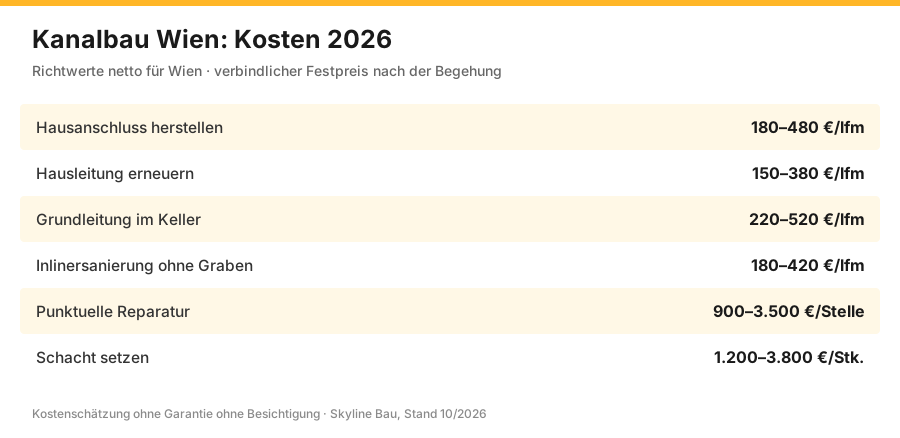
The price is calculated per running metre and depends above all on depth and soil. As a guide:
As of 2026 · net, excl. 20 % VAT · guide values — much depends on the individual case, on depth, soil and surface reinstatement. Final price after site visit, in writing as a fixed price under ÖNORM B 2110.
what matters
- The fall — A sewer must have an even fall: too little and the water stands; too much and the water runs away from the solids. Both lead to blockages. The right fall is the heart of a working sewer.
- Leak-tightness — A leaking sewer loses waste water into the ground, contaminates the soil and in the worst case undermines foundations. After construction, leak-tightness is tested; the record is part of the acceptance.
- The bedding — The pipe lies in a sand bed and is carefully backfilled. Incorrect backfilling leads to settlement that changes the fall — then the water stands despite the new pipe.
- Roots — Ingrowing roots are a common cause of damage in older sewers. This can be avoided through the choice of route and tight joints.
- Permits — The connection to the public sewer must be registered with Wien Kanal, and excavations on public land require a permit. We clarify this before construction starts.
Sewer construction — in all 23 districts and the surrounding area
We carry out sewer construction throughout Vienna, as well as in Klosterneuburg and the surrounding area of Lower Austria.
from the trench to the acceptance
01 Site visit & planning
Route, depth, connection point, fall. For existing pipes, a CCTV survey shows the condition. Free of charge.
02 Offer & permit
Bill of quantities with a fixed price under ÖNORM B 2110, plus registration with Wien Kanal and the excavation permit.
03 Excavation
The trench is excavated and secured. In confined locations or under roads, this is the most elaborate part.
04 Pipe laying
Laying in a sand bed with an exact fall, tight joints, manholes and connections.
05 Leak-tightness test
Testing of leak-tightness and fall before backfilling — with a record for the acceptance.
06 Backfilling & reinstatement
Professional backfilling and reinstatement of the surface — paving, asphalt or green space.
Why Skyline Bau for your sewer construction in Vienna
We are the executing building contractor and carry out sewer construction with our own people. The advantage shows when the sewer is part of a larger project: house connection and foundation often lie in the same excavation, and a defective sewer is often the cause of damp in the basement. Planned from one source, nothing gets dug twice.
- One contractual partner for sewer, civil engineering and adjacent work.
- Fixed price according to ÖNORM B 2110, in writing after the site visit.
- Leak-tightness test with record for the acceptance.
- Registration and permit are handled by us.
- €3 million construction liability insurance.
How to recognise a reputable contractor
1. Is the fall planned?
Without an exact fall, no sewer works. A serious offer describes it instead of just saying "lay pipe".
2. Is the leak-tightness test included?
The test with record is part of the service and of the acceptance. If it is missing, the proof is missing.
3. Are permits planned in?
Registration with Wien Kanal and the excavation permit are part of it. Anyone who digs without them risks trouble with the authorities.
4. How is backfilling done?
Backfilling decides on settlement. Professional bedding and compaction are more important than they sound.
5. Is surface reinstatement clarified?
Paving, asphalt, green space — reinstatement can be a large item. It belongs in the offer.
6. Warranty named correctly
Statutory 3 years under § 933 ABGB on the workmanship.
When you do not need us
For simple pipe cleaning or clearing a blocked pipe, call a drain service — that is faster and cheaper. We are the right choice when a sewer has to be newly built, a house connection made or a defective pipe renewed with excavation.
what it includes
Sewer construction is civil engineering with a required fall and a duty of leak-tightness. What is connected:
Sewer trenches are civil engineering — excavation, securing, backfilling.
Before the pipe comes the trench, after it professional backfilling.
House connection and foundation often lie in the same excavation — sensible to bundle.
A defective sewer is often the cause of damp in the basement.
Before damp-proofing, the source of the water — often the sewer — must be clarified.
The overview of all renovation services.
what you should know
So that you know exactly what to expect, we answer the most important questions here — honestly and from the practice of a building contractor that does the work itself.
What does sewer construction include?
Sewer construction concerns waste water disposal: foul and surface water sewers, house connections to the public sewer, manholes and inspection openings. It includes excavation, laying with the right fall, leak-tightness testing and reinstatement of the surface. We take on the project from one source; the connection to the public network is made by licensed partners.
When does a sewer need to be rehabilitated or rebuilt?
Signs are: blockages, backflow, odour, damp basements or subsided areas above the pipe. Old, leaking sewers let water seep away or roots grow in. A CCTV survey shows the condition — then it is decided whether repair or new laying makes sense.
How much does sewer construction in Vienna cost?
The costs depend on pipe length, trench depth, ground conditions and connection points. A simple house connection is cheaper than a long sewer route with several manholes. After a site visit you receive a binding fixed-price offer including earthworks.
Are the earthworks included?
Yes — excavation, trench support, bedding, backfilling and reinstatement are part of the scope. This way you have one contact person for the entire project instead of awarding earthworks and sewer laying separately.
Sewer construction company in Vienna: what the firm should be able to do and show
A sewer construction company works in a place nobody sees again after backfilling. That is exactly why it pays to ask in advance how the work is done. A sewer only works if fall, bedding and leak-tightness are right – defects often only show years later as blockages, root ingress or damp in the basement.
Five points separate a careful contractor from one that just digs:
- Survey before the offer: location of existing utilities and, where possible, a CCTV survey. Without it, any lump-sum price is guesswork.
- Trench shoring from 1.25 m depth: an unsecured trench is life-threatening. If the offer contains no shoring, a mandatory item is missing.
- Leak-tightness test with record: only the record proves that the new pipe is tight – and it is your proof towards Wien Kanal.
- As-built plan after completion: location, depth and manholes surveyed so that later work does not have to search.
- Clear responsibility: who obtains the permit for work on public land and who reinstates the surface should be agreed in writing.
We take on sewer construction as general contractor: excavation, laying and reinstatement coordinated from one source, the connection work to the street sewer with licensed partner firms.
Sewer in the courtyard and under the building passage
In densely built districts, the house drain rarely lies under an open garden. More often it runs under a paved courtyard, under the entrance passage of a tenement building or even under the basement floor. This fundamentally changes the work. An excavator often does not fit through the passage, so digging is done with a mini excavator or by hand. Excavated material has to go to the street by wheelbarrow or conveyor belt, where a skip may only stand with a permit.
Care is needed under vaults and old foundations: if digging comes too close to the base of a wall, it can give way. Here the survey decides whether a trenchless method with a liner is possible – this saves excavation, paving and time. If the pipe has collapsed, the only option is an open trench, in sections and with secured walls. Because residents need access to the building and the bins, the passage is bridged with steel plates rather than closed. Deeper interventions around foundations are described on the foundation underpinning page.
When is the right time for sewer construction
A sewer can in principle be built all year round, as long as the ground is not deeply frozen. The surface is the real bottleneck: asphalt needs dry weather and sufficient temperatures, otherwise a temporary surface remains until spring. It also makes sense to bundle the sewer with other work in the ground. Anyone who is waterproofing the basement, laying drainage or re-paving the courtyard anyway is better off digging once than three times. If a new surface is planned afterwards, it is worth looking at paving.
Frequently asked questions about sewer construction in Vienna
How much does a sewer connection in Vienna cost?
Who pays for the sewer connection?
What is the sewer connection fee?
Do I have to connect my house to the sewer?
How do I know whether there is a branch for my property?
What happens to the old cesspit?
Is an excavation permit needed?
How much does sewer construction in Vienna cost?
A house connection is calculated per running metre and is roughly €150 to €350 per metre, depending on depth, soil and surface reinstatement. The pipe price is the smaller part — excavation, support and backfilling make up the effort. It becomes reliable after a site visit.
Why is the fall so important?
Because a sewer does not work without the right fall. Too little and the water stands; too much and it runs away from the solids — both lead to blockages. The even fall is the heart of a working sewer, not a detail.
Must a sewer be watertight?
Yes, that is mandatory. A leaking sewer loses waste water into the ground, contaminates the soil and in the worst case can undermine foundations. After construction, leak-tightness is tested; the record is part of the acceptance.
Does sewer construction need a permit?
As a rule, yes. The connection to the public sewer must be registered with Wien Kanal, and excavations on public land need a permit. We clarify and apply for this before construction starts — no digging without a permit.
How long does a sewer last?
A professionally laid sewer made of modern pipes lasts for decades. Problems almost always come from the wrong fall, settlement due to poor backfilling or ingrowing roots. That is why careful bedding and backfilling are as important as the pipe itself.
What is a sewer CCTV survey?
A camera is guided through the sewer to check its condition from the inside — cracks, roots, offsets, fall. For existing pipes it shows whether a repair is enough or renewal is necessary, before any digging.
What is the difference between a drain pipe and a house connection?
The drain pipe collects the waste water within the property under the floor slab; the house connection links it to the public sewer. Both must be watertight and have the right fall — damage often occurs at the transitions.
Why do roots grow into the sewer?
Roots seek water and penetrate through leaking joints or fine cracks, where they then form dense root balls. Old sewers with socket joints are particularly susceptible. Modern, tightly welded or bonded pipes and the right choice of route help prevent this.
Can a sewer be rehabilitated without digging?
In some cases, yes — with trenchless methods such as a liner pulled in from the inside. This is possible with an intact alignment and minor damage. With fall problems, fractures or settlement, however, there is no way around excavation. What is possible is shown by the CCTV survey.
What happens during backfilling?
The pipe is laid in a sand bed and backfilled and compacted in layers with the right material. If this is botched, the ground settles, the pipe loses its fall and water backs up. Backfilling is therefore a quality-critical step.
How deep does a sewer lie?
Deep enough to be frost-free and to achieve the necessary fall to the connection point — often one to several metres. The exact depth results from the connection point on the public sewer and the route. Greater depth means more excavation and higher costs.
What is an inspection manhole?
An accessible manhole along the sewer through which it can be inspected, cleaned and, if necessary, surveyed by camera. It is placed at changes of direction and at intervals. Without inspection manholes, a sewer can hardly be maintained later.
Can a defective sewer cause damp in the basement?
Yes, this is a common connection. A leaking sewer or defective drain pipe releases water into the ground, which then penetrates the basement masonry from outside. Anyone with damp basement walls should have the sewer checked as a possible cause.
Should sewer and foundation be done together?
If both are due, yes. House connection and foundation work often lie in the same excavation — doing them together saves a second round of digging and therefore costs. That is why it pays to plan both together.
What needs to be considered with surface reinstatement?
After backfilling, the surface must be reinstated — paving, asphalt or green space. This can be a considerable cost block, especially with elaborate existing surfaces. This item belongs clearly in the offer, otherwise it comes as an extra charge.
How long does sewer construction take?
A simple house connection is often finished in a few days; complex pipes with deep trenches, road crossings or difficult soil take longer. The permit beforehand can take more time than the actual excavation. We reflect this in the schedule.
What is part of drainage?
Drainage carries seepage and groundwater away from the building to keep the masonry dry. It consists of perforated pipes in a gravel pack with a fall to a collection point. It is a separate topic that is often planned together with basement waterproofing and sewer construction.
Who is responsible for the sewer on my property?
The property owner for the pipes up to the connection point on the public sewer. From there, Wien Kanal takes over. This means: the drain pipe and house connection on your land are your business — that is where we come in.
Can the sewer be renewed while the building is in use?
Usually yes, with planning. For short phases the waste water can be diverted or the connection routed temporarily. It rarely works entirely without interruption, but downtimes can be kept short. We discuss this in the schedule.
How much does a sewer CCTV survey cost?
A survey starts at around 350 euros, depending on length and accessibility. It is the inexpensive basis for every decision: only when the condition is known from the inside can it be said whether repair or renewal is necessary — instead of digging on suspicion.
What needs to be considered with heavy rain?
With increasing heavy rainfall, correct sizing and sometimes the separation of rainwater and foul water are important so that the sewer is not overloaded. A backflow valve protects against water being pushed back into the house when the public sewer is overloaded.
What is a backflow valve?
A flap in the pipe that closes when water from the public sewer would push back — for example during heavy rain. It protects low-lying rooms from flooding due to backflow. In vulnerable locations it is strongly recommended.
Does the whole sewer have to be renewed or is a section enough?
The CCTV survey shows this. If only one section is damaged, renewing it or trenchless rehabilitation is often enough. With continuous fall or settlement problems, complete renewal makes more sense. We recommend what the condition calls for, no more.
How do I recognise that my sewer has a problem?
Typical signs: recurring blockages, gurgling in the drains, unpleasant odours, damp basement walls or water emerging in the garden. With such signs, a CCTV survey brings clarity before major damage occurs.
Do I get a warranty on the sewer construction?
Yes, the statutory 3-year warranty under § 933 ABGB on the workmanship. The leak-tightness record from the acceptance is important proof that the sewer was built properly and is watertight.
What is the most common expensive surprise in sewer construction?
The ground and the depth. If the excavation hits rock, old pipes or groundwater, the calculation changes. Elaborate surface reinstatement can also be costly. Because we work with a fixed price after a site visit, we clarify this beforehand, not in the middle of the trench.
Does Skyline Bau also lay rainwater pipes?
Yes. Draining and infiltrating rainwater is part of civil engineering — from the gutter through the pipe to the soakaway trough or the sewer. Whether infiltration or discharge is permitted depends on the location and the requirements; we clarify this as well.
Can sewer work and basement waterproofing be combined?
Yes, this often makes sense. If digging around the building is needed anyway because of a defective sewer, the basement waterproofing from outside can be done at the same time. This saves a second excavation and eliminates causes of damp together.
Does Skyline Bau work with Wien Kanal?
We handle the necessary registration of the connection and the excavation permit so that everything proceeds according to regulations. The public sewer itself remains the responsibility of Wien Kanal — we professionally make the connection from your property to it.
Why is excavation more expensive than the pipe?
What is liner rehabilitation?
When does a liner not work?
What fall does a sewer pipe need?
What is the backflow level?
Do I need a backflow valve?
When do I need a lifting station?
How long does a house connection take?
What happens to the street?
What about other utilities in the trench?
How much does hand excavation cost?
What needs to be considered with groundwater?
Can a leaking sewer cause settlement?
What do I receive at the end?
Which documents should a sewer construction company hand over after the work?
Can a sewer under a building passage be renewed without closing the building?
Why is hand excavation in a courtyard so much more expensive than with an excavator?
Related services
Sewer finished? Driveway and basement handed over clean.
Sewer work brings dirt into the basement, driveway and staircase. Bling Premium Cleaning takes care of the cleaning afterwards, and if required also disinfection of affected basement areas. More at bling-bling.at.
Send enquiry
Enquire directly here — fixed-price quote free of charge. Skyline Bau replies within 2 working days.
Ready for your sewer connection in Vienna?
Write to us directly on WhatsApp — send photos. Reply within 2 working days.
Note: Skyline Bau is the brand name of the construction and renovation division of Bling Bling GmbH and is not a separate legal entity. The sole contractual partner is Bling Bling GmbH. Bling Bling GmbH is a restricted construction trade business under § 99 GewO (Austrian Trade Regulation Act) and not a licensed master builder (Baumeister). Under § 99 (5) GewO, the title “Baumeister” is reserved for businesses licensed under § 94 no. 5 GewO. Regulated trades — master-builder services, structural engineering, gas and sanitary engineering, electrical engineering — are carried out exclusively by authorised, licensed partner companies.