Basement ceiling insulation Vienna the ground-floor floor is warm again.
Basement ceiling insulation in Vienna: from the contractor who does the work — not from a broker.
Basement ceiling insulation in Vienna: insulating a basement ceiling in Vienna costs €40 to €150 per square metre. Exposed insulation boards €40–75/m², with a coating €55–95/m², with a substructure €85–150/m². No scaffolding, no permit, finished in a few days – and you feel the difference immediately.
What basement ceiling insulation costs in Vienna
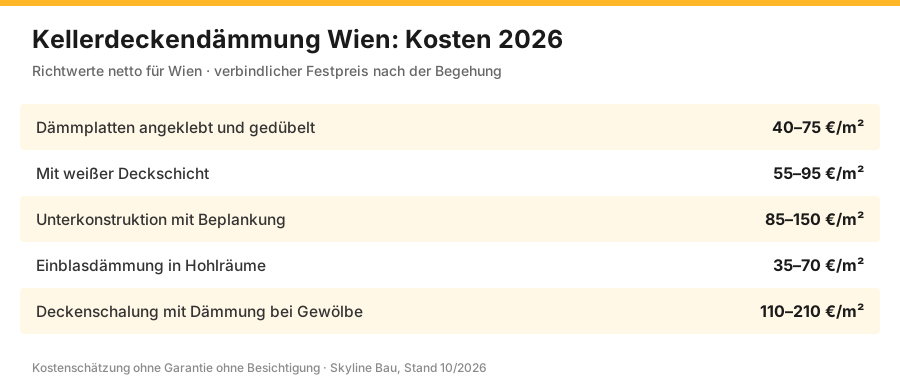
Guide prices net, as of 2026, binding after a site inspection. Basement ceiling insulation makes an immediate, noticeable difference because it tackles the exact spot where residents feel the cold: the floor.
| Option | Build-up | Price net | Duration |
|---|---|---|---|
| Insulation boards, bonded and dowelled | EPS or mineral wool 10–14 cm, left exposed | 40–75 €/m² | 2–5 days |
| With white top layer | additionally coated or skimmed | 55–95 €/m² | 4–8 days |
| Substructure with board cladding | for uneven ceilings or fire protection requirements | 85–150 €/m² | 1–2 weeks |
| Blown insulation into cavities | for timber joist ceilings above the basement | 35–70 €/m² | 2–4 days |
| Ceiling boarding with insulation for vaults | Viennese brick vaults, custom-fitted | 110–210 €/m² | 2–4 weeks |
Unit prices
| Item | Unit | Price net | What is included |
|---|---|---|---|
| Site inspection and moisture measurement | lump sum | free of charge in Vienna | Measurement, ceiling build-up, moisture test |
| Cleaning and preparing the ceiling | m² | 6–16 € | Removing loose material, bonding primer |
| Hacking off old plaster where it is hollow | m² | 15–38 € | Hacking off, disposal, re-plastering |
| EPS insulation boards 12 cm | m² | 28–48 € | Adhesive, boards, dowels |
| Mineral wool boards 12 cm | m² | 38–68 € | non-combustible, better acoustics |
| Insulation boards with white surface | m² | 48–85 € | Fleece-laminated, left directly exposed |
| Coating or skim finish | m² | 14–32 € | Reinforcement, paint, clean appearance |
| Edge areas and junctions | linear m | 12–28 € | Wall junctions, reveals, transitions |
| Insulating around pipes and services | linear m | 18–45 € | Cut-outs, sleeves, insulating cold water pipes |
| Basement window and door reveals | pc. | 60–180 € | Insulating wedge, junction |
| Clearing out the basement area | m³ | 45–110 € | Clearance, sorting, disposal |
| Fire-rated cladding where required | m² | 35–75 € | Substructure, boards according to classification |
Total around €24,500 net, which works out at €94/m². Without the coating, i.e. with exposed insulation boards, it would be around €17,000. In basements used only for storage, this is the more common option.
How basement ceiling insulation compares
| Building element | Share of heat loss | Price per m² | Scaffolding | Permit | Noticeable for residents |
|---|---|---|---|---|---|
| Basement ceiling | 6–12 % | 40–75 € | no | no | immediately, at floor level |
| Top-floor ceiling | 15–25 % | 35–70 € | no | no | indirectly |
| Facade | 20–35 % | 120–190 € | yes | usually yes | after one heating season |
| Windows | 10–20 % | €750–1,800/pc. | partly | yes in a protected zone | immediately, draughts |
First check that the basement is dry
Basement ceiling insulation is one of the cheapest measures of all — but only if one condition is met: the basement must be dry. Insulation has no place in a damp old basement. Mould grows behind it, and you end up paying twice.
- Clarify the moisture first. Rising damp is the rule, not the exception, in Vienna's Gründerzeit buildings (built 1848–1918). Every basement ceiling insulation job should start with a moisture measurement — with a written record, not a gut feeling.
- Watch the ceiling height. Insulating the basement ceiling takes away height. In low old basements this can make the room unusable. Measure beforehand rather than regret it afterwards.
- Services on the ceiling. Pipes and cables under the basement ceiling have to be worked around, re-hung or insulated along with it. That takes effort — and belongs in the quotation as a separate item.
- Fire protection. If the basement forms part of an escape route or there is a garage beneath it, requirements apply to the combustibility of the insulation. That is no mere formality.
How to recognise a reputable provider
Check these points with every contractor offering basement ceiling insulation in Vienna — including us.
1. Was the moisture measured?
No moisture measurement, no basement ceiling insulation. Anyone who sends a quotation straight away without having been in the basement has skipped the most important step.
2. Ceiling height checked?
The insulation costs height. In low old basements this can be decisive.
3. Services routing in the quotation?
Pipes and cables under the basement ceiling mean extra work. If they are not in the bill of quantities, they will come back as a variation.
4. Fire protection taken into account?
For escape routes and garages, requirements apply to the combustibility of the insulation material.
5. Ask for the GISA number
The Austrian trade register (Gewerberegister) shows you which trades the business has actually registered.
6. Do not confuse the warranty
By law 3 years under § 933 ABGB (Austrian Civil Code) for immovable property.
Key figures and guide values
- Cost: €30-100/m².
- Heating cost saving: up to 10%.
- Minimum insulation thickness: 12 cm of mineral wool or polystyrene.
- Construction time: 1-3 days for a standard detached house.
- Eligibility for funding: can be funded by the City of Vienna (THEWOSAN) and the federal government (renovation bonus, Sanierungsbonus) at the same time.
- Comfort effect: completely eliminates cold floors on the ground floor.
- Fire protection: A1 mineral wool recommended where basement fire protection requirements apply.
The four method variants
Classic board installation
The standard. EPS or mineral wool boards 12-18 cm thick are bonded and dowelled to the basement ceiling. €55-95/m². Easy to carry out on accessible, smooth ceilings. Construction time 1-2 days.
Polyurethane spray insulation (PUR)
Rigid PUR foam is applied with a spray gun. Lambda 0.022-0.025 W/mK. €60-110/m². Joint-free, seamless, the highest insulation value per centimetre. Ideal for awkwardly shaped old basements.
Blown-in insulation with a suspended ceiling
In old Viennese buildings with lots of pipes and services: a suspended ceiling is installed and filled with blown-in mineral wool. €55-95/m². Still worthwhile even where little ceiling height remains.
Special methods for cramped Viennese basements
Narrow inner-city basements, often with a ceiling height of only 1.90–2.10 m — special materials with a thinner PIR build-up.
Insulation materials compared
- EPS boards (polystyrene): lambda 0.032-0.038 W/mK. Economical. Standard 14 cm. Fire class E.
- Mineral wool boards: lambda 0.035-0.040 W/mK. Fire class A1 (non-combustible). The standard where fire protection requirements apply.
- Rigid PUR foam: lambda 0.022-0.028 W/mK. The slimmest build-up, the highest insulating performance per centimetre. For cramped Viennese basements.
- Rigid PIR foam: lambda 0.022-0.025 W/mK. Like PUR, but fire-classified (B1). For Viennese basements where fire protection is relevant.
- Wood fibre boards: lambda 0.038-0.045 W/mK. Ecological. Ideal in building-physics terms for timber joist ceilings (moisture-buffering).
- Calcium silicate boards: lambda 0.058-0.065 W/mK. For old basements with moisture problems — capillary-active, eliminates the risk of condensation.
Costs 2026 by method and size
- EPS board installation 14 cm: €30-50/m². Detached house with 60-90 m² basement ceiling = €1,080-2,520.
- Mineral wool board installation 16 cm: €40-65/m². Detached house = €1,320-3,150.
- PUR spray insulation 8-10 cm: €60-100/m². Detached house = €2,100-4,950.
- PIR board installation 10 cm: €55-90/m². Detached house = €1,920-4,320.
- Blown-in insulation, suspended ceiling: €55-95/m² incl. ceiling construction. Detached house = €1,800-4,950.
- Special method for inner-city old buildings: €75-140/m² depending on effort. Flat with 50-80 m² basement ceiling = €2,250-6,800.
- Additional building physics report for old Viennese buildings with a moisture risk: €800-2,500.
- Submission to MA 37 (building authority) where a permit is required: €350-1,200.
- Energy performance certificate under OIB Guideline 6: €350-850 for a detached house, €1,200-2,500 for an apartment building.
Subsidy landscape 2026
- THEWOSAN City of Vienna: thermal and energy-efficient residential renovation — 30-35% of the eligible costs as a non-repayable grant for basement ceiling insulation.
- Federal renovation bonus 2026 (Sanierungsbonus): up to €9,000 for individual thermal measures — basement ceiling insulation can be funded on its own.
- Federal renovation drive (Sanierungsoffensive): up to €14,000, can be combined comprehensively.
- OeKB climate loan: low-cost loan financing for insulation measures.
- City of Vienna — thermal and energy-efficient renovation: the central funding scheme for “thermal insulation of external walls, party walls, top-floor ceilings, roofs, basement ceilings or the replacement of windows and doors”.
- Hauskunft Wien: free, manufacturer-independent advice — the first port of call before any funding application.
- Apply BEFORE construction starts: mandatory. A late application = loss of funding.
OIB guidelines and the ÖNORM family
- OIB Guideline 6 (2023 edition): U-value ≤ 0.40 W/(m²K) for basement ceilings as standard. With funding, a U-value ≤ 0.30 W/(m²K) is required.
- ÖNORM B 8110-1: thermal protection in building construction, requirements.
- ÖNORM B 8110-2: water vapour diffusion and condensation prevention — critical for Viennese basement ceilings above damp rooms.
- ÖNORM B 8110-6: energy performance certificate calculation — mandatory for a funding application.
- ÖNORM B 6000 family: requirements for thermal insulation materials.
- OIB Guideline 2: fire protection — A1 mineral wool is mandatory where basement fire protection requirements apply.
- Vienna Building Code (WBO): submission to MA 37 is mandatory where structural aspects are affected.
- ÖNORM B 2110 (2023 edition): contract for work with a fixed-price guarantee.
Six case studies 2026
Detached house, Floridsdorf, 75 m² basement ceiling
EPS board installation 14 cm. Total €1,800, THEWOSAN funding 30% = €540, net €1,260. Heating cost saving 7% p.a.
Terraced house, Donaustadt, 55 m² basement ceiling
Mineral wool 16 cm. Total €1,650, funding €500, net €1,150. Comfort: cold floors in the ground-floor living room completely eliminated.
Viennese Gründerzeit flat, Mariahilf, 45 m² basement ceiling
Cramped inner-city basement: PIR 10 cm with a special build-up. Total €2,200, funding €660, net €1,540. Skyline special method.
Viennese period apartment building (Zinshaus), Hernals, 6 flats, 120 m² basement ceiling
Based on a resolution of the condominium owners' association (WEG). Mineral wool 14 cm. Total €3,840, funding €1,150, net €2,690. Lower heating costs for all 6 flats.
Cottage villa, Hietzing, 90 m² basement ceiling
Premium wood fibre 18 cm for compatibility with the timber joist ceiling. Total €3,420, funding €1,025, net €2,395.
Old Viennese flat, Neubau district, 38 m² basement ceiling
Special calcium silicate build-up because of moisture. Building physics report + submission to MA 37. Total €3,800, funding €1,140, net €2,660.
Skyline Bau's 8-step process in Vienna
- Step 1 — Advice from Hauskunft (free): first port of call hauskunft-wien.at. Free advice on funding.
- Step 2 — On-site inspection by Skyline Bau: measuring the basement ceiling, analysis of the existing structure, moisture check, inventory of services.
- Step 3 — Building physics assessment: choice of method. An additional report where there is a moisture risk.
- Step 4 — Energy performance certificate under OIB Guideline 6: a mandatory prerequisite for the funding application.
- Step 5 — Funding application BEFORE construction starts: THEWOSAN, renovation bonus, renovation drive — all applications BEFORE the contract is awarded.
- Step 6 — Submission to MA 37: where a permit is required (structurally relevant interventions, special build-up). Skyline routine.
- Step 7 — Construction: 1-3 days for standard work, up to 5 days for special methods.
- Step 8 — Final acceptance and payment of funding: funding is paid out once the final account and the new energy performance certificate have been submitted.
Specifics of Vienna's districts
- Districts 1-9 (inner city, Gründerzeit): mostly cramped old basements, low ceiling heights, timber joist ceilings, lots of services. Skyline special method.
- Districts 10-19 (mixed building stock): terraced houses and residential complexes from the 1960s-1980s with accessible basements. Classic board installation is standard.
- Districts 20-23 (outer districts): cottage villas, detached houses, terraced houses. PUR spray insulation is popular for awkwardly shaped basements.
- Floridsdorf (Skyline Bau's home district): Skyline knows the typical 1970s terraced-house basements with low ceilings and lots of services.
- Donaustadt (aspern Seestadt): new builds with modern insulation — basement ceiling insulation is already in place from the outset. Here it is more about optimisation than retrofitting.
- Hernals, Ottakring, Hietzing: many cottage houses with timber joist ceilings and wooden beams — a special wood fibre build-up is standard.
Special topics in old Viennese buildings
- Timber joist ceilings (Tramdecken) in Gründerzeit buildings: require a moisture-buffering material (wood fibre or cellulose). Classic PUR spray insulation is problematic.
- Low ceiling heights in inner-city basements: often only 1.90-2.10 m. Special materials with the thinnest build-up (PIR 8 cm instead of EPS 14 cm).
- Rising damp from Viennese basement walls: first renovate the plinth with a horizontal damp-proof barrier, then insulate the basement ceiling. The order is crucial.
- Timber beam ends in the basement ceiling: critical in building-physics terms — risk of condensation at the bearing point. A special build-up is needed.
- Viennese basement rooms used as boiler rooms: basement ceiling insulation makes less sense here — insulating the boiler room walls is more sensible instead.
- Inventory of services in old Viennese buildings: lots of water, gas and electricity lines under the ceiling — blown-in insulation in a suspended ceiling is often the best solution.
- Fire protection requirements: in multi-occupancy buildings, A1 mineral wool (non-combustible) is often mandatory.
- Mandatory submission to MA 37: where structural aspects are affected or the load-bearing structure is altered. Skyline routine.
Common mistakes and how to avoid them
- Mistake 1 — ignoring moisture: basement ceiling insulation above damp walls = mould damage within 2-5 years. Renovate the plinth first, then insulate.
- Mistake 2 — the wrong material for timber joist ceilings: PUR spray insulation on wooden beams traps moisture. Solution: wood fibre or cellulose.
- Mistake 3 — applying for funding only after awarding the contract: the funding is refused. The correct order: application first, then contract.
- Mistake 4 — the wrong U-value design: 8 cm is often not enough for funding. Minimum insulation thickness 12 cm.
- Mistake 5 — forgetting fire protection: A1 mineral wool is mandatory in multi-occupancy buildings. EPS is only permitted with fire barriers.
- Mistake 6 — ignoring thermal bridges at the walls: if the insulation does not run right up to the wall → thermal bridge. Solution: a continuous insulation line carried into the wall junction.
- Mistake 7 — underestimating building physics in cramped Viennese basements: standard materials do not work. Use Skyline Bau's special method.
- Mistake 8 — DIY installation: without professional workmanship, funding and warranty are lost. Better to use a contractor who carries out the work.
Added value and life cycle
- Payback period: typically 6-12 years on energy savings alone. Plus a considerable gain in comfort.
- Service life of mineral wool and EPS: 50+ years.
- Service life of PUR/PIR foam: 40-60 years.
- Service life of wood fibre: 40-50 years with correct building physics.
- Maintenance: practically maintenance-free. With a suspended ceiling, a visual inspection every 10 years.
- Heating cost saving: 5-10% p.a. for a typical detached house.
- Increase in property value: +1-3% of market value from basement ceiling insulation alone. Considerably more if the energy performance class goes up a band.
- Skyline Bau warranty: 3 years under § 933 ABGB on all construction work.
Why choose Skyline Bau for your basement ceiling insulation?
First — we measure the moisture first. Insulation has no place in a damp old basement. If the measurement shows that the moisture has to be dealt with first, we tell you so — even if that makes the job bigger or smaller than you expected.
Second — the complete renovation model. We combine basement ceiling insulation with riser renovation, underfloor heating installation on the ground floor or plinth renovation in old Viennese buildings — all from a single source with a fixed price under ÖNORM B 2110:2023.
Third — funding routine. THEWOSAN application + renovation bonus + renovation drive combined. Application before construction starts, energy performance certificate as the first step.
Fourth — building physics know-how. Gründerzeit timber joist ceilings, timber beam ends, low inner-city basements, rising damp — standard knowledge at Skyline Bau. We coordinate the entire process with licensed master builder partners (§ 94 Z 5 GewO).
Subsidies: what you need to check yourself
Several funding schemes come into question for basement ceiling insulation in Vienna — THEWOSAN for thermal residential renovation, the federal renovation bonus and, if the heating system is replaced, the “Raus aus Gas” (Out of Gas) programme as well. We deliberately do not quote specific amounts here. Funding levels, conditions and application deadlines change constantly, sometimes several times a year. A commitment that is correct today may be wrong next month.
- Apply before construction starts. This is the most common mistake. Anyone who starts the basement ceiling insulation and applies for funding afterwards usually gets nothing. The order is not negotiable.
- Check at the source. Current subsidy amounts for Vienna can be found with the City of Vienna and the Vienna Housing Fund (wohnfonds_wien); for federal subsidies, with the renovation campaign (Sanierungsoffensive). The free advice service Hauskunft is the usual first step.
- Insulation thickness is decisive. Funding is usually tied to minimum insulation thicknesses and the energy performance figures achieved. We plan the basement ceiling insulation so that the requirements are met — but the commitment is given by the funding body, not by us.
- Your own labour is rarely recognised. Anyone who works on the project themselves often loses their entitlement. It is better to clarify this beforehand too.
We support you with the paperwork and plan so that the work qualifies for subsidies. What we do not do: promise you a subsidy amount that is not ours to decide.
what is included
Insulating the ceiling above an unheated basement works above all against cold floors. Related topics:
If the basement is damp, insulating the ceiling achieves little — the moisture has to go first.
Rising damp is common in old Viennese buildings. It must be resolved before any insulation, otherwise mould grows behind it.
The overview: which insulation for which part of the building.
The counterpart at the top. Both together are inexpensive and take effect immediately.
Basement plus roof plus façade — the complete package.
When the ground-floor floor is renovated instead of the basement ceiling.
Basement ceiling insulation — in all 23 districts and the surrounding area
We carry out basement ceiling insulation throughout Vienna, as well as in Klosterneuburg and the surrounding area of Lower Austria.
what you should know
So that you know exactly what to expect, we answer the most important questions here — honestly and from the practice of a construction company that carries out the work itself.
What does basement ceiling insulation achieve?
Insulating the basement ceiling stops heat escaping from the living spaces into the unheated basement. This gives warmer floors on the ground floor, lowers heating costs and increases comfort. It is easy to carry out and offers a good cost-benefit ratio.
How is the basement ceiling insulated?
Usually, insulation boards are fixed to the underside of the basement ceiling. Where ceiling height is tight, thinner high-performance insulation materials are available. Installation is comparatively quick and possible without major disruption to the living spaces.
Is basement ceiling insulation eligible for funding?
Yes — as a thermal measure it is eligible for funding in Vienna through THEWOSAN. Because it is easy to carry out and has a quick effect, it is a popular element of energy-efficient renovation. We check the funding in advance.
What does basement ceiling insulation cost?
The cost depends on the area, the insulation material and the thickness. It is one of the inexpensive insulation measures with a fast payback. After a site visit you receive a fixed-price quotation.
Costs by material, insulation thickness and method
What basement ceiling insulation in Vienna costs depends on three factors: the insulation material, the insulation thickness and the installation method. As a rough guide, basement ceiling insulation in Vienna comes to around €30 to €100 per square metre — the exact price depends on the following points. After a site visit you receive a binding fixed-price quotation.
Costs by insulation material
The insulation material largely determines the price and properties. EPS (expanded polystyrene rigid foam) is the cheapest option at around €30 to €60 per square metre — good for flat basement ceilings. Mineral wool (stone wool) is non-combustible and sound-absorbing and costs around €40 to €80 per square metre. High-performance insulation materials such as resol rigid foam or PU cost around €60 to €110 per square metre — they insulate particularly well at a small thickness and are suitable where ceiling height is tight.
Costs by insulation thickness
The thicker the insulation, the better the effect — and the higher the material price. Usual thicknesses for basement ceiling insulation are 8 to 16 centimetres. Insulation of 8 to 10 cm is the inexpensive entry point; 12 to 16 cm gives the best effect and is usually required for THEWOSAN funding. Where the ceiling height in the basement is tight, thinner high-performance insulation materials are used, which insulate well despite their small thickness.
Costs by installation method
The simplest and cheapest method is bonding or dowelling insulation boards to a flat basement ceiling — here the price is at the lower end. With uneven ceilings, vaulted basements or lots of pipes and services, the effort increases because everything has to be cut and fitted. Suspended systems or blown-in insulation in cavities are more elaborate. After the site visit we tell you which method makes sense for your basement ceiling and what the exact price is.
What else affects the price?
Apart from material, thickness and method, the area (larger areas are often cheaper per square metre), the accessibility of the basement, the condition of the ceiling and any preparatory work all play a role. Funding also has an effect: in Vienna, THEWOSAN funding noticeably reduces the net cost if the insulation thickness is right and the application is made before the contract is awarded.
Ceiling above a carriageway, building entrance or open passage
Not every cold ground-floor ceiling sits above a basement. In many Viennese buildings, a flat or office on the first floor lies directly above the carriageway entrance (Hauseinfahrt); in newer buildings, above an open passage or a walkway through to the courtyard. In terms of building physics, this is a different case: below it there is not an unheated but sheltered room, but outside air. The temperature difference in winter is considerably greater, and OIB Guideline 6 sets stricter requirements for ceilings against outside air than for ceilings above unheated basements.
In practice, this means thicker insulation, a weather-resistant and impact-resistant surface instead of bare boards, and a tight connection to the walls so that no wind can get behind the insulation. The entrance is also often part of the escape route, which is why only non-combustible insulation materials are an option. For entrances with vaulting or stucco, we clarify in advance whether the appearance has to be preserved – in that case, insulating from above, within the floor build-up of the flat, is often the better choice.
Insulate from below, or the ground floor from above?
If the ground-floor flat is being renovated anyway and the floor is being ripped out, the question arises whether the insulation would be better placed in the new floor build-up. Both approaches have their merits. Working from below leaves the flat untouched, the room height does not change, and the entire basement ceiling is insulated in one go – including beneath the stairwell and the neighbouring flat. Working from above, on the other hand, makes you independent of the building: no resolution is needed for the basement, no pipes have to be re-insulated, and the insulation lies beneath the new screed.
The price for this is build-up height. Every centimetre of insulation from above raises the floor, and doors, thresholds and connections to the stairwell have to accommodate this. In tall period rooms this is usually unproblematic; in flats with limited ceiling height, less so. A combination can also make sense: a thinner layer in the floor build-up and insulation from below if the building follows suit later. How the new floor build-up is put together is described on the page screed laying.
How to recognise properly installed insulation
Once the work is finished, it is worth taking a walk round with a keen eye. The boards should be laid in a staggered bond, i.e. without continuous cross joints, and fit tightly together at the butt joints; open joints are thermal bridges. The anchors sit flush – neither protruding nor pressed in deeply. At walls, piers and downstand beams, the insulation connects without a gap, and wherever pipes or cables pass through the ceiling, the boards have been cut out neatly and the gaps re-insulated. Lights and cable trays have been refitted, and junction boxes remain accessible. If you want to know for certain, have a thermal image taken from below in the first winter: weak points show up there as bright lines. For coordination with other measures on the building envelope, see insulation in Vienna.
Frequently asked questions about basement ceiling insulation in Vienna
What does basement ceiling insulation cost per square metre?
Is it worth it with only 6 to 12% heat loss?
Does the ground floor really get warmer?
Basement ceiling insulation: how thick should it be?
How much height do I lose in the basement?
Which insulation suits the basement ceiling?
What applies to fire protection?
Do the insulation boards have to be plastered?
What about the services under the ceiling?
What about cold water pipes?
Does the basement get colder afterwards?
Can condensation form as a result?
What if the basement is damp?
What about Viennese brick vaults?
What about timber joist ceilings above the basement?
How long does the work take?
Does the basement have to be cleared out?
Can residents continue to use their basement storage?
Basement ceiling insulation: do I need a building permit?
Basement ceiling insulation: who pays in a rented building?
Basement ceiling insulation: who decides in a condominium?
Can I do it myself?
How long does the insulation last?
Is it worth combining with other measures?
Basement ceiling insulation: do you also take on small areas?
How is a ceiling above an open carriageway entrance insulated?
Should I insulate the basement ceiling from below or the ground-floor floor from above?
How can I tell whether the basement ceiling insulation has been installed properly?
Legal note: Skyline Bau is the brand name of the construction and renovation division of Bling Bling GmbH and not a separate legal entity. The sole contractual partner is Bling Bling GmbH. It is a restricted building trade business under § 99 GewO (Austrian Trade Regulation Act) and not a licensed master builder (konzessionierter Baumeister).
Under § 99 (5) GewO, the title „Baumeister“ (master builder) is reserved exclusively for businesses licensed under § 94 no. 5 GewO. Regulated trades — master builder services (§ 94 no. 5), structural engineering, electrical engineering (§ 94 no. 16), gas and plumbing (§ 94 no. 25) — are carried out exclusively by authorised, licensed partner firms. Planning, coordination, site management and warranty are provided in our capacity as a construction company carrying out the work.
Contribution to climate protection and CO₂ savings
- CO₂ reduction per detached house: 250–700 kg CO₂/year with 5–10% heating energy savings — depending on the heating system.
- With gas heating: the greatest CO₂ saving effect — approx. 200 g CO₂ per kWh of gas.
- With a heat pump: a smaller absolute effect, because the electricity mix is already cleaner.
- Life-cycle balance: after 18–30 months, the energy used to manufacture the insulation boards has been paid back. After that, it is pure CO₂ savings over a service life of 50+ years.
- Contribution to the climate plan: the City of Vienna's Climate Roadmap 2040 calls for carbon neutrality. Basement ceiling insulation is one contribution within the existing housing stock.
- EU Taxonomy: thermally renovated properties can be classified as “taxonomy-aligned” — relevant when selling to institutional buyers.
Insurance aspects
- Skyline Bau construction liability insurance: €3 million cover. For basement ceiling insulation, this is more than sufficient for typical damage scenarios.
- Your own household insurance: inform your insurer before the construction phase. If the property increases in value, adjust the sum insured.
- Liability risk: with DIY work, the client is personally liable. A contractor carrying out the work assumes the risk during the construction phase.
- Fire-safety insurance aspect: A1 mineral wool complies with insurance requirements in multi-occupancy buildings. EPS only with fire barriers.
- Maintenance contracts after renovation: with a suspended ceiling, a visual inspection every 10 years. Skyline Bau offers a maintenance service.
- Liability for defects: statutory warranty of 3 years under § 933 of the Austrian Civil Code (ABGB). For hidden defects, the limitation period begins on discovery.
Preparation as the property owner's own contribution
Before commissioning Skyline Bau, the property owner can carry out valuable preparatory work themselves and thereby shorten the construction phase:
With basement ceiling insulation in Vienna, experience and clean workmanship are what count. For basement ceiling insulation across Vienna and the surrounding area, you receive a transparent fixed-price quotation.
- Clearing the basement: clear all items out of the Viennese basement before work starts. Skyline Bau needs free access to the ceiling.
- Documenting moisture: if there is visible damp damage, take photos and write a description. Skyline's building physics expert assesses this before the method is chosen.
- Documenting heating costs: gas and electricity bills for the last 3 years — the basis for the cost-effectiveness calculation and the comparison of subsidies.
- Services plan: document known water, gas and electricity lines beneath the Viennese basement ceiling. This prevents interruptions to the works.
- WEG resolution for condominiums: in a multi-occupancy building, the basement ceiling is jointly owned property. Prepare a resolution of the condominium owners' association (WEG) with a qualified majority.
- Inform the neighbours: in a multi-occupancy building, let residents know about the planned construction phase.
- Hauskunft advice appointment: the first port of call is hauskunft-wien.at — free advice before placing an order with Skyline.
Detailed building physics calculation using an example
Using a typical detached house, we show the specific building physics design of a basement ceiling insulation in detail. Starting point: a detached house with 130 m² of living space, 75 m² of which sits above the basement ceiling. Built in 1985, existing basement ceiling of 20 cm reinforced concrete without insulation. Current U-value: 2.8 W/(m²K) — that is extremely poor.
The target is the subsidy standard of U-value ≤ 0.30 W/(m²K). Using mineral wool with a lambda value of 0.035 W/mK, the required insulation thickness is 12 cm. The building physics calculation: 1/U = 1/2.8 + 0.12/0.035 = 0.357 + 3.429 = 3.786 (m²K)/W, so U = 1/3.786 = 0.26 W/(m²K). This meets the subsidy standard with a margin to spare.
At a material cost rate of €22/m² for mineral wool plus installation, the total cost comes to 75 m² × €22/m² = €1,650. With a 30% THEWOSAN subsidy (€495) and a proportionate share of the renovation bonus (€250), the owner's share falls to approx. €905. Annual heating cost savings: 7–9% with a standard gas bill of €1,800–2,200 — i.e. €125–200 per year. Payback in 5–7 years.
Detailed construction at junctions
Professional basement ceiling insulation is all about the details. Insulation performance stands or falls with the quality of the junctions between building components:
If you are planning basement ceiling insulation in Vienna, Skyline Bau is the right choice: basement ceiling insulation in Vienna at a fixed price, carried out professionally and from a single source.
- Wall-to-ceiling junction: the insulation must reach right up to the wall. A gap of just 1–2 cm means 20–30% less insulating effect at that point. Skyline Bau consistently takes the board insulation right up to the wall and fills any remaining joints with PU foam.
- Window junctions with Viennese basement windows: where there are basement light wells, the insulation must be routed around the light well. Solution: a special corner build-up with calcium silicate battens to prevent condensation at the lintel.
- Stair junction: with Viennese basement stairs, the insulation must also be continued beneath the stairs — otherwise a thermal bridge forms. With solid reinforced concrete stairs, this is straightforward using conventional board installation.
- Heating pipes and plumbing lines: all heating pipes on the Viennese basement ceiling must be insulated separately (pipe lagging), in addition to the ceiling insulation. Skyline Bau coordinates this detailed work with its heating engineering partner.
- Electrical cables and lighting: the electrical cables are planned before the insulation is installed. Socket boxes are fitted with special adapters. Skyline coordinates with a licensed electrical engineer (§ 94 Z 16 GewO).
- Fire stopping: in multi-occupancy buildings with fire compartmentation requirements, penetrations through the basement ceiling must be sealed in compliance with fire-safety rules.
- Plinth junction in inner-city period buildings: a critical point — this is where rising damp comes into play. Before installing the insulation, renovate the plinth with a horizontal damp-proof barrier.
- Render junction with a visible finish: if the insulation is to be rendered (e.g. because the basement is used as living space), it receives a reinforcing layer and a finishing render, as with ETICS facades.
Special case: an owner-occupied flat in a multi-occupancy building
In multi-occupancy buildings, basement ceiling insulation is legally and organisationally complex. Here is the typical constellation:
- Who decides? The basement ceiling is jointly owned property. A WEG resolution with a qualified majority is required.
- Who pays? Proportionately, according to the share of use value (Nutzwert). When applying for funding, the subsidy is divided proportionately among the flat owners.
- Who benefits? Primarily the residents of the ground-floor flats (fewer cold feet, lower heating costs). Often a point of contention in WEG discussions.
- THEWOSAN application procedure for a WEG: WEG majority, application by the property management, payment to the WEG. Skyline Bau coordinates with property managers.
- Reserve fund aspect: the WEG reserve must be sufficient. A special renovation levy is an alternative if the reserve is low.
- Early termination of the tenancy? No — tenants must tolerate the construction phase (with prior notice). The increase in value benefits the landlord.
- Rent increase after renovation: possible for the main rent under § 18 MRG — the renovation costs are passed on proportionately to tenants over several years.
What determines the price
Prices for basement ceiling insulation vary significantly by district and provider model. Here is a market overview for 2026:
- Inner districts (1–9) with special methods: €75–140/m² net. Due to cramped conditions and the effort involved in submissions to MA 37.
- Outer districts (10–23) with standard board installation: €55–95/m² net. The most economical segment.
- Multi-occupancy buildings commissioned via the WEG: €40–70/m² net. Larger areas, economies of scale in material purchasing.
- Individual orders without subsidy optimisation: €80–140/m² gross — higher because less subsidy is secured.
- Skyline Bau fixed price under ÖNORM B 2110:2023: typically €45–80/m² net depending on specialisation — no extra charges, guaranteed.
- Pure insulation specialists: often cheaper on materials alone, but without the MA 37 submission and without subsidy support.
- Housing renovation programmes: in council housing (Gemeindebau) renovations, bulk prices below €18/m² are possible.
- Premium providers with a full service: €80–140/m² gross — the Skyline Bau level for special methods and routine MA 37 handling.
Tax aspects for property owners
Basement ceiling insulation has different tax consequences depending on how the property is used. A brief overview (not tax advice):
- Owner-occupied main residence: no direct tax deduction for renovation costs. The increase in value only becomes relevant on a later sale (main residence exemption).
- Let flat or house: renovation costs are deductible as income-related expenses (Werbungskosten) — either as maintenance expenditure or as production expenditure.
- Maintenance expenditure: for the mere renewal of existing building components — an immediate deduction in the year of payment is possible.
- Production expenditure: for a substantial improvement or the creation of new building components — spread over 15 years as proportionate income-related expenses.
- Basement ceiling insulation as maintenance or production expenditure? If in doubt, maintenance expenditure — immediately deductible. In the case of a very substantial improvement, production expenditure. Tax advice is recommended.
- Input VAT deduction for commercial letting: with letting subject to VAT (hotel, commercial), input VAT is deductible.
- Subsidies and tax: non-repayable grants are not taxable — but they are deducted from the acquisition or production costs.
Comparison: basement ceiling insulation vs. floor slab insulation
A question that comes up often: should you insulate the basement ceiling, or rather the floor slab beneath the ground floor? Here is a direct comparison:
- Basement ceiling insulation: insulates the ceiling between the unheated basement and the ground floor. The standard solution for existing buildings with a basement. On site: easily accessible from below.
- Floor slab insulation: insulates the floor slab beneath the ground-floor screed. The solution for houses without a basement (direct ground contact) or with a heated basement.
- Cost-effectiveness of basement ceiling insulation: €30–100/m² — the most economical thermal renovation measure.
- Cost-effectiveness of floor slab insulation: only possible in a complete new build or a gut renovation with the screed broken out — €120–220/m². Considerably more expensive.
- U-value requirements: basement ceiling ≤ 0.30 W/(m²K), floor slab against the ground ≤ 0.40 W/(m²K). Both are eligible for subsidies.
- Recommendation for existing buildings with a basement: always choose basement ceiling insulation — minimal intervention, maximum effect.
- Recommendation for houses without a basement: in a gut renovation, insulate the floor slab beneath the screed. In a mere modernisation, optimise the screed build-up.
- Combined solution: for houses with a partially basemented floor plan, the area above the basement receives the basement ceiling solution, while the area without a basement receives the floor slab solution or perimeter insulation in the ground.
30-year life cycle and climate protection balance
Basement ceiling insulation has an exceptionally long service life and delivers its full cost-effectiveness and climate protection effect over three decades. Here is the typical balance after 30 years:
- Investment for a detached house (75 m² basement ceiling, 14 cm mineral wool): €1,650 gross, approx. €900 net after subsidies.
- Cumulative heating cost savings over 30 years: with gas heating, typically €150/year × 30 = €4,500 (excluding energy price increases).
- With an annual energy price increase of 3%: cumulative savings of approx. €7,130.
- Cumulative CO₂ savings: with gas heating, 400 kg/year × 30 = 12,000 kg of CO₂ avoided.
- Maintenance costs over 30 years: practically zero with conventional board installation. With a suspended ceiling, 2–3 visual inspections at €80–150 each.
- Net owner's share vs. savings: €900 owner's share → €7,130 savings = a factor of 7.9. An exceptionally good investment.
- Increase in property value: for houses, typically +1–3% of market value, plus a jump in energy performance certificate class with a complete renovation.
- Comfort value: cannot be measured in money, but noticeable every day — it completely eliminates cold floors on the ground floor.
Related services
Basement ceiling insulated? Basement handed over clean.
After installation, offcuts and drilling dust are left behind in the basement. Bling Premium Reinigung takes care of the deep clean before anything is put back into storage. Find out more at bling-bling.at.
Send enquiry
Enquire directly here — fixed-price quotation free of charge. Skyline Bau replies within 2 working days.
Ready for your basement ceiling insulation?
Message us directly on WhatsApp — send photos of your Viennese basement. Reply within two working days.
Note: Skyline Bau is the brand name of the construction and renovation division of Bling Bling GmbH and not a separate legal entity. The sole contractual partner is Bling Bling GmbH. Bling Bling GmbH is a restricted building trade business under § 99 GewO (Austrian Trade Regulation Act) and not a licensed master builder (konzessionierter Baumeister). Under § 99 (5) GewO, the title „Baumeister“ (master builder) is reserved for businesses licensed under § 94 no. 5 GewO. Regulated trades — master builder services, structural engineering, gas and plumbing, electrical engineering — are carried out exclusively by authorised, licensed partner firms.