Tiling Vienna where the joint is right because the substrate is right.
Tiling Vienna: from the building contractor that does the work — not from an agent.
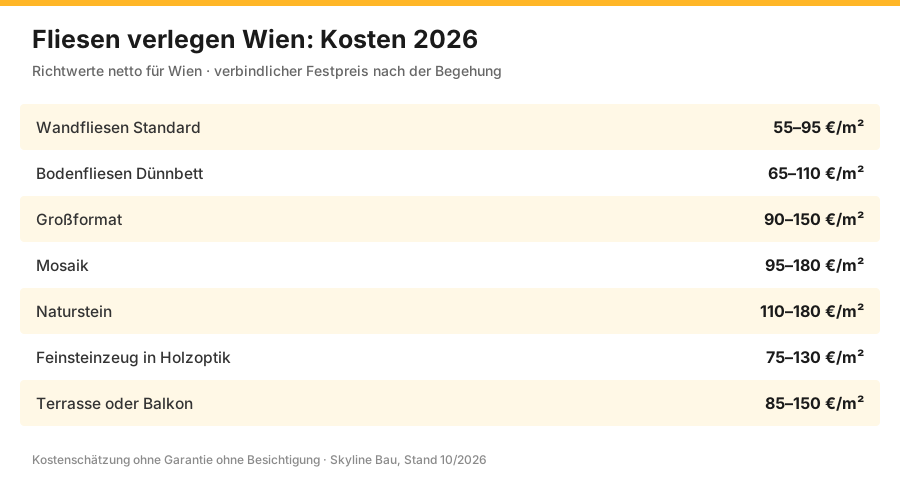
Tiling Vienna: tiling in Vienna costs 55 to 110 euros per square metre. Wall tiles €55–95/m², floor in thin bed €65–110/m², large format from €90/m², natural stone €110–180/m². Waterproofing in wet areas, uncoupling and substrate preparation come on top.
Tiling Vienna: costs 2026
Net guide prices for labour, as of 2026, material supplied by the client. The range comes from format, substrate and laying pattern – not from the tile brand.
| Service | Format or area | Net price | Note |
|---|---|---|---|
| Standard wall tiles | up to 30 × 60 cm | €55–95/m² | Adhesive, laying, grouting, silicone |
| Floor tiles in thin bed | up to 60 × 60 cm | €65–110/m² | Levelling, laying, joints |
| Large format | from 60 × 120 cm | €90–150/m² | Buttering-floating, two tilers, suction lifter |
| Mosaic | Mesh-mounted | €95–180/m² | high proportion of cuts and joints |
| Natural stone | Marble, granite, limestone | €110–180/m² | Impregnation, special adhesive |
| Porcelain stoneware in wood look | Plank format | €75–130/m² | Offset maximum one third, otherwise lippage |
| Terrace or balcony | on pedestals | €85–150/m² | Height adjustment, falls in the waterproofing |
What comes on top
| Item | Unit | Net price | When needed |
|---|---|---|---|
| Removing and disposing of old tiles | m² | 22–48 € | almost always – tiles on tiles is rarely right |
| Levelling the substrate | m² | 12–32 € | for unevenness over 3 mm per 1 m |
| Primer, bonding agent | m² | 4–12 € | for absorbent or smooth substrates |
| Bonded waterproofing to ÖNORM B 3407 | m² | 38–55 € | Bathroom, shower, WC, laundry room – mandatory |
| Sealing tape, collars, corners | lin. m | 12–28 € | at every corner and penetration |
| Uncoupling mat | m² | 18–38 € | Screed with residual moisture, timber substrate, terrace |
| Level-access shower, falls | lump sum | 450–1.200 € | Forming falls of 1.5–2 % to the drain |
| Epoxy grout instead of cement grout | m² | +22–45 € | stain-resistant, more laborious to work with |
| Tile skirting | lin. m | 14–32 € | Cutting, edge finishing, laying |
| Mitre cut on external corners | lin. m | 18–40 € | Alternative to an edge trim, higher quality |
| Holes for fittings and sockets | pcs | 12–35 € | Diamond drill, more laborious for large format |
| Silicone joints | lin. m | 8–18 € | all movement joints, corners, connections |
Total around €6,960 net for labour. The tile material adds €25 to €90 per m², so €850 to €3,060 for 34 m² – usually bought by the client.
The substrate decides the result
A tile is only as good as what it lies on. These five checks come before every installation – they take half an hour and prevent the most expensive mistakes.
- Flatness. According to ÖNORM DIN 18202, around 3 mm per metre is permissible. For large formats from 60 × 120 cm that is not enough – there we level to 2 mm, otherwise lippage occurs that you can feel with bare feet.
- Residual moisture in the screed. Cement screed needs four to six weeks, anhydrite three to four. It is measured with the CM device, not estimated. Tiling too early means cracks and hollow spots.
- Load-bearing capacity. The substrate is tapped. Whatever sounds hollow comes out – even if it looks like more work.
- Absorbency. Highly absorbent substrates need a deep primer, smooth ones a bonding agent. Without the right primer, no adhesive bonds permanently.
- Movement. Timber beam floors, fresh screed with residual moisture and terraces move. There an uncoupling mat goes between substrate and tile, €18 to €38/m².
Format, joint, pattern
Format
Large format looks calm and has fewer joints, but requires a very level substrate and two tilers with a suction lifter. From 60 × 120 cm, buttering-floating is part of it – adhesive on both the substrate and the back of the tile – otherwise hollow spots form that later lead to cracks. With large format, allow 15 to 20 % waste instead of the usual 10.
Laying pattern
| Pattern | Surcharge | Waste | Effect |
|---|---|---|---|
| Grid pattern, straight | – | 10 % | calm, standard, cheapest option |
| Half offset | +5–12 % | 10–12 % | critical with large format, lippage |
| Third offset | +8–15 % | 12 % | recommended for plank formats |
| Diagonal | +15–25 % | 15–20 % | makes rooms look larger, a lot of waste |
| Herringbone | +35–60 % | 15–25 % | laborious, high-quality look |
Joint
Narrow joints from 2 mm look high-quality but require calibrated tiles – this is the case with porcelain stoneware, not always with natural stone. A good cement grout with fungicide is enough for most bathrooms. Epoxy grouts are practically indestructible and stain-resistant, but cost €22 to €45/m² more and do not forgive rework. Silicone belongs exclusively in movement joints: corners, floor-to-wall junction, connection to the bath and shower tray – it is a maintenance joint, not a waterproofing component.
Slip resistance
| Area | Recommendation | Reason |
|---|---|---|
| Living room, kitchen | R9 | walked on dry, easy to clean |
| Bathroom floor | R9 to R10 | Barefoot area, balance of grip and cleanability |
| Level-access shower | R10 with assessment group B | wet, barefoot, inclined surface |
| Accessible bathroom | R10/B, better R11 | Risk of falling, often with a shower stool |
| Terrace, balcony | R10 to R11 | Wet, leaves, frost |
| Stairwell, commercial | R10 to R11 | Footwear, wet from outside |
Too much slip resistance is no gain: R12 in a residential bathroom is hardly cleanable, because the rough surface holds soap residue.
Tiles in the bathroom: the waterproofing is the component, not the tile
This is the most important sentence on this page. A tile is water-repellent, but the joint is not, and the adhesive certainly is not. A bathroom becomes watertight through the bonded waterproofing underneath, carried out according to ÖNORM B 3407.
Tilers in Vienna: prices and services
Anyone looking for a tiler in Vienna usually wants to know two things: what the square metre costs and when someone can come. Both depend less on the district than on the substrate and the tile format.
| Service | Net price per m² | Remark |
|---|---|---|
| Tiling, standard format up to 60×60 | 55–80 € | straight bond, level substrate |
| Large format from 80×80 and slabs | 85–140 € | two people, suction lifter, higher flatness requirement |
| Mosaic and small format | 95–160 € | considerably more time per area |
| Removing and disposing of old tiles | 18–32 € | including removal, tonnage separate |
| Filling and priming the substrate | 12–28 € | depending on condition, almost always needed in old buildings |
| Bonded waterproofing in wet areas | 22–38 € | mandatory in the shower and splash zone |
| Renewing silicone joints | €9–16/rm | wear part, due every 5 to 10 years |
Having tiles laid with us means: site visit, measurement, fixed price, date. We bundle small areas with other jobs nearby, so the lead time for a single bathroom is sometimes longer than for a whole apartment.
Laying large tiles: what is different
Formats from 80×80 centimetres and slabs up to 120×240 have been the standard request for several years. They look calmer, have fewer joints – and do not forgive an uneven substrate.
| Point | Standard format | Large format |
|---|---|---|
| Flatness of the substrate | tolerance per standard is usually enough | almost always has to be refilled |
| Adhesive application | one side | buttering-floating, both sides, full contact |
| Bond | half bond possible | third offset at most, otherwise the edges rock |
| Cutting | wet saw | rail system, holes with a cutter |
| Staff | one person | two people with a suction lifter |
| Waste | 5–8 % | 10–15 %, more with patterns |
In old-building apartments there is another factor: the timber beam floor moves. Large slabs need an uncoupling mat there, otherwise the joints crack in the first winter. That is not a surcharge at will, but a question of the floor build-up – we check it during the site visit.
Tiles in Viennese old buildings
Timber beam floors move
Over 60 % of Viennese old-building apartments have timber beam floors. They move with temperature and season. Tiles laid directly on them crack. The right approach is dry screed as a load-distributing layer plus an uncoupling mat – then the covering holds. The total weight stays at 40 to 50 kg/m² instead of 100 with wet screed.
Crooked walls
Deviations of 5 to 15 cm over three metres are normal. With large-format wall tiles this is immediately noticeable. Either the wall is filled beforehand or levelled with a furring wall – both cost space and belong in the quote before the tile is bought.
Old build-ups
Under old bathroom tiles there are bitumen coatings, mastic asphalt screed, slag fill or several layers of tiles on top of each other. What comes to light when they are removed determines the build-up above – which is why the quote contains an assumed quantity with a unit price for additional work.
Build-up height in the bathroom
Waterproofing, adhesive and tile need 1.5 to 2.5 cm, a new screed with falls considerably more. If the bathroom door no longer opens afterwards or a step to the hallway appears, this calculation was not made.
Process
The ten most common mistakes
- No waterproofing, only tile adhesive. The most common finding when old bathrooms are stripped – and the cause of most water damage.
- Silicone mistaken for waterproofing. Silicone is a maintenance joint with a service life of five to eight years, not a component.
- Laid too early on fresh screed. Without CM measurement, the tiles crack as soon as the screed continues to dry.
- Large format in thin bed without buttering-floating. Hollow spots under the tile that lead to breakage at the first impact.
- Half offset with long formats. From 60 cm in length, noticeable lippage occurs in the middle – offset by a third at most.
- No movement joints. From about 20 m² of continuous area and at every change of material, a joint is needed.
- Falls in the shower forgotten. Water stands, joints grow algae, the drain does not draw.
- Natural stone with the wrong adhesive. Marble discolours with moisture-rich cement adhesives – a white rapid-setting cement adhesive belongs there.
- Tiles on tiles in the bathroom. Hides the condition of the old waterproofing and costs build-up height.
- Started without a sample layout. Tile colour looks different on the sample board than on 30 m² – and afterwards nothing can be changed.
How to check a tiling quote
Who we tile for
Private clients
Bathroom, kitchen, hallway – usually as part of a renovation. You buy the material yourself; we supply the list with quantities and waste.
Property management companies
Bathrooms in rental apartments between two tenancies, stairwells, laundry rooms. Documented and on schedule.
Developers
Tiling work for entire storeys as a subcontract, with our own foreman and measurement according to ÖNORM.
Commercial
Restaurants, medical practices, kitchens with increased requirements for slip resistance and cleanability.
When you do not need us
If only a few tiles are cracked and replacement tiles are available, a tradesman replaces them in two hours. If only the joints look unsightly, joint renovation is enough – scrape out, regrout, €25 to €55/m². And if the bathroom is being renovated anyway, the tiling belongs in that project and should not be awarded as a separate job; see bathroom renovation Vienna. We tell you this at the site visit, even if it makes the job smaller for us.
Price per square metre or hourly rate: how tilers charge in Austria
Two methods of charging for tiling work have become established in Austria. For continuous areas – a bathroom, a kitchen, a hallway – charging is per square metre, separated by wall, floor, format and ancillary services such as waterproofing or silicone joints. For small jobs where no area can sensibly be measured, such as replacing individual tiles or reworking a connection, charging is by the hour, known as time-and-material work.
For you as the client, the price per square metre is almost always the better basis, because the risk of slow work lies with the company and not with you. An hourly rate alone says little: whether someone needs one or two days for 10 m² of wall depends on the format, the substrate and experience.
Why prices in Vienna are often higher than in the countryside has practical reasons: transporting material in old buildings without a lift, finding parking and loading zones, protecting the stairwell and floors in an occupied building. We list such items openly in the quote so that it is clear what is being paid for. The guide prices for the tiling itself are in the price table above.
Large tiles in Gründerzeit apartment buildings: Währing, Hernals, Ottakring and Penzing
In the districts west of the Gürtel – the 18th (1180), 17th (1170), 16th (1160) and 14th district (1140) – many apartments are in apartment buildings from around 1900. Anyone who wants large tiles laid there runs into a problem that has nothing to do with laying: transport. A slab in 120 × 240 cm format has to go up the stairwell flat or on edge, and many of these buildings have no lift or only a very small one fitted later.
That is why, before choosing the material, we measure the narrowest point along the way: building entrance, half landing, apartment door, corridor width. It often turns out that 120 × 120 cm is still easily possible, but the very large format only by cutting it into pieces or not at all. Better to clarify this before the tiles are ordered.
Then there is the substrate. On the upper floors of these buildings there are usually timber beam floors that move slightly. Large format on such a floor needs a rigid dry screed and uncoupling; what the build-up looks like is described on the page screed laying, and if the floor itself is weakened, timber beam floor renovation.
Worked example: what a square metre in a small bathroom really costs
A typical Viennese old-building bathroom has about 5 m² of floor area and 22 m² of wall area up to the ceiling. With the net guide prices on this page, material supplied by the client, the picture is roughly as follows:
| Item | Quantity | Guide value net |
|---|---|---|
| Removing and disposing of old tiles | 27 m² | 490–860 € |
| Filling and priming the substrate | 27 m² | 320–760 € |
| Bonded waterproofing floor and shower | approx. 12 m² | 260–460 € |
| Wall tiles, standard format | 22 m² | 1.210–2.090 € |
| Floor tiles in thin bed | 5 m² | 330–550 € |
Together that is about €2,600 to €4,700 for labour, i.e. around €95 to €175 per tiled square metre – considerably more than the pure laying price. The difference lies in removal, preparation and waterproofing, which make up a large share in a small bathroom. If plumbing and sanitary fittings are added, it becomes a bathroom renovation; for that there is the page bathroom renovation Vienna.
Frequently asked questions about tiling in Vienna
What does tiling cost per square metre in Vienna?
What does it cost to tile a bathroom?
What does the material cost?
How much waste do I need to allow for?
Why is large format more expensive?
What is buttering-floating?
Which tile size suits a small bathroom?
What slip resistance do I need?
What do assessment groups A, B, C mean?
Do I really need waterproofing?
How high up the wall must waterproofing go?
Why two layers in different colours?
Is silicone waterproofing?
How often does silicone need renewing?
What to do about mould in silicone joints?
How is a level-access shower built?
How much build-up height does tiling need?
Can tiles be laid on tiles?
Can I tile on timber beam floors?
What is an uncoupling mat?
When is a screed ready for covering?
Where do movement joints belong?
Cement grout or epoxy grout?
What joint width is right?
What is different about laying natural stone?
Can porcelain stoneware look like wood?
Do tiles work with underfloor heating?
How long does it take to tile a bathroom?
Can I use the bathroom in the meantime?
Who decides how the tiles are aligned?
How are external corners finished?
What happens to the old tiles?
Can individual damaged tiles be replaced?
What does joint renovation cost?
Can tiles be painted over?
What is different about tiling terraces and balconies?
Why do tiles come loose on the balcony?
Do you also lay mosaic?
Do you also do kitchen splashbacks?
How clean does the apartment stay?
Do I get documentation?
Tiling: what warranty is there?
Tiling: who carries out the work?
Tiling: is there a fixed price?
Tiling: do you also do small areas?
Tiling: how quickly do I get a quote?
Do you tile throughout Vienna?
Do tilers charge by the hour or by the square metre?
How do large-format slabs get into an old-building apartment without a lift?
Why is the price per square metre higher in a small bathroom than in a large one?
Yes, that is common — tiles in the bathroom, wood or vinyl in the living area. What matters is a clean transition with a suitable profile strip and matching build-up heights so that no trip edge is created. This belongs in the planning.
Do I get a warranty on the tiling work?
Yes, the statutory warranty of 3 years under § 933 ABGB on the workmanship. Manufacturers give their own guarantees on the material. Proper care and intact silicone joints are important for the warranty.
Who exactly lays the tiles for you?
A licensed tiler under § 94 no. 38 GewO, our permanent partner company. We prepare the substrate, waterproof and coordinate the other trades; the tiles themselves are laid by the authorised company, which we name to you before the contract is signed.
What is the most common expensive surprise when tiling?
A substrate that is worse than expected — uneven, damp or cracked. Then preparation is added that was not visible beforehand. Because we work with a fixed price after measurement, we consult you before additional costs arise; extras only for additionally commissioned work.
What does a tiler in Vienna cost per square metre?
What does it cost to have large tiles laid?
Do you also tile in my district?
Related services
Tiled? Cement haze does not come off with water.
After grouting, a cement haze remains on the tiles that needs an acidic deep clean. Bling Premium Reinigung does this professionally without attacking the joints. More at bling-bling.at.
Send enquiry
Enquire directly here — fixed-price quote for your tiling in Vienna free of charge, after site visit and measurement. Skyline Bau replies within 2 working days.
Ready for your tiling work in Vienna?
Write to us directly on WhatsApp — send photos of the room. Reply within two working days.
Note: Skyline Bau is the brand name of the construction and renovation division of Bling Bling GmbH and is not a separate legal entity. The sole contractual partner is Bling Bling GmbH. Bling Bling GmbH is a restricted construction trade business under § 99 GewO (Austrian Trade Regulation Act) and not a licensed master builder (Baumeister). Under § 99 (5) GewO, the title “Baumeister” is reserved for businesses licensed under § 94 no. 5 GewO. Regulated trades — master-builder services, structural engineering, gas and sanitary engineering, electrical engineering — are carried out exclusively by authorised, licensed partner companies.