Riser pipe replacement Vienna new risers, without anyone having to move out.
Riser pipe replacement Vienna: from the contractor that does the work — not from a broker.
Riser pipe replacement Vienna: replacing the risers (Strangsanierung) in a Viennese building costs €25,000 to €60,000 per riser stack, which works out at roughly €4,000 to €12,000 per connected flat. The risers for water, waste water, gas and electricity are renewed, together with the service shaft and all making good. Work proceeds stack by stack in the occupied building, two to three weeks per stack. Fixed price under ÖNORM B 2110.
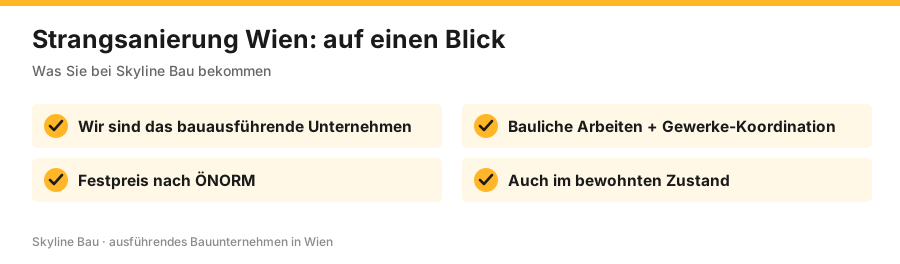
Riser pipe replacement Vienna from a single source
Riser pipe replacement Vienna refers to renewing a building's vertical supply lines — the so-called stacks or risers (Stränge). These risers run through every storey, supply the individual flats with water, carry away waste water and often carry gas and electricity as well. They are the lifelines of a multi-occupancy building. If they stop working reliably, the whole building is affected.
Unlike renewing the pipes inside a single flat, riser replacement concerns the entire building. The risers form a shared system — if one is renewed, every flat connected to it is affected. That is why riser replacement is a key measure for preserving the value and operational safety of a Viennese tenement building (Zinshaus). It secures the building's basic supply for decades to come.
Skyline Bau handles riser replacement as an executing construction company working with licensed master builder partner firms, and as general contractor. Riser replacement brings two worlds together: the building work — cutting chases, opening masonry, forming shafts, making everything good and replastering — and the installation work of the specialist trades. Skyline Bau carries out the building side and coordinates the trades, so responsibility for the whole project rests with one party.
For the owner and the property manager this means one point of contact for a project that would otherwise be spread across several firms. Instead of appointing and coordinating a builder, a plumber and an electrician separately, the riser replacement runs through one general contractor — with one contract and one fixed price. This bundling takes a considerable coordination burden off the property management.
The usual reason for riser replacement is the age of the pipework. Supply lines have a limited service life. Risers from the post-war reconstruction decades are often at the end of that life today — and outdated pipework means a growing risk of burst pipes and water damage.
A second reason is drinking water quality. Old pipes — lead ones, for example — can impair the quality of drinking water. Where that is the case, riser replacement is not just a matter of preserving value but of residents' health.
Where drinking water is concerned in particular, riser replacement should not be put off.
One big advantage of riser replacement: in many cases it can be carried out while the building is occupied. With temporary supply lines, the flats remain usable throughout the works. This makes riser replacement feasible even in let tenement buildings, without all tenants having to move out. For the owner, it avoids vacancy and lost rental income during construction.
We carry out riser replacement for tenement buildings, residential complexes and multi-occupancy buildings in Vienna. Skyline Bau assesses the condition of the risers, plans the building work, coordinates the installation trades and hands over a building with renewed services — at a binding fixed price under ÖNORM B 2110.
Riser replacement is a demanding project — but with an experienced general contractor it becomes an orderly, predictable process.
Riser pipe replacement Vienna — all services
Water risers
Building work accompanying the renewal of the vertical drinking water risers.
Waste water stacks
Building work for renewing the waste water and soil stacks.
Gas pipes
Building work accompanying the renewal of gas risers, where present.
Electrical risers
Building work for renewing the electrical rising mains.
Chasing & breaking-out work
Professional opening of walls and ceilings for the new pipework.
Reinstatement
Closing, plastering and making good the opened surfaces.
Service shafts
Constructing and repairing the shafts through which the risers run.
Trade coordination
Coordinating the plumber and electrician as the executing construction company.
Riser replacement for tenement and multi-occupancy buildings — building work from chases and shafts through to making good, plus coordination of all installation trades — an executing construction company working with licensed master builder partner firms, general contractor, one fixed price under ÖNORM B 2110, also while occupied, 3-year warranty under § 933 ABGB.
If a riser has already burst, it is no longer a renovation job but a damage case: water damage restoration Vienna.
How much does riser pipe replacement in Vienna cost?
The cost of riser pipe replacement in Vienna depends on the scope — from simply renewing the risers to the extended option with partial renovation of the flats — as well as on the condition of the pipework, the number of stacks and how accessible the shafts are. After a site inspection, Skyline Bau prepares a binding fixed-price quotation under ÖNORM B 2110.
As of 2026 · net · guide values · scope, pipe condition, number of stacks and accessibility determine the final price · binding price after site inspection.
The biggest influence on the price is the scope. Basic riser replacement is limited to renewing the main supply lines in the shafts and stops at each flat's sub-distribution — it is the most economical option. Extended riser replacement additionally includes partial renovation of the flats, such as the bathrooms, and costs correspondingly more.
A second factor is accessibility. If the risers run in existing, easily reachable service shafts, the building work is less extensive. If the pipes have to be concealed and the old risers are embedded in the walls, extensive chasing, breaking-out and reinstatement work is needed — which significantly increases the building share of the cost.
Then there is the number of stacks and the condition of the pipework. Skyline Bau inspects the building, assesses the risers and shafts, prices the building work and obtains quotations from the installation trades — and names one binding overall fixed price. The entire price of the riser replacement is thus set out in a single, transparent quotation, so the owners' association knows what the riser replacement costs before it votes. This cost certainty is the foundation for a sound resolution.
Riser pipe replacement Vienna — what riser replacement is
Not everyone is familiar with the term riser replacement — yet it describes one of the most important renovation measures a tenement building can undergo.
A riser (Strang) is a vertical supply line running through every storey of a building. There are water risers for the drinking water supply, waste water stacks for drainage, often gas risers and electrical rising mains. They all supply the individual flats — and they all age.
Riser replacement means renewing these risers. The crucial point: unlike renewing the horizontal pipes inside a single flat, riser replacement concerns the entire building. The risers are a shared system — they cannot be renewed flat by flat. That is precisely why riser replacement is always a matter for the whole community of occupants.
Riser replacement should therefore not be confused with flat renovation. Flat renovation is about renewing an individual flat. Riser replacement focuses on the shared supply infrastructure of the whole building — a measure that is decided by the owners' association and planned for the entire building. Riser replacement is therefore always a whole-building project.
Riser pipe replacement Vienna — basic, extended or complete riser replacement?
Riser replacement is not always the same size of job. In practice there are three levels — and it helps to know them in order to gauge your own needs.
Basic riser replacement is the smallest level. It is limited to renewing the main supply lines — plumbing, heating, electrics — in the existing service shafts and stops at each flat's sub-distribution. The flats themselves are left untouched. It is the most economical option and works well in an occupied building. For many tenement buildings it is exactly the right scope, concentrating on what genuinely needs renewing from a technical point of view.
Extended riser replacement goes further. In addition to renewing the main supply, the flats are partially renovated: bathrooms and kitchens are modernised, radiators and heating risers renewed, and in some cases the electrical installation too. This can also be carried out in an occupied building. It combines riser replacement with a noticeable upgrade of the flats.
Complete riser replacement is the most thorough solution. It additionally includes the full renovation and modernisation of all connected flats, which brings it close to a comprehensive refurbishment of the building, combining riser renewal with complete modernisation. Skyline Bau advises the owners' association on which level suits the condition of the building and the budget — and carries out the chosen option as the executing construction company. That way, exactly the scope the building really needs is delivered.
Riser pipe replacement Vienna — when riser replacement is needed
Riser replacement is a considerable investment — and it is rarely agreed without good reason. That makes it all the more important to recognise the signs in time. There are a few clear warning signs that a building's risers ought to be renewed.
The first warning sign is age. Supply lines do not last forever. Risers installed several decades ago are approaching the end of their service life. The closer they get to that end, the higher the risk — and the more urgent the riser replacement becomes.
The second warning sign is burst pipes and water damage. When burst pipes become more frequent in a building, it is a clear signal that the risers are finished. Every single water damage incident brings costs and hassle — and a planned riser replacement is almost always cheaper than the sum of the unplanned damage cases that postponing it brings. Here, too, renovating with foresight is the more economical decision.
A third reason is drinking water quality — for instance with old lead pipes — and a fourth is insurance: insurers often charge higher premiums or restrict cover for buildings with outdated pipework. Skyline Bau assesses the condition of the risers honestly and tells the owners' association frankly how urgent riser replacement is — as a reliable basis for its resolution.
An honest assessment helps the community act at the right moment — neither too early nor too late.
Riser pipe replacement Vienna — while occupied
One of the most important questions before a riser replacement is: do the tenants have to move out? The good news is — in most cases, no.
In many cases riser replacement can be carried out while the building is occupied. This is made possible by a simple, proven principle: before the old risers are taken out of service, temporary supply lines are installed — usually from the basement via the stairwell into the individual flats. These temporary lines keep bathroom and kitchen usable throughout the works, so residents' daily lives are disrupted as little as possible.
For this to work, good coordination is essential. The property manager and site management brief residents in advance during a walk-through on the scope, schedule and contacts. Residents know what will happen and when — and the works can proceed quickly and without disruption. Clear information removes residents' uncertainty and speeds up the project. Riser replacement in an occupied building is a piece of joint organisation. When everyone involved is well informed, it runs remarkably smoothly.
For let tenement buildings, working while occupied is a major advantage. The riser replacement can be carried out without interrupting all the tenancies — saving vacancy costs and effort. Skyline Bau plans the riser replacement from the outset so that working in the occupied building goes smoothly, and coordinates closely with the property management. Good preparation is half the battle in an occupied riser replacement.
Riser pipe replacement Vienna — in the Viennese tenement building
The typical Viennese riser replacement concerns a tenement building (Zinshaus) — a Gründerzeit building (built 1848–1918) whose service infrastructure has grown over many decades. That brings particular challenges.
In the Viennese tenement building the risers are often old — many were installed during the post-war reconstruction decades and are now nearing the end of their service life. On top of that, there have been repairs, additions and alterations over the years: a tenement building's riser infrastructure is rarely as clear-cut as a drawing might suggest.
A careful on-site survey of the existing condition is therefore indispensable. Experience with structures that have evolved over time is worth its weight in gold here. A builder who knows Viennese tenement buildings factors the quirks of the building fabric in from the very start.
One particular feature is the owners' association. Because the risers are a shared system, riser replacement is decided not by an individual owner but by the community of owners. That resolution needs a reliable cost estimate — the owners have to know what the measure costs before they agree to it.
In a tenement building, riser replacement is often linked to tenement building renovation as a whole. Renewing the building services — and with them the risers — is a central element of a comprehensive refurbishment. If renovation is happening anyway, it makes sense to include the riser replacement in the plans. Skyline Bau plans both together: riser replacement as a stand-alone measure or as part of a tenement building renovation — always as the executing construction company, with a reliable cost estimate for the owners' association. Anyone who plans both measures together saves on setting up the site twice and on disruption twice over.
Riser pipe replacement Vienna — Viennese specifics
- Viennese tenement building — Gründerzeit buildings with riser infrastructure that has grown over time and is often outdated.
- Entire building — riser replacement affects all flats, not just one.
- Three levels — basic, extended and complete riser replacement, depending on need.
- Work while occupied — in many cases possible with temporary supplies and no moving out.
- Building work & installation — Skyline Bau carries out the building side and coordinates the trades.
- Owners' association — riser replacement is decided jointly.
- Chasing & making good — professional opening and neat closing of the walls.
- General contractor — one contract, one fixed price, one point of contact.
- Realistic Austrian prices — prices in Austria are higher than comparable figures in Germany.
- Fixed price under ÖNORM B 2110 — building work and trades fully costed.
Riser pipe replacement Vienna — active in all Viennese districts
Riser pipe replacement Vienna — process and construction time
Riser replacement is an orderly project with a clear sequence. Knowing it helps the owners' association plan and communicate the measure better.
It starts with the site inspection and planning: Skyline Bau assesses the risers, shafts and accessibility, plans the building work and, together with the installation trades, prepares the binding fixed-price quotation. If the riser replacement is carried out while the building is occupied, the temporary supply lines are laid first so that the flats remain usable.
Next come the building work and the installation: walls and shafts are opened, the old risers removed, the new pipes laid and pressure-tested for leaks — and the opened surfaces professionally made good and replastered. The project concludes with the handover of the building with renewed services.
Depending on size, construction takes anywhere from a few weeks to several months — Skyline Bau states the binding time frame in its quotation. A realistic schedule helps the property manager keep residents reliably informed. The earlier the schedule is fixed, the better the occupied construction phase can be organised.
Riser pipe replacement Vienna — the building share and coordination
Riser replacement is not purely an installation project. A considerable part of the work is building work — and this is exactly where Skyline Bau's core competence lies.
Before a new pipe can be laid, the building has to be opened up. Walls are chased, ceilings broken through, shafts formed or enlarged. This chasing and breaking-out work is demanding: it has to be carried out in such a way that the building's load-bearing structure is not compromised — a task for construction, not for the plumber. This is precisely where it pays off that Skyline Bau carries out the building work itself and brings in a licensed master builder partner firm for structurally relevant interventions.
The making good is building work too. Once the new risers are in place, the opened walls and shafts have to be properly closed, plastered and reinstated. Sloppy work here leaves cracks, uneven patches and weak points behind, so careful reinstatement is just as important as the installation itself. Clean making good determines how the building looks after the riser replacement. In the end, a properly plastered wall gives no hint that a riser has been renewed behind it. Before work starts, a pre-construction condition survey records the condition of the affected units and those below them.
The pipes themselves are laid by the specialist trades — the plumber installs the water and waste water risers, the electrician the rising mains. Skyline Bau carries out the building side and at the same time takes on the coordination of these trades as the executing construction company. Building work and installation thus go hand in hand instead of running side by side.
For the owner, this means one point of contact for the entire project — building work and installation, one contract, one fixed price. That is the simplest and safest way to handle a riser replacement. It is precisely this bundling that makes riser replacement predictable and secure. The owner does not have to mediate between builder and plumber — the general contractor takes care of that.
Riser pipe replacement Vienna for property managers, owners & investors
Property manager
Riser replacement in managed tenement buildings — one point of contact, one fixed price.
Owners' association
A reliable cost estimate as the basis for the renovation resolution.
Tenement building owners
Renewal of the supply risers to preserve the value of the tenement building.
Investors
Riser replacement as part of upgrading an acquired investment property.
Typical service packages for riser pipe replacement in Vienna
- Site inspection, condition assessment of risers and shafts
- Reliable cost estimate for the owners' association resolution
- Binding fixed-price quotation under ÖNORM B 2110
- Installation of temporary supply lines for work while occupied
- Chasing and breaking-out work to open the walls
- Construction and repair of the service shafts
- Building work accompanying renewal of the water and waste water risers
- Building work accompanying renewal of gas and electrical risers
- Coordination of plumber and electrician as the executing construction company
- Professional making good and plastering of the opened surfaces
- Optional: extended riser replacement with partial renovation of the flats
- Handover of the building with renewed services at a fixed price
Riser pipe replacement Vienna — from site inspection to handover
Riser pipe replacement Vienna — why proper planning is decisive
Riser replacement is an intervention that affects an entire building, touches many flats and incurs considerable costs. All the more reason why planning decides whether it succeeds.
The first point is an honest assessment of the existing condition. Before anything is planned, it must be clear what state the risers are really in and which scope — basic, extended or complete riser replacement — is actually necessary. An honest assessment protects the owners' association from approving too little or far too much. The right scope is the one the building really needs — no more and no less. This clarity at the outset saves a great deal of debate later on.
The second point is a reliable cost estimate. The owners' association decides on riser replacement on the basis of figures. If those figures are too optimistic, variations and disputes loom in the middle of the project. A binding fixed-price quotation under ÖNORM B 2110 that fully reflects the building work and the trades is therefore the best basis for a sound resolution.
The third point is coordinated execution. Building work and installation have to dovetail, work in the occupied building has to be organised and the property management has to be involved. Skyline Bau stands for exactly these three points — honest assessment, reliable costing and coordinated execution as the executing construction company. These three points are how you recognise a dependable partner for riser replacement. This turns a complex intervention into an orderly project with a result that lasts for decades. It is precisely this long-term benefit that justifies investing in a professionally executed riser replacement.
Why choose Skyline Bau for your riser pipe replacement in Vienna
- Executing construction company — the building work professionally planned and carried out.
- General contractor — coordination of all installation trades from a single source.
- One point of contact — for a project that would otherwise be spread across several firms.
- Work while occupied — riser replacement with temporary supplies and no need for tenants to move out.
- Tenement building experience — familiar with the riser infrastructure of Viennese Gründerzeit buildings.
- Clean making good — opened walls properly closed and plastered.
- Reliable costing — a dependable basis for the owners' association resolution.
- Fixed price under ÖNORM B 2110 — building work and trades fully costed.
- €3 million construction liability insurance.
- Subcontractor on the Parliament renovation 2022 — renovation work on the Vienna Parliament, 1010 Vienna, in 2022.
Riser pipe replacement Vienna — how to spot a reputable contractor
Check these six points with every riser replacement contractor in Vienna — including us. They take ten minutes and, in the worst case, spare you a legal dispute.
1. Ask for the GISA number
Every trade business in Austria has a GISA number. In the public trade register you can see which trades the business has actually registered. Anyone who will not give you the number has a reason for it.
2. Who carries out the regulated trades?
Interventions in the building fabric involve master builder services under § 94 no. 5 GewO — design, structural engineering, submission to the building authority (MA 37). A construction company that carries out building work may not do this itself. Ask which licensed master builder will take it on.
3. Site visit before quotation
A quotation for riser replacement in Vienna without a site visit is guesswork. What lies behind the wall or under the floor only becomes visible once it is opened — and that is exactly where variations arise.
4. Bill of quantities instead of a lump sum
A reputable quotation lists items with quantities and unit prices. “All-in lump sum” without a breakdown is not a quotation but an invitation to variations.
5. Ask for proof of construction liability insurance
Ask for the insurer and the amount of cover. In an occupied Viennese tenement building, damage can quickly run into six figures — and then affect other people's flats too.
6. Do not confuse the warranty
The statutory warranty for immovable property is 3 years under § 933 ABGB (Austrian Civil Code). Anyone who promises you more must put it in the contract — verbally it is worth nothing.
Riser pipe replacement Vienna — when is riser replacement necessary?
- Lead pipes — Viennese Gründerzeit tenement buildings often still have lead pipes for drinking water. Immediate replacement is mandatory under the Austrian Drinking Water Ordinance (Trinkwasserverordnung).
- Galvanised iron pipes — typical of Viennese buildings from 1900–1960. Internal corrosion causes rust particles in the drinking water, pressure losses and pitting.
- Frequent water damage — if damage occurs several times a year, replacing the riser is more economical than repairing it.
- Classic TN-C earthing (Nullung) for electricity — old Viennese building wiring with screw-in fuses. No residual current protection (RCD), cable cross-sections too small for modern loads.
- Old cast-iron waste pipes — cracks, poor hydraulics, noise.
- Gas pipes — when the heating is switched to a heat pump / district heating, gas pipes can be removed or decommissioned.
Riser pipe replacement Vienna — Vienna's funding landscape
- wohnfonds_wien basic renovation (Sockelsanierung) — riser replacement is part of the subsidised basic renovation of Viennese tenement buildings, up to 40% of eligible costs.
- City of Vienna housing subsidy (wien.gv.at) — financial support for ecological or thermal building renovation with a riser component.
- Raus aus Gas Wien (Vienna's get-off-gas programme) — up to €5,250 per flat for switching heating systems, combinable with the federal boiler replacement grant of up to €17,500. This makes decommissioning gas risers economically attractive.
- Qualitätsplattform Sanierung (qp-sanierung.at) — City of Vienna platform for quality assurance in renovation.
- Hauskunft Wien — free advice on combining funding schemes.
Riser pipe replacement Vienna — what goes with it
Riser replacement involves several trades. What is connected:
Heating, plumbing, ventilation — the risers are the heart of the building services.
Electrical risers via licensed partners under § 94 Z 16 GewO.
When the risers are replaced, the adjoining bathrooms are usually renovated as well.
Chases and shafts for the risers, followed by closing them up.
After the walls have been opened, bathroom and kitchen are retiled.
The overview of all renovation services.
Riser pipe replacement Vienna — why Skyline Bau for your Viennese riser replacement?
First — the risers are inspected by camera in advance and documented, and the construction sequence is agreed staircase by staircase with the property management so that each flat is without water for only a few days.
Second — general contractor model with licensed master builder partners. Regulated activities (master builder § 94 Z 5, sanitary engineering § 94 Z 25, electrical engineering § 94 Z 16, gas engineering) are handled through authorised partner firms. Fixed-price contract under ÖNORM B 2110:2023.
Third — tenement building routine. We know the typical Viennese riser layout (main cold and hot water riser in the stairwell or in the courtyard service shaft) and plan the construction phase with minimal disruption to tenants.
Fourth — all Viennese funding streams combined. Basic renovation (Sockelsanierung) + Raus aus Gas + housing subsidy. Applications handled through us.
Skyline Bau acts as a construction company carrying out building work. Regulated trades — in particular master builder services (§ 94 no. 5 GewO), design and structural engineering services, electrical engineering (§ 94 no. 16 GewO), gas and plumbing (§ 94 no. 25 GewO) and tiling work (§ 94 no. 38 GewO) — are carried out exclusively by appropriately authorised subcontractors and partner firms. Construction work is carried out by tradespeople within the group of companies holding a valid licence.
Riser pipe replacement Vienna — what you should know
So that you know exactly what to expect, we answer the most important questions about riser pipe replacement in Vienna here — honestly and from the day-to-day practice of an executing construction company.
What is riser replacement?
Riser replacement renews a building's vertical supply lines — the risers for water, waste water and often gas that run through every storey. In old tenement buildings these pipes are often at the end of their service life: rust, limescale, leaks. The renovation renews them systematically.
How can you tell that the risers need replacing?
Signs include rusty or brown water, falling water pressure, frequent burst pipes and damp patches along the risers. Old steel and lead pipes should be renewed in any case. Replacement prevents more serious water damage.
How does riser replacement work?
The risers run through several flats, so coordination is crucial: access to the affected areas, an orderly sequence storey by storey and the shortest possible outages for residents. As the executing construction company, we organise this in a structured way with a schedule.
How much does riser replacement cost?
The cost depends on the number of storeys, the length of pipework, accessibility and whether water, waste water and gas are renewed together. After a site visit you receive a fixed-price quotation.
Riser and flat pipework: where the boundary lies in a Viennese building
When people talk about a riser, they mean the vertical pipes running from the basement through every storey, to which the individual flats are connected. Water, waste water and often electricity and gas are distributed through the building this way. For the question of who pays and who decides, the boundary between this building pipework and the pipework inside the flat matters. In practice, the riser counts as one of the common parts of the building, and responsibility for it lies with the owners' association or the building owner. From the branch into the flat, usually from the first shut-off valve or the flat's meter, begins the area the occupant of the flat looks after. Exactly where the dividing line lies can vary depending on the building, the contract and the legal form, and should be recorded before the renovation. This has a direct consequence for the works: if the first section inside the flat is also renewed as part of the riser replacement, it must be clear who pays for that part. The clean solution is separate items in the quotation, so that the property manager can allocate common and flat-related costs correctly.
What a property manager should gather before tendering
The better the starting situation is documented, the more accurate the quotations and the fewer surprises when the shafts are opened. Three things are especially helpful. First, an overview of how many risers there are and which flats are connected to which riser, even if it is only a hand sketch. Second, the damage history: where have there been water damage, blocked drains or rusty water in recent years, and which plumber attended? Third, a list of flats noting whether bathroom and kitchen have already been renewed, because there the shafts are often tiled over or built in behind cupboards. A trial opening at one or two points is very valuable, revealing the material, condition and space in the shaft. It costs little and stops every bidder from pricing on assumptions. Where individual flats have ongoing damp damage, it is worth factoring in restoration after water damage at the same time.
Riser by riser: how the order within the building is decided
A Viennese multi-occupancy building is not renovated all at once but riser by riser. Which one goes first depends on three criteria. As a rule, the riser with the most damage comes first, because that is where the risk is greatest. After that, location counts: risers that share a basement section or a common collecting drain are worked on one after the other so that the basement only has to be open once. Finally, the occupants play a role — for example medical practices, ground-floor shops or households with people in need of care, for whom shut-off times are planned with particular care. Within a riser, work proceeds from top to bottom or the other way round, depending on where the new pipe is connected to the existing system. If a flat's bathroom is also being redone at the same time, it pays to coordinate with a bathroom renovation in the same time window.
Frequently asked questions about riser pipe replacement in Vienna
How much does riser replacement cost in Vienna?
What is riser replacement?
What is a riser?
What is the difference from flat renovation?
What are the three levels of riser replacement?
Can riser replacement be carried out while the building is occupied?
When is riser replacement needed?
Why are old risers a risk?
What does riser replacement have to do with drinking water quality?
What role does Skyline Bau take on in riser replacement?
What building work does riser replacement involve?
Who lays the new pipes?
How is riser replacement decided?
How long does riser replacement take?
Riser replacement: what determines the price?
What is extended riser replacement?
Is riser replacement eligible for funding?
Riser replacement: is there a fixed price?
Is riser replacement suitable for let tenement buildings?
Is riser replacement part of tenement building renovation?
Does Skyline Bau handle coordination with the property management?
Riser replacement: does Skyline Bau also work outside Vienna?
How much does riser replacement cost per flat?
How many risers does a typical Viennese tenement building have?
How can I tell that our risers are at the end of their life?
How old is the pipework in Viennese period buildings typically?
Are lead pipes still an issue in Vienna?
Which pipe material is installed today?
What happens to the old shaft?
Why does the shaft need access panels?
Are water meters fitted for each flat at the same time?
Is the electrical rising main renewed as well?
What about the gas pipes?
How noisy will it be, and when?
How long is the water actually turned off?
Is there a substitute supply during construction?
Do residents have to move out?
Do you need access to every flat?
What happens to tiles and cupboards in front of the shaft?
Can an old riser be lined instead of replaced?
What about legionella?
Will the water pressure be better afterwards?
How is sound insulation of the new waste pipe dealt with?
Who bears the costs, owner or tenant?
How does it work in a condominium?
What if asbestos turns up when the shaft is opened?
Does the riser belong to the flat or to the building?
What is a trial opening before tendering for?
What criteria decide which riser is replaced first?
Related services Skyline Bau
Related services
New risers? Bathroom and kitchen need a deep clean.
After the risers have been replaced, bathroom, kitchen and stairwell are covered in dust. Bling Premium Reinigung takes care of post-construction and stairwell cleaning, timed to match each section. Find out more at bling-bling.at.
Send enquiry
Enquire directly here — fixed-price quotation free of charge. Skyline Bau replies within 2 working days.
Need your risers renewed?
Message us directly on WhatsApp — send details of the tenement building, number of flats and key data. Reply within two working days.
Note: Skyline Bau is the brand name of the construction and renovation division of Bling Bling GmbH and not a separate legal entity. The sole contractual partner is Bling Bling GmbH. Bling Bling GmbH is a restricted building trade business under § 99 GewO (Austrian Trade Regulation Act) and not a licensed master builder (konzessionierter Baumeister). Under § 99 (5) GewO, the title "Baumeister” (master builder) is reserved for businesses licensed under § 94 no. 5 GewO. Regulated trades — master builder services, structural engineering, gas and plumbing, electrical engineering — are carried out exclusively by authorised, licensed partner firms.