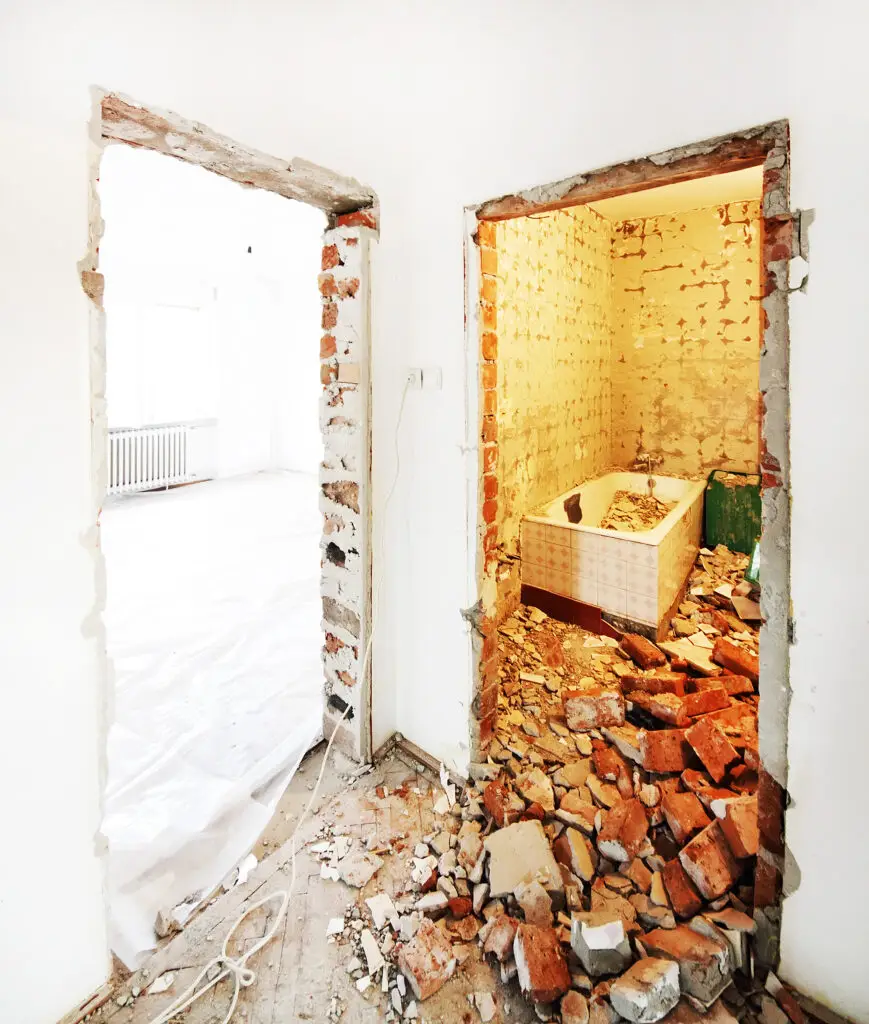
Strip-out Vienna back to the shell, disposed of by material type.
Strip-out Vienna: from the construction company that does the work — not from an agent.
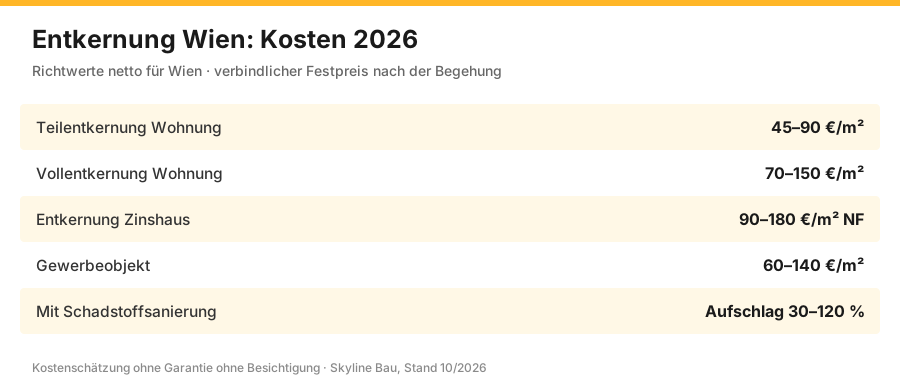
Strip-out Vienna: a strip-out in Vienna costs 45 to 180 euros per square metre. Partial strip-out €45–90/m², full strip-out back to the shell €70–150/m², period apartment building €90–180/m² of usable floor area. Up to 45 % of this is accounted for by disposal – which is why everything is separated by material type.
What a strip-out costs in Vienna
Net guide prices, as of 2026, binding after a site visit and hazardous substance survey. The biggest cost block is not the demolition but the disposal.
| Scope | What is removed | Net price | Duration |
|---|---|---|---|
| Partial strip-out of a flat | Floors, partition walls, sanitary | €45–90/m² | 3–8 days |
| Full strip-out of a flat | back to the shell, incl. services and plaster | €70–150/m² | 1–3 weeks |
| Strip-out of a period apartment building | all units, stairwell, cellar | €90–180/m² UFA | 6–16 weeks |
| Commercial property | Fit-out, building services, suspended ceilings | €60–140/m² | 2–8 weeks |
| With hazardous substance removal | Asbestos, man-made mineral fibres, tar-containing materials | Surcharge 30–120 % | depending on findings |
Unit prices, so you can check a quote
| Item | Unit | Net price | What is included |
|---|---|---|---|
| Hazardous substance survey | lump sum | 800–3.500 € | Sampling, laboratory analysis, report |
| Removing floor coverings | m² | 8–25 € | Parquet, laminate, carpet, adhesive residue |
| Breaking out screed | m² | 18–45 € | Breaking, removing insulation, loading |
| Demolishing non-load-bearing walls | m² | 22–55 € | Masonry or drywall, loading |
| Removing plaster | m² | 14–35 € | back to the shell, disposal |
| Knocking off tiles | m² | 18–40 € | including adhesive bed |
| Dismantling suspended ceilings | m² | 12–30 € | Panels, substructure, insulation |
| Removing sanitary fittings and pipework | lump sum per bathroom | 380–900 € | Fittings, pre-wall, pipes, capping |
| Removing electrical installations | m² | 8–20 € | Cables, boxes, distribution boards, disconnection |
| Removing doors and frames | pcs | 35–90 € | Door leaf, frame, disposal |
| Removing windows | pcs | 60–180 € | Sash, frame, disposal separated |
| Setting up a rubble chute | lump sum | 450–1.400 € | Installation, hire, dismantling |
| Skip for separated rubble | t | 18–35 € | Transport, landfill, certificate |
| Skip for mixed construction waste | t | 120–260 € | Transport, sorting plant, certificate |
| Asbestos-containing material | t | 300–700 € | licensed specialist firm, containment, certificate |
| Dust protection and containment | lump sum | 350–1.400 € | Plastic sheeting walls, airlock, stairwell protection |
| Final cleaning after strip-out | m² | 4–12 € | Rough cleaning, handed over broom-clean |
Total around €14,600 net, which is €154/m². If the rubble had been disposed of mixed instead of separated, this item alone would have been around €7,500 instead of €3,700 – the reason why materials are separated on site.
We cut service penetrations and openings instead of chiselling them – see Core drilling and concrete cutting.
If household goods and furnishings have to go first, we take care of that too: House clearance Vienna.
Disposal: the biggest cost block
| Fraction | Price per tonne | What belongs in it |
|---|---|---|
| Separated rubble | 18–35 € | Brick, concrete, screed, tiles, plaster |
| Untreated timber | 35–80 € | Beams, boards, uncoated frames |
| Treated timber | 90–180 € | painted, glued, impregnated |
| Scrap metal | proceeds possible | Pipes, profiles, radiators |
| Mixed construction waste | 120–260 € | everything that was not separated |
| Asbestos-containing material | 300–700 € | Asbestos cement, floor adhesive, pipe insulation |
| Old man-made mineral fibres | 250–500 € | Insulation from before 1998 |
Strip-out Vienna from a single source
Strip-out Vienna refers to removing the internal structure of a building while the load-bearing parts — the facade and the structural frame — are retained. In a strip-out, a building is literally hollowed out: its interior is removed until the shell condition is reached. The outer envelope remains standing.
The strip-out is a preparatory step. It comes at the start of a core refurbishment, a change of use or a comprehensive modernisation. Only when the building has been taken back to its structure and envelope can the existing building be rethought — with new floor plans, modern building services, up-to-date insulation. The strip-out creates a blank sheet, so to speak, within the retained building envelope.
Skyline Bau carries out the strip-out as a construction company doing the work with its own construction team. We remove internal walls, ceiling and floor constructions, doors and built-in fixtures, dismantle all building services, survey and remove hazardous substances and dispose of the material properly. You have one contract, a binding fixed price under ÖNORM B 2110 and one point of contact.
A strip-out is more demanding than it seems at first glance. The decisive point is structural stability: only what is not load-bearing may be removed. Load-bearing walls, columns and the structural frame must remain untouched or, where they are altered, be structurally secured. Distinguishing between load-bearing and non-load-bearing elements is a task for a construction company working with licensed master builder partner firms.
As with demolition, the survey of hazardous and problem substances is a central step. Old buildings often contain asbestos, man-made mineral fibres or other contaminated materials. These must be surveyed and properly removed before the actual deconstruction. Skyline Bau takes hazardous substance removal into account in the strip-out planning from the outset.
Deconstruction during a strip-out follows ÖNORM B 3151 — the Austrian standard for the deconstruction of buildings. It requires a deconstruction concept, a hazardous substance survey, separation of materials by type and documentation. Skyline Bau works to this standard — so the strip-out is not only carried out cleanly but is also legally sound.
For the client this means security on several levels: technically, because the deconstruction is planned and controlled, and legally, because the documentation proves the correct handling of the construction waste.
We know the typical strip-out situations — the Gründerzeit period apartment building whose interior is to be renewed while the protected facade remains, the shop that is being converted to a new use, the office building before a general refurbishment. Skyline Bau plans every strip-out individually and carries it out as a clean, officially secured part of the construction project — on request through to the subsequent refurbishment from a single source.
The strip-out is the invisible first step that determines the success of an entire refurbishment. If too much is removed, the fabric suffers; if too little is removed, legacy items obstruct the new fit-out; if hazardous substances are overlooked, the project becomes more expensive in the middle of the construction phase. Skyline Bau therefore plans the strip-out thoroughly from the outset — as a well-thought-out basis for everything that is to follow in the refurbished building.
all services
Full strip-out
Complete removal of the building's interior back to the structure and envelope — the shell condition.
Partial strip-out
Removal of selected elements — individual walls, ceilings or floors — without a full strip-out.
Dismantling building services
Removal of electrics, sanitary, heating and ventilation — all of the building's technical systems.
Removing internal walls
Demolition of non-load-bearing internal walls — while preserving the load-bearing structure.
Ceilings & floors
Removal of floor coverings, screeds and non-load-bearing ceiling constructions.
Hazardous substance removal
Survey and professional removal of asbestos and contaminated materials.
Material separation
Separation of deconstruction material by type according to ÖNORM B 3151 for recycling.
Disposal
Proper disposal and processing of the material according to the Waste Management Act (AWG).
Full and partial strip-out back to the shell condition, dismantling of building services, hazardous substance removal and deconstruction by material type according to ÖNORM B 3151 — a construction company doing the work in partnership with licensed master builder firms, structural stability preserved, fixed price under ÖNORM B 2110, our own construction team, 3-year warranty under § 933 ABGB.
What does a strip-out in Vienna cost?
The cost of a strip-out in Vienna depends on the scope of the deconstruction, the level of fit-out of the building, the presence of hazardous substances and accessibility. A light partial strip-out is considerably cheaper than a complete deconstruction back to the shell. After a site visit and a deconstruction concept, Skyline Bau prepares a binding fixed-price offer under ÖNORM B 2110.
As of 2026 · net · hazardous substance removal and official fees are calculated separately · final price after site visit and deconstruction concept.
The biggest cost factor is the scope of the deconstruction. A light strip-out — mainly removing detachable elements, lightweight partition walls and coverings — costs around 25 to 40 euros per square metre. An average strip-out with internal walls and building services is in the range of 50 to 90 euros. A complete deconstruction back to the shell condition with all services reaches 80 to 120 euros per square metre and more.
Complicating circumstances can drive up the price: difficult access, work over several storeys without a lift, the use of lifting platforms, a high proportion of hazardous substances and cramped inner-city locations. Disposal is also a separate item — material separated by type is cheaper to dispose of than mixed rubble.
Hazardous substance removal is calculated separately, because its scope is only known after the survey. Skyline Bau prepares the offer on the basis of the deconstruction concept and the hazardous substance survey — so the fixed price is reliable and contains no nasty surprises that would later turn up as supplements with a mere per-square-metre estimate. This care is particularly worthwhile for a strip-out, because hidden building elements and undetected hazardous substances behind cladding and screeds can otherwise make a project considerably more expensive.
what exactly a strip-out is
The term strip-out is often confused with demolition — yet the two describe fundamentally different processes. Anyone planning a strip-out should know exactly what it involves.
In a strip-out, the building is taken back to its load-bearing parts. What is removed is the interior: non-load-bearing internal walls, floor coverings and screeds, non-load-bearing ceiling constructions, doors, windows, built-in fixtures and, above all, the complete building services — electrics, sanitary, heating, ventilation. What remains is the load-bearing structure: the structural frame, the load-bearing walls and the facade. The result is the shell condition.
A distinction is made between a full strip-out and a partial strip-out. In a full strip-out, the entire interior is removed and the building is taken right back to the shell. In a partial strip-out, only certain elements are removed — for example individual walls, ceilings or floors — without changing the entire structure. Which scope makes sense depends on the planned construction project.
What is decisive in every strip-out is the clean distinction between load-bearing and non-load-bearing elements. Only non-load-bearing elements may be removed without further ado. If the structural frame is to be altered — for example for a new floor plan — a structural assessment and securing are required. Skyline Bau makes this distinction as a construction company working with licensed master builder partner firms.
This distinction is not a detail but the safety-relevant core of every strip-out. If a load-bearing wall is mistakenly taken for a partition and removed, this can endanger the structural stability of the entire building. That is exactly why a strip-out belongs in the hands of a licensed master builder and not an improvised solution.
Strip-out or demolition?
Before a larger construction project on an existing building, the fundamental strategic question often arises: should the building be completely demolished or only stripped out? Both routes lead to a fresh start, but in different ways.
In a demolition, the entire building — envelope, structure, interior — is removed. The plot is then free for a completely new building. Demolition makes sense if the building fabric is so poor that preserving it makes no sense, or if a new building significantly improves the use of the plot.
In a strip-out, the envelope and structure are retained and only the interior is removed. The building is taken back to the shell condition and can then be fitted out anew. A strip-out makes sense if the load-bearing structure and the facade are good or — a frequent case — if the facade has to be preserved for heritage reasons. A strip-out is also the right route for a core refurbishment or a change of use.
An important argument for a strip-out is embodied energy: the structure and facade contain a lot of material and energy that would be lost in a demolition. Preserving the building fabric conserves resources. As a construction company doing the work with licensed master builder partners that carries out both, Skyline Bau advises honestly on which route is more sensible for the specific building — demolition or strip-out. Since Skyline Bau works on both routes equally, this recommendation is free of any economic self-interest in one solution or the other.
when a strip-out makes sense
A strip-out is always a means to an end. There are some typical situations in which it is the right step — and it is worth knowing them.
The most common occasion is a core refurbishment. An ageing building is to be comprehensively modernised — new floor plans, modern building services, up-to-date insulation. Instead of patching individual elements, the building is stripped out and rebuilt from the retained envelope. This creates a practically new interior within the old building.
A second frequent reason is a change of use. If a residential building becomes a commercial property or vice versa, or a shop becomes a flat, the old interior no longer fits the new use. The strip-out creates the basis for fitting out the building anew for its new purpose.
Other occasions are the removal of hazardous substances — when contaminated materials have to come out of the building — and heritage protection: if the facade of a Gründerzeit building has to be preserved but the interior is to be renewed, a strip-out is the only way. Skyline Bau plans the strip-out to suit the respective goal and carries it out as the first step of a well-thought-out overall project.
Hazardous substances and asbestos
As with demolition, dealing with hazardous substances is a central, strictly regulated part of every strip-out. Contaminated materials are to be expected in old buildings in particular.
It starts with the survey of hazardous and problem substances. The building is examined for dangerous substances — asbestos, old man-made mineral fibres, tar-containing materials, contaminated elements. Only when it is clear which hazardous substances are installed where can the strip-out be planned safely and calculated reliably.
The best-known hazardous substance is asbestos — in old floor coverings, adhesives, insulation or fire protection cladding. Asbestos-containing materials must be removed in a controlled manner by a specialist firm before the actual deconstruction, securely packed and properly disposed of as hazardous waste — in accordance with strict protective requirements for the workers and the surroundings.
Skyline Bau takes hazardous substance removal into account in the strip-out planning from the outset. The survey, the proper removal and the separate disposal are documented — as required by the Waste Management Act and ÖNORM B 3151. A thorough survey before the offer is prepared also protects against undetected hazardous substances making the strip-out more expensive in the middle of the construction phase. In this way, hazardous substance removal is part of the fixed price from the start and not a cost factor added on afterwards.
Deconstruction to ÖNORM B 3151
Proper deconstruction during a strip-out does not follow improvisation but a clear standard: ÖNORM B 3151, the Austrian standard for the deconstruction of buildings.
ÖNORM B 3151 describes deconstruction as an orderly, controlled process. It requires a deconstruction concept setting out the sequence, a survey of hazardous and problem substances before work begins, separation of materials by type during deconstruction and documentation of the construction waste produced. Deconstruction to the standard is thus the opposite of wild tearing down.
This standard-compliant approach has tangible advantages. It ensures safety — the deconstruction is planned and structural stability is preserved. It enables recycling — material separated by type returns to the material cycle. And it creates legal certainty — the documentation proves that the construction waste was handled correctly, as required by the Waste Management Act.
Skyline Bau carries out strip-outs in accordance with ÖNORM B 3151. As a construction company working with licensed master builder partner firms, we know the normative and waste-law requirements and implement them — the strip-out is thus not only clean and safe but also documented and legally sound.
Specifics
- Facade retention — with protected Gründerzeit facades the envelope remains standing and only the interior is removed.
- Load-bearing vs. non-load-bearing — only non-load-bearing elements are removed without further ado; interventions in the structure are structurally secured.
- ÖNORM B 3151 — deconstruction follows the Austrian standard with concept, survey, separation and documentation.
- Hazardous substance survey — old buildings often contain asbestos and other contaminated materials.
- Building-law relevance — an extensive strip-out may require notification or a permit, especially if the structure is altered.
- Separation by material type — the deconstruction material is recorded separately, which lowers disposal costs.
- Inner-city location — cramped access and work over several storeys increase the effort.
- Occupied surroundings — the strip-out often takes place in a partly occupied building, with dust protection and an orderly sequence.
- Disconnecting building services — electricity, gas, water and district heating are properly disconnected before deconstruction.
- Preparing the refurbishment — the strip-out hands the building over to the following trades in a clean shell condition.
Note: a strip-out is not the same as demolishing a house. If the entire building is to come down in your project, different rules apply — demolition permit, hazardous substance survey, disconnection of services. We have described this in detail on the Demolition Vienna page.
what comes next
A strip-out is never the goal but the beginning. The shell is standing — and then?
The classic next step: new floor plans, new services, new surfaces in the stripped-out shell.
In Viennese Gründerzeit buildings, the strip-out is the first step. Afterwards it becomes clear what the fabric is really capable of.
Strip-out of individual flats or entire staircases in an occupied period apartment building — with dust protection and consideration for the neighbours.
Strip-out plus reconstruction in one contract. One point of contact, one fixed price.
If the survey shows that the fabric is no longer worth preserving: demolishing the house instead of stripping it out.
After the strip-out, what was previously hidden behind cladding becomes visible — rising damp is common in Viennese period buildings.
Strip-out in Vienna — in all 23 districts and the surrounding area
We carry out strip-outs throughout Vienna, as well as in Klosterneuburg and the surrounding area of Lower Austria. Disposal routes and landfill fees differ depending on the location — we show this separately in the offer.
how a strip-out proceeds
A professional strip-out follows a clear sequence. Anyone who knows the process understands why preparation carries more weight than actually taking out the elements.
It starts with the assessment of the building fabric and the deconstruction concept. Which elements are load-bearing and which are not? What condition are the structure and facade in? Which hazardous substances are installed? Only when these questions have been answered can the strip-out be planned safely and calculated reliably.
Before the actual deconstruction, the building is prepared. The supply lines — electricity, gas, water, district heating — are properly disconnected. Loose furnishings and contents are removed. Hazardous substances are removed before deconstruction begins. This sequence is not arbitrary but mandatory for safety reasons.
The actual deconstruction is carried out in an orderly fashion: first the building services, then the non-load-bearing internal walls, floors and ceilings. The material is separated by type and taken away. Where the structure is altered, this is only done after structural securing. The end result is a clean shell condition. Skyline Bau coordinates this entire sequence as one continuous project — so the phases mesh without time being lost.
in a partly occupied building
Unlike demolition, a strip-out often takes place in a building that is still partly in use — for example when individual flats or a shop are stripped out in a period apartment building while the rest remains occupied. This requires a particularly well-thought-out process.
The most important point is dust protection. Deconstruction work produces dust, and this must not get into the occupied parts of the building. Skyline Bau consistently seals off the work area, protects the circulation routes and keeps the impact on the remaining users low.
Logistics are also demanding. The deconstruction material has to be removed from the building — via stairwells that are partly still in use, through an occupied building. Noisy work is scheduled in an orderly manner and the residents are informed about the process. Before work begins, evidence preservation documents the condition of the adjoining areas.
Skyline Bau plans the strip-out in a partly occupied building so that the impact on the remaining users stays as low as possible. Orderly, standard-compliant deconstruction to ÖNORM B 3151 also helps here — planned deconstruction is predictable, wild deconstruction is not. This keeps the strip-out manageable even while the building is in use.
Transparent communication with the residents is more than a courtesy — it is part of a professional construction process. Anyone who knows what is happening when can prepare for it. Skyline Bau keeps the remaining users informed about the construction phases and thus ensures fair coexistence on the building site.
the bridge to core refurbishment
A strip-out is rarely an end in itself — it is usually the first step of a core refurbishment. It is worth thinking about both processes together, because they are closely linked.
A core refurbishment is the most comprehensive form of building modernisation. The building is taken back to its structure and envelope and then completely refitted from scratch — with new floor plans, modern building services, up-to-date insulation and new interior fittings. The result is practically a new building within the retained envelope.
The strip-out is the prerequisite for this. It creates the clean shell condition from which the core refurbishment starts. If the strip-out and core refurbishment are planned together, the deconstruction can be tailored specifically to the refurbishment concept — exactly what has to make way for the new fit-out is removed, and exactly what is to remain is preserved.
As a construction company working with licensed master builder partner firms, Skyline Bau offers both from a single source — the strip-out and the subsequent core refurbishment. This has a tangible advantage: no interface problems, no handover losses between two firms, continuous responsibility from the first deconstruction step to the fully refurbished building. The client has one contractual partner for the entire project. This not only saves coordination effort but also prevents responsibility from being shifted back and forth between a deconstruction firm and a refurbishment firm.
Strip-out Vienna for owners, developers & businesses
Tenement building owners
Strip-out as preparation for the core refurbishment — the protected facade remains, the interior is renewed.
Apartment owners
Strip-out of individual flats as the basis for a comprehensive refurbishment with a new floor plan.
Developers & investors
Strip-out of entire buildings for refurbishment and change-of-use projects — compliant with standards and documented.
Commercial & change of use
Strip-out of shops and office buildings for a change of use or a general refurbishment.
Typical service packages for strip-out in Vienna
- Site visit and preparation of the dismantling concept
- Survey of hazardous and problematic substances
- Clarifying whether notification or a permit is required
- Proper disconnection of electricity, gas, water and district heating
- Dismantling all building services
- Hazardous substance removal — asbestos and contaminated materials
- Removal of non-load-bearing internal walls
- Removal of floor coverings, screeds and ceiling constructions
- Structural securing when the structure is altered
- Separation of materials by type according to ÖNORM B 3151
- Proper disposal of the deconstruction material
- Handover of the building in the shell condition
from concept to shell
Why Skyline Bau for your strip-out in Vienna
- Construction company doing the work — distinguishing load-bearing from non-load-bearing elements is in expert hands.
- Structural stability preserved — interventions in the structure are structurally assessed and secured.
- Deconstruction to ÖNORM B 3151 — with deconstruction concept, hazardous substance survey, material separation and documentation.
- Hazardous substance removal — asbestos and contaminated materials are surveyed in advance and properly removed.
- Our own construction team — no chain of subcontractors, reliable deadlines and consistent quality.
- Fixed price according to ÖNORM B 2110 — based on the dismantling concept and hazardous substance survey, without nasty surprises.
- Separation by material type — material separation for recycling and cheaper disposal.
- Strip-out and refurbishment from a single source — on request from deconstruction to the fully refurbished building.
- €3 million construction liability insurance.
- Subcontractor for the renovation of the Austrian Parliament 2022 — renovation work at the Parliament building, 1010 Vienna, in 2022.
What becomes visible after the strip-out
A strip-out exposes what has been hidden behind cladding for decades. That is exactly why it is the most honest moment of any refurbishment — and the one in which most supplements arise. What you have to expect in Viennese period buildings:
- Moisture in the masonry. Rising damp was not visible under the old plaster. After the strip-out it is. It has to be eliminated before reconstruction, otherwise it will be back in two years.
- Pipes and cables that should not exist. Decommissioned gas pipes, old power cables without a protective conductor, lead water pipes. Not uncommon in Viennese period apartment buildings.
- Load-bearing walls that are not – and vice versa. The plans are rarely correct. What actually bears load only becomes apparent after the strip-out. This is a structural engineering question and, under § 94 no. 5 GewO, belongs with the licensed master builder.
- Ceilings in worse condition than expected. Timber joist ceilings with pest infestation or sagging Dippelbaum ceilings. Visible after the strip-out, not before.
- Hazardous substances. Asbestos-containing adhesives under old floors, man-made mineral fibres in intermediate ceilings. These have to be disposed of separately.
That is why we calculate a strip-out with a survey after exposure – and then tell you what this means for the fixed price. An offer that pretends everything is known in advance is not reputable.
The most important strip-out specialists
The typical strip-out sequence
- Phase 1 — hazardous substance assessment according to ÖNORM S 5730: for buildings from before 1990, asbestos and PAH testing is mandatory. If the result is positive, special disposal.
- Phase 2 — preliminary structural check: which elements are load-bearing and must be retained? Masonry plan and ceiling plan; in Viennese Gründerzeit buildings, the ceilings are often timber joist ceilings.
- Phase 3 — dismantling the interior fit-out: doors, windows, floor coverings, suspended ceilings, sanitary installations, kitchen, bathroom fittings.
- Phase 4 — dismantling partition walls: non-load-bearing walls (drywall, thin brick partitions) are removed.
- Phase 5 — removing plaster and screed: in a complete strip-out, the wall plaster is also knocked off and the screed removed.
- Phase 6 — separation by type and disposal: brick, concrete, timber, metal, gypsum separated. Recycling standard.
- Phase 7 — cleaning and handover: structure cleaned, structural stability secured, handover for reconstruction.
What is removed in a strip-out?
- All non-load-bearing elements: partition walls, drywall, suspended ceilings.
- Doors and windows: including frames and fittings.
- Floor coverings: parquet, vinyl, laminate, tiles.
- Screed and impact sound insulation: in a complete strip-out.
- Wall plaster and wallpaper: if necessary down to the shell substance.
- Sanitary installations: bathroom fittings, WC, washbasins, baths/shower trays.
- Kitchen fittings: units, appliances, worktops.
- Heating systems: radiators, pipes, boilers.
- Electrical installations: sockets, switches, distribution boards, complete wiring if necessary.
Strip-out costs 2026
- Strip-out of an 80 m² flat: €8,000–18,000 depending on depth.
- Complete strip-out of a flat in a Viennese period apartment building: €200–450/m².
- Strip-out of a whole storey: €18,000–55,000.
- Special asbestos disposal: an additional €250–800/m² of affected area.
- Rubble disposal in Vienna: separated €3–7/t, mixed €12–30/t.
- Hazardous substance report to ÖNORM S 5730: €800–2,500 per flat.
- Duration: 1–3 weeks for a standard flat, 3–8 weeks for a complete strip-out.
The family of ÖNORM standards for strip-out work
- ÖNORM B 3151 — dismantling and hazardous substances in buildings.
- ÖNORM S 5730 — investigation of hazardous substances in buildings (asbestos, PAH, MMMF, PCB).
- ÖNORM EN 16627 — sustainability of construction works (recycling rates).
- Vienna Building Code § 60 et seq. — a permit is required for structural interventions.
- Waste Management Act (AWG) — disposal regulations.
- BauKG — Construction Work Coordination Act, health and safety plan for larger strip-outs.
- ÖNORM B 2110 (2023 edition) — works contract with a fixed price.
Why Skyline Bau for your strip-out?
Firstly — strip-out as part of the complete renovation. Pure strip-out specialists such as AGS-Austria, DDZ or Rümpeltrupp only deliver the strip-out. Skyline Bau coordinates strip-out + complete renovation in one fixed-price contract under ÖNORM B 2110:2023.
Secondly — Viennese Gründerzeit routine. Skyline Bau knows the existing buildings with timber joist ceilings, brick external walls and masonry partitions — and strips them out without causing structural damage.
Thirdly — hazardous substance assessment as the first step. Before every strip-out we have a hazardous substance report prepared according to ÖNORM S 5730 — asbestos, PAHs, man-made mineral fibres.
Fourthly — disposal separated by type. Recycling standard with separate skips for brick, concrete, timber, metal and gypsum.
Skyline Bau acts as an executing building contractor. Regulated trades — in particular master-builder services (§ 94 no. 5 GewO), planning and structural engineering, electrical engineering (§ 94 no. 16 GewO), gas and sanitary engineering (§ 94 no. 25 GewO) and tiling (§ 94 no. 38 GewO) — are carried out exclusively by suitably authorised subcontractors and partner companies. Construction work is performed by trade businesses within the group of companies that hold a valid trade licence.
what you should know
So that you know exactly what to expect, we answer the most important questions here — honestly and from the practice of a building contractor that does the work itself.
What does strip-out mean?
In a strip-out, the interior of a building is completely removed — non-load-bearing walls, floors, ceiling linings, services, sanitary and electrics — while the load-bearing structure and usually the facade are retained. It is the first step before a core refurbishment or a fundamental conversion.
What is the difference between strip-out and demolition?
In a demolition, a building is torn down completely or partially. In a strip-out, the structure remains standing and only the interior is removed. A strip-out creates an "empty shell" for reconstruction without sacrificing the building fabric — in Vienna often the basis for the core refurbishment of period buildings.
What should be considered during a strip-out?
It is important to distinguish load-bearing from non-load-bearing elements — a structural assessment helps here, so that nothing load-bearing is removed. In addition, hazardous substances (e.g. old insulation materials) must be handled properly and the material separated by type and disposed of.
What does a strip-out cost?
The costs depend on the area, quantities, hazardous substances and disposal. After a site visit you receive a binding fixed-price offer including disposal.
Having a house stripped out: what matters when choosing the company
Stripping out a house means removing everything down to the load-bearing structure: floors, partition walls, services, plaster. The company must first clarify which walls are load-bearing, whether there are hazardous substances in the building and how disposal by type will be handled – up to 45 % of the costs are accounted for by disposal. A partial strip-out costs €45 to €90/m², a full strip-out of a building back to the shell €70 to €150/m².
Stripping out a detached house: what is different from a flat
Most examples of strip-outs revolve around period apartment buildings and period flats. With a detached house – for example an estate house in Floridsdorf, Donaustadt or Liesing – the task is similar, but the conditions are not. The advantage: skips usually stand on your own land, there is no need for a rubble chute over four storeys and no need to consider neighbours in the same stairwell. On the other hand, there are areas that do not exist in a flat.
- Loft and roof: old insulation between the rafters has to come out. Older mineral wool is considered potentially harmful to health and is removed with protective equipment, packed and disposed of separately.
- Cellar and building services: boilers, water heaters and any oil tank are removed. The tank must first be emptied and cleaned by a specialist firm.
- Utility connections: gas is shut off by the network operator, while electricity and water remain as construction power and construction water, because they are needed for the work.
- Outdoor areas: terrace coverings, canopies or an old conservatory are often removed at the same time.
Because the house is detached, the work can be scheduled efficiently: start at the top, work down layer by layer, and the rubble goes straight into the right skip. If conversion or an extra storey follows, the next page is house renovation in Vienna.
What you can do yourself before the strip-out – and what you can't
Anyone wanting to save costs can take on part of the preparatory work. Anything that requires no specialist knowledge and no disposal certificates makes sense. Clearing out the house or flat, emptying furniture, household goods and cellar compartments saves hours that the crew would otherwise charge. It is also worth marking reusable elements beforehand or selling them yourself: box-type windows, double doors with old fittings, herringbone parquet or cast-iron radiators find buyers. For a larger clearance there is a separate service, house clearance.
Hands off, on the other hand, anything that concerns safety or certificates. Electricity and gas lines are disconnected exclusively by licensed firms. Material that could contain asbestos – old floor tiles, window putty, fibre cement panels – is not touched before the hazardous substance survey is available. Load-bearing walls and ceilings remain untouched until a structural engineer has assessed them. And disposing of rubble in your own trailer saves less than you think: without proof of separate disposal, a document is missing later that may be required for subsidies or a sale. A clear list of who does which work therefore belongs in the contract – then the strip-out company only charges for what it actually does.
Frequently asked questions about strip-out in Vienna
What does a strip-out cost in Vienna?
What is a strip-out?
What is the difference between strip-out and demolition?
What is the difference between a full and a partial strip-out?
When does a strip-out make sense?
Are the load-bearing walls retained?
What is ÖNORM B 3151?
Is the building checked for hazardous substances?
How is asbestos removed?
What is removed in a strip-out?
Do I need a permit for a strip-out?
How long does a strip-out take?
Can I stay in the building during the strip-out?
What does shell condition mean?
Is the material separated?
What does disposal cost?
What makes a strip-out more expensive?
Does a strip-out conserve resources?
Does Skyline Bau also carry out the refurbishment?
Are the building services disconnected properly?
Strip-out: what warranty does Skyline Bau give?
Strip-out: does Skyline Bau also work outside Vienna?
Is every building suitable for a strip-out?
What does a strip-out cost per square metre?
What proportion is accounted for by disposal?
How much rubble is produced?
What remains after a strip-out?
Is the plaster knocked off as well?
Which hazardous substances occur?
What does the hazardous substance survey cost?
What happens if asbestos is found?
What is slag fill?
Do I need a permit for the strip-out?
How does the rubble get down from the fourth floor?
How is the stairwell protected?
How loud does it get?
Can the neighbours continue living there?
Can elements be preserved or reused?
How is stucco protected?
What happens to the services?
What has to be considered with gas pipes?
Is the screed removed as well?
What has to be considered with timber joist ceilings?
Will I receive disposal certificates?
How is the handover done?
Do you also do the reconstruction?
How quickly can you start?
What happens to the old heating oil tank when a house is stripped out?
Can I do parts of the strip-out myself to save costs?
Do electricity, gas and water have to be cancelled before the strip-out?
Related services Skyline Bau
Related services
Stripped out? Rough cleaning before reconstruction.
After the strip-out, rubble and dust residue remain in the shell. Bling Premium Cleaning takes care of the rough cleaning so that the following trades can start on a clean substrate. More at bling-bling.at.
Send enquiry
Enquire directly here — fixed-price quote free of charge. Skyline Bau replies within 2 working days.
Ready for your strip-out?
Write to us directly on WhatsApp — send photos and key details of the building. Reply within two working days.
Note: Skyline Bau is the brand name of the construction and renovation division of Bling Bling GmbH and is not a separate legal entity. The sole contractual partner is Bling Bling GmbH. Bling Bling GmbH is a restricted construction trade business under § 99 GewO (Austrian Trade Regulation Act) and not a licensed master builder (Baumeister). Under § 99 (5) GewO, the title “Baumeister” is reserved for businesses licensed under § 94 no. 5 GewO. Regulated trades — master-builder services, structural engineering, gas and sanitary engineering, electrical engineering — are carried out exclusively by authorised, licensed partner companies.