Road construction Vienna costed from the sewer up, not from the asphalt.
Road construction in Vienna: from the construction company that does the work — not from an agency.
Road construction in Vienna: depending on the specification, 100 metres of road cost anywhere between €12,500 and well over a million. The difference lies not in the surface, but in whether sewers, water, power and lighting are built at the same time. We build gravel tracks, private roads, driveways and site development schemes – with or without utilities.
What we mean by road construction
Road construction ranges from a compacted gravel track and an asphalted courtyard driveway to full site development with sewers, water, power and lighting. For you as the client it makes no difference how many trades are involved – you have one contract, one construction schedule and one contact person. For the costing it makes all the difference, and that is exactly why every enquiry starts with the same question: is a surface being paved, or is a utility route being developed?
In the first case we build on the natural subsoil, and the work is done in days to a few weeks. In the second case, utility providers, permits, inspections and a construction period come into play, during which the neighbours' access must keep working. We carry out both – just with completely different effort, and we make this difference visible in the quote instead of hiding it in a lump sum.
The most common reason for an enquiry is a road that has been used as a gravel track for years and is now to be paved because the residents are fed up with the dust and potholes. The second most common is land rezoned for building, where a driveway including utilities first has to be created. For the first case, the cost range is further down this page; for the second, the calculation per linear metre of trench.
Why prices from the internet don't work here
Anyone searching for road construction costs will find ranges from €1,500 to €1.8 million for 100 metres. Both figures are correct in themselves and useless for a quote, because they describe two completely different things.
| Specification | What is meant | Converted to a 5 m width | Why the figure is misleading |
|---|---|---|---|
| €1,500 for 100 m | gravel spread on the existing ground | 3 €/m² | doesn't even cover the material: 25 cm of gravel alone costs €8–15/m² delivered |
| €1.8 million for 100 m | full site development including infrastructure | 3.600 €/m² | includes sewers, water, power, gas, data, lighting, pavements and traffic management – the carriageway is a minor item within it |
Road construction in Vienna: costs 2026
Guide values, net, as of 2026. The first table applies to the carriageway without utilities, the second to the trench route with utilities. Binding after a site visit and clarification of the existing utilities.
Carriageway without utilities
| Execution | Price net | 100 m at 3 m width | 100 m at 5 m width |
|---|---|---|---|
| Gravel track, compacted | 25–55 €/m² | 7.500–16.500 € | 12.500–27.500 € |
| Gravel track with edging and drainage | 55–95 €/m² | 16.500–28.500 € | 27.500–47.500 € |
| Asphalt, car driveway | 95–160 €/m² | 28.500–48.000 € | 47.500–80.000 € |
| Asphalt, heavy-duty | 130–210 €/m² | 39.000–63.000 € | 65.000–105.000 € |
| Private road with kerbs and drainage | 160–260 €/m² | 48.000–78.000 € | 80.000–130.000 € |
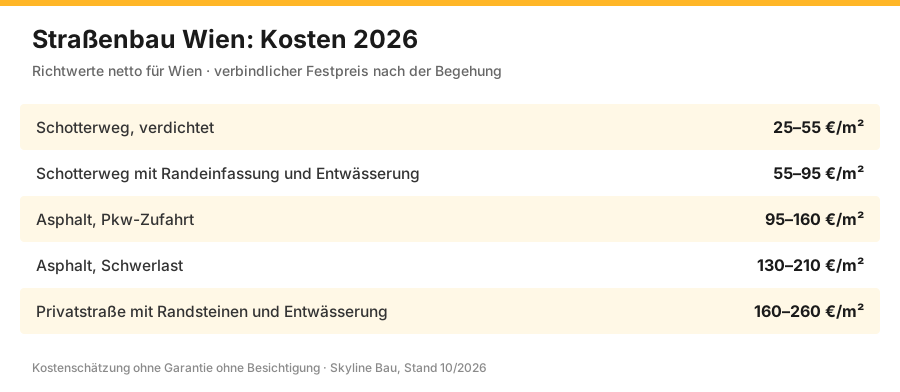
The jump from €160 to €260 per square metre comes almost entirely from drainage and edging, not from the asphalt. Kerbs with foundation and haunching cost €38 to €95 per linear metre, a channel with grating €120 to €320, and a road gully €650 to €1,800 each. With 100 metres of edging on both sides, that alone comes to €7,600 to €19,000.
Trench route with utilities
| Trade | Price per linear metre of trench | What is included |
|---|---|---|
| Sewer, foul water | 280–650 € | trench, bedding, pipe, backfilling, compaction |
| Sewer, surface water | 220–520 € | depending on diameter and depth |
| Manholes | €1,200–3,800 each | required every 30–50 m |
| Water main | 120–320 € | pipe, valves and fittings, flushing, pressure test |
| Power and data cables | 90–260 € | cable ducts, sand bedding, warning tape, cable pulling by the network operator |
| Gas main | 140–340 € | installed by the network operator, trench dug by us |
| Street lighting | €750–2,400 per lighting point | foundation, column, luminaire, cabling |
| Reinstatement of the carriageway above the trench | 95–210 €/m² | build-up and surfacing after backfilling |
Total around €91,500 net, which is €183/m² or €915 per linear metre of road. Drainage and edging account for a good quarter of this.
Total around €208,300 net, i.e. €2,083 per linear metre. The carriageway accounts for 44 per cent – with more elaborate site developments involving a deeper sewer, a pumping station or pavements, its share falls below 20 per cent.
What kind of road is being built
The terms are often mixed up in everyday use, but they differ considerably in build-up, approval and maintenance obligations.
| Type | What defines it | Typical build-up | Who maintains it |
|---|---|---|---|
| Gravel track, farm track | stabilised, but without a bound surface | 20–30 cm of gravel, compacted | Owner |
| Private driveway | one plot, car traffic | frost blanket, base course, asphalt 6+3 cm | Owner |
| Private road | several plots, residents' traffic, often refuse collection | as for a driveway, plus drainage and edging | owner or road users' association (Wegegemeinschaft) |
| Development road | new building plots, with utilities in the trench route | full specification including infrastructure | initially the developer, often adopted later |
| Municipal road | dedicated for public use | according to the road authority's specifications | municipality or city |
| Industrial road | works and warehouse traffic, lorries | reinforced build-up, 70–80 cm in total | the business |
The transition between private road and municipal road is where projects often get stuck. If a private development road is later to be adopted by the municipality, it must be built to the municipality's specifications from the outset – width, build-up, radii, drainage, lighting, and in some cases pavements too. Anyone who builds more cheaply in the hope of later adoption pays the difference afterwards as retrofitting, on the finished road.
The sequence: why the digging comes first
In road construction, the sequence has a greater impact on costs than any choice of material. Everything that lies beneath the carriageway must be finished before the carriageway – otherwise it gets built twice.
Drainage: where the water is allowed to go
A road creates a sealed surface, and the resulting rainwater must be drained in a controlled way. What is permitted depends on the soil, the groundwater and the permit.
| Option | When it is an option | Order of magnitude |
|---|---|---|
| Infiltration via verge or swale | permeable soil, space available | inexpensive, €40–120/lin. m |
| Soakaways | limited space, suitable soil | €1,200–3,500 per soakaway |
| Road gullies connected to the sewer | impermeable soil, sewer available and approved | €650–1,800 per gully plus pipework |
| Detention basin or attenuation | larger areas, requirement of the authority | project-dependent |
| Channels as linear drainage | gates, transitions, changes of gradient | €120–320/lin. m |
The decision is not made on site but at the planning stage: an infiltration solution requires a different sub-base from a surface that drains into gullies, and whether it is permitted depends on the conditions imposed. We clarify this before excavation, because the gradients and levels of the entire road are derived from it.
The build-up: what lies beneath the road
A road carries loads not because of its surface, but because of the build-up beneath it. The thicknesses depend on the heaviest vehicle that uses it regularly – and on a residential road that is not the car but the refuse lorry.
| Use | Frost protection | Base course | Asphalt | Total |
|---|---|---|---|---|
| Footpath and cycle path | 20–25 cm | – | 3 cm | approx. 25–30 cm |
| Private driveway, cars | 25–30 cm | 15 cm | 6 + 3 cm | approx. 45–55 cm |
| Private road with refuse collection | 30–35 cm | 20 cm | 8 + 4 cm | approx. 60–70 cm |
| Municipal road, through traffic | 35–40 cm | 20–25 cm | 8–10 + 4 cm | approx. 70–80 cm |
| Industrial road, heavy traffic | 40 cm | 25 cm | 10 + 4 cm | approx. 80 cm |
Then there is the subsoil itself: if it is cohesive, soft or water-bearing, the standard build-up is not enough. In that case the soil is either replaced to a greater depth, a geotextile or geogrid is laid, or the subsoil is stabilised. This decision is made after excavation, when the formation level is exposed – which is why it appears in our quotes as a provisional item with a unit price rather than as a surprise.
| Finding at formation level | Measure | Additional cost |
|---|---|---|
| Load-bearing gravel or crushed stone | compact, build-up as planned | none |
| Cohesive soil, damp | geotextile as a separating layer, thicker frost blanket | 8–22 €/m² |
| Soft subsoil | soil replacement, in some cases with geogrid | 25–70 €/m² |
| Water-bearing layer | French drain in the verge, discharge | €45–120/lin. m |
| Contaminated land or polluted material | sampling, separate disposal | depending on findings |
Construction time and lead time
| Project | Construction time | Lead time | What determines the lead time |
|---|---|---|---|
| Gravel track 100 m | 3–6 days | 1–2 weeks | material scheduling |
| Asphalted driveway 100 m | 1–2 weeks | 2–4 weeks | slot at the asphalt plant, weather |
| Private road 100 m with drainage | 2–4 weeks | 3–6 weeks | drainage permit |
| Site development 100 m with utilities | 6–12 weeks | 2–6 months | coordination with all utility providers |
| Municipal contract after tender | according to the bill of quantities | length of the procedure | procurement procedure and objection periods |
With site developments, the lead time is almost always longer than the construction time. Each utility provider has its own lead times, its own specifications for depth and bedding, and its own inspections. If you want to build in spring, you should start coordinating in the autumn before – that is the realistic timeframe, not the pessimistic one.
Who lays which utility
Several parties work in a development trench, and not everyone is allowed to carry out every task. The division is similar on every project:
| Trade | Who digs | Who lays and connects | Who inspects |
|---|---|---|---|
| Sewer | us | us, to the provider's specifications | the provider, with a leak-tightness test |
| Water main | us | us or a specialist firm, depending on the specification | the water supplier, with pressure test and flushing |
| Power | us | the network operator pulls the cables | Network operator |
| Gas | us | Network operator | Network operator |
| Telecommunications | us | the provider; we lay the ducts | Provider |
| Street lighting | us | licensed electrical contractor | the client, with a test report |
This gives rise to the real work of a site development project: five to seven parties have to be coordinated in the same trench, each with their own dates and their own inspections. That is precisely our task as the contractor doing the work – one shared trench instead of six separate ones, a sequence that works, and reinstatement that only begins once everyone has finished.
What you get at the end
- As-built records of the utilities with position and depth – the basis for every later excavation and for buyers of the building plots.
- Compaction test certificates for trenches and base courses.
- Test reports: leak-tightness test for the sewer, pressure test and flushing for water, inspection report for the lighting.
- Build-up description with layer thicknesses and materials.
- Photo documentation of trench, bedding, backfill and formation level – everything that becomes invisible afterwards.
- Acceptance report under ÖNORM B 2110 with snagging list and deadlines.
For site developments that are later to be handed over to a municipality, the as-built records are the most important part. Without them, adoption is routinely refused, because nobody will take responsibility for utilities whose position has not been documented.
Private roads: who pays, who maintains, who is liable
With private roads and shared driveways, most conflicts arise not during construction but afterwards. These points should be clarified in writing before work starts:
| Question | Why it matters | Recommendation |
|---|---|---|
| Who owns the land? | determines who may build and who maintains | check the land register, note any easements |
| Who bears the construction costs? | usually several neighbouring owners | agree a cost-sharing formula in advance, e.g. by plot size or use |
| Who maintains the road later? | snow clearing, repairs, lighting | reach an agreement on running costs |
| Who is liable in the event of accidents? | road keeper's liability (Wegehalterhaftung) falls on the keeper | clarify responsibility and insurance |
| Winter service | uncleared private roads are a liability issue | hire a service provider or agree a rota |
| Later adoption by the municipality | only possible if built to standard | obtain the specifications in advance and build accordingly |
From a construction point of view, the last point is the most relevant, because it determines the build-up. That is why we ask for every private road whether adoption is being considered – and, if in doubt, obtain the specifications before costing. The extra cost of a specification suitable for adoption is usually 15 to 30 per cent; retrofitting a finished road costs many times that.
Traffic management during construction
With roads, the construction site itself is a topic in its own right, because residents, delivery traffic, refuse collection and emergency vehicles all need to get through.
- Sections instead of a full closure. Work is carried out in stretches so that every driveway remains accessible – except on individual days, such as when the asphalt is laid.
- Steel plates as crossings. Open trenches are bridged at driveways so that nobody is cut off for days.
- Notice and posted information. Period, sections, contact person – two weeks in advance, just as in residential construction.
- Coordinate refuse collection. Where the lorry cannot get in, a collection point is agreed rather than leaving the bins standing.
- Emergency vehicles. Access for ambulances and the fire brigade must be guaranteed at all times; this belongs in the traffic management plan.
- Signage and safety barriers as specified, with a permit for work in public areas.
These measures appear as separate items in our quotes. At first glance they look like extras, but they are the reason why road works in residential areas either run smoothly or escalate.
Work for municipalities and public clients
Road construction is the area in which we most often work for municipalities, associations and publicly influenced clients. Different rules apply than for private contracts – not in construction terms, but in terms of procedure.
| Topic | What applies | What we provide for it |
|---|---|---|
| Procurement procedure | depending on the contract value, direct award, negotiated procedure or open tender under the Austrian Federal Procurement Act (Bundesvergabegesetz) | quote according to the tender documents, complete and on time |
| Bill of quantities | items and quantities are specified by the client | prices per item, no lump sums, no alternatives unless marked as such |
| Contractual basis | usually ÖNORM B 2110, often with supplementary contract terms | execution in line with the standard, acceptance, performance and warranty retention |
| Evidence | trade licence, insurance, references, proof of suitability | complete documents submitted with the quote |
| Subcontractors | must be named and in some cases approved | named in the quote together with their licence |
| Construction time and penalties | deadlines are fixed in the contract, delays are penalised | a realistic construction schedule instead of optimistic promises |
| Traffic management | residents, driveways, refuse collection and emergency vehicles remain accessible | traffic management plan, signage, coordination with the authority |
| Billing | according to the quantities actually delivered, verifiable | joint measurement, invoice by item |
The thresholds up to which a direct award is permitted are set by regulation and have been adjusted several times in recent years. The client knows which value applies in the specific case – we follow it and deliver the quote in the form required by the procedure in question.
Widths, radii and what the fire brigade needs
On private roads and development roads, the dimensions are determined not by cars but by the largest vehicles that use them regularly: refuse collection, delivery traffic and emergency vehicles.
| Element | Practical value | Why |
|---|---|---|
| Carriageway width, single lane | 3,0–3,5 m | car traffic with passing places |
| Carriageway width for two-way traffic | 5,0–5,5 m | two vehicles can pass each other |
| Access for emergency vehicles | as specified, usually from 3.5 m | clear width and load-bearing capacity are regulated |
| Inner turning radius | from approx. 5 m | refuse lorries and fire engines need a swept path |
| Turning head | diameter according to vehicle type | otherwise vehicles have to reverse, which refuse collectors refuse to do |
| Longitudinal gradient | up to approx. 10%, critical in winter | anything steeper becomes impassable in snow |
| Load-bearing capacity | based on the heaviest vehicle | a loaded refuse lorry weighs over 20 tonnes |
A point that regularly gets lost in planning: the refuse lorry only comes in if the width, radii and turning space are right. Without a turning head, the bins have to be taken to the start of the road – by the residents, every Tuesday. This can only be solved later by buying additional land, which in practice means not at all.
Renovation of existing roads
| Damage | Cause | Measure | Price net |
|---|---|---|---|
| Individual potholes | water ingress, frost | cut out, relay | €180–450 per spot |
| Settlement above utility trenches | trench poorly compacted | open up the area, compact, rebuild | 120–260 €/m² |
| Crazing across the surface | sub-base at the end of its life | renew the full build-up | 95–210 €/m² |
| Broken edges | no edging | set kerbs, make good the edge | €38–95/lin. m |
| Frost heave damage after winter | frost blanket too thin or wet | renew locally, check drainage | by area |
| Sunken manhole covers | compaction around the manhole | re-bed the manhole area | €450–1,400 per manhole |
With municipal roads, the question regularly arises whether resurfacing is enough or whether the sub-base has to be done as well. The honest answer depends on the pattern of damage: individual potholes and edges can be repaired, crazing across the whole surface cannot. Renewing only the surface course there buys two to three years – which can make economic sense if utility renovation is due anyway, and does not if twenty years of peace are expected afterwards.
Why roads break up in winter
Most road damage is caused not by traffic but by water combined with frost. That is why the decisive components are not the asphalt and base course, but the drainage and frost blanket.
| Process | What happens | What helps |
|---|---|---|
| Water penetrates through cracks and open edges | collects in the base course | seal cracks early, maintain the edging |
| The water freezes | expands, lifts the surface | a free-draining frost blanket in which no water stands |
| It thaws again | the build-up subsides unevenly | sufficient thickness and compaction |
| Vehicles load the weakened spot | the surface breaks up and a pothole forms | repair damage immediately in spring |
| De-icing salt gets into the build-up | attacks concrete and reinforcement, asphalt less so | drainage that carries away salty water |
This leads to a simple maintenance rule: sealing the cracks that have opened up and cleaning the gullies in spring extends the life of the surface by years. Wait until potholes appear and you are no longer repairing the surface but the build-up – and that costs ten times as much.
The most common mistakes in road construction
| Mistake | Why it happens | Consequence |
|---|---|---|
| Utilities after the carriageway | connections not fully checked | the finished road is cut open, €2,500–6,000 per crossing |
| Trenches poorly compacted | saves time, not checked | settlement in the surface along the trench |
| No turning head | land is saved | refuse lorry won't come in, hardly solvable later |
| Insufficient width or radii | designed for cars instead of refuse lorries | vehicles can't get through, edge damage |
| Drainage not clarified | regarded as a detail | standing water, frost damage, breach of permit conditions |
| Build-up below municipal standard | adoption assumed, not checked | municipality won't adopt, retrofitting on the finished road |
| No traffic management planned | the site is underestimated | residents' complaints, work stoppage, delays |
| Lump-sum quote without quantities | looks simpler | not verifiable, variations impossible to trace |
How to make two quotes comparable
- Separate sections for utilities and carriageway – otherwise you cannot see what has been priced for what.
- Trench metres with depth and width, not just "sewer, 100 m".
- Excavation and disposal in cubic metres, stating whether material will be reused.
- Layer thicknesses in centimetres for frost blanket, base course and asphalt.
- Edging and drainage in linear metres and units.
- Compaction test certificates, especially above the trenches.
- Traffic management and reinstatement as separate items.
In public tenders these points are specified in the bill of quantities anyway. In private projects they are often missing – and that is exactly where variations arise, because nobody has specified how deep to dig and how thick the build-up should be.
What we carry out ourselves in road construction
So that it is clear where we work with our own people and where licensed partner firms take over:
| Service | Execution |
|---|---|
| Excavation, formation level, soil replacement, compaction | carried out by us |
| Trenches for all utilities, bedding, backfilling | carried out by us |
| Sewers and surface water pipes, manholes | carried out by us to the provider's specifications |
| Frost blanket, base course, edging, drainage | carried out by us |
| Asphalt base and surface course | carried out by us with an asphalt crew |
| Paved and concrete surfaces | carried out by us |
| Electrical work on the lighting | licensed electrical contractor, named in the quote |
| Gas and in some cases water connections | network operator or licensed specialist firm |
| Surveying and structural engineering where required | chartered civil engineer (Ziviltechniker) as partner firm |
This division is set out in every quote, because for public clients it is a suitability criterion, and for private clients it answers the question of who is responsible if something goes wrong. Coordination of all parties remains with us – that is the core of the service, not an add-on.
How this differs from our other services
| Your project | Matching page |
|---|---|
| Asphalting the surface only, no utilities | Asphalt paving |
| Paved finish | Paving |
| Sewer, connection, decommissioning a cesspit | Sewer construction |
| Water and pressure pipes | Pipeline construction |
| Excavation, terrain, formation level | Earthworks |
| Retaining walls along the route | Retaining wall |
| Warehouse and industrial floors | Industrial floor repair |
When you do not need us
For a single pothole or a short patch repair, a repair crew is enough. We are worth it as soon as trench, utilities, sub-base, drainage and surfacing come together, when a development is to be built to a provider's specifications, or when a public client needs a verifiable quote based on a bill of quantities.
Public road or private land: who is responsible for what in Vienna
In Vienna, the city itself plans, awards and maintains the public roads; the responsible body is the municipal department for road administration and road construction. Anyone who needs a carriageway on public land therefore does not commission a construction firm directly, but contacts the city or the district. Even so, plenty of road construction remains for private clients: driveways to residential complexes, access roads on building plots, commercial yards, car parks, paths in allotment and housing estates, and areas that are only to be transferred to the city once completed.
As soon as your works affect public land – for a sewer or water connection in the street, say, or a new driveway entrance across the pavement – you need a permit from the city before any digging starts. This involves plans, the construction period and traffic management; the reinstatement of the surface must meet the city's specifications. We build these steps into the schedule, because in practice they often take longer than the construction work itself.
The driveway crossing over the pavement: a small component with its own procedure
Many private road projects end at the property boundary – and that is exactly where a detail lies that is easily forgotten: the vehicle crossing over the public pavement. So that vehicles can cross the kerb, the kerb is lowered and the pavement in that area is built up for the higher load. This is not part of your plot but public land, for which the city's consent is needed. Plan this application at the same time as the driveway, otherwise the finished private road will end at a kerb that nobody is allowed to drive over. Where the entrance is paved or asphalted, you will find details on the surfaces under paving and asphalting.
What happens to the excavated material: disposal as a cost factor in road construction
Road construction produces more spoil than you might expect. For a load-bearing build-up, the soil is removed to a depth of several decimetres depending on the subsoil, and considerably deeper for utility trenches. In Austria this material may not simply be dumped anywhere: before a landfill accepts it, it is sampled and classified. Clean spoil is cheap to dispose of or can be reused on site, while material containing foreign matter or old made ground costs many times as much. On former commercial or garden land on the outskirts of Vienna in particular, such made ground is no rarity.
A reputable quote therefore states the assumed soil class and sets out what happens if the analysis shows something different. If suitable recycled material is used for the base course, transport and costs fall. You can find more on handling large volumes of earth under earthworks.
Frequently asked questions about road construction in Vienna
How much does site development cost per building plot?
Why is a shared trench cheaper?
What if the subsoil won't bear the load?
Who is liable on a private road?
How much more does it cost to build to adoptable standard?
What belongs in the as-built records?
How much do 100 metres of road cost?
Why does the internet quote figures from €1,500 to €1.8 million?
Is it calculated in square metres or linear metres?
How much does a gravel track cost?
Why is a private road more expensive than a driveway?
In what order is it built?
What happens if a connection is forgotten?
Are spare cable ducts worthwhile?
Why does the surface sink above utility trenches?
How wide does a private road need to be?
Is a turning head needed?
Where is the rainwater allowed to go?
Can a private road later be adopted by the municipality?
Do you work for municipalities?
How does a procurement procedure work?
Who carries out electrical work on the lighting?
How much does street lighting cost?
Does the road remain usable during construction?
How long does site development over 100 metres take?
What about winter damage?
Is it enough to renew only the surface course?
How is invoicing handled on public contracts?
What about utilities that are not shown on the plans?
Can you also take on individual trades only?
How quickly can I get an assessment?
Can I, as a private individual, have a public road built in Vienna?
Do I need a permit for a driveway entrance across the pavement?
Why is disposal of excavated material often so expensive?
Related services
Road finished? The construction site leaves its mark.
Once the work is complete, our partner firm Bling Premium Reinigung takes care of cleaning the adjacent areas and driveways. Find out more at bling-bling.at.
Send enquiry
Enquire directly here — fixed-price quotation free of charge. Skyline Bau replies within 2 working days.
Ready for your road construction project in Vienna?
Write to us directly on WhatsApp — send photos. Reply within 2 working days.
Note: Skyline Bau is the brand name of the construction and renovation division of Bling Bling GmbH and not a separate legal entity. The sole contractual partner is Bling Bling GmbH. Bling Bling GmbH is a restricted building trade business under § 99 GewO (Austrian Trade Regulation Act) and not a licensed master builder (konzessionierter Baumeister). Under § 99 (5) GewO, the title „Baumeister“ (master builder) is reserved for businesses licensed under § 94 no. 5 GewO. Regulated trades — master builder services, structural engineering, gas and plumbing, electrical engineering — are carried out exclusively by authorised, licensed partner firms.