Underground car park renovation Vienna Chloride eats concrete from within.
Underground car park renovation Vienna: from the contractor who does the work — not from a broker.
Underground car park renovation Vienna: renovating an underground car park in Vienna costs €90 to €280 per square metre. Concrete repair €120–320/m², surface protection €45–110/m², crack injection €60–180 per linear metre. Carried out to ÖNORM EN 1504, while the car park stays in use, section by section.
How to tell that renovation is needed
- Spalling on the ceiling or columns, often with visible, rusty reinforcing steel. This is not a cosmetic flaw but a loss of cross-section in a load-bearing element.
- Rust streaks and brown efflorescence on the concrete surface – the rust migrates outwards with the water before the concrete spalls.
- Lime efflorescence and stalactites on the ceiling. Water is running through the structure, usually along cracks or construction joints.
- Standing puddles, because there is no fall or the drains are blocked. Standing salt water is the worst condition of all.
- Cracks in the floor surface, especially across the driving lane and at junctions between building elements.
- Blistering and detachment of the coating, often where moisture is pushing up from the substrate.
- Corrosion on built-in components: railings, anchor plates, pipe clamps, door frames.
We carry out structural repairs on affected floor areas, including exposed reinforcement: industrial floor renovation.
Underground car park renovation Vienna: costs 2026
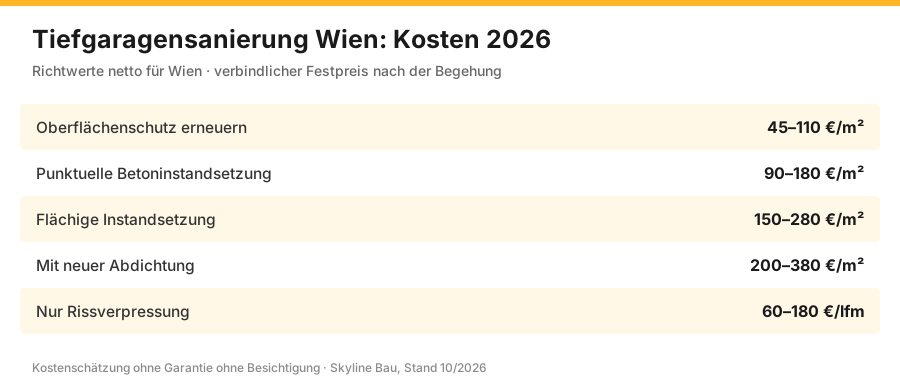
Guide prices net, as of 2026, binding after the condition survey. The range depends on the chloride content and the proportion of damaged areas.
| Scope | What is done | Price net | Duration |
|---|---|---|---|
| Renewing surface protection | Cleaning, primer, coating | 45–110 €/m² | 2–5 weeks |
| Localised concrete repair | Removing damaged areas, reinforcement, reprofiling | 90–180 €/m² | 4–10 weeks |
| Full-area repair | plus large-scale removal, new top layer | 150–280 €/m² | 3–6 months |
| With new waterproofing | Ramp, ceiling or walls in contact with the ground | 200–380 €/m² | 4–8 months |
| Crack injection only | Setting packers, injecting resin | €60–180/lin. m | 1–3 weeks |
Unit prices
| Item | Unit | Price net | What is included |
|---|---|---|---|
| Condition survey and chloride profiles | lump sum | 2.500–8.000 € | Drill dust samples, laboratory values, damage mapping |
| Potential mapping | m² | 6–18 € | reveals corrosion before the concrete spalls |
| Pull-off adhesion test | pc. | 120–280 € | Load-bearing capacity of the substrate for the coating |
| Ultra-high-pressure water jetting | m² | 28–65 € | removes chloride-contaminated concrete, protects the reinforcement |
| Exposing and derusting reinforcement | linear m | 35–90 € | Sandblasting to the standard degree of cleanliness |
| Supplementing reinforcement | kg | 4,50–9,00 € | where cross-section loss exceeds 10% |
| Corrosion protection on the reinforcement | linear m | 12–30 € | two coats as specified by the system |
| Reprofiling with PCC mortar | m² | 85–190 € | Bonding agent, mortar to ÖNORM EN 1504-3 |
| Crack injection with epoxy resin | linear m | 60–140 € | structural bond, for dormant cracks |
| Crack injection with PU resin | linear m | 80–180 € | flexible, for moving and water-bearing cracks |
| Surface protection OS 8, trafficable, rigid | m² | 45–85 € | Epoxy with broadcast aggregate, for parking areas |
| Surface protection OS 11, crack-bridging | m² | 75–140 € | elastic, for driving lanes and ramps |
| Laying a sloped screed | m² | 45–95 € | where water stands |
| Renewing drainage channels | linear m | 180–420 € | Channel, grating, connection, waterproofing |
| Renewing joint tapes and expansion joints | linear m | 90–260 € | Clearing out, preparation, new profile |
| Markings and signage | Parking space | 35–90 € | Bay markings, numbering, guide lines |
| Site set-up and dust protection | lump sum | 3.500–14.000 € | Partitioning, extraction, lighting, diversion |
Total approx. €224,200 net, which is €160/m² or €5,340 per parking space. If you wait too long, it is not the price per square metre that rises but the damaged area – going from 18% to 40% roughly means doubling the repair costs.
Surface protection systems: which one for what
| System | Price per m² | Property | Area of use |
|---|---|---|---|
| OS 8, rigid | 45–85 € | Epoxy with quartz broadcast, very robust | Parking spaces without crack movement |
| OS 11a, crack-bridging | 85–140 € | elastic intermediate layer, bridges moving cracks | Driving lanes, ramps, slabs above occupied rooms |
| OS 11b, crack-bridging | 75–120 € | thinner build-up, lower movement capacity | areas under light loads |
| OS 10, waterproofing beneath screed | 60–110 € | liquid-applied, with a protective layer on top | Slabs with occupied space below |
| Hard aggregate broadcast without a system | 18–40 € | no protection against chloride | only where the concrete is demonstrably uncontaminated |
How an underground car park renovation works
Renovation while the car park stays in use
- Section by section instead of all at once. Thirds or halves are usual, so that some of the parking spaces always remain usable.
- Re-parking plan and notice four weeks in advance, with a posted notice, signage and personal allocation of substitute spaces.
- Allow for curing times: depending on the system, coatings need 12 to 72 hours before they can be driven on. This cannot be shortened; it belongs in the schedule.
- Ventilation and extraction. Blasting and coating produce dust and solvent fumes. The ventilation system is integrated, and access points to residential areas are sealed off.
- Escape routes and fire protection remain clear at all times, fire-fighting equipment stays accessible, and escape route signs remain visible during the construction phase as well.
- Access to building services: sprinkler control room, pumps, transformer station and lift shaft must be accessible at all times.
Who pays and who decides
| Constellation | Who decides | Funding |
|---|---|---|
| Condominium ownership, garage as common property | Owners' meeting, majority resolution | Reserve fund, special levy if needed |
| Condominium ownership, parking spaces as appurtenances | likewise the owners' association | the structure remains common property |
| Tenement building in sole ownership | the owner | Maintenance under § 3 MRG (Austrian Tenancy Act), rent reserve |
| Commercial property | the owner or as set out in the lease | depending on the agreement |
| Maintenance or improvement | Distinction made in the survey report | determines whether costs can be passed on |
To support the resolution, we provide a survey report with damage mapping, a bill of quantities, options and their cost implications, plus a recommendation on how to divide the work into sections. An owners' meeting cannot decide on more than €200,000 on the spur of the moment.
The eight mistakes that ruin an underground car park renovation
- Coating without a chloride analysis. The salt stays in the concrete, corrosion continues, and within three to six years everything is open again.
- Too little removed. The contaminated concrete has to go, not just the loose outer shell.
- Rigid system over moving cracks. OS 8 cracks there within a single season; what is needed is a crack-bridging OS 11.
- No fall created. Where salt water remains standing, the damage starts again at the same spot.
- Drainage not renewed. Blocked or corroded channels render even the best coating ineffective.
- Expansion joints coated over. A joint must remain a joint, otherwise the layer next to it cracks open.
- No layer-thickness checks. A coating applied too thinly does not reach its service life, yet looks exactly the same.
- No maintenance agreed. Annual cleaning and visual inspection extend the service life considerably and cost little.
How to check a quote
When you do not need us
If a few pieces of concrete have fallen but everything else looks unremarkable, start with a condition survey rather than a renovation contract – sometimes a localised repair is enough, at a fraction of the cost. If your garage is less than fifteen years old and has never been cleaned, annual cleaning combined with a visual inspection is often the right measure. And if drainage is the problem, solve that first – a coating over standing salt water is money down the drain.
Coating against corrosion: what it can and cannot do
A coating protects the steel inside the concrete only indirectly. It keeps water and dissolved de-icing salt away from the surface so that chloride never migrates as far as the reinforcement. But if the chloride is already there, the steel keeps rusting beneath a new layer – just out of sight. So the right answer depends on how far the damage has progressed.
| Condition | Appropriate corrosion protection |
|---|---|
| Chloride only in the outer zone, steel passive | Surface protection system as a precaution, regular inspection |
| Chloride at the reinforcement, rust in places | remove contaminated concrete, derust and protect the steel, reprofile, then coat |
| contaminated over large areas, removal hardly economical | cathodic corrosion protection designed by specialist engineers, supplemented by surface protection |
Cathodic protection shifts the electrical potential of the steel so that it no longer corrodes, sparing you large areas of demolition. However, it requires permanent monitoring and only makes sense under certain conditions. Inhibitors applied to the surface are regarded as a supplement, not as a solution on their own. Which option fits can only be said after the chloride profile and potential measurement.
Column bases, wall plinths and ramps: the zones that give way first
In many garages the driving lane still looks passable while the columns are already being damaged. The reason lies at the base: tyres throw salty water against the bottom few centimetres, slush collects at the edge of the column and never dries out completely. The same applies to wall plinths along the parking spaces and to ramps where water runs off as cars drive in. During renovation these areas are therefore given an upstand coating, i.e. taken beyond the floor up the column and wall, with a neatly formed cove as the transition. On ramps, a non-slip broadcast is added so that the surface stays safe to drive on when wet. Anyone who renovates only the surface and forgets the junctions will find the next spalling exactly there. If the load-bearing capacity of columns or foundations is already in doubt, strengthening the foundations comes into play.
What else should be considered besides concrete and coating
An underground car park is more than a concrete slab. During the works, the ventilation system, smoke detectors, CO warning system and lighting, where present, must be protected from dust and blasting water and then tested again afterwards. Many owners' associations also use the closure to replace old light fittings with energy-efficient technology or to lay empty conduits for future charging points – this is considerably cheaper while the surface is open anyway. The electrical work for this is carried out by an authorised partner firm. If the garage adjoins cellar compartments, it is worth checking their walls too, because moisture and salt migrate there as well; more on this under basement renovation.
Frequently asked questions about underground car park renovation in Vienna
How much does an underground car park renovation cost?
Why is de-icing salt the main problem?
What is a chloride profile?
What is potential mapping?
Can't you just apply a coating?
What do OS 8 and OS 11 mean?
Which system do I need where?
What is ultra-high-pressure water jetting?
When does reinforcement need to be supplemented?
What is reprofiling?
How much does crack injection cost?
Underground car park renovation: how long does it take?
Is the garage closed during the works?
How long after coating must the surface not be driven on?
Will the flat smell of solvents?
What happens to the drainage?
How long does a renovated underground car park last?
What maintenance is needed?
Underground car park renovation: who decides in a condominium?
What do I need for the owners' meeting?
Is it maintenance or improvement?
What happens if we wait a little longer?
Can the structure be affected?
Underground car park renovation: who carries out the work?
Underground car park renovation: is there a fixed price?
How quickly can I get an assessment?
Is a new coating enough if the concrete already shows rust stains?
What is cathodic corrosion protection in an underground car park?
Can empty conduits for EV charging points be laid during the renovation?
Related services
Garage renovated? Initial clean before reopening.
Before the parking spaces are released for use, a deep clean is needed; after that, regular cleaning helps the coating last longer. Bling Premium Reinigung takes care of both. More at bling-bling.at.
Send enquiry
Enquire directly here — fixed-price quotation free of charge. Skyline Bau replies within 2 working days.
Ready for your underground car park renovation in Vienna?
Write to us directly on WhatsApp — send photos of the damage in your underground car park. Reply within two working days.
Note: Skyline Bau is the brand name of the construction and renovation division of Bling Bling GmbH and not a separate legal entity. The sole contractual partner is Bling Bling GmbH. Bling Bling GmbH is a restricted building trade business under § 99 GewO (Austrian Trade Regulation Act) and not a licensed master builder (konzessionierter Baumeister). Under § 99 (5) GewO, the title "Baumeister” (master builder) is reserved for businesses licensed under § 94 no. 5 GewO. Regulated trades — master builder services, structural engineering, gas and plumbing, electrical engineering — are carried out exclusively by authorised, licensed partner firms.