Minor repairs Vienna one call, one tradesperson, one appointment.
Minor repairs in Vienna: from the construction company that does the work — not from an agency.
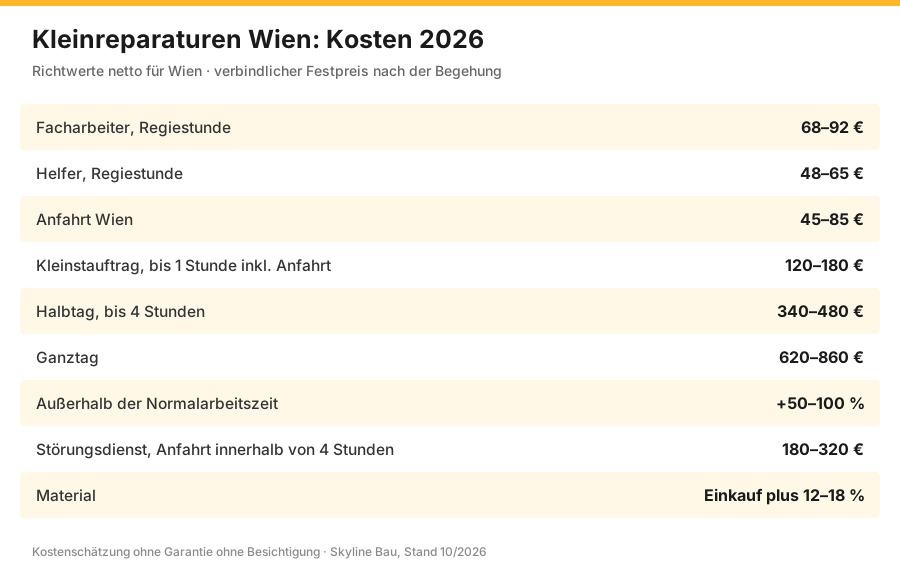
Minor repairs in Vienna: in Vienna, minor repairs cost €68 to €92 per hour, and the smallest billing unit is €120 to €180 including travel. For property managers and owners with ongoing needs, we work under a framework agreement: fixed prices, a fixed response time and a single point of contact.
Minor repairs in Vienna: costs 2026
| Item | Unit | Price net | Note |
|---|---|---|---|
| Skilled tradesperson, hourly rate (time and materials) | hour | 68–92 € | per quarter-hour or part thereof |
| Labourer, hourly rate (time and materials) | hour | 48–65 € | for carrying and clearing work |
| Travel within Vienna | trip | 45–85 € | often a flat rate under the framework agreement |
| Very small job, up to 1 hour incl. travel | lump sum | 120–180 € | smallest billing unit |
| Half day, up to 4 hours | lump sum | 340–480 € | several jobs in the same building |
| Full day | lump sum | 620–860 € | combined visit, list worked through |
| Outside normal working hours | hour | +50–100 % | evenings, weekends, public holidays |
| Emergency call-out, on site within 4 hours | Application | 180–320 € | initial response, damage limitation |
| Material | based on effort | Purchase price plus 12–18% | receipts enclosed on request |
| Disposal of small quantities | trip | 85–160 € | old parts, packaging, building rubble |
Fixed prices for recurring work
| Work | Duration | Price net |
|---|---|---|
| Replace a door lock or cylinder | 20–40 min. | €140–260 plus materials |
| Adjust a door hinge, door sticking | 20–30 min. | 120–190 € |
| Renew silicone joints in a bathroom or kitchen | 1–2 hrs | 180–420 € |
| Replace a single tile | 1–2 hrs | €180–380 plus materials |
| Patch and paint a small area of plaster | 1–3 hrs | 190–520 € |
| Paint one room | half a day | 380–680 € |
| Renew skirting board | per linear m | 18–34 € |
| Secure a staircase banister | 1–2 hrs | 190–420 € |
| Reset a pavement slab or paving stone | 1–3 hrs | 220–560 € |
| Seal or replace a cellar window | 2–4 hrs | €320–780 plus materials |
| Secure a letterbox unit, replace parts | 1–2 hrs | 160–390 € |
| Seal a drainpipe in the cellar, fit a pipe clamp | 1–2 hrs | 190–420 € |
These rates are the standard under the framework agreement: they apply without a separate quote, as long as the work stays within the scope described. If opening something up reveals more – damp behind a tile, for instance – we stop, take photos and report back before carrying on.
What we repair – and what we don't
| Area | Typical jobs | We do it |
|---|---|---|
| Walls and ceilings | cracks, damaged plaster, holes, painting | yes |
| Floors | loose tiles, skirting boards, threshold strips, small patches of parquet | yes |
| Doors and windows | fittings, hinges, locks, seals, sticking | yes |
| Bathroom and kitchen | silicone, tiles, fixings, clearing drains | yes |
| Common areas | staircase, cellar, courtyard, driveway, bin room | yes |
| Outdoor areas | paving, steps, fencing, cellar stairs | yes |
| Electrics | sockets, light fittings, distribution boards | via a licensed partner firm |
| Gas, water, heating | taps and mixers, burst pipes, combi boilers | via a licensed partner firm |
| Lift | breakdown, maintenance | no, a matter for the lift company |
| Chimney | flue, exhaust gas | no, a matter for the chimney sweep |
The framework agreement for property managers
A framework agreement is not a subscription with a basic fee, but an agreement on prices, procedures and deadlines. Work is still commissioned job by job – just without renegotiating every time.
| Point | Provision |
|---|---|
| Prices | fixed hourly rates and item prices for twelve months |
| Commissioning | informally by email, the property manager's order number is enough |
| Approval limit | up to an agreed amount without further enquiry, above that with a cost estimate |
| Response time | reply within 24 hours, appointment within 48 hours on working days |
| Emergency call-out | on site within 4 hours for water leaks, risk of falling parts, blocked routes |
| Scheduling | directly with the tenant, the property manager receives a copy of the confirmation |
| Documentation | before and after photos, a short work report |
| Billing | consolidated invoice per property, monthly, with order numbers |
| Escalation | one contact person, a named deputy during holidays |
| Term | twelve months, renewed automatically, terminable at any time to the end of the month |
How a job runs
| Step | What happens | Deadline |
|---|---|---|
| 1. Report | the property manager, owner or tenant reports the damage with a photo | — |
| 2. Feedback | assessment of whether it is covered by the framework agreement, rough price range | 24 hours |
| 3. Scheduling | directly with the occupant, two time slots to choose from | 48 hours on working days |
| 4. Execution | repair; if anything deviates, stop and check back | as scheduled |
| 5. Documentation | photos, working time, materials, a short report | on the same day |
| 6. Invoicing | consolidated invoice per property at the end of the month | monthly |
Step two decides how satisfied people are. An honest reply that the appointment is only possible in ten days causes less annoyance than a promised date that gets postponed twice. We promise what we can keep and report delays before they happen.
Who pays: property manager, owner or tenant
The most common delay with minor repairs does not arise in the workshop, but over the question of who gets the invoice. The basic principle in Viennese tenancy law is simpler than it is often made out to be.
| Case | Who usually bears the cost | Note |
|---|---|---|
| Serious damage to the building, roof, pipes, load-bearing structure | landlord or the condominium owners' association (WEG) | duty of maintenance |
| Common areas, staircase, courtyard, cellar | owners' association, from the reserve fund | property manager commissions the work |
| Combi boiler, water heater or heating boiler let with the flat | landlord, where the Austrian Tenancy Act (MRG) applies in full | expressly regulated since 2015 |
| Wear and tear inside the flat | depends on the contract and the scope of application | frequently disputed |
| Damage caused by the tenant | Tenant | check the household contents insurance |
| Owner-occupied flat (Wohnungseigentum), inside the flat | Flat owners | common parts remain the responsibility of the community |
| Damage from the neighbouring flat | the party responsible or their liability insurer | documentation is decisive |
Combined visits: how property managers save money
The biggest saving lies not in the hourly rate, but in bundling. A calculation that repeats itself in every building.
| Approach | 5 small jobs in one building | Cost net |
|---|---|---|
| Five separate call-outs | 5 × very small job at €150 | 750 € |
| One combined visit in the morning | Half day €420 plus materials | 420 € |
| Full day with a list, 10 to 14 items | Full day €740 plus materials | 740 € |
For this to work, each property needs an ongoing defects list instead of individual calls. We keep this list for you on request: every report that is not urgent is collected and dealt with at the next combined visit. Urgent matters are still handled immediately.
Emergency call-out
| Case | Initial response | Call-out |
|---|---|---|
| Water escaping from a pipe or the ceiling | shut off, soak up the water, contain the damage | within 4 hours |
| Rainwater ingress | cover over, clear the drain, seal temporarily | within 4 hours |
| Risk of falling, loose building component | cordon off, secure, remove | within 4 hours |
| Blocked escape or access route | clear, secure temporarily | within 4 hours |
| Smashed pane in a common area | remove the remains, close up temporarily | within 4 hours |
| Faulty lighting in the staircase | emergency lighting, replacement via a partner firm | next working day |
The emergency call-out service is designed for the initial response: stop the damage, remove the danger, document the condition. The permanent repair follows at a regular appointment, with a cost estimate and approval. Keeping these separate keeps costs under control, because the expensive time outside normal working hours is used only for what is strictly necessary.
Minor repairs between tenancies
The gap between one tenant moving out and the next moving in is the most expensive vacancy of the year. Every week without a tenant costs roughly a quarter of the monthly rent, and most of that time is not spent on work but on waiting between trades.
| Work | Duration | Price net |
|---|---|---|
| Handover inspection with a defects list and photos | 1 hr | 140–240 € |
| Fill holes, patch walls | 2–4 hrs | 220–520 € |
| Paint a 60 m² flat throughout | 1–2 days | 1.100–2.200 € |
| Renew silicone joints in bathroom and kitchen | 2–3 hrs | 260–480 € |
| Adjust doors, replace fittings | 2–4 hrs | 240–560 € |
| Spot-repair floor damage | based on effort | 180–900 € |
| Final cleaning by a partner firm | — | by area |
If there is more to do than patching and painting, flat refurbishment is the right framework, and for a larger scope flat renovation. In practice the line lies where pipes, floors or sanitary fittings are replaced completely.
For owners and investors
| Situation | What makes sense |
|---|---|
| A let flat in Vienna, owner lives elsewhere | a fixed contact person, appointments directly with the tenant, photo report |
| Several flats in a portfolio | framework agreement with a consolidated invoice per property |
| Short-term letting | a quick response between two bookings, combined visits in the off-season |
| Inherited flat, condition unclear | inspection with a defects list and cost estimate before any decision |
| Sale planned | fix visible minor defects – it adds more to the price than it costs |
For owners who live elsewhere, the documentation is the real value: anyone who cannot drop by in person needs before and after photos, a clear description and an invoice they can follow. That is exactly what we deliver with every job, at no extra charge.
What we bring – and what should stay in the building
| What | Who provides it | Note |
|---|---|---|
| Tools, ladder, small machines | us | included in the price |
| Standard materials, wall plugs, silicone, white paint | us | charged according to use |
| Leftover tiles, special colour shades, spare parts from the renovation | Building | ideally stored in the cellar |
| Keys, access, contact person on site | property manager or occupant | decides whether the appointment succeeds |
| Parking space or stopping permit | the building, where possible | otherwise parking costs in the short-stay parking zone |
| Power supply in the common area | Building | for work in the courtyard and cellar |
The annual walk-round: maintenance instead of repair
The cheapest repair is the one that never has to happen. A structured walk-round once a year finds the points that will become expensive next winter – and costs less than a single emergency call-out.
| Area | What we look at | What it prevents |
|---|---|---|
| Gutters and downpipes | leaves, blockages, loose brackets | water on the façade, damp in the masonry |
| Flat roof and terrace drains | free drainage, emergency overflow | water ingress after heavy rain |
| Façade plinth area | hollow spots, flaking render | falling parts, liability claims |
| Window sills (metal flashing) and junctions | loose flashing, open joints | damp in the window reveal |
| Stairwell | handrail, step edges, lighting | falls and trips |
| Basement | signs of damp, light wells, windows | water in the cellar, mould |
| Courtyard and access | loose slabs, trip edges, lighting | accidents, duty to keep premises safe |
| Bin room and ancillary rooms | doors, locks, ventilation | odours, pests, complaints |
| Attic | water marks, open windows, pigeon droppings | damage going unnoticed for months |
| Service | Scope | Price net |
|---|---|---|
| Walk-round, small building, up to 10 units | inspection, photo log, defects list with cost estimate | 380–620 € |
| Walk-round, tenement building (Zinshaus), up to 25 units | as above, including cellar and attic | 620–1.100 € |
| Walk-round with immediate work | small items dealt with on the spot | plus hourly rates |
Seasonal work
| Period | Typical work |
|---|---|
| Spring | winter damage to plaster and paving, façade plinth, outdoor areas, courtyard drainage |
| Early summer | painting between tenancies, window work, balcony and terrace drains |
| Late summer | annual walk-round, gutters, flashing, cellar windows, lighting before the dark season |
| Autumn | clear drains, turn off outdoor water, door seals, check snow-clearing equipment |
| Winter | emergency call-outs, frost damage, safe access routes, emergency repairs |
How the work is spread over the year is itself a cost factor: if you schedule painting and patching in the summer, you get appointments and steadier prices. If you commission everything at once in November, you also pay for waiting time and surcharges.
Typical reports and what lies behind them
| Report | Most common cause | What we check first |
|---|---|---|
| Door sticks or no longer closes | hinge has dropped, timber has moved, less often settlement | hinge, rebate, whether the frame is still plumb |
| Window is draughty | seal has hardened, fitting out of adjustment | seal, contact pressure, frame junction |
| Black joint in the bathroom | silicone at the end of its service life | whether there is damp behind it or only on the surface |
| Tile sounds hollow | adhesive has come loose, often due to moisture ingress | tap the surrounding area, measure |
| Stain on the ceiling | leak from above, less often condensation | moisture measurement, use of the space above |
| Crack above the door | movement at the lintel, often old and no longer active | measure the width, the course, whether fresh or painted over |
| Light in the staircase fails | bulb, motion sensor, rarely the wiring | inspection, electrical work via a partner firm |
| Drain in the cellar smells | dried-out trap | trap, non-return valve, ventilation |
| Water in the light well | blocked drain, missing cover | clear the drain, check the connection |
| Paving is sinking | sub-base washed out, often a leaking pipe | open up the bedding, establish where the water is coming from |
What occupants can do themselves
- Flush the trap: fill rarely used drains with water once a month and they won't smell.
- Air the room instead of painting over it: opening the windows wide twice a day prevents most mould reports in living spaces.
- Keep furniture away from external walls: five centimetres of air behind a wardrobe on a cold wall saves a mould remediation behind it.
- Grease window fittings: once a year – it noticeably extends their service life.
- Keep silicone joints dry: wipe them down after showering – it doubles their lifespan.
- Report escaping water immediately: every hour increases the damage and the drying time later on.
- Send photos: a report with a picture saves an inspection trip and speeds up the appointment.
The last point is the most effective one for property managers: a report with two photos and a location can usually be assessed and scheduled without a preliminary visit. Without a picture, someone has to drive out to see what needs doing – and in the end the building pays for that trip.
What the framework agreement actually takes off the property manager's hands
| Function | Without a framework agreement | With a framework agreement |
|---|---|---|
| Obtaining quotes | 3 firms per job, 2 don't reply | not needed up to the approval limit |
| Checking prices | compare afresh every time | price list valid for twelve months |
| Appointment with the tenant | property manager acts as go-between | directly between tradesperson and occupant |
| Chasing up | several phone calls | reply within 24 hours guaranteed |
| Paperwork | many separate invoices | consolidated invoice per property and month |
| Proof for owners | hard to substantiate | photo report for every job |
| Recurring defects | nobody notices them | are tracked in the property list |
This is the real reason property managers sign framework agreements: it is not the hourly rate that matters, but how much working time is tied up in their own office. A clerk who spends three quarters of an hour organising each small job generates more cost with thirty jobs a month than the price difference between two contractors over an entire year.
Property list: the running schedule of defects
For every building we look after, we keep a simple list of the open items. It is the tool that turns individual reports into work that can be planned.
| Column | Content | Purpose |
|---|---|---|
| Date reported | when and by whom it was reported | traceability for owners |
| Location | staircase, floor, flat number, area | makes combined visits plannable |
| Description and photo | what exactly is wrong | assessment without a preliminary visit |
| Urgency | immediate, soon, collect | separates emergencies from items that can wait |
| Responsibility | community, owner, tenant | clarifies the invoicing in advance |
| Cost frame | rough estimate | prepares the approval or resolution |
| Status | open, commissioned, done | basis for the next appointment |
Working in an occupied building
| Point | How we handle it |
|---|---|
| Notice | appointment confirmed, time slot given, any change reported immediately |
| Protection | floors and furniture covered, dust protection for chiselling work |
| Working hours | working days 7 am to 5 pm, noisy work not before 8 am |
| Escape routes | kept clear, no materials stored in the staircase |
| Cleanliness | work area left broom-clean |
| Keys | only against a signed receipt, return documented |
| Neighbours | notice posted for noisy work or closures |
Cleanliness is the point where repair firms most often fall down. A technically flawless repair with dust on the living room floor produces a complaint that lands on the property manager's desk – creating exactly the work the framework agreement is meant to avoid. Where thorough cleaning after the work is wanted, our partner firm takes care of it.
What a building spends on minor repairs each year
For budgeting, typical values per unit are more useful than individual items. The following ranges apply to Viennese residential buildings without a major renovation under way.
| Building type | Minor repairs per unit per year | Remark |
|---|---|---|
| New build, under 15 years old | 60–140 € | mainly fittings, silicone, lighting |
| Residential building from the 1960s to 1990s | 140–320 € | pipes and bathrooms are ageing |
| Gründerzeit tenement building (built 1848–1918), renovated | 180–380 € | common areas, façade, courtyard |
| Gründerzeit tenement building, unrenovated | 320–700 € | many individual cases, often damp |
| Commercial premises in the building | higher | shopfronts, floors, more intensive use |
The same thinking applies to the reserve fund: minor repairs come out of running costs, larger refurbishments out of the reserve. Mix the two and you can no longer see either. That is why, in the consolidated invoice, we state for each job whether it is a repair or a separate refurbishment measure.
Obligations behind many jobs
| Obligation | What it means | Typical resulting jobs |
|---|---|---|
| Maintenance of the building | keep the structure in usable condition | plaster, roof, pipes, common areas |
| Duty to keep premises safe | nobody may come to harm because of the building's condition | loose components, trip hazards, lighting, handrail |
| Pavement duties in winter | clearing and gritting at the prescribed times | grit bins, equipment, kerbstones |
| Fire safety in escape routes | routes clear, doors working | door closers, fittings, clearing out corridors |
| Safety at drop edges | railings and parapets stable | railing fixings, balcony parapet |
Where a defect has to be dealt with immediately but the permanent solution takes time, we first make it safe temporarily and document this: cordoned off, removed, temporarily secured, date, photo. That removes the danger and keeps the process traceable until the final repair is commissioned.
When a minor repair turns into something bigger
Some reports are not repair cases at all, but the visible end of a bigger problem. Spotting this early saves the owners' association a great deal of money.
| Report | Can also mean | Next step |
|---|---|---|
| Bathroom tile keeps coming loose | leaking waterproofing under the covering | open up, measure, consider a bathroom renovation |
| Damp patch on the ground floor | rising damp in the masonry | measurement, damp-proofing of walls |
| Cracks return after patching | movement in the component | monitor, masonry repair |
| Render falling off the façade | hollow spots over larger areas | tap-testing, façade renovation |
| Water in the cellar after rain | missing or faulty waterproofing | Basement renovation |
| Mould returns after painting over | thermal bridge or leak | establish the cause, mould remediation |
| Several flats report the same thing | a building-component problem rather than an isolated one | survey of the whole building |
The most common mistakes
- Symptom repaired instead of the cause. The stain is painted over, the leak remains. Six months later you pay for both.
- No approval limit agreed. Every small job goes through the full approval loop, and processing it costs more than the work.
- Ad hoc calls instead of a list. Without a maintained defects list, the tradesperson drives to the same building five times.
- No photos. Without a before picture, it is impossible to trace later what was done and why it cost so much.
- Responsibility only clarified after the repair. The invoice then stays with the property manager instead of the party who caused the damage.
- Urgency misjudged. The sticking door becomes an emergency call-out, while the water leak waits for the combined visit.
- Having the tradesperson fetch materials that are already in the building. Leftover tiles and paint from the last renovation save time and ensure a matching appearance.
- No access arranged. The appointment fails for want of a key, and the call-out still has to be paid.
- Cheapest contractor for each individual job. Calculated over a year, a stable partner with a fixed price list beats every one-off comparison.
Together, the first three points account for most of the avoidable costs – and all three are a matter of organisation, not price.
Price examples from practice
Total around €1,590 net for 11 completed items, which is about €145 per item. With eleven separate call-outs, the very-small-job flat rates alone would have come to around €1,650, without materials and spread over six weeks.
Total around €2,010 net, of which €890 at the weekend. Had the permanent repair also been carried out on the Saturday, it would have cost around €700 more – with no benefit whatsoever, because the plaster could only be patched after drying anyway.
How to recognise a good repair partner
| Feature | Good workmanship | Warning sign |
|---|---|---|
| Reply | within 24 hours, even if it is a no | no answer, appointment left open |
| Prices | fixed list, hourly rate and call-out charge known in advance | "we'll take a look and see" |
| Deviations | stop and check back before doing more | surprise on the invoice |
| Documentation | before and after photos, a short report | just one line on the invoice |
| Invoice | date, working time, materials, order number | lump sum without a breakdown |
| Trade boundaries | says openly what goes through a partner firm | does everything itself, including regulated work |
| Availability | one contact person with a named deputy | changing numbers, nobody responsible |
| Conduct with the tenant | appointment confirmed, punctual, left clean | complaints pile up |
How this differs from our other services
| Situation | Matching service |
|---|---|
| A single repair, a few hours of work | Minor repairs, this page |
| Preparing a flat for re-letting | Flat refurbishment |
| Renewing a flat from the ground up | Flat renovation |
| Renewing a staircase | Stairwell renovation |
| Clearing a flat or cellar | House clearance |
| Drying out after water damage | Building drying |
| Refurbishing a whole building | Tenement building renovation |
When you do not need us
A dripping tap aerator, a blown light bulb, a furniture fitting that needs tightening: none of these is worth an appointment or a call-out – the caretaker or the occupant can deal with them. Nor does it make sense to give us a job that clearly falls within another trade and can be awarded directly there – boiler servicing belongs with the plumber, a lift fault with the lift company, the chimney with the chimney sweep. We are the right partner when several small things come together, when nobody wants to take responsibility, or when the repair turns into construction work.
Frequently asked questions about minor repairs in Vienna
How much does a minor repair cost in Vienna?
Is there a minimum charge?
How quickly can you come?
What does a weekend call-out cost?
What exactly is a framework agreement?
What is an approval limit?
Does the framework agreement cost anything?
Do you also work for individual owners?
Do you also do electrical and plumbing work?
Who pays for the repair – landlord or tenant?
Can you arrange appointments directly with the tenant?
What happens if there is more to do on site than was reported?
Will I get photos of the work?
How do you invoice?
How are materials charged?
Is a combined visit worthwhile?
Will you keep a defects list for our building?
What counts as urgent?
Do you also carry out repairs in the staircase and courtyard?
What if the same spot keeps breaking?
Do you prepare flats for re-letting?
Do you also do the final cleaning?
Do you need a key?
What happens if nobody answers the door?
Do you also work in occupied flats?
How long are the prices valid?
Is there a warranty?
Can you take on several properties at short notice?
Do you also work outside Vienna?
How do I get started?
Related services
Small-scale renovation: when repairing is no longer enough
Between a quick repair and the renovation of an entire flat lies an area that rarely has a name of its own. We call it small-scale renovation. This means work that takes more than a quick fix but remains limited to one room or one component: a section of floor that has buckled after a burst water pipe, a wall with damp patches behind the wardrobe, a window board on a rotten base, or a toilet whose cistern is leaking inside the wall-hung frame.
Such cases often start as a repair report and turn out to be bigger once we are on site. It is then better to pause briefly rather than carry on at an hourly rate. We record the damage, photograph it and draw up a short quote with a fixed price for the small-scale renovation. This has two advantages: the costs are known in advance, and the property manager or owner can decide whether to have more done at the same time. If the scope grows beyond one room, flat refurbishment is the right framework.
With small-scale renovations, the sequence is what matters. Paint over a damp patch before the cause has been found and you will see it again within a few weeks. Replace a buckled floor without measuring the screed underneath and you lay new parquet on a wet base. That is why the first question is always why the damage occurred, and only then how to fix it.
Bundling small repairs in your own flat
For private individuals, the most expensive part of a small repair is often not the work, but the call-out and the smallest billing unit. Have a dripping trap, a sticking balcony door and a loose skirting board repaired on three different days and you pay the call-out three times. Report them together and they can usually be dealt with in half a day.
It therefore makes sense to draw up a short list before you get in touch. Walk through your flat once and note down whatever has been bothering you for a while: doors that scrape, silicone joints with dark patches, loose sockets, cracks above door lintels, a window that no longer closes tightly. Take a photo of each item. The photos allow us to estimate which tools and materials need to come along, so the appointment is not interrupted by a trip to the DIY store.
Electrical and gas work belongs in the hands of licensed specialist firms and is handled by us through partner firms. If painting is due after the repairs, you will find the prices under painting and decorating in Vienna.
More questions
What is the difference between a minor repair and a small-scale renovation?
How do I prepare several small repairs in my flat?
What happens if more serious damage comes to light on site?
Cleaning after the repair?
Our partner firm Bling Bling Premium Reinigung handles staircase, post-construction and final cleaning. Find out more at bling-bling.at.
Send enquiry
Enquire directly here — fixed-price quotation free of charge. Skyline Bau replies within 2 working days.
Ready for your minor repairs in Vienna?
Write to us directly on WhatsApp — send photos. Reply within 2 working days.
Note: Skyline Bau is the brand name of the construction and renovation division of Bling Bling GmbH and not a separate legal entity. The sole contractual partner is Bling Bling GmbH. Bling Bling GmbH is a restricted building trade business under § 99 GewO (Austrian Trade Regulation Act) and not a licensed master builder (konzessionierter Baumeister). Under § 99 (5) GewO, the title „Baumeister“ (master builder) is reserved for businesses licensed under § 94 no. 5 GewO. Regulated trades — master builder services, structural engineering, gas and plumbing, electrical engineering — are carried out exclusively by authorised, licensed partner firms.