Asphalt paving Vienna sub-base, base course, surface – in one go.
Asphalt paving Vienna: from the building contractor that does the work — not from an agent.
Asphalt paving Vienna: asphalting in Vienna costs 45 to 160 euros per square metre, depending on the build-up. Excavation, frost protection, base course, asphalt base and surface course, falls and drainage – for courtyard entrances, driveways, car parks, commercial yards and private roads.
When the authorities require asphalt instead of paving
This happens more often than you might think – even on private land. A typical case: part of the area is already paved, and the permit for the second part is granted on condition that it is asphalted. The reasons are usually not about appearance but about function.
| Possible reason | What lies behind it | What it means for the works |
|---|---|---|
| Connection to public land | The driveway joins an asphalted road; the transition should be seamless and watertight | Connection detail with joint tape, flush, cleanly cut |
| Drainage and discharge | Asphalt is impermeable, water is channelled in a controlled way instead of seeping away | Falls, channel or gully, connection to sewer or soakaway |
| Access for emergency vehicles | Fire brigade access routes have requirements for load-bearing capacity and surface | stronger build-up, defined axle loads |
| Noise and vibration | Paving creates rolling noise when driven on | Asphalt surface instead of paving, especially close to residential buildings |
| Accessibility | Paving joints are unfavourable for wheelchairs and walkers | level, jointless surface |
| Uniform appearance | Requirement from a permit or a zoning plan | Material and colour as stipulated |
In practice, for a half-paved area this means: the two areas are not simply laid next to each other but joined with a clean transition – kerb or concrete haunching as a separator, flush connection, continuous falls and drainage that takes both areas into account. Without this separation the paving creeps into the asphalt, and the joint between them is open after two years.
If sewer, water, electricity or lighting go into the same route, it is no longer an asphalt project but road construction: then the route determines the price, not the area.
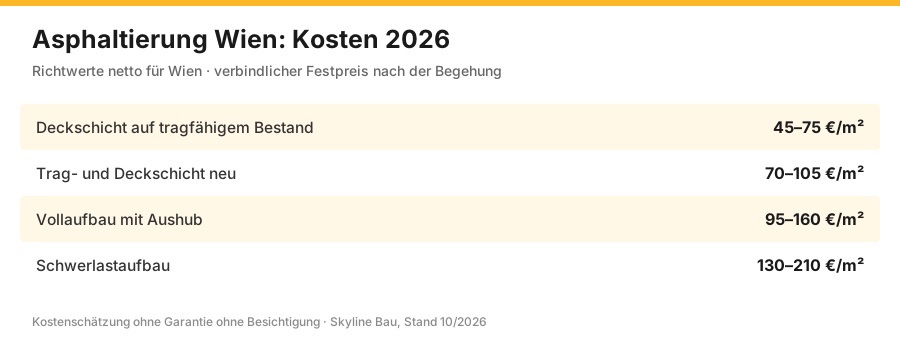
Asphalt paving Vienna: costs 2026
Net guide prices, as of 2026. The price depends almost entirely on the build-up and accessibility, hardly on the area itself – binding after site visit.
| Build-up | What for | Net price | Duration |
|---|---|---|---|
| Surface course on a load-bearing existing base | existing asphalt is milled off and resurfaced | €45–75/m² | 1–3 days |
| New base and surface course | Existing sub-base holds, pavement layers are renewed | €70–105/m² | 3–6 days |
| Full build-up with excavation | New construction including frost protection layer | €95–160/m² | 1–3 weeks |
| Heavy-duty build-up | Lorries, forklifts, commercial areas | €130–210/m² | 2–4 weeks |
Unit prices
| Item | Unit | Net price | What is included |
|---|---|---|---|
| Excavation and removal | m³ | 28–65 € | Excavator work, haulage, landfill fee |
| Breaking up old surfacing | m² | 12–35 € | Paving, concrete or asphalt, separated by type |
| Milling off asphalt | m² | 6–16 € | Milled material is recycled |
| Forming and compacting the formation level | m² | 6–14 € | Levels, falls, load-bearing capacity |
| Frost protection layer | m² | 18–42 € | depending on thickness 25–40 cm, compacted in layers |
| Unbound base course | m² | 14–30 € | Aggregate mix, compacted |
| Asphalt base course AC 22 | m² | 22–42 € | usually 6–10 cm |
| Asphalt surface course AC 11 | m² | 18–34 € | usually 3–5 cm, fully rolled |
| Setting kerbs or edging | lin. m | 38–95 € | Concrete foundation, haunching |
| Drainage channel with grating | lin. m | 120–320 € | Channel, foundation, connection |
| Road gully or inlet shaft | pcs | 650–1.800 € | Shaft, connecting pipe, cover |
| Soakaway | pcs | 1.200–3.500 € | depending on depth and soil |
| Connection to existing carriageway | lin. m | 25–70 € | Cutting, joint tape, bonding |
| Markings and signage | lump sum | 350–2.500 € | Parking bays, direction arrows, signs |
Total around €35,700 net, which is €162/m² including excavation and drainage. The transition to the existing paved area was separated with a kerb and haunching so that both surfaces can move independently.
Total around €59,200 net, which is €93/m². The area could be driven on once it had cooled after rolling; the markings followed the next day.
The build-up from bottom to top
An asphalt build-up consists of several layers, each with a different task. If one of them is left out, no other layer takes over its function – which is why centimetres saved in the sub-base later show up as cracks and waves.
| Layer | Usual thickness | Task | What happens if it is missing |
|---|---|---|---|
| Subgrade, formation level | – | carries everything, must be compacted and laid to falls | Settlement, hollows, standing water |
| Frost protection layer | 25–40 cm | prevents frost heave, drains water | Heave in winter, cracks in spring |
| Unbound base course | 15–25 cm | distributes the load onto the subgrade | Ruts, local sinking |
| Asphalt base course | 6–10 cm | takes the traffic load | Crazing, deformation under load |
| Asphalt surface course | 3–5 cm | Surface, skid resistance, impermeability | – |
| Edge restraint | – | holds the build-up together at the sides | Edges break away, surface creeps |
Why the frost protection layer determines durability
Vienna lies in a climate zone with regular freeze-thaw cycles. Water that stands in the subgrade and freezes expands and lifts the layers above it. When it thaws, everything settles again, but not evenly – this is where waves and cracks come from.
The frost protection layer prevents this in two ways: it consists of coarse, permeable material in which no standing water remains, and it moves the frost-sensitive zone downwards, away from the surface. Its thickness depends on soil type and loading – more in cohesive soils, less in gravelly ones, more under lorry traffic than under cars.
| Use | Frost protection | Base course | Asphalt | Total build-up |
|---|---|---|---|---|
| Footpath, terrace | 20–25 cm | – | 3 cm surface course | about 25–30 cm |
| Car driveway, courtyard | 25–30 cm | 15 cm | 6 + 3 cm | about 45–55 cm |
| Car park with delivery traffic | 30–35 cm | 20 cm | 8 + 4 cm | about 60–65 cm |
| Commercial area, lorries | 35–40 cm | 20–25 cm | 10 + 4 cm | about 70–80 cm |
These figures also explain the price range: a footpath needs a third of the material of a lorry area and a quarter of the excavation. If you are offered a driveway for €60/m² on which delivery vehicles will later drive, you are almost certainly getting a footpath build-up – and ruts in three years.
Falls and drainage
Asphalt is impermeable. That is its advantage over paving with open joints, and at the same time its condition: the water has to go somewhere. Without well-thought-out falls it stands on the surface, penetrates at the edges and freezes exactly there in winter.
| Topic | Guide value | Note |
|---|---|---|
| Longitudinal and cross falls | at least 2 %, better 2.5 % | less leads to standing water, more becomes uncomfortable when parking |
| Falls away from the building | always | Water must never run towards the facade or into the garage |
| Channel in front of gates and entrances | Standard | catches the water before it runs into the building |
| Gully with silt trap | depending on area | without a silt trap the pipe clogs up |
| Infiltration | where permitted | depending on soil, groundwater and conditions |
| Connection to sewer | only with a permit | Rainwater may not be discharged without limit |
Where the water is allowed to go is not a question of construction taste but is regulated in Vienna. Whether it is infiltrated, collected or discharged depends on the soil, the groundwater level and the permit. We clarify this before excavation, because the decision determines the whole build-up: an infiltration area needs a different sub-base from an area that drains to a gully.
Asphalt, paving or concrete: what fits when
All three surfaces have their place. The decision is usually made on the basis of use, appearance, drainage and – as in many Viennese cases – conditions in the official decision.
| Criterion | Asphalt | Paving | Concrete |
|---|---|---|---|
| Cost per m² | 45–160 € | 90–220 € | 80–180 € |
| Construction time | short, surface in one day | longer, manual work | medium, plus curing |
| Trafficable after completion | after cooling, usually the same day | immediately | after days to weeks |
| Repair | cut out the spot, relay | individual stones replaceable | laborious, usually replace a whole bay |
| Infiltration | impermeable, needs drainage | possible depending on joints | impermeable |
| Appearance | functional, uniform | customisable, high-quality | plain to designed |
| Rolling noise | low | high | medium |
| Accessibility | very good, jointless | limited by joints | very good |
| Weeds in joints | not an issue | ongoing maintenance | not an issue |
| Heavy loads | good, with a suitable build-up | good with correct bedding | very good |
For a residential driveway with car traffic, price, construction time and accessibility speak for asphalt, design speaks for paving. With lorry traffic on a small area with manoeuvring, concrete is often superior because it better absorbs the shear forces of steering while stationary. Where the authorities prescribe one option, there is nothing to weigh up – then it is only about clean execution. If you want to combine both surfaces, you will find the paving page under paving.
How an asphalt paving job runs
The critical point is step seven: asphalt is laid at 140 to 180 degrees and must be compacted before it cools. This means an area is finished in one go – with enough staff and coordinated deliveries. Anyone who works in small sections gets cold joints, and that is exactly where the surface will crack later.
Why the weather has a say
| Condition | Impact | How we handle it |
|---|---|---|
| Rain during laying | Asphalt cools too quickly, compaction fails | postpone, no compromise |
| Wet subgrade | Bond between layers suffers | let it dry or drain the water away |
| Temperature below about 5 degrees | too rapid cooling, insufficient compaction | use the seasonal window, usually March to November |
| Strong wind in cold weather | accelerates cooling | shorter laying sections, more rollers |
| Heat above 30 degrees | Surface course stays soft for longer | longer cooling time before release |
That is why we always give dates for asphalt work subject to the weather. Laying postponed by two days is annoying; a surface course laid in the rain is damage that becomes visible after one winter and then costs the entire pavement structure.
What the official decision says – and how we deal with it
When an authority requires a particular execution, the official decision is the governing basis, not the idea of the finished courtyard. We extract these points before we calculate:
| Point in the decision | What it determines | Effect on the price |
|---|---|---|
| Prescribed material | Asphalt, concrete or paving | determines the entire build-up |
| Load-bearing capacity and axle loads | Layer thicknesses, material quality | biggest cost driver |
| Drainage | Infiltration, discharge or collection | Shafts, channels, pipes |
| Level and connection | Transition to public land | Connection works, partly with permit |
| Fire brigade areas | Set-up area, access width, load-bearing capacity | reinforced build-up |
| Deadlines | by when the works must be completed | determines scheduling and seasonal window |
These points form the basis of the bill of quantities. We write in which build-up follows from which condition – this helps twice over: you see what you are paying for, and if the authority makes enquiries, the execution can be understood without further explanation.
A tip from practice: where an official decision prescribes an option that seems unfavourable to you, it is worth talking to the responsible office before building – occasionally an equivalent execution can be agreed. What we do not do is build and hope nobody checks. That regularly ends with a finished surface being removed, and nobody bears those costs except the owner.
How to make two quotes comparable
With asphalt work, quotes differ above all in what you can no longer see later. These seven points make a comparison possible:
- Layer thicknesses in centimetres, separately for frost protection, base course, asphalt base and surface course.
- Excavation volume in cubic metres including removal and landfill costs – a large item in full build-ups.
- Edge restraint as a separate item, in running metres, with foundation and haunching.
- Drainage specified: channels, gullies, shafts, connecting pipes, each with quantity.
- Falls stated in percent and direction – not just “with falls”.
- Compaction and proof, where required.
- Connections to existing areas, shafts and doors, in running metres or units.
A quote that only says “asphalting, 220 m², lump sum” cannot be compared with anything. The difference between two quotes almost always lies in the centimetres in the sub-base – and you only see them when the surface cracks after three winters.
Maintenance and service life
| Measure | Interval | Effect |
|---|---|---|
| Clean channels and gullies | once or twice a year | prevents backflow and water ingress |
| Seal cracks early | when they appear | keeps water out of the sub-base, extends service life considerably |
| Check edges | annually | spot break-outs early, before they grow |
| Winter service with care | ongoing | De-icing salt attacks concrete more than asphalt, snowploughs can damage edges |
| Remove oil stains | as required | Mineral oil dissolves the binder and makes the surface brittle |
The most effective point is the second: a crack sealed in the first year costs a few euros per running metre. The same crack that lets water into the sub-base for three winters leads to damage that can only be repaired by rebuilding that area. That is why an annual visual check pays off – ten minutes that decide over years.
The difference between asphalt and tar
In everyday speech people often say “tar”, but they mean asphalt. The difference is not just linguistic: tar comes from coal processing, contains harmful substances and has not been used in road construction for decades. Asphalt consists of stone and bitumen, a petroleum product that binds the grains.
This matters in practice with old surfaces: if an area from the 1970s or earlier is broken up, tar-containing material may be present. That is no reason to panic, but a reason to test, because tar-containing rubble must be separated and disposed of separately – at higher cost than normal asphalt rubble. We clarify this before demolition so that disposal does not become an issue in the middle of the works.
| Material | Binder | Occurrence | Disposal |
|---|---|---|---|
| Asphalt | Bitumen from petroleum | today's standard | recyclable, reused |
| Tar-containing surfacing | Coal tar | old existing surfaces, mostly before 1980 | separated, separate disposal, more expensive |
| Bitumen emulsion | Bitumen with water | Bonding coat between layers | unproblematic |
Recycling: what happens to the old surfacing
Asphalt is one of the most recyclable building materials. Milled material is processed and goes back into road construction as aggregate in new asphalt or as an unbound base course. For you this has two effects: removal is cheaper than for other construction rubble, and disposal is documented with proof.
It is different if the rubble is contaminated – with soil, concrete or tar-containing material. Then the price rises because it has to be sorted or disposed of separately. That is why separation starts at the beginning of demolition and not everything is thrown into the same skip. That costs a little more time on site and considerably less at the landfill.
Typical Viennese situations
The site conditions in Vienna vary more than the build-up itself. What is simple in the outer districts becomes a logistics task in the inner city.
| Situation | Challenge | Solution |
|---|---|---|
| Inner courtyard without lorry access | Material has to come through the passageway | smaller machines, more trips, manual laying at the edges |
| Narrow passageway with height restriction | Paver and tipper do not fit | mini paver or laying in sections with coordinated joints |
| Access must remain usable throughout | Neighbours, garages, deliveries | Build in sections, steel plates as crossings |
| Area borders a neighbouring property | Levels and water flow affect both | agree in advance, lay falls so that no water crosses over |
| Old utilities underground | Sewer, gas, electricity at shallow depth | Survey before excavation, hand digging near utilities |
| Trees in the area | Root zone is protected | Adapt build-up, leave root zone free or make it permeable |
| Listed surroundings | Appearance is prescribed | Coordination, sometimes combined with paved strips |
The fifth point deserves particular attention: in Viennese courtyards, utilities often lie considerably shallower than the plans suggest. That is why every excavation is preceded by surveying, and near utilities we dig by hand. A damaged sewer or a severed power cable costs more than the entire area – and in the worst case brings the whole building to a standstill.
Planning the construction time realistically
| Area | Full build-up | Pavement layers only | What determines the time |
|---|---|---|---|
| up to 150 m² | 5–8 days | 2–3 days | Excavation volume, accessibility |
| 150–400 m² | 8–14 days | 3–5 days | Drainage, edge restraint |
| 400–1,000 m² | 2–4 weeks | 5–8 days | Sections, accessibility |
| over 1,000 m² | as planned | as planned | Traffic management, construction phases |
On top of that comes the lead time: site visit, quote, any permits and scheduling with the asphalt plant. The actual construction time is usually the shortest part of asphalt work – plan two to six weeks of lead time, longer for works connecting to public land.
Repair instead of renewal: when that is enough
Not every damaged area has to be completely renewed. What matters is whether the sub-base still holds.
| Damage | Cause | Measure | Net price |
|---|---|---|---|
| Individual potholes | Water ingress, frost | cut out, relay | €180–450 per spot |
| Cracks, crazed pattern | Sub-base overloaded | rebuild the area, not just resurface | by area |
| Single crack, straight | Shrinkage, construction joint | rout out, seal | €18–40/rm |
| Ruts | base course too thin | mill off and rebuild | €70–105/m² |
| Broken edges | missing edge restraint | set kerbs, make good the edge | €38–95/rm |
| Settlement at a shaft or gully | Compaction around the shaft insufficient | open the shaft area, compact, re-integrate | €450–1,400 per shaft |
| Whole area deformed | Sub-base at the end of its life | Renew full build-up | €95–160/m² |
The most common wrong decision is to cover crazed cracks with a new surface course. That looks good for a year; then the same cracks reappear – because the cause lies in the sub-base and nothing was changed there. In such cases we say openly that resurfacing is only a temporary solution for two to three years; anyone who chooses it consciously does so informed.
Common mistakes
| Mistake | Why it happens | Consequence |
|---|---|---|
| Frost layer too thin | saves money that is immediately visible | Heave and cracks from the first winter |
| No edge restraint | seems dispensable | Edges break away, surface creeps |
| Falls too shallow | looks more pleasing | standing water, frost damage, icy patches |
| Falls towards the building | Levels not thought through | Water in garage or basement |
| Asphalted in sections | too few staff or too little material | cold joints, cracks along the joints |
| Laying in rain or cold | Time pressure | poor compaction, short service life |
| Compaction not documented | considered a formality | cannot be proven if damage occurs |
| Shafts not adjusted | levels stay as before | Settlement and trip edges around covers |
| Conditions in the official decision ignored | private land wrongly considered free of conditions | Remedial work or removal of the finished surface |
What we asphalt
| Area | Typical requirement | Usual build-up |
|---|---|---|
| Courtyard entrance and driveway | Cars, occasionally a delivery vehicle | Frost layer 25–30 cm, 6 + 3 cm asphalt |
| Car park of a residential complex | Long-term parking, manoeuvring | Frost layer 30 cm, base course, 6 + 4 cm |
| Commercial and storage area | Lorries, forklifts, point loads | Frost layer 35–40 cm, 10 + 4 cm |
| Private road, residential lane | Residents' traffic, refuse collection | as car park, plus drainage |
| Fire brigade access | defined axle load, trafficable in an emergency | reinforced build-up as specified |
| Footpath and connecting path | Pedestrians, accessibility | Frost layer 20–25 cm, 3 cm surface course |
| Sports areas and playgrounds | level, jointless surface | fine-grained surface course |
What you get in the end
- Build-up description with layer thicknesses and materials – important for later repairs and for questions from the authorities.
- Proof of compaction of the base courses, where agreed.
- Delivery notes for the asphalt with type and quantity.
- Photo documentation of formation level, frost layer and drainage – that is, of everything that is invisible afterwards.
- Acceptance record according to ÖNORM B 2110 with warranty periods.
When you do not need us
For a single pothole or a short crack, an asphalt company with a repair crew is enough, and that is cheaper. We are worthwhile when excavation, sub-base, drainage, edge restraint and asphalt come together, when conditions from an official decision have to be implemented, or when a transition to an existing paved area has to be solved cleanly.
Why excavation, sub-base and surface belong together
An asphalted area is a continuous system: each layer builds on the one beneath it and is only as good as its compaction. If the frost layer is laid too loosely, the best surface course is of no use; if the formation level is not laid to falls, even the most expensive channel will not help. That is exactly why the quality of an area can no longer be assessed after completion – only the top of five layers is visible.
Asphalt areas are often contracted separately: one company does the excavation, a second the sub-base, a third the asphalt surface. On paper that is cheaper, in the final account rarely. The reason lies in responsibility for load-bearing capacity: if the area cracks after two years, the asphalt company points to the sub-base, the earthworks contractor to the subgrade, and the owner is caught between three opinions.
We carry out excavation, frost layer, base course, edge restraint, drainage and asphalt under one contract. That means one responsibility for the result and one warranty for the entire area instead of three separate ones for individual layers. That is the real difference – not the price per square metre, but the question of who stands up for the area when it moves in the third winter.
Asphalt price per m² in Austria: why the figures online vary so much
Anyone who wants to know what a square metre of asphalt costs will find figures between 20 and 200 euros. Both numbers can be right; they just describe different things. The low one usually means pure mix ex works or a thin surface course on an area that already holds. The high one includes excavation, frost layer, base course, edge restraint and drainage. Almost every private driveway lies between these extremes.
For Austria, three points come on top that are missing from German guides. First, prices here are usually quoted net; 20 percent VAT is added on the invoice. Second, in eastern Austria the frost layer is not an extra because of the winter frosts, but part of a durable build-up. Third, landfills charge for excavated soil by quantity and contamination, and in Vienna the subgrade often contains brick rubble and slag from earlier fill.
Our net guide prices for Viennese sites: €45–75/m² for a new surface course on a load-bearing existing base, €70–105/m² if base and surface course are renewed, and €95–160/m² for a full build-up with excavation. Which of these levels your area needs is shown by a trial opening or a look at the damage pattern. A network of fine cracks almost always points to the sub-base; a single hole does not.
What does 100 m² of asphalt cost? Three cases calculated
A hundred square metres is a typical size for a double garage with driveway or a small inner courtyard. With the same guide prices, very different totals result depending on the condition.
| Starting point | What is done | Net guide price for 100 m² |
|---|---|---|
| Old asphalt, sub-base intact | Mill off, new surface course | 4.500–7.500 € |
| Ruts, base course too thin | New base and surface course | 7.000–10.500 € |
| Lawn, gravel or paving | Excavation, frost layer, full build-up | 9.500–16.000 € |
Drainage channels, kerbs and shafts are only partly included; they depend on the geometry and are calculated separately. On small areas, fixed costs such as getting the paver and roller to site carry more weight, so they tend to be at the upper end of the range. Laying two neighbouring areas together saves exactly this share.
Asphalting a driveway: what is different about a house entrance
A private driveway is rarely a simple rectangle. It connects garage, pavement and garden, has to lead water away from the house and must not form an edge at the transition to public land. It is exactly these connections that make the difference between an area that lasts twenty years and one that breaks at the edges after the third winter.
We clarify three points in advance for every driveway. First, the falls: at least two percent, and away from the garage, otherwise water stands in front of the door. Second, the edge to the pavement: the pavement is public land, works on it require the city's consent and are coordinated separately. Third, the loading: a car needs a different build-up from a motorhome or a van that drives up regularly.
If you are considering paving instead of asphalt, you will find the differences in cost and appearance under paving in Vienna. If soil has to be removed or an old foundation taken out first, this is described under excavation.
Frequently asked questions about asphalt paving in Vienna
What is the difference between asphalt and tar?
What happens to the old surfacing?
What about utilities underground?
How long does completion take?
Does the driveway remain usable during the works?
What needs to be considered with trees on or next to the area?
What does asphalt paving cost in Vienna?
Why do prices vary so much?
The municipality requires asphalt instead of paving, even though it is private land – is that possible?
How do I connect an existing paved area to new asphalt?
How thick does the build-up need to be?
Why is a frost protection layer needed?
How much fall does the area need?
Where may the rainwater go?
When can the area be driven on?
Can asphalt be laid in the rain?
Up to what time of year can work be done?
What is the difference between base course and surface course?
Can only the surface course be renewed?
What does it cost to repair a pothole?
Why does the surface sink around manhole covers?
Do I need a permit?
Can you also build the connection from public land?
How long does an asphalted area last?
Is asphalt or paving cheaper?
What about weeds?
Can parking bays be marked?
How noisy and dirty is the site?
Can the area be done in sections?
What is documented?
How quickly can the area be scheduled?
What does 1 m² of asphalt cost including the sub-base?
Is asphalt more expensive in Austria than in Germany?
Is it worth asphalting a small driveway together with the neighbour?
Related services
Area finished? Construction dust on paths and facade.
After laying, our partner company Bling Premium Reinigung takes over cleaning of the adjacent areas – footpaths, courtyard and facade plinth. More at bling-bling.at.
Send enquiry
Enquire directly here — fixed-price quote free of charge. Skyline Bau replies within 2 working days.
Ready for your asphalt paving in Vienna?
Write to us directly on WhatsApp — send photos. Reply within 2 working days.
Note: Skyline Bau is the brand name of the construction and renovation division of Bling Bling GmbH and is not a separate legal entity. The sole contractual partner is Bling Bling GmbH. Bling Bling GmbH is a restricted construction trade business under § 99 GewO (Austrian Trade Regulation Act) and not a licensed master builder (Baumeister). Under § 99 (5) GewO, the title “Baumeister” is reserved for businesses licensed under § 94 no. 5 GewO. Regulated trades — master-builder services, structural engineering, gas and sanitary engineering, electrical engineering — are carried out exclusively by authorised, licensed partner companies.