Pipework Vienna what lies behind the wall has to stay watertight.
Pipework in Vienna: from the contractor who does the work — not from an agent.
Pipework in Vienna: water and waste water pipes cost €45 to €140 per linear metre installed. Water service connection pipe €120–320/lm, underground drainage pipe €220–520/lm. Pressure testing and photo documentation before closing up are standard.
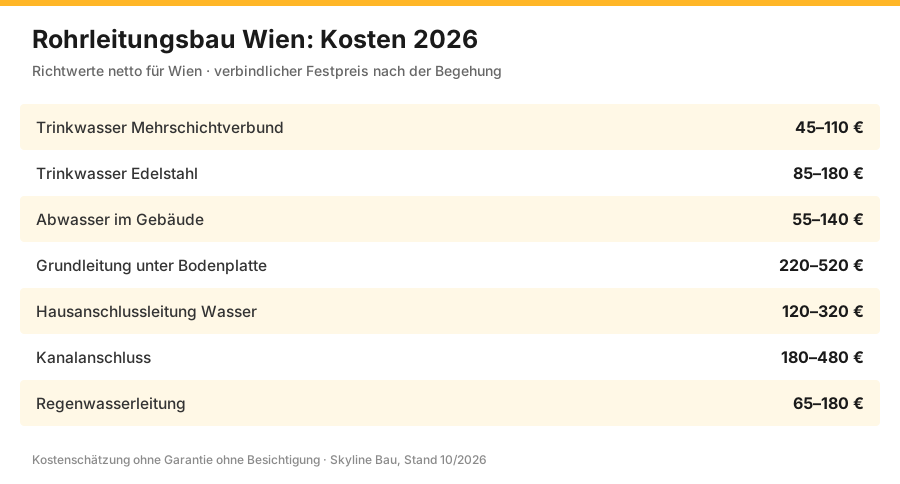
Pipework in Vienna: costs 2026
Guide prices net, as of 2026, binding after a site visit. Gas and plumbing installations are carried out by licensed partner firms under § 94 Z 25 GewO, which are named in the quotation.
| Pipe | Installation location | Price net per lm | What matters |
|---|---|---|---|
| Drinking water, multilayer composite | Wall, pre-wall, shaft | 45–110 € | Insulation, fixing, pressure test |
| Drinking water, stainless steel | Riser, exposed | 85–180 € | Press fitting, corrosion protection |
| Waste water inside the building | Pre-wall, shaft, ceiling | 55–140 € | Fall, sound insulation, ventilation |
| Underground drain beneath the floor slab | Basement, chiselling work | 220–520 € | Fall, watertightness, inspection opening |
| Water service connection pipe | In the ground, frost-free | 120–320 € | Depth from 1.2 m, protective sleeve |
| Sewer connection | In the ground, up to the property boundary | 180–480 € | Depth, shoring, surface |
| Rainwater pipe | Downpipe to soakaway | 65–180 € | Cross-section, backflow protection |
Unit prices
| Item | Unit | Price net | What is included |
|---|---|---|---|
| Pipe and cable locating | lump sum | 250–850 € | before chiselling and drilling |
| CCTV drain survey | lump sum | 350–900 € | Condition, displacement, roots, deposits |
| Drinking water pressure test | lump sum | 180–450 € | with report, before closing up |
| Waste water leak-tightness test | lump sum | 450–1.200 € | Water or air pressure test |
| Pipe insulation | linear m | 8–22 € | against heat loss and condensation |
| Shut-off valve | pc. | 85–220 € | per flat and per riser |
| Inspection opening | pc. | 120–380 € | Access to branches and for cleaning |
| Anti-flood valve | pc. | 850–2.600 € | for drains below the backflow level |
| Fire collar | pc. | 85–260 € | where pipes pass through fire compartments |
| Chiselling and making good | linear m | 28–65 € | Chase, plaster, without painting |
| Replacing lead pipes | linear m | 65–160 € | Removal, disposal, new pipe |
Total approx. €10,600 net, excluding sanitary fittings and tiles. If the risers in the building are already more than 50 years old, it should be clarified beforehand when the riser renovation is due – otherwise the new installation will be opened up again when it happens.
Which pipe for which purpose
| Material | Application | Strengths | Please note |
|---|---|---|---|
| Multilayer composite | Drinking water, heating within flats | flexible, oxygen-tight, inexpensive | only with the manufacturer's system fittings |
| Stainless steel | Risers, hygienically sensitive areas | durable, dimensionally stable | more expensive, requires professional pressing |
| Copper | Existing installations, heating | proven, durable | prone to corrosion with soft water and mixed installations |
| PP and PE waste water | Waste water inside the building | lightweight, watertight | sound insulation via the fixings |
| Cast iron | Waste water, risers | very quiet, fire-safe | heavy, more expensive |
| Lead | only in old existing installations | — | releases harmful substances, must be replaced |
The most common mistakes
- Closed up without a pressure test. A leaking press joint only shows itself weeks later at the neighbour's.
- Waste water fall not measured in. Too little leads to deposits; too much leaves solids behind – both cause blockages.
- Mixed materials without separation. Copper downstream of galvanised steel leads to corrosion.
- No photos with dimensions. In five years' time, someone will drill into the pipe.
- Sound insulation forgotten. Waste water in the wall without acoustic decoupling can be heard in the neighbouring flat.
- Fire compartments breached without a collar. The pipe becomes a fire path between storeys.
Which pipe runs where in the building
Before talking about material and price, it needs to be clear which section of pipework is actually concerned. The terms get mixed up in everyday use, but responsibilities and costs differ considerably.
| Section | Where it runs | Who is responsible |
|---|---|---|
| Water service connection | from the main in the street to the water meter | Wiener Wasser (Vienna's water utility) up to the handover point, the property after that |
| Building supply after the water meter | Basement, distribution to the risers | Owners' association |
| Riser | vertically through all storeys | Owners' association, common part |
| Branch into the flat | from the riser to the shut-off valve | Transition, if in doubt the community of owners |
| Pipework within the flat | Bathroom, kitchen, WC | Flat owner or landlord |
| Waste water stack | vertical, usually in a shaft or wet room | Owners' association |
| Underground drain | horizontal, beneath the basement floor or in the ground | Property, up to the sewer connection |
| Sewer connection | Connection to the public sewer | Property, City of Vienna regulations |
Pipe routing: where should the pipe go?
| Routing | Advantages | Disadvantages | Additional cost |
|---|---|---|---|
| Pre-wall installation | accessible, acoustically decoupled, quick to install | takes up floor space | Standard |
| Chases in the masonry | no loss of space | chiselling work, structural considerations, no later access | +15–30 % |
| In the floor build-up | invisible, short runs | leaks only become visible late, build-up height required | +10–20 % |
| In the service shaft | accessible riser by riser, maintainable | a shaft must exist or be creatable | Standard in new builds |
| Exposed on the wall | cheap, can be inspected immediately | appearance, risk of frost on external walls | −10–20 % |
| Suspended ceiling in the basement | long runs without chiselling | room height, observe fire safety | Standard in existing buildings |
In Viennese period buildings, the pre-wall is almost always the right answer: brick masonry does not tolerate deep vertical chases, timber joist ceilings do not tolerate openings wherever you like, and a pipe you can still reach in twenty years is worth more than a few centimetres of extra space. Where chases are unavoidable, their depth and position are specified in advance and executed according to the rules for load-bearing masonry.
Waste water: the fall is what matters, not the pipe diameter
Most waste water problems in existing buildings are not a question of material. They are caused by incorrect falls, missing ventilation or pipe sections that were rerouted during alterations without regard for the flow.
| Pipe | Usual fall | What happens with the wrong fall |
|---|---|---|
| Connection pipe to washbasin, WC, shower | approx. 1–2% | too little: deposits; too much: the water runs away from the solids |
| Collector pipe on each floor | approx. 1–2% | blockage at the flattest point |
| Underground drain beneath the basement floor | approx. 1–2% | backflow, odours, recurring renovation cases |
| Stack | vertical | without ventilation, traps are siphoned dry |
| Service | Unit | Price net |
|---|---|---|
| CCTV survey of a pipe with findings report | lump sum | 350–900 € |
| High-pressure jetting of the underground drain | per linear m | 12–28 € |
| Renewing the underground drain, open-cut in the basement | per linear m | 220–520 € |
| Cured-in-place lining, trenchless renovation | per linear m | 320–700 € |
| Creating an inspection opening | pc. | 120–380 € |
| Installing a backflow preventer | pc. | 850–2.600 € |
| Lifting station for rooms below the backflow level | pc. | 2.400–6.500 € |
| Replacing the stack, per storey | storey | 900–2.200 € |
Rooms below the backflow level – in Vienna's existing building stock, practically every basement – need protection against sewer water backing up. Without it, waste water stands in the basement during heavy rain, and the first thing the insurer asks about is the backflow preventer. Where sanitary rooms lie lower down, there is no way around a lifting station.
Drinking water: hygiene is a construction issue
Drinking water is a foodstuff, and the pipe is its packaging. Two factors determine the quality at the tap: stagnation and temperature.
| Topic | Rule | What goes wrong |
|---|---|---|
| Cold water | should stay cold | uninsulated next to the heating pipe, it warms up |
| Hot water | should be hot throughout | long branch pipes cool down |
| Stagnation | water should be replaced regularly | dead legs from decommissioned taps |
| Pipe cross-section | as small as possible | oversized means slow water turnover |
| Circulation | keeps hot water moving | missing or incorrectly balanced |
| Insulation | Cold and hot insulated separately | laid together in the same chase |
How long pipes last – and when replacement is due
Service life depends more on water quality, temperature and workmanship than on the material alone. The following ranges are empirical values for conditions in Vienna and serve for planning purposes, not for assessing individual cases.
| Pipe | Usual service life | Typical failure pattern |
|---|---|---|
| Lead drinking water pipe | replace regardless of condition | lead released into the water |
| Galvanised steel | 40–60 years | cross-section narrows, rust-brown water |
| Copper | 50–70 years | pitting corrosion at individual spots |
| Multilayer composite | 40–60 years | usually failure at the joints, not in the pipe |
| Stainless steel, pressed | 50 years and more | pressing faults during installation |
| Cast iron waste water | 60–100 years | leaking sockets, corrosion at the invert |
| Vitrified clay underground drain | 60–100 years | fractures at sockets, root ingress |
| Plastic waste water | 50 years and more | deformation due to settlement, incorrect bedding |
| Sign | What it usually means | Next step |
|---|---|---|
| Brown water after a longer absence | corrosion in galvanised pipes | open up a pipe section and assess it |
| Pressure drops | cross-section narrowed | riser inspection, measure the cross-section |
| Recurring small leaks | material at the end of its service life | phased plan instead of individual repairs |
| Odour from the drain | ventilation or trap | check ventilation, inspect the trap |
| Gurgling when draining | ventilation missing or blocked | check the vent pipe |
| Damp patch on the shaft wall | leaking pipe in the shaft | open the shaft, check the pipe |
The process
| Phase | What happens | Duration |
|---|---|---|
| 1. Site visit and survey | Record pipe routes, determine materials, assess condition, CCTV survey for waste water | 1 appointment |
| 2. Planning | Define routes, cross-sections, shafts, openings, coordination with the structural engineer where necessary | 3–10 days |
| 3. Quotation | Linear metres per pipe, openings, reinstatement, schedule | 2 working days after the site visit |
| 4. Preparation | Shut-offs, temporary supplies, notice to residents, protective measures | 1–3 days |
| 5. Opening up | Chases, openings, core drilling, trenches | depending on scope |
| 6. Installation | Pipes, fixings, insulation, fire protection, acoustic decoupling | Main work |
| 7. Testing | Leak-tightness and pressure test with report, re-measure the fall | 1 day |
| 8. Documentation | Photos with dimensions, as-built plan of the routes | before closing up |
| 9. Closing up and reinstatement | Plastering, closing the pre-wall, tiles, screed, painting | depending on scope |
| 10. Handover | Reports, flushing record, briefing on the shut-offs | 1 appointment |
Tests and what they prove
| Test | What is checked | When |
|---|---|---|
| Drinking water leak-tightness test | pipe holds pressure without any drop | before closing up |
| Load test | behaviour under operating pressure | before commissioning |
| Flushing | residues and particles from installation | before commissioning |
| Waste water leak-tightness test | water or air test of the pipe | before closing up |
| Fall test | even run without sags | after installation |
| CCTV survey after completion | workmanship of the underground drain | usual for pipes laid in the ground |
| Fire-safety certification at penetrations | collars and fire stops | at floor and fire compartment separations |
All reports belong in the handover file, not in the contractor's archive. When damage occurs, the question of whether the pipe was demonstrably tested decides liability – and when the property is sold, complete documentation is a tangible selling point.
Fire protection and sound insulation for pipes
| Point | Requirement | Typical mistake |
|---|---|---|
| Penetration of a floor slab | fire stop appropriate to the building component | pipe pushed through, hole smeared shut with mortar |
| Plastic pipe through a fire compartment | Fire collar | missing or wrong size |
| Stack in the wet room | fixing decoupled from structure-borne sound | pipe clip screwed rigidly to the wall |
| Pipe on a bedroom wall | acoustic pipe or lining shell | standard pipe in the partition wall |
| Lifting stations and pumps | elastic mounting | mounted directly on the screed |
Pipes in the ground
Outside the building, different rules apply: frost depth, bedding, compaction and the question of whether digging is necessary at all.
| Point | Requirement | Why |
|---|---|---|
| Laying depth for water | frost-free, in Vienna usually around 1.2 to 1.5 m | frost damage to the pipe |
| Bedding | sand or fine-grained material all round | point bearing breaks the pipe |
| Compaction | in layers, controlled | otherwise the surface above settles |
| Warning tape | laid above the pipe | protects during later excavations |
| Distance to other services | as specified by the operators | electricity, gas, district heating, telecoms |
| Connection to the sewer | in accordance with City of Vienna regulations | inspection and connection approval |
| Service | Unit | Price net |
|---|---|---|
| Digging, backfilling and compacting the trench | per linear m | 85–220 € |
| Excavation by hand in a cramped courtyard | per linear m | 180–420 € |
| Breaking up and reinstating paving | per m² | 95–220 € |
| Breaking up and reinstating asphalt | per m² | 110–260 € |
| Core drilling through the basement wall | pc. | 280–650 € |
| Annular seal at the penetration | pc. | 180–420 € |
| Trenchless renewal, pipe bursting | per linear m | 280–600 € |
Where the path between the house and the street is paved or asphalted, reinstatement quickly accounts for the larger share of the costs. It is then worth checking whether the work can be done trenchless: with pipe bursting, the old pipe is expanded and a new one pulled in without opening the surface along the entire length. This requires a straight run and a pipe that can be expanded.
Existing pipework in Viennese period buildings
| Material | Where it occurs | What needs to be done |
|---|---|---|
| Lead | Drinking water in buildings up to about 1960 | replace, not a candidate for renovation |
| Galvanised steel | Drinking water, 1950s to 1970s | check the cross-section, usually replace |
| Copper | from the 1970s onwards | can be retained depending on water and condition |
| Cast iron | Waste water stacks | often still sound, check the sockets |
| Vitrified clay | Underground drains in old existing buildings | CCTV survey, often fractures at the sockets |
| Fibre cement | occasionally in ventilation and waste water runs | testing for hazardous substances before any intervention |
Who is allowed to do what
In existing buildings, pipework is almost never a single trade. The demarcation decides who is liable and who issues which certificate.
| Work | Trade | Who carries it out |
|---|---|---|
| Opening up, chiselling, openings, trenches | Construction work | us |
| Drinking water and waste water installation | Gas and plumbing engineering, § 94 Z 25 GewO | licensed partner firm |
| Gas pipes | Gas and plumbing | licensed partner firm, with acceptance inspection |
| Electric trace heating, pump connection | Electrical engineering, § 94 Z 16 GewO | licensed partner firm |
| Structurally relevant openings | Master builder and planning services, § 94 Z 5 GewO | authorised master builder (Baumeister) or structural engineer |
| Tiling after reinstatement | Tiling, § 94 Z 38 GewO | authorised partner firm |
| Plastering, painting, screed, disposal | Construction work | us |
When the pipe is replaced while the building stays in use
In occupied buildings, the problem is not the pipe but the time without water. With planning, the interruption can be limited to a few hours per flat.
| Measure | Effect |
|---|---|
| Lay the new riser in parallel, reconnect only at the end | interruption only for the reconnection, often under 4 hours |
| In stages, by staircase or riser | never the whole building affected at once |
| Temporary water supply | for longer works in individual flats |
| Announce work during core hours | residents can plan ahead, fewer complaints |
| Retrofit shut-offs flat by flat | future repairs possible without shutting off the whole building |
| Ensure WC use | reconnect waste water last, alternative solution for longer shut-offs |
What belongs in the quotation
- Linear metres per pipe type: broken down into cold drinking water, hot water, circulation and waste water, not as a lump-sum item.
- Openings and bores: number and diameter, including making good.
- Insulation and fire protection: listed separately, not silently included in the pipe price.
- Tests: leak-tightness test, flushing, reports as a separate item.
- Reinstatement: plastering, tiles, painting – the item usually missing from plumbers' quotations.
- Disposal: old pipes, rubble, lead listed separately.
- Schedule: duration per flat and timing of the supply interruption.
- Firms carrying out the work: who does the regulated work, by name.
Water damage from a pipe: the first few hours
| Step | What needs to be done |
|---|---|
| 1. Shut off | flat valve, otherwise the building shut-off in the basement |
| 2. Check the electricity | have the affected circuits switched off |
| 3. Remove the water | remove standing water immediately, stop it spreading |
| 4. Report | property management and insurer, with photos and the time |
| 5. Locate the cause | leak detection – do not chisel open on suspicion |
| 6. Repair | repair the pipe, test report |
| 7. Dry out | measurement, drying concept, final clearance measurement |
| 8. Reinstate | only once dryness has been proven |
Step five saves the most money. Leak detection with measuring equipment usually costs €380 to €850 in Vienna and pinpoints the spot to within a few centimetres – compared with exploratory breaking-open across several square metres of floor build-up, this is the cheaper decision in almost every case. Everything else about drying is covered on the page building drying, and the complete process on the page water damage restoration.
How to recognise proper workmanship
| Feature | Good workmanship | Warning sign |
|---|---|---|
| Fixing | even spacing, expansion taken into account | pipe sags, clips placed at random |
| Insulation | continuous, including at bends and clips | gaps at every fixing |
| Cold and hot | routed and insulated separately | together in the same chase |
| Joints | a single system from one manufacturer | a mix of leftovers from several systems |
| Change of material | only with a suitable transition piece | copper directly onto galvanised steel |
| Waste water fall | measured in, even | judged by eye, sags |
| Penetrations | fire-stopped, documented | smeared shut |
| Before closing up | pressure test and photos | wall closed, no records |
Special cases
| Case | Special feature | Approach |
|---|---|---|
| Listed historic fabric | stucco, vaults, historic floors | routes along secondary building components, coordination before work begins |
| Timber beam ceiling | penetrations weaken the structure | determine the position of the joists, coordinate openings |
| Ground-floor shop premises | business carries on | work outside opening hours, in stages |
| Medical practice, laboratory, restaurant | increased hygiene requirements | flushing plan, sampling, coordination with the operator |
| Pipe in an unheated area | risk of frost | insulation, drainage option, trace heating if in doubt |
| Garage and underground car park | fire compartments, drainage | fire stopping, check the oil separator |
In each of these cases, preparation determines the costs. Anyone who only discovers on opening up a timber joist ceiling that the planned opening sits right in the middle of a joist loses a day and needs a new route – with a survey beforehand, it would not have happened.
What you can prepare
- Look for old plans: planning submission drawings, installation plans, documents from earlier renovations.
- Compile a list of damage: which pipe leaked when – this shows the order of priority.
- Clarify access to the basement, shafts and attic: keys, lighting, clear routes.
- Find and label shut-offs: saves the decisive minutes in an emergency.
- Keep spare tiles ready: for reinstatement after chasing.
- Inform residents: post dates and interruptions in good time.
Price examples from practice
Total approx. €28,430 net for a complete riser over five storeys, which is about €2,843 per connected flat. For comparison: five individual bathrooms, each with its own partial renewal, cost more in total and still leave the riser old.
Total approx. €16,600 net. The previous approach – jetting twice a year at €450 each time – would have cost €9,000 over ten years without solving the problem, and the risk of basement damage remained with every heavy downpour.
For property managers and developers
| Point | How we handle it |
|---|---|
| Condition survey | material, age and condition of each riser, with photo record |
| Phased plan | order of the risers over several years, with a cost framework for each phase |
| Supply interruption | announced, limited in time, with a temporary supply where needed |
| Access | two appointment windows per flat, cancellations recorded |
| Reinstatement | plastering, tiles and painting in the same contract, no second firm |
| Documentation | route photos for each flat, test reports, as-built plan |
| Billing | by linear metre and by item, not as a lump sum without evidence |
How this differs from our other services
| Situation | Matching service |
|---|---|
| Laying new pipes, trenches, openings | Pipework, this page |
| Renewing all risers in a building | Riser renovation |
| Completely new bathroom | Bathroom renovation |
| Heating, ventilation, air conditioning | HVAC and plumbing |
| Sewer in the ground up to the public network | Sewer construction |
| Drying out after a burst pipe | Building drying |
| Fully repairing water damage | Water damage restoration |
When you do not need us
For a dripping tap or a blocked drain, call a plumber, not a construction company. We step in when pipes need to be relaid, walls opened up, trenches dug or several trades coordinated.
Underground pipeline construction: when the pipe goes into the trench
What in Germany is often called Tiefrohrleitungsbau or Rohrleitungstiefbau (underground pipeline construction) is, for us, the part of the pipework that takes place below ground: service connections to water and sewer, rainwater to the soakaway, supply lines to outbuildings or to the pool. Here, it is not the pipe but the trench that determines service life. The trench (Künette) is dug wide enough for compaction all round the pipe, with battering or shoring from a depth of 1.25 m. The pipe rests on a bedding of sand or fine gravel, not on stones or rubble, and is packed at the sides and on top with stone-free material before the rest of the excavated soil goes back in.
Before the pipe is backfilled, it is tested and surveyed. Sewer pipes are tested for leak-tightness to ÖNORM EN 1610, and pressure pipes with a pressure test. The survey record with depth and position is the document that saves – or at least shortens – the next excavation in twenty years' time. As a net guide price, a trench including backfilling and compaction costs €85 to €220 per linear metre, more in a narrow courtyard with hand excavation. How larger trenches and sewers are carried out is described on the page sewer construction.
Pipework in Austria: which rules apply to which pipe
The requirements for pipework in Austria are not bundled in a single set of rules but separated by medium. Drinking water installations in buildings are governed by ÖNORM EN 806 and ÖNORM B 2531, and building drainage by ÖNORM EN 12056 together with ÖNORM B 2501. For sewers and pipes in the ground, the ÖNORM EN 1610 mentioned above is decisive, and for gas, the guidelines of the ÖVGW (Austrian Association for Gas and Water). In Vienna, there are also the network operators' requirements: the connection pipe from the street to the water meter is the responsibility of Wiener Wasser, and the connection to the public sewer is coordinated with Wien Kanal. For you as the client, this means: a quotation should state the rules according to which testing and documentation are carried out. If it only says “professionally”, there is no basis against which the work can later be measured.
Reading pipework prices: why linear metres alone are not enough
The price per linear metre is the most convenient figure for comparison, but also the least precise. A metre of straight pipe in an open shaft costs something completely different from a metre with three bends, two branches and a wall penetration. Reputable quotations therefore separate pipe, fittings, valves and fixings, or at least state how many fittings are included in the price per metre. The second difference lies between unit prices and time-and-materials billing (Regie): a quotation based on hourly rates looks flexible but shifts the quantity risk entirely onto you. We charge for pipework at unit prices, and on a time-and-materials basis only for the unforeseeable and with prior approval. For orientation, from our price table: drinking water inside the building €45 to €110/lm, waste water €55 to €140/lm, underground drain beneath the floor slab €220 to €520/lm, all net. Whether a pipe will be replaced anyway as part of a riser renewal is something we clarify via the riser renovation.
Frequently asked questions about pipework in Vienna
How much does a new water pipe cost?
Who is allowed to lay water and gas pipes?
Why a pressure test?
What fall does a waste water pipe need?
Do I still have lead pipes?
Multilayer composite or stainless steel?
Why no mixed installations?
Why are pipes photographed?
How deep does a water pipe have to lie in the ground?
What is an underground drain?
How much does a CCTV survey cost?
Do I need an anti-flood valve?
Why sound insulation for waste water?
What are fire collars?
When is a riser renovation worthwhile?
How long does replacing the pipes in a flat take?
Who pays in a tenement building?
Pipework: what certificates do I receive?
Pipework: how quickly do I receive a quotation?
How much does replacing a riser in a tenement building cost?
Jetting or renewing – which is cheaper?
Can an underground drain be renewed without digging?
Do I need a backflow preventer?
How long is the water shut off?
Why does my drain gurgle?
How is sound insulation achieved?
Who does the reinstatement after chasing?
What needs to be considered with timber joist ceilings?
How deep are pipes laid in the ground?
How much does leak detection cost?
Who is responsible for the water pipe between the street and the building?
How is a pipe in the ground tested before the trench is closed?
Why is a quotation based on hourly rates difficult to compare?
Related services
Builders' clean after the installation?
Our partner company Bling Bling Premium Reinigung takes care of the builders' clean and fine cleaning after the pipe replacement. Find out more at bling-bling.at.
Send enquiry
Enquire directly here — fixed-price quotation free of charge. Skyline Bau replies within 2 working days.
Ready for your pipework project in Vienna?
Write to us directly on WhatsApp — send photos. Reply within 2 working days.
Note: Skyline Bau is the brand name of the construction and renovation division of Bling Bling GmbH and not a separate legal entity. The sole contractual partner is Bling Bling GmbH. Bling Bling GmbH is a restricted building trade business under § 99 GewO (Austrian Trade Regulation Act) and not a licensed master builder (konzessionierter Baumeister). Under § 99 (5) GewO, the title „Baumeister“ (master builder) is reserved for businesses licensed under § 94 no. 5 GewO. Regulated trades — master builder services, structural engineering, gas and plumbing, electrical engineering — are carried out exclusively by authorised, licensed partner firms.