Electrical work Vienna a third of it is masonry work.
Electrical work Vienna: from the building contractor that does the work — not from an agent.
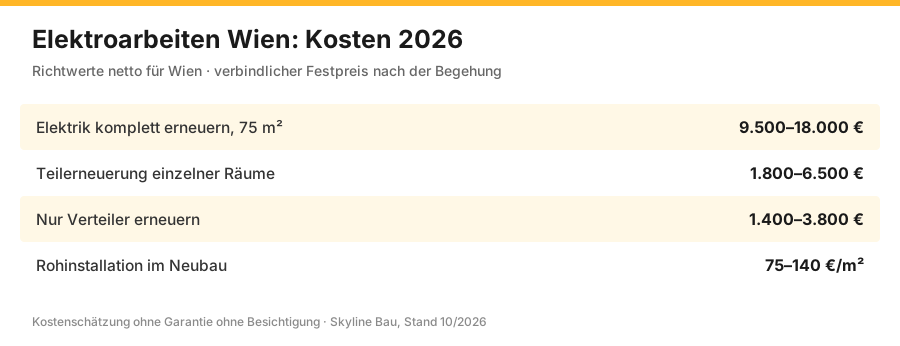
Electrical work Vienna: rewiring in Vienna costs 9,500 to 18,000 euros for a 75 square metre apartment. Single socket €95–220, new distribution board €1,400–3,800, first-fix installation in a new build €75–140/m². Carried out by licensed electrical engineers.
Electrical work in Vienna from a single source — structural design and master builder services through licensed partner companies, site management by us. — One contract, one contact person.
“Electrical work Vienna, a third of it is masonry work” — the standard is clear: every socket live, every switch working, every cable with a measurement and test record according to ÖVE/ÖNORM E 8001. Electrical installations must not first attract attention when the RCD trips or at the first short circuit — they are a sensitive trade that must be documented by authorised electrical engineers with an installation log and commissioning report. Skyline Bau coordinates this with authorised electrical engineers under § 94 no. 16 GewO from its own network.
What electrical work in Vienna costs
Net guide prices, as of 2026, binding after site visit. Carried out by licensed electrical engineers under § 94 no. 16 GewO, coordinated through our site management.
| Scope | What is done | Net price | Duration |
|---|---|---|---|
| Complete rewiring, 75 m² | Distribution board, cables, boxes, test report | 9.500–18.000 € | 2–4 weeks |
| Partial rewiring of individual rooms | Cables, boxes, connection to existing installation | 1.800–6.500 € | 3–10 days |
| New distribution board only | Meter cabinet, RCD, circuit breakers, test report | 1.400–3.800 € | 1–2 days |
| Apartment building, renewing risers | per riser, with rising main and distribution boards | per project | 6–16 weeks |
| First-fix installation in a new build | Conduits, boxes, cables before plastering | €75–140/m² | 1–3 weeks |
Unit prices
| Item | Unit | Net price | What is included |
|---|---|---|---|
| Fitting a socket or switch | pcs | 95–220 € | Box, cable, chasing, plastering |
| Ceiling outlet | pcs | 110–260 € | Cable, box, connection |
| High-voltage connection for a cooker | pcs | 320–750 € | dedicated cable, fusing |
| Connection for a heat pump or wallbox | pcs | 650–2.400 € | Cable, fusing, registration |
| New distribution board, apartment | pcs | 1.400–3.800 € | Cabinet, RCD, circuit breakers, labelling |
| Retrofitting an RCD | pcs | 280–650 € | Installation, test, record |
| Chasing and laying a cable | lin. m | 28–65 € | Chase, conduit, cable, making good |
| Conduit in a new build | lin. m | 12–28 € | before plastering or concreting |
| Laying a network socket | pcs | 150–380 € | Cat 7 cable, socket, patch panel connection |
| Equipotential bonding in the bathroom | lump sum | 280–850 € | Busbar, connection, test |
| Laying a foundation earth electrode | lin. m | 12–35 € | before concreting |
| Preparing an electrical test report | lump sum | 250–900 € | Measurement, test, record |
| Increase of connection capacity with the grid operator | lump sum | according to tariff | Application, meter conversion |
| Painting after chasing | m² | 12–28 € | filling, priming, painting |
Total around €15,300 net, which is €196/m². A third of this is not for electrics but for chasing, making good and painting – which is why the right time for rewiring is always when renovation is happening anyway.
For conduits and supply cables through brick or concrete, electrical contractors need clean penetrations: core drilling Vienna.
How to tell that rewiring is needed
| Findings | What it means | Urgency |
|---|---|---|
| No RCD in the distribution board | no protection against electric shock | retrofit immediately |
| Two-wire system without protective earth | installation from before 1965 | rewiring due |
| Fabric-covered cables | insulation becomes brittle | rewiring due |
| Old screw-in fuses | no circuit breakers | renew distribution board |
| Fuse blows repeatedly | overload or fault in the cable | have it checked |
| Warm sockets or switches | loose terminal, fire risk | immediately |
| Too few sockets, multi-plug adapters | installation does not meet requirements | include in the renovation |
| No equipotential bonding in the bathroom | missing protective measure | mandatory in a bathroom renovation |
What does electrical work in Vienna cost?
For a complete new installation, the guide value is around 100 to 150 euros per square metre of living space — including cables, boxes, switches, distribution board and RCD protection. That applies to standard situations; much is individual and depends on the existing installation. The exact scope only becomes clear at the site visit, because most of it lies behind the plaster.
As of 2026 · net, excl. 20 % VAT · guide prices for standard services — much is individual. Final price after site visit, in writing as a fixed price.
Specifics
Electrical installations in existing buildings have their own issues that you need to know about. This is what we pay attention to:
- Classic TN-C earthing (“Nullung”) in Gründerzeit buildings — many Viennese old buildings still have the old protective system without a separate protective earth. It is considered outdated and is replaced during renovation by a modern protective system with an RCD.
- Too few circuits — old-building electrics were designed for completely different loads. Two or three circuits for the whole apartment were normal — today the fuse constantly trips with that.
- Fabric-covered cables — very old installations contain cables with a textile sheath. They are brittle and a safety risk — they need replacing, not patching.
- Surface-mounted or concealed in protected buildings — in protection zones and in buildings worth preserving, not every chasing job is permitted. Then surface-mounted systems or existing conduits are used.
- Risers in apartment buildings — in an owners' association, risers and communal power are a shared matter. Changes require a resolution.
- ÖVE testing obligation — every new or significantly altered installation must be measured by the electrical engineer and documented with a test report. Without this report, the installation cannot be accepted.
Electrical work — in all 23 districts and the surrounding area
We coordinate electrical work throughout Vienna, as well as in Klosterneuburg and the surrounding area of Lower Austria. It is carried out by our licensed electrical engineering partners.
for homeowners, property management & owners' associations
Depending on their role, people who need an electrical installation have different requirements. We adapt to them.
Homes & apartments
During renovation, the electrics are usually completely renewed — new cables, sufficient circuits, RCD protection, a modern distribution board. We coordinate this with the rest of the fit-out so that walls are not opened up twice.
Property management
For property managers, traceable quotes and clean documentation count. You receive a bill of quantities, test report and photo documentation — for owners and insurers.
Owners' associations & apartment buildings
Risers and communal power are a shared matter. We provide the documents for the resolution and coordinate the work with the property management.
from plan to handover
An electrical installation follows clear steps:
01 Site visit & measurement
The electrical engineer checks the existing installation, distribution board and cable routes. Only then is it clear what needs renewing. Free of charge.
02 Planning & quote
Circuits, socket and switch plan, distribution board, protective measures — as a bill of quantities with a fixed price according to ÖNORM B 2110.
03 First-fix installation
Chasing, setting cables and boxes, laying conduits — before plastering. That is why coordination with the other trades is decisive.
04 Distribution board & second fix
After plastering and painting: switches, sockets, light fittings and the distribution board with RCD protection and fuses.
05 Testing & report
The electrical engineer measures the entire installation and prepares the test report according to ÖVE. Only then can it be accepted.
06 Handover
You receive the test report, distribution board plan and photo documentation of the concealed cables — important for later conversions.
Why Skyline Bau for your electrical work in Vienna
We are the building contractor doing the work and coordinate the electrical work through licensed electrical engineering partners. The advantage lies in the interface: when electrics, plumbing, plaster and floor come together, nobody has to mediate between several companies.
- One contractual partner for the whole renovation — even when several trades are involved.
- Fixed price according to ÖNORM B 2110, in writing after the site visit.
- Licensed electrical engineer under § 94 no. 16 GewO, whom we name before the contract is signed.
- Test report and photo documentation of the concealed cables at every handover.
- €3 million construction liability insurance and experience in occupied Viennese apartment buildings.
How to recognise a reputable contractor
Check these points with every provider — including us:
1. Who is the authorised electrical engineer?
Electrical engineering is regulated under § 94 no. 16 GewO. Ask for the authorised company to be named — with every provider.
2. Is the test report included?
The ÖVE test report is part of the service. If it is missing from the quote, it comes as an extra — or not at all.
3. Bill of quantities instead of a lump sum
Circuits, boxes, distribution board — item by item. “Everything as a lump sum” without a breakdown is an invitation to extras.
4. RCD protection and number of circuits clarified?
A reputable quote states how many circuits and which protective measures are planned — not just “new electrics”.
5. Site visit before the quote
Without a site visit, the price is guesswork. What lies behind the plaster can only be seen once it is opened.
6. Do not confuse warranty and guarantee
The statutory warranty is 3 years under § 933 ABGB. Anyone who promises more must put it in the contract.
Materials: cables, switches, distribution boards
Where quality lies in an electrical installation — and where the price differences come from:
Cables
The cross-section depends on the load. If it is too thin, the cable gets hot — a real risk. No savings are made here.
Distribution board
The heart of the installation. A modern distribution board has room for sufficient circuits, RCDs and reserve for later — such as a wallbox.
Switches & sockets
Here taste is the main factor — the price range is wide. Functionally, the standard range does the job; design costs extra.
Smart home components
Anyone who wants to add smart functions later should provide the conduits and space in the distribution board now — that saves expensive retrofitting.
Photovoltaics, wallbox, smart home
Electrics today are more than lights and sockets. Three topics that should be considered with a new installation:
- Wallbox — charging an electric car requires a dedicated, adequately sized circuit and usually a special RCD type. Anyone who lays the conduit to the garage now saves chasing later.
- Photovoltaics — the electrical engineer plans the PV system itself; what matters is the connection to the distribution board and the meter replacement. In an apartment building, a system on the communal roof is a matter for the owners' association.
- Smart home — whether KNX bus or a wireless solution: the basic cabling decides what is possible later. A bus system needs to be planned from the start; wireless is easier to retrofit.
Who actually carries out the electrical work
Clarity about who does what: electrical engineering is a regulated trade under § 94 no. 16 GewO. A building contractor may not carry it out itself. We are the building contractor doing the work and coordinate the overall renovation; the electrical work is carried out by our licensed electrical engineering partner, whom we name to you before the contract is signed. We remain your contractual partner — with one fixed price and one warranty for the entire project.
What you receive from us before signing the contract
Site visit
Free of charge, on site. Without having seen what lies behind the plaster, there is no reliable price.
Bill of quantities
Circuits, boxes, distribution board, protective measures — as traceable items, not as a lump sum.
Name of the electrical engineer
You find out which licensed company carries out the work — before signing.
Fixed price according to ÖNORM B 2110
In writing, binding. Extras only for services you commission additionally.
Four things you hear elsewhere — but not from us
- “Price over the phone” — without a site visit, every phone price is guesswork. We state it after the inspection, in writing.
- “We do everything ourselves” — a building contractor may not carry out electrical work itself. Anyone who claims otherwise is not telling the truth.
- “20-year guarantee” — the statutory warranty is 3 years under § 933 ABGB. Longer promises must be in writing.
- “You don't need a test report” — yes, you do. Without an ÖVE report the installation cannot be accepted and is a problem in insurance matters.
When you do not need us
To be honest: for a single faulty socket or an additional light, call an electrical engineer near you directly — that is faster and cheaper. We are the right address when the electrics are part of a larger renovation and several trades need to be coordinated.
what it includes
Electrical work is part of almost every renovation. What is connected:
Whether private or commercial — we carry out electrical work in Vienna on schedule and cleanly. Professional electrical work saves time, money and nerves.
In an apartment renovation, the electrics are almost always renewed — old cables often no longer comply with standards.
Special protection zones apply in the bathroom — electrics and plumbing must be planned together.
A new kitchen almost always means new connections, sockets and often a dedicated circuit.
In Viennese old buildings, old cables without RCD protection are the rule.
Clean execution is what counts in electrical work. For electrical work throughout Vienna and the surrounding area, you receive a transparent fixed-price quote.
Heating, ventilation and electrics are interlinked — heat pumps and ventilation need suitable electrics.
The overview of all renovation services.
what you should know
So that you know exactly what to expect, we answer the most important questions here — honestly and from the practice of a building contractor that does the work itself.
What electrical work do you carry out?
We coordinate the renewal and installation of electrical installations as part of renovations and conversions: new cables, distribution boards, sockets, lighting and connections. Electrical work is a regulated trade — the work requiring a licence is carried out by our authorised electrical partner companies, and we coordinate the overall project.
When do the electrics need renewing?
Signs include: old cables without a protective earth, too few sockets, fuses that often blow, a missing RCD. In old buildings, the electrics are often no longer up to date and are a safety risk. A renovation is the ideal time to renew them.
Is electrical work part of an apartment renovation?
Yes — in a comprehensive renovation the electrics are usually renewed as well, because the walls are open anyway. As the building contractor, we coordinate the electrical partners with the other trades so that everything runs from a single source.
What does electrical work cost in Vienna?
The costs depend on the scope, the number of connections and whether walls have to be opened. After a site visit you receive a binding fixed-price quote.
Electrical installation during old-building renovation: the order in which the work is done
In an old-building renovation, the electrics are not a project of their own but a trade that has to fit into the construction sequence. Anyone who schedules it at the wrong time opens up freshly plastered walls again. The sensible sequence is as follows:
- Survey the existing installation: the electrical engineer measures the existing installation, checks the protective measure and cable cross-sections and determines whether the supply from the riser is sufficient.
- Plan: using the furniture layout, circuits, sockets, outlets and network are defined – above all in the kitchen and bathroom, where later changes are most expensive.
- First-fix installation: chases, boxes and conduits are created before screed, plaster and tiles. Cables on the floor lie on the bare slab and are covered by the insulation.
- Closing up: chases are plastered, followed by screed, painter and flooring.
- Second fix and test report: switches, sockets, distribution board and light fittings are installed, measured and recorded.
Most mistakes happen between the second and third steps: if the kitchen is only planned after the first fix, connections are later missing exactly where the appliances stand. How the electrics are embedded in an overall renovation is shown on the page old-building renovation in Vienna.
What is structurally different in the districts
The starting situation differs from building to building. In the Gründerzeit apartment buildings of Favoriten (1100) or Leopoldstadt (1020), the cables usually run in brick walls with timber beam floors above, and the risers are often designed for far less power than today's kitchens need. In the villas and large old-building apartments of Währing (1180) and the 19th district, there are also stucco ceilings and parquet floors that must be protected during installation. In Donaustadt (1220) and Liesing, detached and terraced houses from the 1960s to 1980s dominate; their electrics are younger but rarely offer enough circuits for a heat pump, wallbox or photovoltaics.
Electrical service in old buildings: retrofits and smaller jobs
Not every old-building apartment needs a complete rewiring straight away. Often it is about individual measures: retrofitting an RCD, adding a circuit for the dishwasher, replacing a loose socket or rewiring a room. For a pure fault without construction work – the fuse trips, a light does not work – going directly to an electrical engineer is faster, because no construction coordination is needed there.
An electrical service through us makes sense when chasing, plastering and painting work arise along with the electrics, or when a property management wants to bundle several smaller jobs in different apartments. Then electrical engineers, bricklayers and painters come in a coordinated way, and at the end the wall is closed and painted again – not just the socket wired. For property managers, we document every job with photos and a test record, so that even years later it can be traced what was renewed in which apartment.
Electrical installation in new builds and extensions
In a new build, electrics are cheaper than in an existing building because there is hardly any chasing: conduits and boxes go into the floor slab before concreting or into the wall before plastering. The guide prices are €75 to €140/m² net for the first-fix installation. The most important moment is the foundation earth electrode – it must be laid before the floor slab is concreted and cannot be cleanly added afterwards. It is also worth laying empty conduits now for a later photovoltaic system, a wallbox in the carport or additional network cables: a conduit costs little in the shell, but afterwards it means chasing. Anyone planning an extension should also have it checked whether the existing distribution board and the building connection can still take the new circuits.
Distinction: electrics alone or as part of an apartment renovation
This page deals with electrical work as a trade of its own – with costs, process and interfaces. If the bathroom is renewed, the kitchen replaced and the floor redone at the same time, the overall process is the real topic; then you will find the appropriate planning under apartment renovation in Vienna. There the electrics are one building block, but price and duration depend on the entire conversion.
Frequently asked questions about electrical work in Vienna
What does the electrical installation in an apartment cost?
For a complete new installation, the guide value is 100 to 150 euros per square metre of living space — including cables, boxes, switches, distribution board and RCD protection. Partial renovation of individual circuits is cheaper. Much is individual; the exact scope only becomes clear at the site visit.
Can you estimate the electrical conversion over the phone?
Why isn’t Skyline Bau allowed to carry out all trades itself?
Because electrical engineering is a regulated trade under § 94 no. 16 GewO. As a building contractor we may do a lot of work ourselves, but electrics, gas and plumbing belong to authorised specialist companies. We coordinate them — you still have only one contractual partner.
With us, electrical work means one contact person, one contract, a fair price. That is how electrical work in Vienna runs without surprises.
What is a non-regulated trade — and what is a regulated one?
Who actually carries out the electrical work?
A licensed electrical engineer, our permanent partner company. We are the building contractor doing the work and coordinate the overall renovation; the electrical work is done by the authorised company, which we name to you before the contract is signed.
Electrical work: who is my contractual partner?
Skyline Bau. Even if several trades are involved, you have one contract, one fixed price and one warranty — for the entire project. We take over the coordination of the specialist companies.
Why do the electrics in old buildings almost always need renewing?
Because old installations were designed for completely different loads: too few circuits, often classic TN-C earthing without a separate protective earth, no RCD protection, sometimes fabric-covered cables. That no longer corresponds to the state of the art and is a safety issue.
What is an RCD and why is it mandatory?
The residual current device cuts off the power in fractions of a second if it takes the wrong path — for example through a person. It is mandatory in wet rooms and for new installations. If it is missing, that is a safety defect.
What is equipotential bonding?
All metal pipes and components are conductively connected to each other so that no dangerous voltage differences arise. It is the basis of every safe installation and part of a standard-compliant installation.
What happens to old fabric-covered cables?
They are replaced, not patched. Over the years the textile sheath becomes brittle, and so does the insulation underneath — that is a fire and safety risk. In a renovation they come out.
What is classic TN-C earthing (“Nullung”)?
An old protective system without a separate protective earth, widespread in Viennese old buildings. It is considered outdated today. In a renovation it is replaced by a modern protective system with its own protective earth and an RCD.
How many circuits does an apartment need?
That depends on size and appliances, but considerably more than in the past: dedicated circuits for kitchen, bathroom and larger appliances, plus enough socket circuits per room. Too few circuits are the main reason why the fuse constantly trips in old buildings.
Experience and clean execution are what count in electrical work. For electrical work throughout Vienna and the surrounding area, you receive a transparent fixed-price quote.
If you are planning electrical work in Vienna, Skyline Bau is the right choice: electrical work at a fixed price, professional and from a single source.
How long does electrical work take?
A complete new installation in an apartment takes about one to two weeks depending on size, split into the first fix before plastering and the second fix afterwards. The exact sequence depends on the other trades.
Can I stay in the apartment during the electrical work?
With partial renovation often yes, with a complete installation usually not — there are phases without any power, and there is chasing and dust. We clarify this in advance in the schedule.
Do I get an electrical test report?
Yes. The electrical engineer carrying out the work prepares a test and measurement report according to ÖVE regulations. It is proof that the installation complies with standards and is safe — and decisive in insurance matters. Always ask for it to be handed over.
Do I get photo documentation?
Yes. We document the cable routes before plastering. That is worth its weight in gold when a picture is hung later or a wall is opened — you know where the cable runs.
Do I get photos of what nobody will see later?
That is exactly what the photo documentation is for: concealed cables, boxes and connections, recorded before plastering. You receive the pictures at handover.
What is the most expensive item in electrical work?
Usually not the material but the labour — chasing, pulling cables, setting boxes, closing everything up again. That is why it is worth bundling electrics with other work while the walls are open anyway.
How do I recognise a poor electrical quote?
Does electrical work require an MA 37 permit?
For pure electrical installation, as a rule no. A permit becomes necessary if building-law interventions are added — for example in a comprehensive renovation with changes to the building fabric. We clarify this in advance.
Can I have a wallbox retrofitted?
Yes. It requires a dedicated, adequately sized circuit and usually a special RCD type. If renovation is happening anyway, the conduit to the garage or parking space should be laid at the same time.
If you are planning electrical work in Vienna, Skyline Bau is the right choice: electrical work at a fixed price, professional and from a single source.
What needs to be considered with photovoltaics?
The electrical engineer plans the PV system; what matters is the connection to the distribution board and the meter replacement. In an apartment building, a system on the communal roof is a matter for the owners' association and requires a resolution.
Is a smart home worthwhile in a renovation?
If everything is open anyway, yes — at least the preparation. A bus system like KNX needs to be planned from the start; wireless solutions are easier to retrofit. The basic cabling decides what is possible later.
What needs special attention in the bathroom?
In the bathroom, protection zones apply around the shower and bath, in which only certain protected installations are permitted. Electrics and plumbing must therefore be planned together — a classic coordination point.
Does the distribution board always have to be replaced?
Not always, but often. An old distribution board has too little space for the circuits and RCDs needed today. If the installation is extended, replacement is usually the more sensible solution than patchwork.
What does it cost to renew only individual circuits?
Considerably less than a complete installation. A targeted partial renovation of individual circuits is possible if the rest of the installation is in order. Whether that is enough or the whole installation is due is shown by the site visit.
How is work done in buildings worth preserving?
In protection zones and in buildings worth preserving, not every chasing job is permitted. Then surface-mounted systems or existing conduits are used to protect the fabric.
Who is responsible for electrical work in an apartment building?
Within the apartment the owner, but risers and communal power are a shared matter. Changes to them require a resolution of the owners' association. We provide the documents for it.
What applies to the warranty on electrical work?
The statutory warranty is 3 years under § 933 ABGB. It applies to the installation carried out. Manufacturer guarantees on individual appliances are something different and run separately.
What happens if something unexpected turns up when the wall is opened?
That happens in old buildings — old cables that are not on the plan, or damp masonry. Because we work with a fixed price after a site visit, we consult you before additional costs arise. Extras only apply to services you commission additionally.
What does rewiring cost?
Why does a socket cost €95 to €220?
Who carries out the electrical work?
What is an RCD and do I need one?
What is a two-wire installation?
How do I recognise an old installation?
How many sockets do I need?
Do I need a dedicated circuit for the cooker?
Is my connection capacity sufficient?
What is equipotential bonding in the bathroom?
What is an electrical test report?
How long does rewiring take?
Is the apartment habitable during the electrical work?
When is the right time?
What is first-fix installation?
What needs to go into the floor slab or screed?
Should I lay network cables?
Electrical work: who pays in a rental building?
What about photovoltaics and storage?
Electrical work: how quickly do I get a quote?
How can I tell whether my old-building apartment still has classic TN-C earthing?
Can the electrics be renewed without opening up all the walls?
What happens if the building's riser is too weak for my new kitchen?
Do new cables in my apartment require the consent of the property management?
Related services
Rewired? Chasing dust is particularly fine.
After chasing for cables, fine dust settles throughout the apartment. Bling Premium Reinigung takes care of post-construction cleaning with industrial vacuum cleaners. More at bling-bling.at.
Send enquiry
Enquire directly here — fixed-price quote free of charge. Skyline Bau replies within 2 working days.
Ready for your electrical work in Vienna?
Write to us directly on WhatsApp — send photos. Reply within 2 working days.
Note: Skyline Bau is the brand name of the construction and renovation division of Bling Bling GmbH and is not a separate legal entity. The sole contractual partner is Bling Bling GmbH. Bling Bling GmbH is a restricted construction trade business under § 99 GewO (Austrian Trade Regulation Act) and not a licensed master builder (Baumeister). Under § 99 (5) GewO, the title “Baumeister” is reserved for businesses licensed under § 94 no. 5 GewO. Regulated trades — master-builder services, structural engineering, gas and sanitary engineering, electrical engineering — are carried out exclusively by authorised, licensed partner companies.