Fire damage restoration Vienna after the fire comes the soot.
Fire damage restoration Vienna: from the building contractor that does the work — not from an agent.
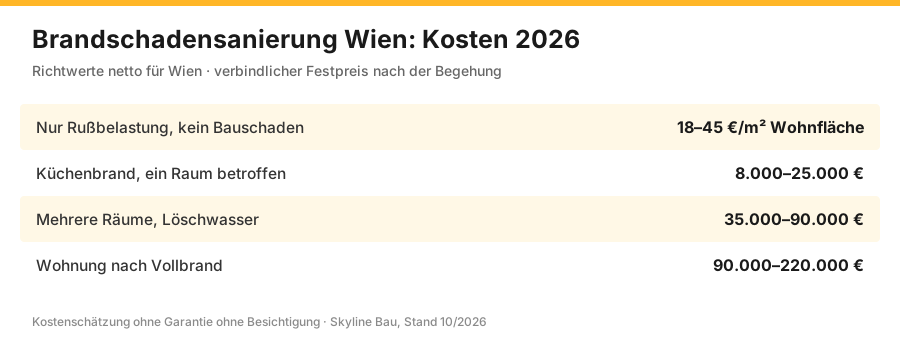
Fire damage restoration Vienna: restoring fire damage in Vienna costs 180 to 1,400 euros per square metre of living space. Soot cleaning without structural damage €18–45/m², partial restoration of one room €8,000–25,000, apartment after a full fire €90,000–220,000. In most cases billed via the building or household insurance.
What to do in the first days
Finding a company that bills the building insurer directly
This is the most common question after a fire, and it is justified: nobody wants to advance twenty or a hundred thousand euros and then argue for months about reimbursement. This is how it works with us.
- Direct billing with the insurer: once cover has been confirmed, we bill the insurer, not you. You bear the excess and whatever goes beyond the cover because you wanted it that way.
- Detailed restoration plan before work begins: you and the loss adjuster receive a bill of quantities by trade, with quantities, unit prices and schedule. This is the basis on which the insurer confirms cover — a lump-sum offer for one total is regularly rejected.
- Coordination with the loss adjuster: we walk through the property with them before anything is disposed of. What was cleared away beforehand will not be replaced later.
- Documentation per construction phase: photos before, during and after each phase, measurement records during drying, clearance measurement for odour. These are attached to the final invoice.
- First measures immediately, regardless of the cover confirmation: securing, covering, extracting extinguishing water and drying cannot wait. These costs are covered in every fire insurance policy under the duty to mitigate damage.
One piece of advice we give everyone: do not sign an assignment declaration by which a restoration company takes over your claims against the insurer. You would give up control over the amount of the claim. Direct billing does not require this.
Fire damage restoration Vienna: costs 2026
Net guide values, as of 2026, binding after damage assessment. The cost breakdown is structured so that the insurer's loss adjuster can check it item by item.
| Extent of damage | What is done | Net price | Duration |
|---|---|---|---|
| Soot contamination only, no structural damage | Special cleaning, odour treatment, painting | €18–45/m² living space | 3–7 days |
| Kitchen fire, one room affected | Removal, electrics, plaster, kitchen, cleaning of other rooms | 8.000–25.000 € | 3–6 weeks |
| Several rooms, extinguishing water | additionally drying, screed, floors | 35.000–90.000 € | 2–4 months |
| Apartment after a full fire | Strip-out, structural engineering, complete reconstruction | 90.000–220.000 € | 4–8 months |
| Staircase and neighbouring apartments | Soot cleaning, painting, fire doors | by measurement | 1–4 weeks |
Individual items
| Item | Unit | Net price | What is included |
|---|---|---|---|
| Damage assessment with photo documentation | lump sum | 350–950 € | Site visit, measurement, breakdown for the insurer |
| Pollutant testing of fire residues | sample | 180–650 € | Chlorides, PAHs, in old buildings also asbestos |
| Extracting extinguishing water | lump sum | 450–1.800 € | Extraction, disposal, initial drying |
| Technical drying | Day | €18–45 per device | Condensation dryer, measurement record |
| Soot cleaning of surfaces | m² | 12–35 € | Dry sponge, special cleaner, extraction |
| Odour neutralisation | room | 180–650 € | Ozone or hydroxyl, after clearance |
| Corrosion protection for metal parts | lump sum | 250–900 € | Radiators, fittings, electrical appliances |
| Removal of burnt components | m² | 35–95 € | Plaster, drywall, floors, separate disposal |
| Isolating primer | m² | 8–18 € | prevents soot from bleeding through the paint |
| New electrics after a fire | lump sum | depending on findings | by a licensed partner firm |
Total around €23,700 net excluding kitchen units. If the soot in the rooms that did not burn is merely painted over instead of cleaned and sealed, it bleeds through yellow after weeks – and the smell returns with every rise in humidity.
How we work with the insurer
- Breakdown by item. Removal, cleaning, drying and reconstruction separately, so that the loss adjuster can check each item.
- Photo documentation before each step. Whatever is torn out is documented beforehand.
- Emergency measures shown separately. As damage mitigation, they are usually approved quickly.
- Additional costs announced in advance. If hidden damage is found during removal, the supplementary claim goes to the insurer before work is done.
- Assignment on request. The invoice can go directly to the insurer once cover has been confirmed.
Fire damage restoration in the Viennese districts
After a fire, travel time matters, because soot penetrates deeper into plaster, screed and wood with every day. We are based in the 21st district and on site throughout Vienna within 24 hours for the first measures.
- 1210 Floridsdorf and 1220 Donaustadt: our base and its immediate surroundings. Here we are usually there on the same day for initial securing.
- 1110 Simmering and 1100 Favoriten: a lot of municipal housing and post-war stock. In kitchen fires in residential complexes, coordination with the property management is the first step, because the staircase and neighbouring apartments are also affected.
- 1230 Liesing: terraced and detached houses. Often roof-structure and basement fires, where the structure must be checked before cleaning.
- 1030 to 1090, Gründerzeit stock: timber beam ceilings absorb smoke and release it again for months. Surface cleaning is never enough here — the ceiling must be opened and the fill replaced.
- 1010 Inner City: protection zone. Stucco, box windows and historic floors are cleaned, not replaced. This takes longer and must be coordinated with MA 19.
- 1130, 1180, 1190: villas and cottage houses, often with timber fittings and open fireplaces. The smell sits in the fittings, not in the walls.
Outside Vienna we work in the surrounding area of Lower Austria and in Klosterneuburg. For properties in other federal states we do not refer on but decline — fire damage restoration from a distance does not work.
What soot and fire smoke really do
After extinguishing, the fire is out, but the damage is not over. Fire residues keep working – chemically, from the very first hour.
| Process | What happens | Time frame |
|---|---|---|
| Soot deposition | Particles settle on all surfaces, including in rooms without fire | during the fire |
| Penetration into porous materials | Plaster, wallpaper, wood, textiles absorb odour carriers | hours to days |
| Chloride formation | burnt plastic forms hydrochloric acid with air humidity | from a few hours |
| Corrosion on metal | Fittings, radiators, pipes, electronics are attacked | days to weeks |
| Odour binding | Odour migrates into screed, insulation and cavities | weeks |
| Mould growth due to extinguishing water | damp components at room temperature | from about 3–5 days |
| Material | Reaction to fire residues | Salvageable? |
|---|---|---|
| Smooth surfaces, tiles, glass, painted metal | Soot lies on top | usually fully cleanable |
| Paint on plaster | Soot penetrates, smell remains | Isolating primer and repainting |
| Wallpaper | absorbs smell permanently | remove |
| Wooden surfaces | depending on treatment, open-pored is critical | sand or replace |
| Textiles, curtains, upholstery | Odour carriers | Special cleaning or dispose of |
| Insulation materials | store smell and moisture | remove |
| Electrical installation in the fire area | Chloride contamination on terminals | Check by an electrical firm, usually replacement |
| Screed and insulation layer | Extinguishing water and smell | measure, dry or remove |
Emergency measures: the first days
| Step | What is done | Why |
|---|---|---|
| 1. Wait for clearance | Enter only after clearance by the fire brigade | Collapse, embers, flue gases |
| 2. Secure the building | Emergency closure of windows, doors, roof openings | Weather, unauthorised access |
| 3. Electricity and gas | have affected areas switched off | Chlorides on terminals, risk of short circuit |
| 4. Remove extinguishing water | extract, stop it spreading | every hour increases the moisture damage |
| 5. Document | Photos, video, measurement, inventory list | Basis for the insurer |
| 6. Ventilate and extract | Air purifiers, exhaust routing | Stop odour spreading into unaffected rooms |
| 7. Desalinate metal parts | Initial treatment of fittings, radiators, equipment | stops the corrosion |
| 8. Start drying | Measurement, equipment, record | prevents mould from day three to five |
The process
| Phase | What happens | Duration |
|---|---|---|
| 1. Initial inspection and securing | Record the condition, emergency closure, secure hazards | within 24 hours |
| 2. Damage assessment | Photo documentation, measurement, pollutant testing, cost breakdown | 2–5 days |
| 3. First measures | Extract extinguishing water, desalinate, start drying, air purification | in parallel with phase 2 |
| 4. Coordination with the insurer | Breakdown, inspection with the loss adjuster, approval | 1–4 weeks |
| 5. Removal | remove burnt and contaminated components, dispose of separately | by scope |
| 6. Cleaning and desalination | all surfaces, cavities, equipment, ventilation paths | by scope |
| 7. Drying until clearance measurement | Measurement records until dryness is proven | 2–5 weeks |
| 8. Odour treatment | after cleaning, before reconstruction | 2–5 days |
| 9. Reconstruction | Plaster, screed, floors, electrics, plumbing, painting | main construction time |
| 10. Handover | Records, certificates, documentation for the insurer | 1 appointment |
Cleaning methods compared
| Method | What for | Limits |
|---|---|---|
| Dry cleaning with a chemical sponge | loose soot on delicate surfaces | only superficial, insufficient for greasy soot |
| Wet cleaning with special cleaner | smooth surfaces, tiles, metal, plastic | watch the moisture input |
| Desalination of metal parts | remove chlorides, stop corrosion | time-critical, must be done early |
| Dry-ice blasting | Timber structures, roof structures, masonry | loud, extraction required, not permitted everywhere |
| Ultrasonic cleaning | Small parts, fittings, lights, tools | only removable parts |
| Extraction with fine dust filter | Preparation for any other measure | does not replace cleaning |
| Removal | everything that cannot be cleaned | most expensive, but sometimes the only solution |
Which method is right is decided by the type of soot. Dry soot from paper and wood fires can often be removed well. Greasy soot from kitchen fires and soot from burnt plastic sticks, penetrates and requires chemical cleaning or removal. That is why the damage assessment always includes samples at several points, not just a look into the fire room.
Odour: the part where restorations fail
| Measure | Effect | When it makes sense |
|---|---|---|
| Remove the source | eliminates the cause | always first, everything else is secondary |
| Cleaning all surfaces and cavities | removes odour carriers | before any treatment |
| Ozone treatment | oxidises odour molecules | only in cleared, unoccupied rooms |
| Hydroxyl method | gentler, can also be used when people are present | longer contact time |
| Isolating primer | prevents smell and soot from bleeding through | before repainting, not instead of cleaning |
| Replacing odour-laden components | permanently effective | Insulation, screed, wallpaper, wood-based materials |
Extinguishing water: the second damage
In most apartment fires in Vienna, the extinguishing water causes more structural destruction than the fire. It spreads through joints, shafts and ceiling penetrations and reaches apartments where there was never a fire.
| Area | What to expect | What needs to be done |
|---|---|---|
| Fire apartment | standing water, soaked build-up | extract, open up, measure, dry |
| Apartment below | Ceiling stains, detached plaster, wet floors | separate damage assessment and drying |
| Stairwell | Water runs down the stairs | secure slip hazard, check the covering |
| Basement | Water collects at the lowest point | pump out, have electrical distribution boards checked |
| Service shafts | Water migrates vertically, invisible from outside | open up and measure, do not just look |
| Timber beam ceilings | Water stands in the fill | open up, measure timber moisture, often removal |
Structure and load-bearing elements after a fire
| Building component | Behaviour in fire | Assessment |
|---|---|---|
| Timber beams and roof structure | char in a controlled way, the residual cross-section may carry loads | measure charring depth, structural engineer assesses |
| Steel beams | lose load-bearing capacity in heat, deform | check deformation, often replacement |
| Reinforced concrete slab | Concrete spalling, exposed reinforcement | Testing, repair or strengthening |
| Brick masonry | usually robust, cracks from quenching with extinguishing water | Record and assess cracks |
| Vaults in the basement | sensitive to movement at the supports | check crown and supports |
The assessment of the load-bearing structure belongs at the beginning, not at the end. If it is established that a roof structure must be partly replaced, this changes the sequence, scaffolding and costs of the entire restoration. We therefore bring in the structural engineer during the damage assessment phase and not only when cleaning is already under way.
Pollutants after a fire
| Substance | Arises from | Consequence for the work |
|---|---|---|
| Chlorides | burnt PVC and plastic | Desalination, corrosion protection, protective equipment |
| PAHs | incomplete combustion of organic materials | Protective measures, separate disposal |
| Dioxins and furans | fires involving plastics and flame retardants | Sampling, remediation according to findings |
| Asbestos | Old building fabric exposed by the fire | separate measure in accordance with regulations |
| Man-made mineral fibres | old insulation | Removal with protection, separate disposal |
| Heavy metals | Electronics and batteries | Hazardous waste |
Insurance: which cover for what
| Insurance | Who has it | What it usually covers |
|---|---|---|
| Homeowner's or building insurance | Owner, owners' association | Building fabric, permanently installed parts, clearance and demolition costs |
| Household insurance | Tenant, owner | Furnishings, personal belongings, often hotel costs |
| Liability insurance of the party responsible | whoever caused the fire | Damage to other people's property |
| Business insurance | Business, practice, restaurant or shop | Furnishings, goods, often business interruption |
| Tenancy law claims | Tenant against landlord | Restoration of usability, rent reduction |
Which documents the insurer needs
- Claim notification with date and time: as early as possible, even if the extent is still unclear.
- Fire brigade report and police report: request the incident report; it is the basis for attributing the cause.
- Photo documentation before any change: overview of each room, then details, with date.
- List of damaged items: year of purchase, price, receipts where available.
- Cost breakdown of the restoration: by item, not as a lump sum.
- Measurement and drying records: initial values, progress, clearance measurement.
- Pollutant findings: if special measures were necessary.
- Proof of the first measures: shows that the damage was limited.
How the claim is handled in practice
| Step | Who | Time frame |
|---|---|---|
| Report the damage | Policyholder | immediately |
| Approve the first measures | Insurer, usually by phone | 1–2 days |
| Inspection with the loss adjuster | Insurer, we accompany | 3–10 days |
| Submit the cost breakdown | we | after the damage assessment |
| Approval of the restoration | Insurance | 1–4 weeks |
| Execution with ongoing documentation | we | Construction time |
| Final invoice with evidence | we | after handover |
For larger claims we accompany the on-site inspection. This saves the second round: questions about scope, depth of removal and drying concept can be clarified at the appointment instead of in four weeks of correspondence. Where views differ, the route is a private loss adjuster on the side of the injured party – we provide the documents for this; commissioning remains with the policyholder.
The most common mistakes
- Started too late. Every week that sooty surfaces remain untreated pushes cleanable components towards removal.
- Cleaned yourself. Household cleaner works soot into the surface and turns a cleaning job into repainting with isolating primer.
- Disposed of before documentation. What was not photographed will not be replaced.
- Metal parts not desalinated. Chlorides keep working; fittings and equipment are lost after weeks.
- Drying shortened. Building on a damp substrate leads to mould six to twelve months later, then without insurance cover.
- Odour treatment before cleaning. Ozone acts on surfaces, not in the insulation layer – the smell returns in the first summer.
- Only the fire room treated. Soot spreads through the whole apartment and into neighbouring areas, even where nothing is visible.
- Removal without pollutant findings. With asbestos or high chloride contamination, the removal turns into a contaminated site.
- Electrical installation left in place. Chlorides on terminals lead to leakage currents and, in the worst case, to the next fire.
The first four points all depend on the same factor: time. That is why we separate first measures and restoration – the first measures run immediately and in parallel with coordination with the insurer; the actual restoration begins after approval.
What you can do yourself – and what not
| Useful | Harmful |
|---|---|
| Rescue valuables and documents as soon as clearance is given | Wiping soot surfaces or cleaning them wet |
| Photograph everything, room by room, with date | Throwing away damaged items before they are documented |
| Report the damage to the insurer immediately | Waiting for the inspection before securing |
| Leave windows tilted if the weather allows | Blowing soot into unaffected rooms with fans |
| Close doors to unaffected rooms | Carrying textiles and clothing into clean rooms |
| Collect receipts and purchase dates | Switching on electrical appliances from the fire area |
| Request the fire brigade report | Starting repairs before the extent is known |
Special cases
| Case | Special feature | Approach |
|---|---|---|
| Roof structure fire | Building is open at the top | Emergency closure and scaffolding first, everything else afterwards |
| Basement fire | Smoke travels through the whole building via shafts | Cleaning of all storeys, open the shafts |
| Fire in the electrical distribution board | massive chloride contamination in a small space | desalinate immediately, have the installation checked |
| Shop or medical practice | Business interruption costs more than the restoration | Phases, work outside opening hours |
| Listed building fabric | Stucco, historic floors, box windows | gentle methods, coordination before starting |
| Arson or unclear cause | Investigations are under way | Only change the fire scene after clearance |
| Photovoltaics on the roof | System may be live | Disconnection by a specialist firm before any work |
During ongoing investigations, the rule applies without exception: the fire scene is not altered before clearance is given. Weather protection measures are usually exempt, but they are coordinated and documented – this also protects the injured party, because nobody can later claim that traces were removed.
Living in the apartment during the restoration
| Situation | What is possible | What needs to be clarified |
|---|---|---|
| One room affected, the rest clean | Living there usually possible | Dust protection, access, spread of odour |
| Several rooms, drying under way | possible with restrictions | Noise, electricity costs, use of sanitary facilities |
| Kitchen or only bathroom affected | usually not reasonable | Alternative accommodation, check cover |
| Electrical installation out of operation | not habitable | Temporary solution or alternative accommodation |
| Structure not clarified | not accessible | Wait for the assessment |
For tenants there is also the question of rent reduction. It depends on the extent of the impairment and must be assessed in each individual case; we provide the factual basis – which rooms could not be used and for how long – and not a legal assessment.
How to recognise proper fire damage restoration
| Feature | Good workmanship | Warning signs |
|---|---|---|
| First measures | within 24 hours, before the insurer's approval | "we are waiting for the insurer" |
| Documentation | Room by room, with date, before any change | a few mobile phone photos |
| Pollutants | Sample before removal | chiselling started straight away |
| Drying | Measurement records and clearance measurement | Equipment set up, nothing measured |
| Scope of cleaning | including unaffected rooms and cavities | only the fire room |
| Odour | Source removed, then treated, then sealed | Ozone as the first measure |
| Electrical | Testing or replacement by a specialist firm | cleaned and reused |
| Reconstruction | only after clearance measurement | Screed on a damp substrate |
Schedule: what to expect
| Damage pattern | First measures | Restoration in total |
|---|---|---|
| Soot contamination only, one room | 1–2 days | 1–2 weeks |
| Kitchen fire with extinguishing water | 2–4 days | 6–10 weeks |
| Several rooms, two storeys | 1 week | 3–5 months |
| Full fire in an apartment | 1–2 weeks | 5–8 months |
| Roof structure fire in a tenement building | 2 weeks | 6–12 months |
The largest single item on the timeline is not the construction time but drying and coordination with the insurer. Both can be shortened: drying through first measures started early, coordination through a complete cost breakdown at the first submission. In practice, supplementary submissions cost more time than any construction work.
Price examples from practice
Total around €29,100 net excluding kitchen furniture, duration about nine weeks. The kitchen itself was covered by the household insurance, the building fabric by the building insurance.
Total around €253,000 net, construction time about seven months. The emergency closure on the first day limited the consequential damage in this case: in the week after the fire, 40 millimetres of rain fell.
For property managers and owners' associations
| Point | How we handle it |
|---|---|
| Accessibility | Initial inspection within 24 hours, one contact person for the entire property |
| Delimitation of damage | documented separately for each unit, so that building and contents can be clearly assigned |
| Communication with residents | Notice, time slots, contact person on site during the work |
| Securing the building | Emergency closure, cordoning off, residents' access remains organised |
| Uninhabitability | written confirmation if it objectively applies |
| Insurance documents | one collected documentation for the community, individual parts per apartment |
| Billing | by item, separated into common parts and units |
How this differs from our other services
| Situation | Matching service |
|---|---|
| Fire damage from securing to reconstruction | Fire damage restoration, this page |
| Only extinguishing water, no fire | Water damage restoration |
| Drying with measurement record and clearance measurement | Building drying |
| Mould after water damage | Mould remediation |
| Apartment back to the shell | Gutting |
| Clearing before the restoration | clearance |
| Renewing roof structure and roof covering | Roof renovation |
| Record the condition of neighbouring buildings before work | Pre-construction survey |
What can be done at the same time during reconstruction
After a fire, the building fabric is open anyway. What would later be a separate construction project if retrofitted on its own now costs a fraction – and the insurer pays the share that belongs to the reinstatement anyway.
| Measure | Why now | Additional cost, net |
|---|---|---|
| Bring the electrical installation up to current standard | Cables are open or being replaced anyway | low, usually included in the reconstruction |
| Smoke detectors in all habitable rooms | Ceilings open, fitting without additional effort | €40–120 per device |
| Fire door to the staircase or basement | The frame is being renewed anyway | €900–2,400 per door |
| Fire stopping of service penetrations | Shafts are open | €180–450 per penetration |
| Impact sound and thermal insulation in the floor build-up | Build-up has been removed anyway | €35–75/m² |
| Cable routing documented visibly | before closing, without extra work | included in the price |
| Clear escape routes and keep them clear permanently | The building is a site anyway | low |
The point most often taken up is the electrical installation. In old Viennese apartments it often dates from a time when two sockets per room were enough. If it is being replaced in the fire area anyway, the step to a complete renewal with sufficient circuits is small – and then it is settled for twenty years.
When you do not need us
For a small pan fire without visible soot outside the kitchen, ventilation and thorough cleaning are enough. Contact us if soot can be seen in other rooms, if extinguishing water was used, if plastic burned or if the insurer requires professional restoration.
Fire damage cleaning or restoration: where the line is drawn
After a small fire – a pan on the stove, a scorched power strip, an Advent wreath – people often first look for fire damage cleaning. That is right as long as only surfaces are affected: soot lies on walls, furniture and window frames, but plaster, screed and cables are undamaged. Then dry cleaning, wet cleaning with suitable agents, an isolating primer and a new coat of paint are enough.
It becomes a restoration as soon as components have been damaged. Typical signs are spalling or darkly discoloured plaster, a deformed plastic sub-distribution board, a smell of burning from sockets and cavities, floor coverings swollen by extinguishing water or cracks in plasterboard walls. Cleaning does not help here because the damage sits in the material. Removal, drying, renewal of the electrics by a licensed electrician and reconstruction follow.
The distinction is also important for the insurer: pure cleaning is approved quickly; structural damage needs an assessment. Anyone who does not know the difference either has too much torn out or paints over damage that comes back. If water is standing in the floor build-up after extinguishing, this part technically belongs to water damage restoration and is dried under measurement before reconstruction.
Fire damage restoration and the law: who may do what and who must do what
In fire damage restoration, several parties with their own rights and obligations come together. Sorting this out from the start avoids most delays.
- Authorities and fire investigation: as long as the police or fire investigators have not released the fire scene, nothing is removed there. Securing and covering are possible, clearing is not.
- Policyholder: report the damage immediately, prevent further damage, but do not change the damage pattern unnecessarily before it has been documented or seen by the loss adjuster. These obligations are in practically every policy.
- Landlord and owners' association: they are responsible for the building fabric and the common parts, usually via the building insurance, which in multi-unit buildings is handled by the property management.
- Tenants: they must report the damage and tolerate necessary work in the apartment. If the apartment is wholly or partly unusable, the rent can be reduced accordingly under the ABGB. Contents are a matter for their own household insurance.
- Party responsible: if a third party caused the fire, their liability insurance applies; your own insurer can later recover the money.
This overview does not replace legal advice. In disputes about rent reduction or liability, a tenants' advice service or a lawyer is the right route. For the restoration itself, it is usually enough that everyone involved has the same documentation.
"How do I find a company that bills my insurer?"
Many people ask themselves this question when they have fire damage for the first time. How to recognise a specialised company that bills the building insurer directly and draws up a detailed restoration plan can be clarified with a few test questions in the first conversation:
- "Who draws up the restoration plan for me – and in what form?" Expect a bill of quantities by trade with quantities and unit prices, not a lump sum on half a page.
- "Will samples be taken before removal?" A firm that knows fire damage plans samples for fire residues and, in old buildings, for asbestos before any material is moved.
- "How is drying proven?" Measurement records with date and measuring points are part of the billing; without them hardly any insurer pays for the equipment days.
- "What happens if more turns up when opening up?" Supplements should go to you and the loss adjuster in writing, with photos and before execution.
- "Do I have to assign anything?" For direct billing, the cover confirmation together with a payment instruction is enough. An assignment of your entire claims is not necessary for this.
A reputable contractor answers all five questions without evasion. How cooperation with the insurer then works is described in the section on claim handling above.
Fire restoration: understanding the costs from an example
What a fire restoration costs depends less on the area than on how far the soot and extinguishing water have spread. A calculation for a typical case: in a 70 m² apartment the kitchen burns out; the other rooms are sooted but structurally intact.
| Item | Basis | Guide value net |
|---|---|---|
| Damage assessment with photo documentation | lump sum | 350–950 € |
| Partial restoration of the kitchen | Removal, electrics, plaster, reconstruction | 8.000–25.000 € |
| Soot contamination in the other rooms | around 55 m² at €18–45 | 990–2.475 € |
| Odour neutralisation | two rooms | 360–1.300 € |
| Total | excluding contents and kitchen furniture | around €9,700–29,700 |
The wide range is explained by the condition behind the surface: did the heat only crack the tiles or also attack the cables in the wall? This only becomes clear when opening up, which is why the restoration plan works with items for additional work instead of concealing it.
Having fire damage restored in Simmering: what is different in the 11th district
Anyone in 1110 Vienna who needs fire damage restored usually faces one of three starting situations, and each requires a different first step.
Apartment in a large residential complex
Simmering has many municipal housing blocks and cooperative complexes. Walls, ceilings, windows and staircase belong to the landlord there, so the restoration of these parts is usually commissioned via the property management and its building insurance. Your household insurance covers furniture and contents. Report the damage in writing immediately, photograph every room before anything is cleared away, and ask who approves the first measures – otherwise everyone waits for the other while the soot penetrates.
Allotment and estate house
In the district's allotment gardens there are many houses with a high proportion of timber and light walls. A fire quickly reaches the load-bearing structure here. Before cleaning, a structural engineer clarifies whether the roof structure and walls can stay or whether part has to be dismantled in a controlled way – for this we offer demolition and dismantling.
Workshop, warehouse or business
For commercial premises, besides the building fabric, the time until operations resume counts. Extinguishing water often stands in the screed and walls; how we get it out is described under water damage restoration.
Frequently asked questions about fire damage restoration in Vienna
How much does fire damage restoration cost?
Fire damage restoration: does the insurer pay?
What must I do immediately?
Why is soot so harmful?
How quickly must action be taken?
Can I clean off the soot myself?
Can I just paint over it?
How is the smell of burning removed?
What about the extinguishing water?
Why pollutant testing?
Must the electrics be renewed?
Is the structure affected?
What happens to the neighbouring apartments?
Fire damage restoration: how long does the restoration take?
Fire damage restoration: can I stay in the apartment during the restoration?
Do you bill the insurer directly?
What if more damage turns up during removal?
Fire damage restoration: who carries out the work?
Fire damage restoration: which documents do I receive?
How quickly can you come?
How quickly must fire damage restoration begin?
Why does it smell again after cleaning?
How much does drying after a fire cost?
Does the electrical installation have to be replaced?
Can I stay in the apartment during the restoration?
Does the insurer pay hotel costs?
What is most often deducted?
What about asbestos and other pollutants?
What happens to the roof structure after a fire?
Do you also work for property managers in multi-unit buildings?
May I clear up the fire scene before the loss adjuster has been?
Who pays for fire damage in a rented apartment?
Is cleaning enough after a small fire?
How can I tell whether a company specialises in fire damage?
Related services
Detailed cleaning after the restoration?
Construction and detailed cleaning after fire damage restoration is handled by our partner company Bling Bling Premium Cleaning. More at bling-bling.at.
Send enquiry
Enquire directly here — fixed-price quote free of charge. Skyline Bau replies within 2 working days.
Ready for your fire damage restoration in Vienna?
Write to us directly on WhatsApp — send photos. Reply within 2 working days.
Note: Skyline Bau is the brand name of the construction and renovation division of Bling Bling GmbH and is not a separate legal entity. The sole contractual partner is Bling Bling GmbH. Bling Bling GmbH is a restricted construction trade business under § 99 GewO (Austrian Trade Regulation Act) and not a licensed master builder (Baumeister). Under § 99 (5) GewO, the title “Baumeister” is reserved for businesses licensed under § 94 no. 5 GewO. Regulated trades — master-builder services, structural engineering, gas and sanitary engineering, electrical engineering — are carried out exclusively by authorised, licensed partner companies.