Call nowWhatsAppEmail

Balcony renovation Vienna concrete, waterproofing, surface — watertight for decades.

Balcony renovation Vienna: from the building contractor that does the work — not from an agent.

Balcony renovation Vienna: renovating a balcony in Vienna costs 250 to 550 euros per square metre net. Included are removal, concrete repair, waterproofing, fall, edge trim and new surface. If the railing is added, it is €350 to €800/rm. Construction time 1 to 3 weeks per balcony. Fixed price under ÖNORM B 2110.

A balcony renovation in Vienna costs €250 to €550 per square metre net. The difference lies in the condition of the concrete: if new waterproofing with a new surface is enough, it is €250 to €350/m². If the reinforcement has started to rust and the slab has to be repaired, €400 to €550/m². A new railing costs €350 to €800 per running metre. Construction time 1 to 3 weeks per balcony, plus scaffolding or a cherry picker depending on the location. With several balconies stacked above each other, the price per square metre falls considerably.
✓ Concrete repair to ÖNORM EN 1504✓ Waterproofing to ÖNORM B 3691✓ Fixed price ÖNORM B 2110✓ Photo documentation before closing✓ 3-year warranty

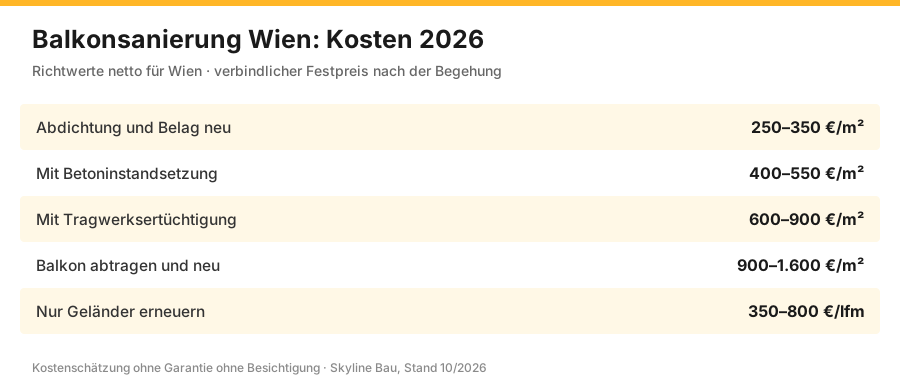
Balcony renovation Vienna: costs 2026

Net guide values, as of 2026, binding after a site visit. The price depends almost exclusively on how badly the concrete is damaged – not on which tile is on top.

ScopeConditionNet priceConstruction time
New waterproofing and surfaceConcrete intact, only the surface damaged€250–350/m²5–8 working days
With concrete repairSpalling, reinforcement visible€400–550/m²10–15 working days
With structural strengtheningReinforcement heavily corroded, structural engineering required€600–900/m²3–5 weeks
Remove and rebuild the balconySlab can no longer be saved€900–1,600/m²4–8 weeks
Only renew the railingConcrete in good order€350–800/rm2–4 working days
Balcony renovation Vienna: costs 2026 – net price overview
Balcony renovation Vienna: the prices from the table at a glance, as of 2026, net.

Unit prices, so you can check a quote

ItemUnitNet priceWhat is included
Removing old covering and screedm²45–90 €Breaking up, removal, disposal with certificate
Removing concrete down to the sound corem²60–140 €Ultra-high-pressure water jetting or breaking out
Derusting and coating the reinforcementlin. m18–45 €Derusting to SA 2½, two-coat corrosion protection
Concrete repair mortar to ÖNORM EN 1504m²70–160 €Bonding bridge, reprofiling, curing
Laying a sloping screedm²35–70 €1.5–2 % away from the building, edge insulation strips
Waterproofing to ÖNORM B 3691m²45–85 €Primer, two coats, sealing tapes, sleeves
Edge trim profile, drip edgelin. m28–60 €Aluminium or stainless steel, integrated into the waterproofing
2 cm porcelain stoneware on pedestalsm²85–150 €Pedestals, slabs, alignment, edge cutting
Porcelain stoneware in thin bedm²70–120 €Uncoupling mat, adhesive, grout, silicone
WPC or timber decking on substructurem²90–170 €Bearers, boards, fixing
Hot-dip galvanised steel railinglin. m350–550 €Removal of old, fabrication, installation, waterproofing connection
Railing with glass infilllin. m550–800 €Laminated safety glass, clamp profile, installation
Drainage, outlet or spoutpcs280–650 €Core drilling, outlet, connection, waterproofing
Repairing and painting the soffitm²45–95 €Concrete repair, filling, facade paint
Scaffolding or cherry pickerlump sum800–3.500 €depending on height, duration and accessibility
Site setup, protection, cleaninglump sum450–1.200 €Protection of the apartment, dust lock, final cleaning
Worked example · Gründerzeit balcony, 6 m², concrete with spalling
Removal and disposal€480
Concrete repair, reinforcement€1,150
Fall, waterproofing, edge profile€1,020
Surface, soffit, site€1,280

Total around €3,930 net, which is €655/m². With four identical balconies stacked above each other, the price per square metre falls to around €430, because scaffolding, travel and site setup are only incurred once.

How to tell that your balcony is due

A balcony gives warning signs long before it collapses. These eight signs mean action is needed – the last three immediately.

  • Damp patches on the soffit or on the wall below. Water is already running through the slab.
  • Lime streaks and sinter traces on the underside of the balcony: water is migrating through the concrete and leaching out lime.
  • Hollow-sounding tiles when tapped. The bond is gone and water is standing underneath.
  • Cracks in joints and at the wall connection, especially after periods of frost.
  • Lifting edge profiles or a missing drip edge: water runs back under the surface at the front edge.
  • Rust streaks on the balcony edge – the reinforcement in the concrete is already corroding.
  • Spalling with visible steel. Rusting steel expands two to four times and bursts the concrete from the inside.
  • Wobbly railing. Usually the anchorage in the concrete has corroded – that is a safety issue, not a cosmetic flaw.
The most common misconception about balconies: "We'll just replace the tiles." The tile is not watertight and never was. What is watertight is the waterproofing underneath. Anyone who lays new tiles on an old, leaking surface pays twice – once now and once in four years, then with concrete damage.

The build-up, layer by layer

1 · Load-bearing concrete slabIt must be clean, sound and free of loose parts. Everything that sounds hollow is removed – better one square metre too many than one spot too few.
2 · Reinforcement protectionExposed steel is derusted to SA 2½ and given two coats. Without this step it continues to rust under the new mortar.
3 · ReprofilingConcrete repair mortar to ÖNORM EN 1504, applied with a bonding bridge and cured. This is not a filler from the DIY store but a tested system product.
4 · Fall1.5 to 2 % away from the building. Without a fall, water stands, and standing water finds every weak point.
5 · WaterproofingBonded waterproofing to ÖNORM B 3691, two coats, with sealing tape at every corner, every connection and every penetration.
6 · Edge trim with drip edgeThe profile carries water over the edge instead of letting it run back at the front face. If it is missing, that is exactly where the rust streaks appear.
7 · UncouplingBetween waterproofing and tiles, so that thermal movements do not carry through into the surface. A balcony experiences temperature differences of 60 degrees and more over the year.
8 · SurfacePorcelain stoneware in a thin bed, on pedestals, or a timber or WPC deck. Each variant has its place – what matters is what lies beneath.

Balconies in old Viennese buildings: five special features

1. The Gründerzeit balcony is often a cantilever with no reserve

Many Viennese balconies from the Gründerzeit are cantilevered slabs with little concrete cover – sometimes only 10 to 15 mm instead of the 40 mm usual today. This means the steel lies closer to the surface and rusts earlier. A thick new build-up also increases the weight on the cantilever. That is why, when reinforcement is visible, structural engineering is part of the job before building.

2. Protection zone and MA 19

If the balcony faces the street and the building is in a protection zone, MA 19 assesses every change in appearance – especially the railing. Replacing a wrought-iron Gründerzeit railing with a glass balustrade is regularly not approved there. Renovating the existing railing is then the way: derust, straighten, coat.

3. French balconies and flower windows

Many "balconies" in Vienna are actually French balconies without a walkable area. There it is only about the railing and the window connection – costs €350 to €800 per running metre, without a waterproofing build-up.

4. Retrofitted balconies

In the 1980s and 90s, many balconies were retrofitted to Gründerzeit buildings, usually as a steel structure with a concrete slab. With these, the anchorages in the facade are the critical point: corrosion there is more dangerous than any spalling in the slab.

5. Access and site

A balcony on the fourth floor without a lift means material and rubble go through the apartment or via a cherry picker. Both must be clarified in advance. For work above the pavement, a permit from MA 46 and fall protection are added.

Who pays: owner, tenant, community?

ConstellationWho paysBasis
Rented apartment, balcony damagedLandlordsMaintenance obligation under § 3 MRG, from the rent reserve
Rented apartment, surface to be made nicerTenant, with consentImprovement under § 9 MRG
Condominium, balcony slabOwners’ associationCommon part of the property, from the reserve fund
Condominium, top floor coveringusually the apartment ownerdepending on the condominium agreement
Damage to the apartment belowCheck the building insuranceoften covered if sudden and unforeseen

Whether the balcony slab counts as a common part is the point most often disputed in owners' associations. We provide a bill of quantities that shows structure and surface separately – so that the billing is transparent.

How a balcony renovation works

Day 0 · Site visitTapping the surface, checking the soffit, measuring concrete cover, checking the railing anchorage, photo record. This shows whether €250 or €550 per square metre is realistic.
Day 1 · Protection and removalApartment sealed off, balcony door protected, old surface and screed removed, rubble via skip or cherry picker.
Day 2 · Assessment of the exposed concreteOnly now is it visible how far the reinforcement has corroded. Additional costs are discussed here and approved in writing – not later on the invoice.
Day 2–4 · Concrete repairRemove loose areas, derust and coat the steel, reprofile with system mortar, cure.
Day 5 · FallLay sloping screed, 1.5 to 2 % away from the building, fit edge insulation strips.
Day 6–7 · WaterproofingTwo coats to ÖNORM B 3691, sealing tapes at the wall connection, door threshold and outlet, edge profile with drip edge integrated. Photos before covering.
Day 8–9 · SurfaceUncoupling, tiles in thin bed or slabs on pedestals, edge cutting, grouting, silicone at movement joints.
Day 10 · Railing and soffitInstall the railing or refit the renovated one, fill and paint the soffit.
Day 11 · AcceptanceWatertightness test, acceptance record under ÖNORM B 2110, handover of the photo documentation, detailed cleaning.

The eight most common mistakes on Viennese balconies

  • Tiles on tiles. Saves two days, costs build-up height and hides the damage instead of fixing it.
  • No waterproofing, only tile adhesive. By far the most common finding during removal.
  • No fall. Water stands, freezes and bursts the surface from below.
  • Missing drip edge. Water runs back at the front face, and that is exactly where the reinforcement rusts first.
  • Connection height at the door too low. Below 15 cm above the top of the surface without a channel, water runs into the living room during driving rain.
  • Railing drilled through the waterproofing afterwards. Every penetration without a sleeve is a leak waiting to happen.
  • Concrete damage filled over instead of repaired. The steel keeps rusting underneath, and in three to five years it spalls again.
  • No movement joint at the wall connection. The balcony expands in summer and the rigid joint cracks.

How to check an offer for balcony renovation

Is waterproofing a separate item?With standard, area and system specified. If it is missing, the offer is not cheaper but incomplete.
Is concrete repair priced in or only "if required"?A serious offer has an item with an assumed quantity and unit price, so you know what extra work costs.
Are edge profile and drip edge included?Two items that are often missing and later devalue the whole build-up.
Who provides the scaffolding or cherry picker?€800 to €3,500 that otherwise come as an extra charge.
Is disposal with certificate included?Construction waste from Vienna must be disposed of with documentation.
Is there a "not included" line?Railing, soffit, painting, lighting – what is missing should be named.
How high is the liability insurance?For work at height above occupied areas, at least €3 million.
Do you get photos before closing?Of the reinforcement, the reprofiling and the finished waterproofing. Without them nothing can be proven later.

Who we renovate balconies for

Property management companies

Several balconies in one facade axis, coordinated with one scaffold. Verifiable bill of quantities, structure and surface shown separately, weekly photo reports.

Apartment owners

A single balcony, often with the question of what the community pays and what the owner pays. We write the offer so that the division is visible.

Tenement building owners

Balcony renovation as part of the facade renovation – the scaffolding is in place anyway, and the price per square metre falls considerably.

Private clients

Your own balcony in a terraced house or owner-occupied apartment. Clear price, clean site, the apartment stays habitable.

When you do not need us

If only the joints look shabby and the surface is well bonded without voids, joint repair for a few hundred euros is enough. If the building is getting a facade renovation in two years anyway, wait – then the scaffolding will be there and you save €800 to €3,500. And if the balcony is in a building that is planning a basic renovation, it belongs there and should not be awarded as a separate measure. We tell you this at the site visit, even if it means postponing an order.

Complete renovation or just renewing the surface?

Whether a balcony needs a complete renovation is not shown by the tiles but by what lies beneath. In a complete renovation everything is removed down to the load-bearing slab: surface, adhesive, screed and old waterproofing come off. Then the concrete is assessed, damaged areas are repaired, a new fall is created, and only then come waterproofing, edge profile with drip edge and the new surface. Railing and soffit are often included because they connect to the same waterproofing.

This depth is necessary when water has already got into the slab: brown stains on the soffit, efflorescence, hollow-sounding slabs or rust streaks. If, on the other hand, the structure is dry and only the surface is worn, a complete removal would be a waste of money. A site visit with a tapping test and, where necessary, a small opening at an inconspicuous spot clarifies the difference.

Coating the balcony instead of tiling: when that is enough

Many ask whether they can simply have the balcony painted. Ordinary floor paint is unsuitable – it looks good for a year or two but does not waterproof anything. A real alternative is a synthetic-resin liquid waterproofing that is applied with fleece reinforcement directly onto the prepared concrete or even onto firmly bonded old tiles and acts as both waterproofing and wearing layer. It needs no additional build-up, which is an advantage with low door thresholds.

The prerequisite is that the substrate is sound and dry and the fall is already correct. If water stands in hollows or the reinforcement is affected, the coating only hides the damage. Then the concrete is repaired first according to ÖNORM EN 1504. The edges also matter: at the door, railing posts and outlets, the material must be turned up with reinforcement, otherwise water gets in exactly there. Similar rules apply to ground-level surfaces; more on this under terrace renovation.

Having a balcony glazed: first the slab, then the glass

Glazing turns the balcony into a sheltered space but also adds load. Glass and profiles add weight and wind loads, which are transferred via the parapet and slab. If the concrete is weakened or the parapet is just a slender railing, it must first be checked whether the structure can take this. Anyone who wants glazing should therefore renovate beforehand – afterwards, the waterproofing behind a glass front is hardly accessible.

In Vienna, glazing changes the external appearance of the building. Whether a permit or notification to the building authority (MA 37) is required depends on the design and is clarified in advance; in a protection zone things are looked at particularly closely. In condominium ownership, the consent of the other owners is also required. After installation, regular ventilation is important, otherwise moisture condenses on the glass and the apartment wall in winter. The glazing itself is supplied by a specialist for glass systems; we prepare the substrate and connections.

How much does it cost to build a new balcony?

Two cases must be distinguished here. If an existing balcony is removed and rebuilt in the same place, the guide values according to the table above are €900 to €1,600 per square metre net, because demolition, a new slab, connection to the facade and railing all come together. A completely new add-on balcony on a building that did not have one before is a separate construction project: it needs structural engineering, in Vienna usually a building permit, and often its own columns with foundations in the courtyard or garden.

Whether a free-standing steel structure or a cantilever slab connected to the floor slab makes sense is decided by the existing building. With the cantilever slab, the low-thermal-bridge connection to the floor slab is the delicate point; with the steel variant it is the foundations and corrosion protection. Without permit drawings no serious lump-sum price can be given – after a site visit we estimate the range and the necessary planning steps.

Frequently asked questions about balcony renovation in Vienna

How much does a balcony renovation in Vienna cost?
€250 to €550 per square metre net. If the concrete is intact and only waterproofing and surface are due, €250 to €350/m². With concrete repair €400 to €550/m². A 6 m² balcony with concrete damage costs around €3,900 net.
How much does a 10 m² balcony cost?
€2,500 to €5,500 net depending on the condition of the concrete, plus scaffolding or a cherry picker at €800 to €3,500. With several balconies above each other, the price per square metre falls by 20 to 35 %.
Why is the price per square metre so high for small balconies?
Because travel, protection of the apartment, scaffolding, disposal and site management are incurred regardless of the area. At 4 m², these fixed costs are spread over a few square metres – that is not a surcharge but arithmetic.
Can't you just replace the tiles?
Technically yes, professionally almost never. The tile is not watertight; what is watertight is the waterproofing underneath. Anyone who lays new tiles on an old surface hides the damage for three to five years – then it comes back, with concrete damage.
How long does a balcony renovation take?
5 to 8 working days if the concrete is intact. With concrete repair 10 to 15 working days, because mortar and waterproofing need drying times. With structural strengthening 3 to 5 weeks.
Balcony renovation: can I stay in the apartment during the renovation?
Yes. The balcony cannot be used during construction and the balcony door is taped up at times, but the apartment itself remains habitable. It gets loud on the demolition days, usually one to two days.
How do I know my balcony needs renovating?
Damp patches or lime streaks on the soffit, hollow-sounding tiles, cracks at the wall connection, rust streaks on the edge, spalling with visible steel or a wobbly railing. The last three mean immediate action is needed.
What does it mean if reinforcing steel is visible?
That the concrete has lost its protective function. Rusting steel expands two to four times and bursts the concrete from the inside. From this point on it gets worse and more expensive with every winter – waiting is not an option here.
Can a balcony collapse?
With advanced corrosion of the load-bearing reinforcement in the cantilever, it cannot be ruled out; there have been such cases in Austria. That is why, with large-area spalling at the fixing point to the wall, a structural engineer is called in before anyone steps onto the surface.
What is concrete cover and why is it important?
The distance between the reinforcing steel and the concrete surface. It protects the steel from moisture and carbon dioxide. Today 40 mm is usual; in Gründerzeit balconies it is often only 10 to 15 mm – that is why they rust earlier than modern structures.
What is carbonation?
Carbon dioxide from the air penetrates the concrete and lowers its alkalinity. As a result, the steel loses its natural corrosion protection. The process runs over decades and is the main reason why old balconies eventually become damaged – regardless of care.
What is ÖNORM EN 1504?
The series of standards for the protection and repair of concrete structures. It regulates which products are permitted for reinforcement protection and reprofiling and how they are applied. An offer that refers to it can be checked – one that says "repair concrete" cannot.
Which waterproofing is used?
On balconies, usually bonded waterproofing to ÖNORM B 3691 directly under the surface, two coats with sealing tapes in all corners and connections. For terraces over living space, sheet waterproofing is an option – this depends on build-up and use.
How much fall does the balcony need?
1.5 to 2 % away from the building, i.e. 1.5 to 2 cm per metre. Less means standing water; more becomes noticeable when walking and makes furniture move.
Why is the drip edge so important?
Without it, water runs back along the front face of the slab and is drawn under the surface. That is exactly where the typical rust streaks and spalling on the balcony edge occur. The edge profile costs €28 to €60 per running metre and prevents the most expensive damage.
How high must the waterproofing be turned up at the balcony door?
At least 15 cm above the top of the surface. For level-access transitions it may be reduced to 5 cm, but then a drainage channel directly in front of the door is mandatory. Without a channel, water runs into the apartment during driving rain.
Can the transition be made step-free?
Yes, with a reduced connection height and a channel in front of the door. This is more elaborate and more expensive, but a prerequisite for age-appropriate or wheelchair-accessible apartments. The surcharge is €600 to €1,400 per door.
Which surface is best?
2 cm porcelain stoneware on pedestals is the lowest-maintenance build-up: frost-proof, removable at any time, water drains underneath on the waterproofing. Porcelain stoneware in a thin bed is cheaper and flatter. Wood is warm and beautiful but needs care every two years. WPC lies in between but gets hot in the sun.
What are pedestals?
Height-adjustable supports on which the slabs float. The surface stays dry, the waterproofing underneath is accessible, the fall lies in the waterproofing layer and the surface remains level. Surcharge €25 to €60/m².
What slip resistance does the balcony surface need?
Outdoors R10 or R11. Outside, wetness, leaves and frost come together – an indoor tile with R9 is risky on a balcony.
How much does a new railing cost?
€350 to €550 per running metre for hot-dip galvanised steel, €550 to €800 with glass infill. Included are removal of the old railing, custom fabrication, installation and the sealed connection to the slab.
How high must the railing be?
In Vienna generally 100 cm, from a fall height of 12 m 110 cm. The clear gap between the bars may be at most 12 cm so that children cannot slip through. The Building Code and OIB guideline 4 are decisive.
Can my old wrought-iron railing be kept?
Usually yes, and in protection zones it is often the only permitted option: remove, derust, replace damaged parts, prime, apply two coats, refit. Costs €180 to €350 per running metre – considerably cheaper than a new one.
Is the railing drilled through the waterproofing?
Not if it can be avoided. Better is lateral fixing to the front face of the slab or installation before waterproofing with integrated sleeves. Every subsequent penetration of the finished waterproofing is a potential leak.
Does the balcony need an outlet?
For small areas with a free edge, a spout over the edge is often enough. From about 8 m², with parapets without a drain or if there is a footpath below, an outlet connected to the roof drainage is needed, €280 to €650 each.
What happens to the soffit?
It is renovated as well: remove loose parts, protect reinforcement, reprofile, fill and paint with facade paint, €45 to €95/m². Anyone who only works on top will still see the damage from below.
Does balcony renovation require a building permit?
Pure repair usually does not. A permit is required for interventions in the load-bearing structure, changes in size or appearance, and in protection zones. Application and structural engineering are handled by licensed partner firms under § 94 no. 5 GewO.
What applies in a protection zone?
MA 19 assesses every change in appearance, especially of the railing. Replacing a historic railing with glass is regularly not approved there – renovating the existing one is the viable route.
Who pays for balcony renovation in a rented apartment?
If the balcony is damaged, the repair falls under the landlord's maintenance obligation under § 3 MRG. If the tenant only wants a nicer surface, this is an improvement under § 9 MRG and requires the owner's consent.
Balcony renovation: who pays in condominium ownership?
The balcony slab itself is a common part of the property; its renovation is financed from the reserve fund and decided at the owners' meeting. Depending on the condominium agreement, the individual owner is often responsible for the floor covering – we show both separately in the offer.
Balcony renovation: does the insurance pay?
With gradual corrosion and wear, generally not; this counts as maintenance. With a sudden event – storm damage, a fallen part, water damage in the apartment below – the building insurance will examine the claim. Photo documentation is the basis for this.
What happens if more concrete damage appears during removal?
We stop, take photos and submit a supplementary offer before continuing. That is why concrete repair appears in the offer with an assumed quantity and unit price – so you know in advance what extra work costs.
Can work be done in winter?
Concrete repair mortar and waterproofing need temperatures above 5 °C. Below that, no waterproofing is done – anyone who does it anyway creates bonding problems. Removal and preparation are possible all year round.
How long does a professional balcony renovation last?
The waterproofing 25 to 30 years, the concrete repair similarly long, tiles 25 years and more. Silicone joints are maintenance joints and should be renewed every five to eight years. A timber deck lasts 12 to 20 years.
How do I look after the balcony afterwards?
Keep leaves and dirt away from the outlet, look at joints and edge connections once a year, do not use de-icing salt in winter – it attacks joints and concrete. With pedestals, lift the slabs every few years and clean underneath.
Are flower troughs a problem?
Yes, if they stand directly on the surface and are permanently damp. Nothing dries underneath, and roots find every weak point in the waterproofing. Better are saucers with spacing or troughs on the railing.
Can I fit a privacy screen or an awning?
Yes, but the fixing should be planned before waterproofing. Drilling through waterproofing or parapet afterwards creates leaks. Tell us during measurement what is to be fitted later.
Do you also do several balconies in one building?
That is the norm with property managers. Several balconies in one facade axis are worked through with one scaffold – this lowers the cost per balcony by 20 to 35 % compared with awarding them individually.
Is it worth combining balcony renovation with the facade?
Very much so. The scaffolding is there anyway, site setup is only needed once, and as part of a subsidised basic renovation the balconies are partly eligible for subsidies. Anyone who separates the two pays for the scaffolding twice.
Is the balcony insulated?
The slab itself usually not. What matters is the thermal bridge at the fixing point: a cantilevered balcony conducts cold into the floor slab. With facade insulation, the soffit is insulated as well to reduce this.
What about retrofitted steel balconies?
There the anchorage in the facade is the critical point, not the slab. Corroded anchors are more dangerous than any spalling. Such structures should be inspected every few years, and the inspection should be documented.
Balcony renovation: does Skyline Bau carry out the work itself?
Removal, concrete repair, screed, waterproofing, tiles and painting are done by our own people. Structural engineering, metalwork on the railing and electrics are handled by licensed partner firms named in the offer.
Balcony renovation: is Skyline Bau a master builder?
No. Skyline Bau is the brand of the construction and renovation division of Bling Bling GmbH, a restricted building trade under § 99 GewO. Master-builder services, structural engineering and permit applications are provided through licensed partner firms under § 94 no. 5 GewO.
Balcony renovation: is there a fixed price?
Yes, after the site visit, as a bill of quantities under ÖNORM B 2110 with items, quantities, exclusions and schedule. Concrete repair is included with an assumed quantity because its actual extent only becomes visible during removal.
Is what was under the surface documented?
Yes. Waterproofing, fall and connections are photographed before closing. In the event of later moisture damage, this is the decisive proof.
Balcony renovation: what warranty is there?
Three years under § 933 ABGB on the construction work. Our construction liability insurance is €3 million; proof is provided before the work starts.
Balcony renovation: how quickly can I get an appointment?
Site visit within five working days, offer within two working days after that. Construction starts two to six weeks later, depending on workload and weather.
Do you also do balconies in the outer districts?
Yes, throughout Vienna. With scaffolding or a cherry picker we check access and set-up space in advance – this determines effort and scheduling.
Is it enough just to recoat the balcony?
It is enough if the concrete is dry and sound, the fall is correct and no reinforcement is exposed. Then a liquid waterproofing with fleece reinforcement can be waterproofing and surface in one. With water damage in the slab, rust streaks or standing water, a coating only hides the damage and the build-up must be removed down to the slab.
May I have my balcony glazed in Vienna?
In principle yes, but not without a preliminary check. Glazing changes the appearance of the building, so it must be clarified with the building authority whether a permit or notification is required, and stricter standards apply in protection zones. In condominium ownership the other owners must agree. In addition, structural engineering should confirm that the slab and parapet can carry the additional load.
Do I need a building permit for a new add-on balcony?
In Vienna, as a rule, yes, because a new balcony extends the building outwards and changes the townscape. The application requires drawings, structural engineering and, in condominium ownership, the consent of the co-owners. Expect several months of lead time before construction may begin. If only an existing balcony is replaced like for like, the effort is lower but should still be clarified in advance.

Related services

◆ Partner company · Bling Premium Cleaning

Balcony finished? The apartment below was affected too.

Balcony work puts dust on adjacent rooms and the areas below. Bling Premium Cleaning takes care of final construction cleaning and glass cleaning. More at bling-bling.at.

Send enquiry

Enquire directly here — fixed-price quote free of charge. Skyline Bau replies within 2 working days.

Enquiry about: Balcony renovation Vienna
Construction emergency? Water damage, mould, acute damage — please contact us directly via WhatsApp 24/7 — we will come promptly.

You and Skyline Bau will each receive a confirmation by email.

Ready for your balcony renovation in Vienna?

Write to us directly on WhatsApp — send photos of the balcony/terrace. Reply within two working days.

Bling Bling GmbH · Skyline Bau brand · Company details in the legal notice

Note: Skyline Bau is the brand name of the construction and renovation division of Bling Bling GmbH and is not a separate legal entity. The sole contractual partner is Bling Bling GmbH. Bling Bling GmbH is a restricted construction trade business under § 99 GewO (Austrian Trade Regulation Act) and not a licensed master builder (Baumeister). Under § 99 (5) GewO, the title “Baumeister” is reserved for businesses licensed under § 94 no. 5 GewO. Regulated trades — master-builder services, structural engineering, gas and sanitary engineering, electrical engineering — are carried out exclusively by authorised, licensed partner companies.