Excavation Vienna it is not the volume that costs, but the tonnes.
Excavation Vienna: from the construction company that does the work — not from an agent.
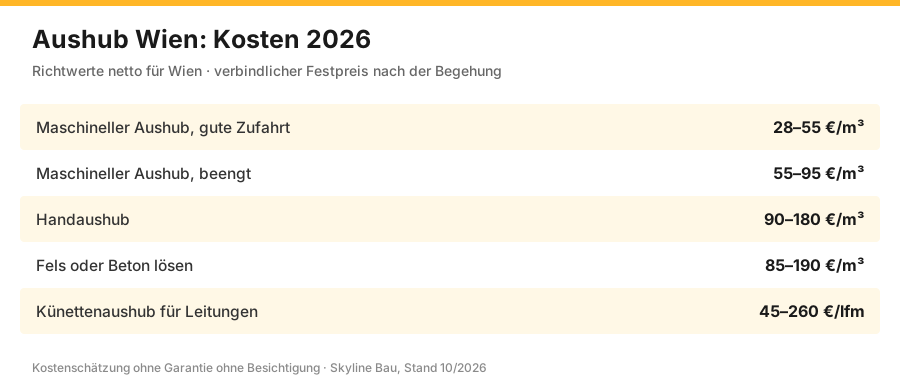
Excavation Vienna: excavation in Vienna costs 28 to 180 euros per cubic metre. By machine with good access €28–55/m³, in a cramped courtyard €55–95/m³, by hand €90–180/m³. Removal and landfill come on top – and often account for more than the digging itself.
What excavation costs in Vienna
Guide values net, as of 2026, binding after a site visit. The price depends on soil class, accessibility and disposal – not on the volume alone.
| Service | Conditions | Net price | Output per day |
|---|---|---|---|
| Machine excavation, good access | excavator, open area | €28–55/m³ | 80–200 m³ |
| Machine excavation, cramped | mini excavator, courtyard | €55–95/m³ | 25–60 m³ |
| Hand excavation | basement, third-party utilities, no access | €90–180/m³ | 3–8 m³ |
| Breaking rock or concrete | hydraulic hammer | €85–190/m³ | 15–40 m³ |
| Trench excavation for utilities | narrow, with shoring | €45–260/lm | depending on depth |
Unit prices and ancillary services
| Item | Unit | Net price | What is included |
|---|---|---|---|
| Soil investigation | lump sum | 1.800–5.000 € | soil class, groundwater, bearing capacity |
| Soil analysis for contaminants | sample | 250–850 € | prerequisite for disposal |
| Site set-up | lump sum | 2.500–12.000 € | access, site fence, cleaning, signage |
| Slope instead of shoring | — | cheapest variant | needs space, sloped from 1.25 m depth |
| Trench shoring, trench box | lin. m | 60–180 € | for trenches from 1.25 m |
| Sheet piling | m² | 180–420 € | installation, removal, in cramped locations |
| Bored pile wall | m² | 380–950 € | with neighbouring buildings directly at the boundary |
| Dewatering | Week | 600–2.200 € | pumps, filter wells, controlled discharge |
| Removal | m³ | 12–35 € | truck, distance to landfill |
| Landfill, uncontaminated spoil | t | 8–22 € | excavated soil class A1 |
| Landfill, contaminated spoil | t | 45–180 € | depending on contaminant class |
| Backfill with excavated material | m³ | 15–38 € | in layers, compacted |
| Backfill with imported material | m³ | 28–65 € | if the spoil is not suitable |
| Condition survey of neighbouring buildings | lump sum | 800–3.500 € | Photos and crack record before work starts |
| Street cleaning | Day | 180–550 € | mandatory when transporting soil over public land |
Total around €42,200 net, which is €132 per cubic metre. Striking: removal and landfill cost more than the digging itself. With contaminated material, this part multiplies – which is why the soil analysis comes at the beginning.
After excavation and formation level, we finish the area on request – paved or as asphalting with frost protection layer, base course and surface course from a single source.
The three figures that determine the price
| Factor | Range | What it means |
|---|---|---|
| Soil class | factor 1 to 4 | sand and gravel are easy to loosen, rock needs the hammer |
| Accessibility | factor 1 to 6 | open access versus courtyard without passageway |
| Contamination | factor 2 to 8 for disposal | €8–22/t uncontaminated versus €45–180/t contaminated |
- Spoil is disposed of by the tonne, not by the cubic metre. One cubic metre of soil weighs 1.6 to 2.0 t. For 320 m³ that is around 576 t – this conversion is missing from many offers and explains later extra charges.
- Loosened material needs more space. Excavated soil has 20 to 35% more volume than in its natural state. Anyone ordering containers based on the pit dimensions orders too few.
- Shoring from 1.25 m. Deeper trenches are sloped or shored – this is occupational safety and not negotiable.
- The soil analysis comes before the excavator. Old fill, former commercial sites and wartime backfill are often contaminated in Vienna. If this is only discovered during removal, the site stands still.
Excavation Vienna from a single source
Excavation in Vienna refers to digging out the soil for a construction project — above all making the building pit into which the basement and the foundation of the building are later placed. Excavation is the starting signal for building construction: this is where a building plot turns into a construction site.
Excavation is often underestimated as simple digging. In fact it is a demanding earthworks service that requires precise planning. A building pit has to be dug to the right size and depth, safely sloped or shored, kept dry if necessary and handed over cleanly to the following trades. Mistakes during excavation can jeopardise the entire construction process.
Skyline Bau carries out excavation as the executing construction company with its own machine fleet. We remove the topsoil, dig the building pit, secure it against slipping, keep it dry if necessary and remove the spoil properly. You have one contract, a binding fixed price to ÖNORM B 2110 and one contact.
Professional excavation begins with topsoil stripping. The top layer of soil — the topsoil — is organic and not load-bearing. It is removed first, about 20 centimetres deep, and stored separately on site, because the humus is valuable and can be reused for later landscaping. Only then does the actual pit excavation begin.
The building pit is always dug larger than the planned building. A working space of about one metre wide is provided around the future building so that the workers can build, waterproof and insulate the basement walls. On top of that comes the slope — the inclined wall of the building pit, whose angle depends on the type of soil.
A central issue is excavation support. A building pit must not slip — neither during the work nor afterwards. Depending on soil type, depth and space, the pit is sloped or, if space is lacking, secured with shoring. The stability of the building pit and the adjoining areas is a task for the executing construction company working with licensed master-builder partner firms.
In addition, dewatering is often needed. If the pit lies in groundwater or surface and perched water enters, the pit has to be kept dry so that work can be done in it. Skyline Bau plans the necessary dewatering as part of the excavation concept.
We know the excavation situation — the dense development with cramped access, the changing ground conditions from load-bearing gravel to settlement-sensitive Tegel clay, the high groundwater level in some locations. Skyline Bau plans excavation realistically and carries it out with its own equipment as a clean, on-schedule part of the construction project — on request from excavation to the finished shell.
Excavation is the moment when plans become visible construction — and at the same time the moment that shows whether the ground lives up to what the planning assumed. An experienced master builder reads the soil, recognises deviations early and reacts before they become a problem for the building above. Skyline Bau brings this experience and ensures that excavation puts the construction project on a reliable footing.
all services
Building pit excavation
Making the building pit for basement and foundation — to the right size and depth.
Basement excavation
Deep excavation for the basement of a building — with excavation support.
Foundation excavation
Excavation of strip and pad foundations for buildings without a basement.
Topsoil stripping
Removing the valuable topsoil and storing it separately.
Utility trenches & ditches
Excavation of utility trenches for connecting the building to services.
Excavation support
Slope or shoring to stabilise the building pit against slipping.
Dewatering
Keeping the building pit dry in case of groundwater, perched water or surface water.
Spoil disposal
Proper removal and disposal of the excavated material after declaration.
Building pit and basement excavation with professional excavation support, dewatering, topsoil stripping and spoil disposal — executing construction company working with licensed master-builder partner firms, own machine fleet, fixed price to ÖNORM B 2110, stability of the building pit ensured, 3-year warranty under § 933 ABGB.
What does excavation in Vienna cost?
The costs of excavation in Vienna depend on the volume, the type of soil, the excavation depth, the accessibility of the site and the disposal effort. Excavation work is usually billed per cubic metre of material moved. After a site visit and based on the excavation volume, Skyline Bau prepares a binding fixed-price offer to ÖNORM B 2110.
As of 2026 · net · guide values · excavation support and dewatering are calculated separately · final price after site visit and excavation volume.
The most important cost factor is the type of soil. Easily loosened soil such as sand or loose gravel is cheap to excavate; firm, cohesive soil, loam or even rock push up the price because the machine effort increases. For this reason, soils are divided into soil classes on which the calculation is based. The excavation depth also plays a role — a deep basement excavation is more complex than a shallow excavation for a ground slab.
A separate, often underestimated item is disposal. The excavated material usually has to be removed and disposed of at a landfill — for a basement pit the quantity is too large to be reused on the plot. Disposal costs depend on the quantity and the nature of the soil; contaminated soil is more expensive to dispose of. Skyline Bau shows disposal transparently.
Aggravating circumstances can drive up the price: difficult access, cramped inner-city locations where smaller equipment has to be used, a high groundwater level that requires dewatering, or complex excavation support. Skyline Bau checks these factors during the site visit and calculates them realistically — so the fixed price is reliable and contains no nasty surprises. Especially in excavation, where the ground is not completely predictable, an experienced, honest calculation is the client's best protection against subsequent cost increases.
what excavation includes
Excavation is more than just digging a hole. It comprises a whole series of partial services which together prepare the site for building construction.
It starts with site setup — laying temporary access roads for construction vehicles and setting up storage and parking areas. Then comes topsoil stripping: the topsoil is removed and stored temporarily. Only then does the actual pit excavation to the planned depth begin.
As mentioned, the building pit is dug larger than the building — with working space and slope. At the same time, the measures for excavation support are implemented and, where necessary, dewatering is set up. The excavated material is stored temporarily or removed directly.
Finally, the excavation bottom is prepared — the fine grading, the clean, level pit bottom brought to the correct height, on which the hardcore layer and the ground slab are then built. Skyline Bau carries out all these partial services as one coherent excavation service and hands over the building pit ready for the next construction step.
That all these partial services are in one hand is not a detail. If they are spread across several providers, gaps threaten: nobody feels responsible for the fine grading, dewatering is forgotten, the working space is too tight. Skyline Bau plans excavation as a closed service package in which none of these tasks falls through the cracks.
Soil classes and their significance
No excavation is like another, because no soil is like another. The type of soil largely determines how complex excavation is — and thus what it costs.
Soils are divided into soil classes that describe the effort required to loosen them. Easily loosened soils such as sand and loose gravel can be excavated quickly with an excavator. Cohesive soils such as loam and clay are tougher and more laborious. Rock, finally, may have to be loosened with special equipment and is the most expensive case. Depending on the location, very different conditions are encountered — from load-bearing gravel to water-sensitive Tegel clay.
The type of soil determines not only the excavation effort, but also the slope angle. Firm soil holds a steep slope, loose, granular soil needs a much flatter one — otherwise the earth slides. A flatter slope angle means more excavation volume and more area, which in turn affects costs.
As an executing construction company working with licensed master-builder partner firms, Skyline Bau assesses the ground conditions — if necessary based on a soil survey — and calculates excavation on this realistic basis. That way there are no nasty surprises when the excavator hits firmer soil than expected. An honest soil assessment at the start is the prerequisite for a reliable fixed price. At the same time it protects against the opposite risk — an excessive lump sum that prices in possible difficulties too generously as a precaution.
Excavation support and slopes
A building pit is an open hole in the ground — and it has to be safe. Excavation support protects the workers in the pit, the adjoining buildings and traffic areas, and the project itself.
The simplest form of support is the slope: the walls of the pit are made inclined so that the soil remains stable by itself. The required slope angle depends on the type of soil — firm soil allows a steep slope, loose soil requires a flat one. The slope is the most economical solution but needs space.
Where there is no space for a slope — which is often the case in dense development — shoring is used. The pit walls are secured by a supporting structure so that they can stand vertically. This is more complex than a slope, but allows excavation even where the plot is tight and directly borders neighbouring buildings.
Skyline Bau plans excavation support to suit the type of soil, the excavation depth and the space available. As an executing construction company working with licensed master-builder partner firms, we bear responsibility for ensuring that the building pit and the adjoining areas remain stable throughout the entire construction phase — a point where no compromises whatsoever are permissible.
Excavation support is also a question of occupational safety: working in an unsecured pit at risk of slipping is dangerous. A professionally secured building pit therefore protects not only the building and the neighbourhood, but above all the people working in it.
Dewatering in the building pit
Water is the natural enemy of every building pit. If water enters the pit, work cannot be done in it, the bottom softens and stability suffers. Dewatering keeps the building pit dry.
Water reaches a building pit in various ways. If the excavation bottom is below the groundwater table, groundwater enters — in some locations, such as near the Danube, the groundwater level is high. Then there is perched water flowing in permeable soil layers and surface water from rain.
Dewatering deals with this water. The simplest form is open dewatering: the seeping water is collected in the pit and pumped out. With a higher groundwater level, groundwater lowering may be necessary, which deliberately lowers the water table in the area of the building pit. Which method fits depends on the soil and water conditions.
Skyline Bau plans dewatering as part of the excavation concept. The high groundwater level in some locations is a known factor that has to be taken into account from the start — because unplanned dewatering is one of the classic sources of unexpected extra costs. Skyline Bau clarifies the water conditions in advance and calculates the necessary measures honestly. This way dewatering is part of the fixed price from the start and not an expensive extra charge that breaks the client's budget in the middle of construction.
Disposal and declaration analysis
Excavation produces a considerable amount of material — for a basement pit quickly several hundred cubic metres. What happens to this material is a separate, cost-relevant part of excavation.
Part of the excavated material can often be reused: the temporarily stored humus is used for later landscaping, suitable material can be used to backfill the working space or to level the ground. The surplus spoil, however — the largest part for a basement pit — has to be removed and disposed of at a landfill.
Disposal is ideally preceded by a declaration analysis. It provides early information on whether the soil contains pollutants, because contaminated soil is considerably more expensive and complicated to dispose of. If the soil quality is clarified in advance, disposal costs can be calculated realistically and delays avoided. For larger excavation quantities, such an analysis is mandatory anyway.
Skyline Bau plans spoil disposal from the outset — including clarifying the soil quality. Where possible, material is reused on the plot to save transport and landfill costs. Disposal is shown transparently in the offer, so that the client knows from the start which item lies ahead.
Clarifying the soil quality early has another advantage: if it only turns out during excavation that the soil is contaminated, this can throw the entire schedule into disarray because disposal then has to be reorganised. Clarifying this in advance avoids this delay — another reason why Skyline Bau puts the declaration at the beginning.
Specifics
- Topsoil stripping first — the valuable topsoil is removed and stored separately.
- Working space & slope — the building pit is dug larger than the building.
- Soil classes — from easily loosened sand to firm Tegel clay and rock, depending on location.
- Excavation support — slope or, if space is lacking, shoring for stability.
- High groundwater level — in some locations dewatering is required.
- Cramped access — dense inner-city locations require smaller equipment and well-thought-out logistics.
- Declaration analysis — the soil quality is clarified in advance; contaminated soil is more expensive to dispose of.
- Fine grading — the pit bottom is brought cleanly to the correct height.
- Condition survey — for deep excavation next to neighbouring buildings, these are documented in advance.
- Interface with the shell — the building pit is handed over ready for hardcore layer and ground slab.
active in all Viennese districts
the process of a building pit excavation
Professional excavation follows a fixed sequence. Anyone who knows the process understands why the order of work is not arbitrary and why preparation decides whether things run smoothly.
Before the first spadeful comes setting out. The position and levels of the building pit are transferred to the plot — based on the planning drawings and the level data. Inaccurate setting out would carry through the entire building, so work here is careful. Position, depth and level reference of the building pit must be exactly right, because all subsequent components build on it.
Then come site setup and topsoil stripping. Access roads are laid, storage and parking areas set up, the topsoil is removed and stored temporarily. Only then does the main excavation to the planned depth begin — usually from top to bottom in layers, with continuous support of the pit walls.
During excavation, excavation support and, where necessary, dewatering are implemented. Finally, the pit bottom is prepared as fine grading — clean, level, at the exact height. The building pit is checked and handed over to the following trades. Skyline Bau coordinates this entire sequence as one continuous project, so that the phases interlock without loss of time.
Excavation in dense development
Excavation on a free, easily accessible plot is a manageable task. Excavation in the densely built-up city of Vienna — between neighbouring buildings, on a busy street — is considerably more demanding.
The most important point is the protection of neighbouring buildings. If excavation goes deep next to an existing building, its stability must not be endangered. This requires carefully planned excavation support — often shoring instead of a space-consuming slope. Before work starts, the neighbouring buildings are documented by a condition survey.
Then there is site logistics. In tight locations, smaller equipment has to be used, the removal of the spoil has to be planned, and placing skips and containers often requires a permit for the use of public space. Pavement and traffic must be safeguarded.
Skyline Bau has experience with excavation in dense locations. We plan the excavation so that the neighbouring buildings are protected, the building pit is safe and the site is cleanly organised. With our own machine fleet, the right machine size can be chosen for every access situation — a major advantage in the dense city. Where a large excavator cannot get in, more compact equipment is used — excavation then becomes more laborious, but remains feasible.
excavation as the first construction phase
Excavation does not stand alone — it is the first step in a long chain of construction services. How well it is carried out affects everything that comes after.
Excavation is followed directly by foundation construction. On the prepared pit bottom, the hardcore layer, the blinding layer and the ground slab or strip foundations are built. If the pit bottom is not made clean and at the exact height, this defect carries over to the foundation — and thus to the whole building.
Closely related is the interface between the trades. Excavation, foundation and shell must be coordinated. If these services are in different hands, friction losses threaten — and in the event of a dispute, the question of who is responsible for a defect. If everything is in one hand, this problem disappears.
Skyline Bau is an executing construction company, works in cooperation with licensed master builders and can take on the entire route — from excavation through the foundation to the finished shell. One contractual partner, continuous responsibility, a seamless transition from one construction phase to the next. Excavation is thus not planned as an isolated service, but as the first, well-coordinated step of an overall project.
Excavation Vienna for clients, developers & businesses
Private clients
Building pit and basement excavation as the first step towards your own home — safely sloped and cleanly handed over.
Developers & investors
Excavation for residential projects including excavation support, dewatering and spoil disposal.
Commercial & industrial
Excavation for commercial buildings and halls — including large volumes with our own machine fleet.
After demolition
Digging out old basements and foundations as part of preparing the site for the new build.
Typical service packages excavation Vienna
- Site visit, measurement and assessment of ground conditions
- Site setup and temporary access roads
- Topsoil stripping and separate temporary storage
- Building pit excavation for basement and foundation
- Excavation of utility trenches
- Excavation support by slope or shoring
- Dewatering in case of groundwater, perched water or surface water
- Declaration analysis of the excavated material
- Removal and proper disposal of the spoil
- Reuse of suitable material on the plot
- Fine grading of the pit bottom
- Handover of the building pit to the following trades
from measurement to handover
Why Skyline Bau for your excavation in Vienna
- Executing construction company — excavation with full technical and structural responsibility.
- Own machine fleet — the right machine size for every access situation.
- Excavation support — slope or shoring, the stability of the pit is ensured.
- Dewatering — the high groundwater level in some locations is planned for from the start.
- Realistic soil assessment — excavation is calculated on the basis of the actual ground conditions.
- Fixed price to ÖNORM B 2110 — binding and in writing, aggravating circumstances calculated in advance.
- Transparent disposal — declaration and disposal costs are shown openly.
- Excavation and shell from a single source — on request from excavation to the finished shell.
- €3 million construction liability insurance.
- Subcontractor for the renovation of the Austrian Parliament 2022 — renovation work at the Parliament building, 1010 Vienna, in 2022.
How to recognise a reputable contractor
Check these six points with every provider of excavation in Vienna — including us. They take ten minutes and in the worst case save you a legal dispute.
1. Ask for the GISA number
Every trade business in Austria has a GISA number. In the public trade register you can see which trades the business has actually registered. Anyone who does not want to give you the number has a reason for it.
2. Who carries out the regulated trades?
Interventions in the building fabric require master-builder services under § 94 no. 5 GewO — planning, structural engineering, submission to MA 37 (Vienna building authority). An executing building contractor may not do this itself. Ask which licensed master builder takes this on.
3. Site visit before the quote
An offer for excavation in Vienna without a site visit is a guess. What lies behind the wall or under the ground only becomes visible when it is opened — and that is exactly where the extra charges arise.
4. A bill of quantities instead of a lump sum
A reputable quote lists items with quantities and unit prices. “Everything as a lump sum” without a breakdown is not a quote but an invitation to extra charges.
5. Ask for proof of construction liability insurance
Ask for the insurer and the sum insured. In an occupied apartment building, damage can quickly reach six figures — and then also affects other people's flats.
6. Do not confuse warranty and guarantee
The statutory warranty for immovable property is 3 years under § 933 ABGB (Austrian Civil Code). Anyone who promises you more must put it in the contract — verbally it is worth nothing.
Excavation methods compared
Classic excavator excavation
Standard. Hydraulic excavator 8–25 t, depending on site size. The most economical method for accessible areas.
Mini excavator for courtyards
1.5–3.5 t micro/mini excavator. Transportable through building passageways. Standard for cramped Gründerzeit courtyards. A specialist area for pool excavation in Vienna.
Suction excavator (flushing)
In sensitive utility areas. High-pressure air loosens the material, a suction hose carries it away. Vibration-free. €80–180/m³.
Berlin shoring / soldier pile wall
For deep building pits with protection of neighbours. Steel beams and timber planks secure the pit wall.
Bored pile wall
Premium civil engineering for very deep building pits (underground car parks 3–5 levels). Very high safety.
Excavation with dumper transport
For large sites with a small courtyard — the dumper transports material over courtyard boundaries.
Authorities and the Vienna Building Code for excavation
- MA 37 — building police: excavation approval as part of the building permit for the structure.
- MA 30 — Wien Kanal: for excavation affecting sewer routes.
- Networks, Wien Energie: utility information before excavation (electricity, gas, water, telecoms).
- RVS 04.02.11 — safety in earthworks.
- ÖNORM B 2206 — earthworks as a contract service.
- BauKG (Construction Work Coordination Act) — safety and health protection plan for larger building pits.
- Waste Management Act — spoil as waste must be reported under the AWG ordinance.
- No-parking application to MA 46: for container placement and truck transport routes.
Why Skyline Bau for your excavation?
First — building pit, support and disposal from one plan – excavation volume, landfill class and transport routes are set before construction starts, not on site.
Second — excavation as part of the overall construction service. While pure earthworks companies only deliver the excavation, Skyline Bau coordinates excavation + foundation + shell + complete construction in one fixed-price contract to ÖNORM B 2110:2023.
Third — courtyard routine. Lifting material over courtyard boundaries, mini excavators for cramped conditions, MA 46 no-parking applications, protection of neighbours under the Vienna Building Code.
Fourth — recycling standard. Separation of spoil by type — Skyline Bau uses a spoil recycling system modelled on the excavation for the underground railway.
Skyline Bau acts as an executing building contractor. Regulated trades — in particular master-builder services (§ 94 no. 5 GewO), planning and structural engineering, electrical engineering (§ 94 no. 16 GewO), gas and sanitary engineering (§ 94 no. 25 GewO) and tiling (§ 94 no. 38 GewO) — are carried out exclusively by suitably authorised subcontractors and partner companies. Construction work is performed by trade businesses within the group of companies that hold a valid trade licence.
what you should know
So that you know exactly what to expect, we answer the most important questions here — honestly and from the practice of a building contractor that does the work itself.
What does excavation include?
Excavation includes digging the building pit or basement, trench support, removal and proper disposal of the material. If required, dewatering (for groundwater) and slope stabilisation are added. Excavation is the first step of almost every construction project.
What happens to the excavated material?
The excavated material is removed and properly disposed of or recycled. Contaminated soil must be treated separately. We take care of proper recycling so that you do not have to worry about anything.
What has to be considered with groundwater or rock?
Both increase the effort: with groundwater, dewatering (pumping out) is needed; with rock, appropriate equipment. These conditions often only become apparent during excavation — a soil report helps to assess them in advance. We calculate transparently.
What does excavation cost in Vienna?
The costs depend on excavation volume, soil type, groundwater, accessibility and disposal. After a site visit you receive a binding fixed-price offer including removal.
Excavation in 1220 Vienna: what makes Donaustadt different
Donaustadt is the district with the most new detached and terraced houses in Vienna. In Essling, Aspern, Breitenlee or Süßenbrunn, houses are often built on former farmland and market gardens, alongside large residential projects. For excavation, this brings three typical conditions.
Thick topsoil layer. On former farmland there is often more topsoil than expected. It is removed separately because it is not suitable as building ground, but is needed again in the garden. Anyone who can store it on the plot saves transport and landfill.
Gravel under the loam. At the edge of the Marchfeld, the cover layer is usually followed by Danube gravel. It is easy to excavate and is often suitable for backfilling the working spaces – provided the soil analysis shows no contamination.
Groundwater. In parts of the 22nd district, especially closer to the Danube and the Old Danube, the groundwater table is comparatively high and fluctuates with the water level. For a basement this means: determine the groundwater level before planning, include dewatering in the calculation and, if necessary, build the basement as a watertight tank. What this means for the foundation is explained on the page on the ground slab.
Then there is logistics: access via narrow residential streets, neighbours on both sides and trenches for sewer and water connections up to the street. Before the first bucket, utility information is therefore obtained so that no electricity, gas or data line in the ground comes as a surprise.
Spoil transport: how cubic metres turn into truckloads
For removal, the truck does not count in cubic metres but in tonnes. Natural soil weighs around 1.6 to 2.0 tonnes per cubic metre, depending on moisture and grain composition. A three-axle tipper may load about 15 tonnes, so it usually only takes seven to nine cubic metres, even though the body would hold more.
An example: a basement with a footprint of 10 × 12 metres and a depth of 3 metres produces around 360 m³ of solid soil, i.e. about 650 tonnes. That is 40 to 50 truckloads. With the net guide values from the price table – removal €12–35/m³, landfill for uncontaminated material €8–22/t – removal alone costs around €9,500 to €27,000. That is why every tonne that stays on the plot, as backfill or landscaping, is worthwhile.
In Vienna, loading zones and street cleaning also determine the process: the truck needs a stopping place directly at the pit, and dirty roads must be cleaned the same day. In narrow lanes, smaller two-axle trucks drive more often, which increases the number of trips but not the tonnes. Anyone who also wants to level the ground will find the follow-up work under grading.
Frequently asked questions about excavation in Vienna
What does excavation cost in Vienna?
What do excavation costs depend on?
What are soil classes?
Why is the building pit dug larger than the house?
What is excavation support?
What is the slope angle?
What is dewatering?
When is dewatering needed?
Is the humus excavated as well?
What happens to the excavated material?
What is a declaration analysis?
What does spoil disposal cost?
How long does excavation take?
What is fine grading?
What are utility trenches?
Does Skyline Bau protect the neighbouring buildings?
Can excavation also be done in tight locations?
What makes excavation more expensive?
Does Skyline Bau also take on the shell?
Excavation: is there a fixed price?
Excavation: what warranty does Skyline Bau give?
Excavation: does Skyline Bau also work outside Vienna?
Is the excavated material reused?
Do I need a permit for containers?
What does excavation cost per cubic metre?
Why is disposal more expensive than digging?
How do I convert cubic metres into tonnes?
What is bulking?
Why do I need a soil analysis?
From what depth is shoring needed?
What does shoring cost?
What happens to the neighbouring buildings?
What has to be done about groundwater?
Can the spoil be reused?
Where is the material stored temporarily?
What does hand excavation cost and when is it needed?
What about utilities in the ground?
Excavation: do I need a permit?
Does the street have to be cleaned?
Can excavation be done in winter?
What about rock or old concrete?
How is invoicing done?
Will I receive disposal certificates?
Do you also do small excavations?
Do you also take care of backfilling and grading?
Excavation: how quickly do I get an offer?
How many truckloads does a basement excavation need?
Should groundwater always be expected in Donaustadt?
Can I keep the humus from the excavation in my own garden?
Related services Skyline Bau
Related services
Excavation finished? The street has to stay clean.
When transporting soil over public land, cleaning the road is mandatory. Bling Premium Cleaning takes care of construction site and surroundings cleaning during and after the work. More at bling-bling.at.
Send enquiry
Enquire directly here — fixed-price quote free of charge. Skyline Bau replies within 2 working days.
Ready for your excavation?
Write to us directly on WhatsApp — send photos and key data of the plot. Reply within two working days.
Note: Skyline Bau is the brand name of the construction and renovation division of Bling Bling GmbH and is not a separate legal entity. The sole contractual partner is Bling Bling GmbH. Bling Bling GmbH is a restricted construction trade business under § 99 GewO (Austrian Trade Regulation Act) and not a licensed master builder (Baumeister). Under § 99 (5) GewO, the title “Baumeister” is reserved for businesses licensed under § 94 no. 5 GewO. Regulated trades — master-builder services, structural engineering, gas and sanitary engineering, electrical engineering — are carried out exclusively by authorised, licensed partner companies.