Energy-efficient renovation Vienna insulate first, then heat.
Energy-efficient renovation in Vienna: from the construction company that does the work — not from a middleman.
Energy-efficient renovation in Vienna: depending on its scope, an energy-efficient renovation of a detached house in Vienna costs between €5,000 and €100,000. Loft floor insulation €25–70/m², façade €120–240/m², heat pump €18,000–32,000. What matters most is the order of the works.
What an energy-efficient renovation costs in Vienna
Guide prices net, as of 2026. The savings refer to the space-heating demand of an unrenovated building built before 1980 and depend heavily on its initial condition.
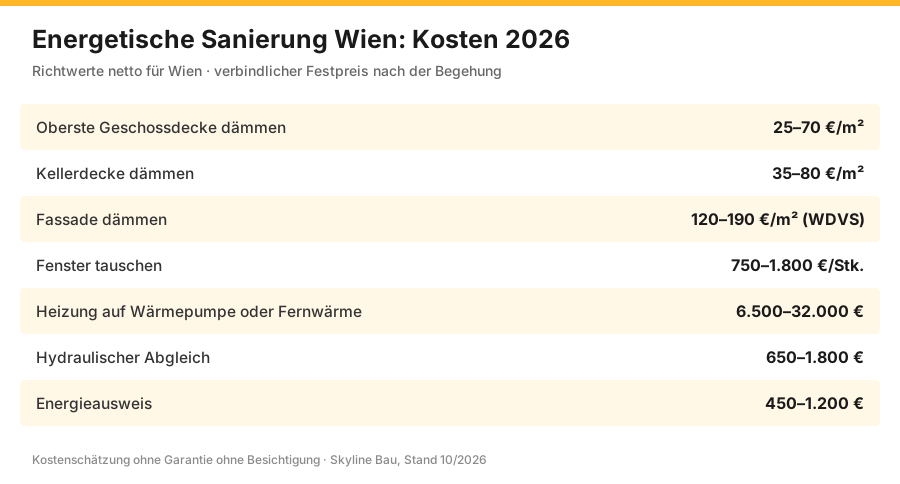
| Measure | Price net | Heating energy saved | Details |
|---|---|---|---|
| Insulating the top-floor ceiling | 25–70 €/m² | 10–20 % | Loft insulation |
| Insulating the basement ceiling | 35–80 €/m² | 5–10 % | Basement ceiling insulation |
| Insulating the façade | €120–190/m² (ETICS) | 20–35 % | Facade insulation |
| Replacing windows | €750–1,800/pc. | 8–15 % | Windows and doors |
| Switching heating to a heat pump or district heating | 6.500–32.000 € | Moving away from fossil fuels | HVAC and plumbing |
| Hydraulic balancing | 650–1.800 € | 5–10 % | often a condition for subsidies |
| Energy performance certificate | 450–1.200 € | — | The basis for every subsidy |
The right sequence
| Step | Why at this point |
|---|---|
| 1 · Energy performance certificate and advice | shows where the losses really are and is a condition for subsidies |
| 2 · Roof or top-floor ceiling | the cheapest measure with a big impact |
| 3 · Windows and façade together | junctions detailed properly, scaffolding needed only once |
| 4 · Basement ceiling | inexpensive, makes ground-floor floors warmer |
| 5 · Heating last | only then is the heating load known and the unit correctly sized |
| 6 · Ventilation concept | a more airtight house needs controlled air exchange |
Total around €98,400 net before subsidies. If the heat pump is installed first, it is sized for the uninsulated building – too large once insulation is in place, so it cycles on and off and wears out faster. The sequence determines twenty years of operation.
Energy-efficient renovation in Vienna from a single source
Energy-efficient renovation in Vienna means modernising a building with the aim of cutting its energy consumption significantly. A poorly insulated old building with high heating demand becomes one that retains heat in winter, stays cool in summer and relieves its occupants of high energy bills for decades to come.
An energy-efficient renovation combines several measures: insulating the façade, the roof and the basement ceiling, replacing the windows and often switching to a modern, climate-friendly heating system. These measures only reach their full effect when they work together — which is precisely why it pays to entrust the energy-efficient renovation to a construction company that does the work itself and coordinates every trade.
Skyline Bau carries out energy-efficient renovations as a hands-on construction company in cooperation with licensed master builder (Baumeister) partner firms. For the owner this means one point of contact, one contract, one fixed price, one schedule for a project that would otherwise be spread across many firms. Instead of hiring an insulation firm, window maker, sheet-metal worker and plumber separately, the owner deals with one company that takes responsibility for the entire energy-efficient renovation.
A central topic in every energy-efficient renovation in Vienna is subsidies. The City of Vienna and the federal government support energy-saving renovation measures with substantial grants — and anyone who takes them into account from the outset lowers the effective cost considerably. Skyline Bau knows the subsidy landscape and builds it into the planning of the renovation.
We carry out energy-efficient renovations for owners, property managers and investors in Vienna — from detached houses and Viennese period apartment buildings (Zinshäuser) to large residential complexes. Skyline Bau plans every trade, coordinates the works and hands over an energy-efficient building — at a binding fixed price under ÖNORM B 2110.
An energy-efficient renovation is more than a series of individual measures. It is a strategic investment in the value and future viability of a building — and it needs to be planned as a whole project. Skyline Bau accompanies the owner from the first survey of the existing building, through the renovation concept and subsidies, to the finished, renovated property. In this way, many individual measures become one managed, predictable overall project.
all services
Facade insulation
External thermal insulation composite system (ETICS) for the biggest saving on the building.
Roof insulation
Insulating the roof and top-floor ceiling against heat loss.
Basement ceiling insulation
Insulating the basement ceiling to prevent cold ground-floor floors.
Window replacement
New high-efficiency windows with low-emissivity insulating glazing.
Heating replacement
Switching from oil and gas to a heat pump, biomass or district heating.
Renovation concept
Survey of the existing building and a coordinated plan for all measures.
Subsidy handling
THEWOSAN and federal subsidies built into the planning.
Construction
All trades from a single source, one fixed price under ÖNORM.
Energy-efficient renovation for period apartment buildings and residential buildings — from façade insulation, roof insulation and window replacement to heating replacement, with a renovation concept and subsidy handling — a hands-on construction company that works with licensed master builder partner firms, one fixed price under ÖNORM B 2110, one point of contact, a 3-year statutory warranty under § 933 ABGB (Austrian Civil Code).
What does an energy-efficient renovation in Vienna cost?
The cost of an energy-efficient renovation in Vienna depends on the scope of the measures, the condition of the building and the energy standard you want to reach. A second factor, however, is decisive for the effective cost: subsidies. In an energy-efficient renovation, the city and the federal government cover a considerable share of the construction costs.
As of 2026 · guide figures · regional and federal subsidies can often be combined · amount depends on the measure, the building and the eligible construction costs · details in the initial consultation.
The scope of the renovation has the biggest influence on cost. A single measure — such as replacing the windows only — costs far less than a comprehensive renovation that renews the façade, roof, basement, windows and heating in one go. The comprehensive renovation is more expensive, but usually more economical per kilowatt-hour saved, because the trades complement one another.
A second factor is the condition of the building. The state of the structure, any existing insulation, the age of the windows and heating, and how accessible the building elements are all determine the effort involved. A Gründerzeit apartment building (built 1848–1918) calls for different solutions from a detached house from the 1980s.
The third factor — and often the decisive one for the effective cost — is subsidies. For thermal and energy-efficient renovation, usually 30 to 35 per cent of the eligible construction costs are subsidised; for window replacement up to 35 per cent and a maximum of €15,000 is possible; heating replacement is supported by a federal subsidy of up to €8,500, which can be combined with regional subsidies.
Skyline Bau inspects the building, plans every trade, factors in the subsidies and quotes a binding fixed price under ÖNORM B 2110 — complete, with no surprises later on. That way the owner knows before work starts what the energy-efficient renovation will actually cost after subsidies.
what an energy-efficient renovation is
The term energy-efficient renovation is used often, and sometimes loosely. It is worth defining it clearly.
An energy-efficient renovation is the modernisation of an existing building with the aim of reducing its energy consumption. The focus is on the building envelope — façade, roof, basement, windows — and on the building services, above all the heating. An energy-efficient renovation measurably improves the building's space-heating demand, which is why it is often also called a thermal renovation (thermische Sanierung) or thermal and energy-efficient renovation. In every case the same goal is meant: a building that uses less energy.
It is important to distinguish it from general renovation. A renovation can also cover purely cosmetic or functional updates — new floors, fresh surfaces, a modern bathroom. An energy-efficient renovation, by contrast, specifically targets energy consumption: every measure — insulation, windows, heating — is meant to lower heat demand and cut energy costs.
It should also be distinguished from a complete refurbishment (Generalsanierung): this renews a building comprehensively, often including energy-saving measures, but goes further and also affects floor plans, pipework and fittings. An energy-efficient renovation is frequently a core part of a complete refurbishment — but it can also be carried out on its own. Skyline Bau delivers both and advises which suits the building and the budget. The sensible scope follows from the condition of the building and the owner's goals.
the key measures
An energy-efficient renovation is made up of several measures. Each one lowers energy consumption on its own; together they transform a building.
Façade insulation usually delivers the largest saving. In uninsulated buildings, a considerable share of the heat escapes through the external walls. An external thermal insulation composite system on the façade reduces this loss significantly. It is complemented by roof insulation or insulation of the top-floor ceiling — because warm air rises and escapes through an uninsulated roof.
Basement ceiling insulation seals the building off from below and keeps ground-floor floors warm. Window replacement swaps old, leaky windows for high-efficiency windows with low-emissivity insulating glazing — they keep the heat in the room and eliminate cold draughts. Old windows are often one of the weakest points of the building envelope.
The second major pillar is heating replacement: switching from fossil fuels — oil and gas — to climate-friendly systems such as a heat pump, biomass or district heating. Only a well-insulated envelope makes a modern heating system truly efficient, which is why insulation and heating replacement belong together. Planning them separately gives away part of the savings potential. Skyline Bau plans all these measures as a complete package and carries them out as a hands-on construction company at a fixed price.
Subsidies 2026
Hardly any area of construction is subsidised as heavily as energy-efficient renovation. The City of Vienna and the federal government support owners with substantial grants — and anyone who knows them and combines them correctly noticeably reduces the effective cost of the renovation.
The main subsidy scheme for thermal renovation is THEWOSAN — Vienna's programme for thermal and energy-efficient renovation of residential buildings. THEWOSAN supports thermal renovation measures on residential buildings, such as façade insulation and roof insulation. As a rule, 30 to 35 per cent of the eligible construction costs are subsidised — a substantial contribution to a comprehensive envelope renovation.
For heating replacement, federal and city subsidies work hand in hand. Switching from fossil fuels to a heat pump, biomass or district heating is heavily supported under the federal initiative „Raus aus Öl und Gas“ (Get out of oil and gas) — with federal grants of up to €8,500 that can be combined with regional subsidies. Window replacement is subsidised too: installing new, high-efficiency windows is eligible for up to 35 per cent and a maximum of €15,000 — and is open to both owners and tenants.
The subsidy landscape is specific: it involves income limits, minimum standards for space-heating demand and different requirements for each measure. Which subsidy applies in a given case, and how much it is worth, depends on the building, the measure and the eligible construction costs. Skyline Bau knows these schemes and builds them into the planning of the energy-efficient renovation from the start — so that the project becomes financially predictable for the owner. Clarifying subsidies early is therefore part of any serious renovation planning.
Advice and points of contact
Because the subsidy landscape is so specific, expert advice is recommended before any energy-efficient renovation. Vienna has several free advice centres for this — and it pays to know them.
The city's central advice centre is the Hauskunft, the free advice service of the Vienna Housing Fund (wohnfonds_wien). The Hauskunft offers guidance on the first steps of a renovation, helps develop a concept and assists with submitting subsidy applications. Anyone planning an energy-efficient renovation will find a neutral first point of contact here.
For federal subsidies, the Umweltförderung (environmental subsidies) platform is the right place to go. It provides general information, details of the federal subsidies — for example the renovation cheque (Sanierungsscheck) and heating replacement — and the option to register. A third point of contact is Wohnservice Wien, which provides information on subsidy programmes that focus particularly on gentle urban renewal (sanfte Stadterneuerung).
Skyline Bau does not replace these advice centres — it works hand in hand with them. As a hands-on construction company, it knows the subsidy schemes, prepares the documents required for the application and plans the renovation from the outset so that it meets the subsidy criteria. The owner therefore gets both: the neutral guidance of the city's services and a construction partner who puts the subsidy into practice. Advice and execution mesh cleanly.
„Raus aus Öl und Gas“
A key element of many energy-efficient renovations is switching to a climate-friendly heating system. The federal initiative „Raus aus Öl und Gas“ (Get out of oil and gas) has given this step a name — and generous funding.
At its heart is heating replacement: an old oil or gas boiler is replaced by a system that works without fossil fuels. The main options are the heat pump, which draws heat from the surroundings, the biomass boiler, which burns wood or pellets, and connection to district heating where it is available. Which system fits depends on the building, its location and the heat demand after insulation. Skyline Bau assesses the options and recommends the most economical system for the building.
The sequence is important. A heating replacement only reaches its full effect once the building envelope is well insulated. A modern heat pump works inefficiently in a poorly insulated house. That is why insulation and heating replacement must be thought through together in an energy-efficient renovation — the insulation reduces the heat demand, and the new heating covers the remaining demand efficiently.
Skyline Bau plans the heating replacement as part of the overall energy-efficient renovation. The company matches insulation and heating to each other, coordinates the installation trades and factors in federal and city subsidies. This way, switching to a climate-friendly heating system is not an isolated intervention but a well-considered step within a coherent overall concept.
in the Viennese period apartment building
A large share of energy-efficient renovations in Vienna concerns period apartment buildings (Zinshäuser). These Gründerzeit residential buildings shape the city — and they hold considerable energy-saving potential.
The Zinshaus brings special conditions to an energy-efficient renovation. Many of these buildings have thick but uninsulated brick walls, old box-type double windows (Kastenfenster) and outdated heating systems. The savings potential is large — but the historic fabric calls for expert solutions that suit the building.
A particular feature is the protection zones (Schutzzonen) and listed-building protection. On many period buildings, the street façade may not be insulated externally in order to preserve the townscape. Alternative solutions are needed here — such as internal insulation of the walls concerned, or concentrating the envelope renovation on the courtyard façade, roof and basement ceiling. Replacing the characteristic box-type windows also needs to be planned with expertise.
Skyline Bau specialises in the energy-efficient renovation of period apartment buildings. The company knows the fabric of Gründerzeit buildings, the official requirements in protection zones and the correct building-physics solutions for historic walls. The result is an energy-efficient renovation that unlocks the savings potential without damaging the character of the house. With a Zinshaus in particular, experience with Gründerzeit fabric pays off.
Specifics
- Subsidies of up to 35% — the city and federal government cover a considerable share of the construction costs.
- THEWOSAN — the subsidy scheme for the thermal renovation of residential buildings.
- Raus aus Öl und Gas — federal subsidy of up to €8,500 for replacing the heating.
- Window replacement — up to 35% and max. €15,000, tenants included.
- Viennese Zinshaus — great savings potential in historic fabric.
- Protection zones — protected façades call for alternative insulation solutions.
- Hauskunft — free advice centre of the wohnfonds_wien.
- Hands-on construction company — all trades from a single source, one fixed price.
- Insulation & heating together — first the envelope, then the new heating.
- Fixed price under ÖNORM B 2110 — all trades fully costed, without variations.
active in all Viennese districts
Subsidies: what you need to check yourself
Several subsidy schemes can apply to an energy-efficient renovation in Vienna — THEWOSAN for the thermal renovation of residential buildings, the federal renovation bonus (Sanierungsbonus) and, for heating replacement, also „Raus aus Gas“. We deliberately do not quote specific amounts here. Subsidy levels, requirements and application deadlines change constantly, sometimes several times a year. A commitment that is correct today may be wrong next month.
- Apply before work begins. This is the most common mistake. Anyone who starts the energy-efficient renovation and only then submits the subsidy application will, as a rule, receive nothing. The order is not negotiable.
- Check at the source. Current subsidy amounts for Vienna can be found with the City of Vienna and the Vienna Housing Fund (wohnfonds_wien); for federal subsidies, with the renovation campaign (Sanierungsoffensive). The free advice service Hauskunft is the usual first step.
- Insulation thickness is decisive. Subsidies are usually tied to minimum insulation thicknesses and achieved energy ratings. We plan the energy-efficient renovation so that the requirements are met — but the approval is granted by the subsidy body, not by us.
- Your own labour is rarely recognised. Anyone who works on the project themselves often loses their entitlement. It is better to clarify this beforehand too.
We support you with the paperwork and plan so that the work qualifies for subsidies. What we do not do: promise you a subsidy amount that is not ours to decide.
the individual building elements
An energy-efficient renovation is made up of individual measures. The site inspection shows which make sense for your building:
The largest building element and usually the biggest lever — but also the most expensive.
The best cost-benefit ratio. Almost always the first step.
Against cold floors on the ground floor.
Old windows are often the weakest point — and a prerequisite for many subsidies.
An overview of all insulation measures.
The overview of all renovation services.
Energy-efficient renovation — in all 23 districts and the surrounding area
We carry out energy-efficient renovations throughout Vienna, as well as in Klosterneuburg and the surrounding area of Lower Austria.
Process and construction time
An energy-efficient renovation is a multi-layered project — and that is exactly why it follows a clearly structured process.
It starts with a survey and renovation concept: Skyline Bau assesses the energy condition of the building, identifies the most effective measures and puts together a coordinated concept. At the same time, the subsidies are clarified — which schemes apply and which documents the application requires. On this basis, the binding fixed-price offer under ÖNORM B 2110 is prepared.
The works follow a logical sequence: usually the building envelope first — façade insulation, roof insulation, basement ceiling insulation and window replacement — and then the heating replacement, which is designed for the now reduced heat demand. The project ends with the handover of the energy-efficient building. The construction period depends on the scope and is stated bindingly in the fixed-price offer. This way the owner knows from the outset when the renovated building will be fully usable again.
why the renovation pays off
An energy-efficient renovation is an investment — and one that pays off on several levels. The return ranges from lower energy costs and greater living comfort to an increase in the property's value.
The most direct gain is lower energy costs. A well-insulated building with airtight windows and efficient heating uses considerably less energy. This saving takes effect year after year — and makes the building less dependent on fluctuating energy prices.
The second gain is living comfort. A renovated building envelope means warm walls instead of cold draughts, even temperatures and pleasantly cool rooms in summer. Energy-efficient renovation is not only a question of cost but also of quality of living.
The third gain is an increase in value. An energy-efficient building has a better energy performance certificate and lower running costs, making it considerably more attractive on the market — whether for sale or for letting. On top of that come the subsidies, which cover a considerable share of the construction costs. Skyline Bau carries out the energy-efficient renovation so that this multiple gain — savings, comfort and value — lasts. A soundly executed energy-efficient renovation is an investment that holds for decades.
Energy-efficient renovation in Vienna for owners, property managers & investors
Homeowners
Energy-efficient renovation of your own home — lower costs, more comfort.
Tenement building owners
Envelope renovation and heating replacement in Viennese period buildings, with protection zones respected.
Property manager
Energy-efficient renovation of managed properties — one point of contact, one fixed price.
Investors
Higher value through a better energy performance certificate and lower running costs.
Typical service packages: energy-efficient renovation in Vienna
- Survey of the building's energy condition
- Renovation concept with the most effective measures
- Clarification of the THEWOSAN, heating replacement and window replacement subsidy schemes
- Preparation of the documents required for the subsidy application
- Binding fixed-price quotation under ÖNORM B 2110
- Façade insulation with an external thermal insulation composite system
- Roof insulation and insulation of the top-floor ceiling
- Basement ceiling insulation against downward heat loss
- Replacement of windows with low-emissivity insulating glazing
- Heating replacement with a heat pump, biomass or district heating
- Coordination of all trades from a single source
- Handover of the energy-efficient building at a fixed price
from survey to handover
why the choice of construction company is decisive
An energy-efficient renovation stands or falls with the quality of the work. And that quality depends on whom the owner entrusts with the project.
An energy-efficient renovation brings together a large number of trades — insulation, sheet-metal work, window fitting, plumbing and heating, electrics, painting. They are interdependent: poorly executed insulation undermines the effect of new windows, and a wrongly sized heating system wastes the savings potential of the insulated envelope. If the trades are contracted individually, there is no one to coordinate them.
Then there are the subsidies. The schemes have specific requirements — minimum standards for space-heating demand, income limits, defined eligible construction costs. Mistakes here mean losing the subsidy. An experienced construction company plans the renovation to comply with the subsidy rules from the very beginning.
Skyline Bau combines both: the professional coordination of all trades and subsidy-compliant planning of the renovation. One company draws up the concept, clarifies the subsidies, schedules the trades and is ultimately accountable for the overall energy result. The owner has one contract, one fixed price, one point of contact — and a hands-on construction company, working with licensed master builder partner firms, that takes responsibility for the entire energy-efficient renovation. This continuous responsibility is the core of our model as a construction company that does the work itself.
Why Skyline Bau for your energy-efficient renovation in Vienna
- Hands-on construction company — the renovation is planned and carried out with expertise.
- All trades from a single source — insulation, windows, heating, matched to one another.
- A construction company that does the work itself — one contract, one fixed price, one contact person.
- Subsidies factored in — THEWOSAN and federal subsidies included from the start.
- Subsidy-compliant planning — the renovation meets the subsidy criteria.
- Zinshaus experience — specialised in renovating Gründerzeit buildings.
- Fixed price under ÖNORM B 2110 — all trades fully costed, without variations.
- Overall concept — envelope and heating planned as a coherent whole.
- €3 million construction liability insurance.
- Subcontractor on the Parliament renovation 2022 — renovation work on the Parliament building, 1010 Vienna, in 2022.
Avoiding overlap: energy-efficient vs. thermal renovation
In the renovation market, „energetische“ (energy-efficient) and „thermische“ (thermal) renovation are often used synonymously, but they have different emphases:
- Thermal renovation in Vienna focuses on the thermal insulation of the building envelope (façade, roof, basement, windows). Reducing U-values is the core objective.
- Energy-efficient renovation in Vienna covers complete energy optimisation — including heating and ventilation systems, the hot water system, photovoltaics and charging infrastructure. The energy balance and CO₂ reduction are the core objectives.
- Both terms are searched for heavily. Skyline Bau offers both depths of renovation.
The most important components
Thermal insulation of the building envelope
ETICS façade, loft, basement ceiling, window replacement. Reduces space-heating demand by 50–70%.
Switching heating to renewable energy
Heat pump (air-to-water or brine-to-water), district heating, pellets, solar thermal. „Raus aus Gas“ as the premium subsidy.
Mechanical ventilation with heat recovery (KWL)
Essential in fully insulated houses. Heat recovery of 80–90%. Improves indoor quality and protection against mould.
Photovoltaic system
Standard in energy-efficient renovation in 2026. 5–15 kWp is typical for a detached house. Subsidies from the province and the federal government.
Power storage / battery
10–20 kWh lithium iron phosphate storage. Raises the self-consumption share from 30% to 65–80%.
Charging infrastructure for electric vehicles
11 or 22 kW wallbox with subsidy. A future-proof addition to an energy-efficient renovation.
Low-temperature radiators / underfloor heating
A prerequisite for an efficient heat pump — flow temperature ≤ 40 °C.
Smart home energy management
Premium solution: heat pump control, optimisation of PV self-consumption, e-car charging control.
How to recognise a reputable provider
An energy-efficient renovation in Vienna is a major undertaking. Check these points with every provider — including us.
1. Energy advice before the offer
An energy-efficient renovation without prior advice is guesswork. The City of Vienna offers free orientation advice through the Hauskunft — use it before you sign anything anywhere.
2. Is the sequence right?
First the building envelope, then the heating. Anyone who installs the heat pump before insulating sizes it too large and pays twice.
3. Application before work begins
Subsidies are almost always granted only before work starts. Build first and you lose your entitlement. This is the most common and most expensive mistake.
4. Who provides the master builder services?
Interventions in the building structure involve services under § 94 Z 5 GewO (Austrian Trade Regulation Act). A construction company without a master builder licence may not provide these itself — ask which licensed master builder (Baumeister) takes them on.
5. Have the regulated trades been clarified?
Heating, electrical and plumbing work are regulated trades (§ 94 Z 16, 25, 31 GewO). Ask to be told which authorised firm carries them out.
6. Do not confuse the warranty
A statutory 3 years under § 933 ABGB on the construction work. Manufacturers' guarantees on appliances are something else.
Subsidy landscape 2026
- Federal renovation bonus: up to €9,000 for individual thermal measures.
- THEWOSAN City of Vienna: 30–35% for the thermal renovation of residential buildings.
- Raus aus Gas Wien: up to €5,250 per flat when switching heating.
- Federal boiler replacement: up to €17,500.
- Federal renovation offensive: up to €14,000 for comprehensive works.
- OeKB climate loan: favourable financing for the renovation.
- Photovoltaic subsidy: EAG market premium, special subsidy €250–450/kWp.
- Federal wallbox subsidy: bonus of up to €600 for e-mobility charging infrastructure.
- Total subsidy: up to €22,000 per flat when fully combined.
Costs 2026
- Individual thermal measure: €5,000–55,000 depending on the building element.
- Switching to an air-source heat pump: €15,000–25,000.
- Switching to a ground-source (brine) heat pump: €25,000–40,000.
- District heating connection: €8,000–25,000.
- Central ventilation system with heat recovery: €12,000–25,000 for a detached house.
- Photovoltaics 10 kWp: €14,000–22,000.
- Power storage 15 kWh: €8,000–14,000.
- Wallbox 11 kW: €800–1,800 incl. installation.
- Complete energy-efficient renovation of a detached house: €110,000–180,000 gross, with subsidies €65,000–110,000 net.
- Building physics example : €90,000 gross, €36,000 subsidy, €54,000 net.
Why Skyline Bau for your energy-efficient renovation?
First — on three thermal sub-topics. For „Fassadendämmung Wien“ (façade insulation), „Dachbodendämmung Wien“ (loft insulation) and „Kellerdeckendämmung Wien“ (basement ceiling insulation), Google cites Skyline Bau directly by name.
Second — a complete package from a single source. While competitors usually supply only one component, Skyline Bau coordinates thermal insulation + heating + ventilation with heat recovery + PV + storage + wallbox as a hands-on construction company.
Third — the subsidy landscape fully used. Up to €22,000 per flat when combined.
Fourth — the energy performance certificate as the first step. Before every energy-efficient renovation, an OIB-compliant energy performance certificate as the basis for the subsidy application.
Skyline Bau acts as a construction company carrying out building work. Regulated trades — in particular master builder services (§ 94 no. 5 GewO), design and structural engineering services, electrical engineering (§ 94 no. 16 GewO), gas and plumbing (§ 94 no. 25 GewO) and tiling work (§ 94 no. 38 GewO) — are carried out exclusively by appropriately authorised subcontractors and partner firms. Construction work is carried out by tradespeople within the group of companies holding a valid licence.
what you should know
So that you know exactly what to expect, we answer the most important questions here — honestly and from the practice of a construction company that carries out the work itself.
What is an energy-efficient renovation?
An energy-efficient renovation — also called a thermal renovation — improves a building's energy efficiency: façade and roof insulation, new windows, modern heating. The aim is lower energy consumption, lower heating bills and greater living comfort. It is often eligible for subsidies.
Which measures does it include?
The most important are: insulating the façade (ETICS), insulating the roof and top-floor ceiling, insulating the basement ceiling, replacing old windows and modernising the heating. Which measures have the greatest effect depends on the building — a package of measures is often the most economical.
Which subsidies are available for energy-efficient renovation?
In Vienna there is THEWOSAN for thermal measures and „Raus aus Gas“ for heating replacement. As of 2026, the nationwide renovation bonus is on hold. We clarify which funding pots can be combined before work starts — what matters is applying before the contract is awarded.
Does energy-efficient renovation pay off financially?
In the long term, usually yes: lower heating bills and subsidies offset the investment over the years, and the property's value rises as well. It is most economical to combine energy-saving measures with renovations that are due anyway.
Cutting heating costs by sealing windows: what works for Viennese box-type windows
Many Gründerzeit apartments (buildings from 1848–1918) still have timber box-type windows (Kastenfenster) – two pairs of casements with an air space in between. Their thermal performance is better than their reputation, as long as they are airtight. Over the years they start to leak at the rebates, at the frame and where the frame meets the wall. This is where sealing comes in: a seal is routed into the inner casement, warped casements are realigned, and the joint between frame and masonry is closed anew. The outer casement is deliberately left a little less tight so that moisture can escape from the gap between the panes and the glass does not mist up.
How much this saves on heating depends on how leaky the windows were beforehand – with badly draughty windows the difference is clearly noticeable, with windows that already close well it is small. There is one side effect you need to know about: once the apartment is more airtight, the unnoticed air exchange disappears. From then on, regular short bursts of full ventilation are a must; otherwise humidity rises and mould can form in cold corners. Whether sealing is enough or replacement makes more sense depends on the condition of the timber and the glass; more on this under windows and doors.
Thermal bridges: why some corners become more critical after insulation
A thermal bridge is a spot where heat escapes to the outside faster than through the rest of the surface – for example a cantilevered balcony slab, a concrete window lintel or the junction between the basement ceiling and the external wall. Before renovation it hardly stands out, because the whole wall is cold. After insulation the surface becomes warmer, but the uninsulated spot stays cold. There, the room air cools down and moisture condenses.
That is why the details are planned as part of the job: window reveals are insulated too, roller shutter boxes are replaced or filled with insulation, and balcony slabs are wrapped or thermally separated. Particular care is needed in old buildings with internal insulation, because interior walls and ceiling beams that tie into the external wall interrupt the insulation layer. A building physicist can verify the critical points by calculation, and a thermographic survey in winter shows after the renovation whether the workmanship delivers what the planning promised.
Thermal renovation in Vienna in stages: keeping the sequence right
Not everyone can renew the building envelope and the heating in a single year. In condominium owners' associations (WEG) it often fails on the reserve fund alone, in detached houses on the budget. Renovating in stages is possible, provided each stage does not get in the way of the next. In practice this means: new windows are fitted so that a later facade insulation can connect cleanly – the window frame then sits further out or is given a connection strip. A new heating system is only sized once it is clear what heat demand remains after insulation; otherwise an oversized system runs inefficiently for years.
A written renovation roadmap records what follows in which year and which subsidy is to be applied for at each step. For owners' associations it is also the basis for the resolution at the owners' meeting. With individual measures such as basement ceiling insulation, you can make a start without scaffolding and with little effort.
Frequently asked questions about energy-efficient renovation in Vienna
What does an energy-efficient renovation cost in Vienna?
What is the difference between energy-efficient and thermal renovation?
In practice, both terms mean the same thing: measures that reduce a building's energy consumption — insulating the façade, roof and basement ceiling, replacing windows and installing efficient heating systems. „Thermische Sanierung Wien“ (thermal renovation) emphasises the thermal insulation of the building envelope (for example via the THEWOSAN subsidy), while „energetische Sanierung“ (energy-efficient renovation) covers all energy-saving measures. We deliver both and check in the free initial consultation which subsidies can be combined for your property.
Is it worth sealing old box-type windows instead of replacing them?
Why does mould sometimes appear in corners after insulation?
Can I replace the windows first and insulate the facade later?
What is an energy-efficient renovation?
How much subsidy is available for energy-efficient renovation in Vienna?
What is THEWOSAN?
How much subsidy is there for replacing the heating?
Is window replacement subsidised?
What does „Raus aus Öl und Gas“ mean?
Which measures are part of an energy-efficient renovation?
What delivers the biggest energy saving?
Where can I get subsidy advice?
What is the Hauskunft?
Why do insulation and heating replacement belong together?
What is the difference between an energy-efficient renovation and a complete refurbishment?
Is an energy-efficient renovation worth it?
Can a single trade be renovated on its own?
Is a period apartment building suitable for energy-efficient renovation?
What applies in protection zones?
Does Skyline Bau handle the subsidy process?
How long does an energy-efficient renovation take?
Energy-efficient renovation: is there a fixed price?
Which heating systems are options for a replacement?
Energy-efficient renovation: does Skyline Bau also work outside Vienna?
Energy-efficient renovation: how do I get an offer?
In what order should I carry out an energy-efficient renovation?
Why the heating last?
Which measure delivers the most per euro?
Why windows and façade together?
What is an energy performance certificate?
Which subsidies are available in Vienna?
Does an energy-efficient renovation pay for itself?
Do I need a ventilation system after the renovation?
What is hydraulic balancing?
Can I carry out an energy-efficient renovation in an old building?
What about internal insulation?
How long does a full renovation take?
Can I renovate step by step?
Related services Skyline Bau
Related services
Energy-efficient renovation done? The windows and surroundings need cleaning.
After insulation and window work, the glass, frames and surroundings are left dirty. Bling Premium Reinigung takes care of window cleaning and post-construction cleaning. More at bling-bling.at.
Send enquiry
Enquire directly here — a free fixed-price offer for your energy-efficient renovation, after a site inspection. Skyline Bau replies within 2 working days.
Planning an energy-efficient renovation?
Write to us directly on WhatsApp — send us the property, year of construction and planned measures. Reply within two working days.
Note: Skyline Bau is the brand name of the construction and renovation division of Bling Bling GmbH and not a separate legal entity. The sole contractual partner is Bling Bling GmbH. Bling Bling GmbH is a restricted building trade business under § 99 GewO (Austrian Trade Regulation Act) and not a licensed master builder (konzessionierter Baumeister). Under § 99 (5) GewO, the title „Baumeister“ (master builder) is reserved for businesses licensed under § 94 no. 5 GewO. Regulated trades — master builder services, structural engineering, gas and plumbing, electrical engineering — are carried out exclusively by authorised, licensed partner firms.