Flat refurbishment Vienna every empty day costs rent.
Flat refurbishment Vienna: from the contractor who does the work — not from a broker.
Flat refurbishment Vienna: refurbishing a flat after a change of tenant costs €60 to €350 per square metre in Vienna. What matters is not the price per square metre but time: every month a 60 m² flat in Vienna stands empty costs around €900 to €1,300 in rent – usually more than the repainting.
Why time costs more than materials
In a refurbishment, two blocks of cost are set against each other: the construction work and the lost rent. The second is regularly underestimated because it does not appear on any invoice.
| Flat size | Typical monthly rent, gross | Cost per week empty | Construction work, Standard package |
|---|---|---|---|
| 45 m² period building | 700–950 € | approx. €175–240 | 5.000–9.900 € |
| 62 m² period building | 900–1.300 € | approx. €225–325 | 6.800–13.600 € |
| 85 m² new build | 1.200–1.700 € | approx. €300–425 | 9.400–18.700 € |
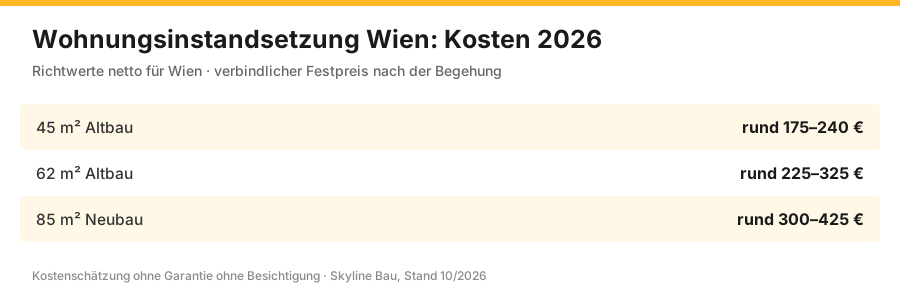
This gives a clear priority: a sequence that saves two weeks is worth around €500 for a 62 m² flat – and those two weeks almost always arise from waiting times between trades, not from the work itself. The painter waits for the floor layer, the floor layer for the electrician, the electrician for an appointment. That is why coordination is the real service.
If the flat is still full, the work begins with clearing it: house clearance Vienna – on request commissioned together with the refurbishment.
The three packages – and what sets them apart
To keep invoicing transparent for property managers, we work with three packages. They do not differ in quality, but in scope.
| Package | Scope | When it fits | Price net | Duration |
|---|---|---|---|---|
| Refresh | Repainting, silicone joints, minor repairs, final clean | short tenancy, flat returned well kept | 60–110 €/m² | 3–6 working days |
| Standard | plus sanding or new floors, doors, fittings, sockets | tenancy of 5–15 years, normal wear and tear | 110–220 €/m² | 6–12 working days |
| Upgrade | plus new bathroom or kitchen, electrics as per inspection | long tenancy, fittings outdated | 220–350 €/m² | 10–20 working days |
| Category upgrade | Bathroom, heating, electrics for a higher fittings category | strategic decision by the owner | after site visit | 3–6 weeks |
Why this tiering? Because the decision almost always comes down to the same point: is sanding enough or does the floor have to come out, and is the bathroom still lettable. Everything else is similar in every package. Anyone who already knows the flat before it is returned can make the decision at the handover itself – which saves further days.
Unit prices: what the items cost
| Item | Unit | Price net | What is included |
|---|---|---|---|
| Painting walls and ceiling | m² wall area | 8–14 € | Covering, filling small holes, two coats |
| Sealing nicotine or water stains | m² | 6–12 € | Stain-blocking primer, otherwise the stain bleeds through |
| Repairing cracks | linear m | 12–28 € | opening, reinforcing, filling |
| Sanding and sealing parquet | m² | 28–45 € | three sanding passes, two coats of lacquer |
| Repairing parquet | pc. | 35–90 € | replacing individual strips |
| New vinyl or laminate floor | m² | 45–80 € | Material, laying, skirting boards |
| Renewing silicone joints | linear m | 8–15 € | removing the old joint, cleaning, re-applying |
| Painting an interior door | pc. | 180–320 € | sanding, priming, lacquering |
| Replacing an interior door | pc. | 420–650 € | Door leaf, fittings, installation |
| Replacing switches and sockets | pc. | 25–45 € | by a licensed electrical contractor |
| Electrical inspection report | lump sum | 250–550 € | Inspection of the installation, report |
| Replacing the lock cylinder | pc. | 90–220 € | so that no old keys remain in circulation |
| Replacing a WC or washbasin | pc. | 450–900 € | Removal, installation, connection |
| Final clean | m² | 3–6 € | Windows, bathroom, kitchen, floors, ready for viewings |
| Clearing items left behind | lump sum | 250–1.500 € | Removal, disposal with proof |
Total approx. €6,180 net, which is €100/m², completed in 8 working days. One additional month of vacancy would have cost more than €1,000 for this flat – more than the entire painting job.
Total approx. €27,700 net, which is €355/m², in 18 working days. After a 22-year tenancy this is no longer a refurbishment but an upgrade – and it determines the price bracket in which the flat can be offered again.
Normal wear and tear or damage: why the distinction matters
When a flat is returned, the same discussion arises time and again: what must the tenant pay, and what does the landlord bear? The legal assessment depends on the individual case and is a matter for a lawyer or the property manager – but the technical basis can be prepared properly. Three things are decisive: the documented condition, the length of the tenancy and whether the damage goes beyond what normal use produces.
| Finding at handover | Usually classed as | What the documentation must show |
|---|---|---|
| Yellowed walls after several years | normal wear and tear | Length of tenancy, overall condition |
| Wall-plug holes to the usual extent | normal wear and tear | Number and distribution |
| Foot traffic marks on the parquet | normal wear and tear | Area, depth of the marks |
| Deep scratches, burn marks on the floor | often excessive wear | Close-up photo with scale, position in the room |
| Heavy nicotine discolouration | disputed, depending on the individual case | Photos, note on stain-blocking primer as extra work |
| Damaged tiles, sanitary fittings | often excessive wear | Close-up photo, replacement cost per item |
| Mould | The cause decides: building or use | Moisture measurement, location, thermal bridge or ventilation |
| Missing fittings, alterations | Check the obligation to reinstate | Comparison with the handover report |
Mould at handover: the most common point of dispute
No other finding leads to disputes as often. The reason: mould can have a structural cause or a cause related to use, and both look the same. From a construction point of view, however, it can be narrowed down.
| Signs | Rather points to | Next step |
|---|---|---|
| Mould in external corners, behind furniture on external walls | Thermal bridge, structural cause | Measure surface temperature, mitigate the thermal bridge |
| Mould around window reveals after window replacement | insufficient air exchange after the renovation | Ventilation concept, rebate vents |
| Mould only in a bathroom without a window | Use and ventilation | Check the extractor, set the run-on time |
| Mould at the base of the wall with a salt line | rising damp | Moisture measurement, check damp-proofing |
| Mould after water damage | Leak | Locate the pipe, drying, then repair |
If the infestation goes back to water damage, every refurbishment is preceded by building drying with a clearance measurement – only then is anything rebuilt.
What is wrong in every case: painting over it. A coat of paint over mould does not remove the infestation, it makes it invisible until the next heating season – and then the discussion is with the new tenant. The right way: clarify the cause, remove the affected material, treat the substrate, and only then seal it. Details on the mould remediation page.
The process, day by day
Using the Standard package as an example, 62 m², eight working days:
| Day | What happens | Why in this order |
|---|---|---|
| Day 0 | Site visit at handover, photos, measurements | Secure the evidence before anything is changed |
| Days 1–2 | Minor repairs, electrics, sanitary replacement | anything that opens up a wall or floor comes first |
| Days 2–3 | Filling, cracks, stain-blocking primer | the substrate must be dry before painting |
| Days 3–5 | Painting walls and ceilings | no more dust may be created after this |
| Days 5–7 | Sanding and sealing floors or laying new ones | the floor is the most delicate surface, so it comes late |
| Day 7 | Silicone, fittings, lock cylinder, remaining work | finishing work after the floor |
| Day 8 | Final clean, after photos, handover | ready for viewings, documented |
The one point at which this sequence regularly tips over is sealing the parquet: it needs drying time, and during that time nobody may enter the flat. Anyone who schedules other trades in parallel loses exactly these days twice over. That is why the floor is either done at the very end or the flat is closed off for two days.
For property managers: the framework agreement
If you hand over flats regularly, you do not need individual quotes but fixed terms and predictable processes. What a framework agreement with us includes:
- Fixed package prices per square metre for Refresh, Standard and Upgrade – calculable as soon as the tenancy is terminated.
- Fixed response times: site visit within five working days, if needed on the day of handover, quote within two working days.
- Consistent documentation: before and after photos, cost breakdown split between maintenance and damage, ready to transfer straight into your accounts.
- One point of contact for all properties, even with several flats running in parallel.
- Final clean included, carried out by our partner company, with no second contract needed.
- Defect rectification window: if the new tenant raises an issue, it is dealt with in the same week.
In numbers, a framework agreement above all saves time: the coordination that would otherwise be repeated for every flat falls away. With fifteen flats a year, that means several weeks less vacancy – and that is the item that appears on no invoice and yet costs the most.
Category upgrade: when doing more pays off
With very old fittings, the same question arises at every handover: just refurbish or upgrade straight away? Technically the answer is simple – if the bathroom, electrics and heating are at the end of their service life anyway, the handover is the only time this can be done without a tenant in the flat. Under tenancy law the question is more complex, because the permissible rent can depend on the fittings category; this has to be checked in each individual case.
| Situation | Recommendation | Reasoning |
|---|---|---|
| Bathroom from the 1980s, functional | refurbish, joints and taps | Effort out of proportion |
| Bathroom with leaking bath, old tiles | renew | Risk of consequential damage, lettability |
| Electrics without an earth conductor | renew | A safety issue, not a comfort issue |
| Gas boiler over 20 years old | Check replacement, consider available subsidies | A breakdown in winter costs vacancy |
| Parquet sanded several times already | lay new | Wear layer used up, sanding achieves nothing |
Floors: what pays off when
In almost every refurbishment, the floor is the second-largest item after painting and the one where most wrong decisions are made. The reason: sanding is cheaper than relaying, but only works as long as there is wear layer left.
| Floor type | How often it can be sanded | How to recognise it | Recommendation |
|---|---|---|---|
| Solid parquet, strip parquet | several times, 8–12 mm wear layer | individual strips, often herringbone | sand, as long as no gaps are opening up |
| Engineered parquet | once or twice, 2.5–4 mm | Click joints, uniform appearance | check the thickness before sanding |
| Laminate | not at all | printed surface | replace |
| Vinyl or PVC | not at all | soft surface, welded seams | replace, cheap and quick |
| Old floorboards | several times | wide boards, visible nails | preserve, repair, sand |
| Tiles | – | – | repair rather than replace, provided the design is acceptable |
A common misconception concerns engineered parquet: it looks like solid parquet but has only a few millimetres of usable wood. If it is sanded for the second or third time, the backing board shows through and the floor is ruined. That is why the thickness is checked at a concealed spot before every sanding – a few minutes' effort that prevents thousands of euros of damage.
In economic terms: sanding and sealing costs €28 to €45/m², relaying with vinyl or laminate €45 to €80/m². So the difference is smaller than many people assume – and a new floor gives a uniform look that pays off immediately at viewings. With old floorboards and herringbone parquet, preserving them is almost always the better decision, because that very floor is the selling point of a period flat.
Painting: why the substrate determines the result
Painting is the item where most corners are cut and the one that costs money again the fastest. The reason almost never lies in the paint, but in the substrate.
| Substrate | Preparation required | What happens if it is missing |
|---|---|---|
| Yellowed emulsion paint | Clean, one or two coats | Coverage insufficient, streaks remain |
| Nicotine | Stain-blocking primer before painting | Yellowing bleeds through after a few days |
| Water stains | Check the cause, then seal | Stain comes back, often larger |
| Cracks in the wall or ceiling | opening, reinforcing, filling | Crack shows through again after a few weeks |
| Old distemper | remove completely | new paint peels off together with the old coat |
| Lime plaster in a period building | choose a breathable paint | Plaster cannot breathe, damage at the base of the walls |
This explains why a quote with the item “painting, lump sum” tells you little. Two quotes for the same flat can differ by a factor of two, and the difference lies in the preparation, which you can no longer see after completion – but certainly will four weeks later.
Bathroom and kitchen: refurbish or renew
At viewings, both rooms have a disproportionately strong influence on lettability, and both are the most expensive items. That is why a sober assessment is worthwhile, rather than renewing everything or leaving everything as it is across the board.
| Findings | Refurbishing is enough | Renewal makes sense |
|---|---|---|
| Joints dark, silicone mouldy | yes, renewing joints €8–15/lin. m | no |
| Taps limescaled or dripping | yes, replacement €180–450 each | no |
| Enamelled bath, dull or chipped | to a limited extent, a coating only lasts so long | yes, if the damage is deep |
| Tiling functional but dated | yes, if the condition is flawless | if there are hollow spots or cracks |
| Waterproofing under the bath uncertain | no | yes, consequential damage is likely |
| Kitchen units damaged, worktop swollen | Replace parts | renew if there is water damage in the carcass |
The most important point is in the second-to-last row: uncertain waterproofing is not a cosmetic issue but a risk for the flat below. Water damage from a leaking shower costs many times the renovation and also causes vacancy in two flats. So when in doubt, it is opened up and checked before new tiles go on. More on this on the bathroom renovation page.
The handover report: the basis for everything that follows
A good report saves more discussion later than any argument after the fact can win. These points belong in it, room by room:
- Condition of every surface – wall, ceiling, floor, doors, windows, each with a short description rather than just “fine”.
- Meter readings for electricity, gas and water, with date and photo.
- Number of keys handed over, including cellar, bin room and letterbox.
- Function check of boiler, drains, roller shutters and windows, with the date of the last service.
- Defects with photos, each with a scale and its position in the room.
- Alterations made by the tenant and whether reinstatement was agreed.
For the refurbishment, the last point is particularly relevant: fixtures the tenant leaves behind – lights, shelves, partition walls, a floor they laid themselves – must either be taken over or removed. Both cost money, and the decision belongs in the report, not in a later discussion.
What you can prepare yourself
If you want to keep the vacancy short, you can take care of a few things before the handover that would otherwise cost days:
| Preparation | When | Effect |
|---|---|---|
| Fix the date for the site visit at handover | on termination | saves 3–5 days |
| Decide on bathroom and floors in advance | before the handover, after a viewing | Materials can already be ordered |
| Clarify access and key handover | before work begins | avoids idle time for the tradespeople |
| Inform the property manager about noisy working hours | before work begins | no complaints, no work stoppage |
| Prepare the listing, schedule photos after completion | during the works | Letting starts on the day of handover |
The last point sounds trivial, but in practice it is the biggest lever: if the listing is only created after completion, another one to two weeks pass before the first viewing – the same time we painstakingly saved in the construction sequence beforehand.
How a flat ages – and what that means for planning
Every flat ages in stages, and anyone who knows the stages can anticipate the work needed at handover instead of discovering it. The following overview shows what typically appears after which length of tenancy.
| Length of tenancy | Typical condition | Suitable package | Expected cost per m² |
|---|---|---|---|
| up to 3 years | Walls usable, floor intact, joints fine | Refresh, often only partly | 40–80 € |
| 3–8 years | Walls yellowed, silicone worn out, floor with foot traffic marks | Refresh to Standard | 60–150 € |
| 8–15 years | Floor needs sanding, doors worn, switches yellowed | Standard | 110–220 € |
| 15–25 years | Bathroom dated, electrics borderline, floor at the end of its life | Upgrade | 220–350 € |
| over 25 years | Fittings completely outdated | Category upgrade or renovation | after site visit |
For property managers this produces a simple planning rule: for tenancies of more than 15 years, the handover budget should be set at upgrade level as soon as notice is given, not at repainting level. Anyone who calculates it the other way round ends up either over budget or with a flat let well below its potential.
Why one contractor for all trades is cheaper than three
On paper, awarding each trade separately is cheaper: each firm only prices its own work, and the sum of the individual prices is below the package price. In the final account this is regularly reversed, for four reasons.
- Waiting days. In practice, every transition between two firms costs one to three days. With four trades that means up to two weeks of vacancy – around €450 to €650 for a 62 m² flat.
- Interfaces. If the painter comes after the floor layer, he has to cover everything and works more slowly. If he comes before, the floor layer has to wait for it to dry. Both cost money, and neither is noticed by anyone because it does not appear as an item anywhere.
- Responsibility. If there is a defect at the interface – paint on the new floor, scratches in the freshly painted wall – two firms point at each other. The client is left to sort it out.
- Coordination effort. Four firms mean four appointments, four access arrangements, four invoices and four contacts. This time is not billed, but it is incurred – by the property manager.
That is why a comparison between separate contracts and a package is only fair once vacancy costs and internal effort are included. In our experience the threshold is three trades: below that, separate contracts pay off; above it, almost never.
What happens to the costs if something turns up during the works
Refurbishments are more predictable than full renovations, but not free of surprises. The three most common:
| Findings | How often | Approach | Typical additional costs |
|---|---|---|---|
| Damp behind furniture or built-in units | common after a long tenancy | Clarify the cause, then dry, then paint | 400–2.500 € |
| Damaged screed under the floor covering | occasionally | repair or level with filler | 15–40 €/m² |
| Electrics without an earth conductor in some areas | common in period buildings | Inspection, decision on partial renewal | 800–4.500 € |
We always handle this the same way: stop, take photos, submit a supplementary quote, wait for approval. Not because it sounds nicer, but because the alternative – carrying on and billing afterwards – regularly leads to disputes over items nobody approved.
What the landlord must maintain – and what not
From a construction point of view, the boundary can usually be clearly defined, even if the legal classification depends on the individual case. The landlord's maintenance obligation covers what keeps the flat usable: watertight windows and roof, working pipes, safe electrics, a usable bathroom, a working heat source. Anything beyond that which improves the fittings is a matter of choice, not obligation.
| Measure | Usually maintenance | Usually improvement |
|---|---|---|
| Replacing a dripping tap | yes | no |
| Renewing a defective boiler | yes | no |
| Replacing a 1985 bathroom with a modern one | no, as long as it works | yes |
| Repairing a leaking window | yes | no |
| Replacing box windows with new windows | depending on condition | often yes |
| Renewing electrics without an earth conductor | yes, a safety issue | no |
| Relaying floors instead of sanding | depending on condition | frequently yes |
Why this matters in practice for the refurbishment: the breakdown we provide separates the items so that this allocation remains traceable. That makes accounting easier towards the owners, towards the reserve fund and – if necessary – towards the previous tenant. Which item is ultimately allocated to whom is decided by the property manager or the owner after legal review.
Materials: where quality matters and where it does not
A rented flat follows a different logic from an owner-occupied home. What matters is not the highest quality but the right balance between purchase price, service life and how easily it can be restored at the next handover.
| Building element | Recommendation | Reasoning |
|---|---|---|
| Wall paint | scrub-resistant quality | copes better with the next change of tenant, costs hardly more |
| Floor covering in living areas | robust vinyl or laminate of a medium use class | hard-wearing, replaceable in sections |
| Silicone joints | with fungicidal additive | stays clean for longer, reduces complaints |
| Taps and fittings | Standard range from a well-known manufacturer | spare parts available for years |
| Door fittings | metal rather than plastic | survives several tenancies |
| Tiles | neutral formats and colours | partial repair possible, remains lettable |
The last point is often underestimated: anyone who chooses an eye-catching format will no longer find a matching replacement tile after five years. A single damaged tile then leads to replacing the whole surface. In such cases, neutrally chosen standard products are the cheaper decision, even if they seem less interesting at the moment of choosing.
Handover to the new tenant
The final stage decides whether the refurbishment turns into a smooth re-letting. Three points have proven their worth:
- Photo documentation after completion. It serves as proof of condition for the new handover – and saves discussion again at the next return.
- Short defect period. Whatever the new tenant raises in the first few weeks is dealt with immediately. That is cheaper than a complaint that drags on for months.
- Documents in one place. Electrical inspection report, boiler service, description of the floor build-up – collected at the property manager's, not scattered across several email inboxes.
This closes the circle: a documented refurbishment is not just a completed job, but the starting point for the change of tenant after next. Anyone who keeps this up has, after two cycles, a portfolio in which every handover can be planned – and that lowers costs more lastingly than any negotiated price per square metre.
Common mistakes in flat refurbishment
| Mistake | Why it happens | What it costs |
|---|---|---|
| Starting without photos before work begins | Time pressure at handover | no basis when dealing with the previous tenant |
| Commissioning trades separately | each individual price looks cheaper | Waiting days, vacancy, coordination for the property manager |
| Painting over stains without stain-blocking primer | saves one step | Stain bleeds through, the room has to be repainted |
| Painting over mould | a quick fix before the viewing | Returns in the heating season, complaint from the new tenant |
| Sanding parquet although the wear layer is gone | cheaper than relaying | Floor ruined, relaying needed on top |
| Laying the floor before painting | the floor layer had time earlier | Covering work, damage, rework |
| Awarding the final clean separately | supposedly cheaper with a cleaning firm | additional appointment, flat stays empty for longer |
| Electrical inspection only after letting | wanting to save costs | Work in an occupied flat, more expensive and disruptive |
What you get from us
- Fixed price per flat after the site visit, broken down into items – not as a lump sum.
- Before and after photo documentation, every defect with its position and a scale.
- Separate cost breakdown for normal wear and tear and for damage.
- One point of contact for all trades, even with several flats at the same time.
- Final clean by our partner company, with no second contract needed.
- Electrical inspection report on request, issued by a licensed electrical engineer.
When you do not need us
If only repainting is needed and the flat will be empty for several weeks anyway, a painting firm is sufficient – and in that case it is also the cheaper solution. We are worth it as soon as several trades come together, the re-letting needs to happen quickly or you, as a property manager, need a permanent partner for all flats in your portfolio.
Frequently asked questions about flat refurbishment in Vienna
How much does it cost to refurbish a flat after water damage?
Can the flat be viewed during the works?
What happens to fixtures installed by the previous tenant?
How is the price calculated for several flats at once?
Do you also carry out minor repairs during an ongoing tenancy?
How long is your quote valid?
How much does refurbishing a flat after a tenant moves out cost?
How quickly can the flat be let again?
Why is vacancy more expensive than painting?
In what order is the work carried out?
Can I recharge the costs to the previous tenant?
What counts as normal wear and tear?
When should the photos be taken?
What happens if there is mould in the flat?
Do you work with property managers?
What is included in the final clean?
Do I need an electrical inspection report when re-letting?
Is a category upgrade worthwhile?
What happens to furniture left behind?
Do you also change the locks?
Can parquet always be sanded?
How long does sealing the floor take?
Do you also carry out partial refurbishments?
Can several flats be done at the same time?
How much does it cost to repaint a flat?
Who is liable if the new tenant notices something?
How do I get the fixed price?
Why do you not give a price over the phone?
Can you come on the day the flat is handed back?
When does it stop being a refurbishment?
Do you also take on flats outside Vienna?
Related services
Flat refurbished? The final clean is already scheduled.
After every refurbishment, our partner company Bling Premium Reinigung takes care of the final clean – windows, bathroom, kitchen, floors, ready for viewings for the re-letting. More at bling-bling.at.
Send enquiry
Enquire directly here — fixed-price quotation free of charge. Skyline Bau replies within 2 working days.
Ready for your flat refurbishment in Vienna?
Write to us directly on WhatsApp — send photos. Reply within 2 working days.
Note: Skyline Bau is the brand name of the construction and renovation division of Bling Bling GmbH and not a separate legal entity. The sole contractual partner is Bling Bling GmbH. Bling Bling GmbH is a restricted building trade business under § 99 GewO (Austrian Trade Regulation Act) and not a licensed master builder (konzessionierter Baumeister). Under § 99 (5) GewO, the title „Baumeister“ (master builder) is reserved for businesses licensed under § 94 no. 5 GewO. Regulated trades — master builder services, structural engineering, gas and plumbing, electrical engineering — are carried out exclusively by authorised, licensed partner firms.