Chimney renovation Vienna without the chimney sweep's report it is guesswork.
Chimney renovation Vienna: from the building contractor that does the work — not from an agent.
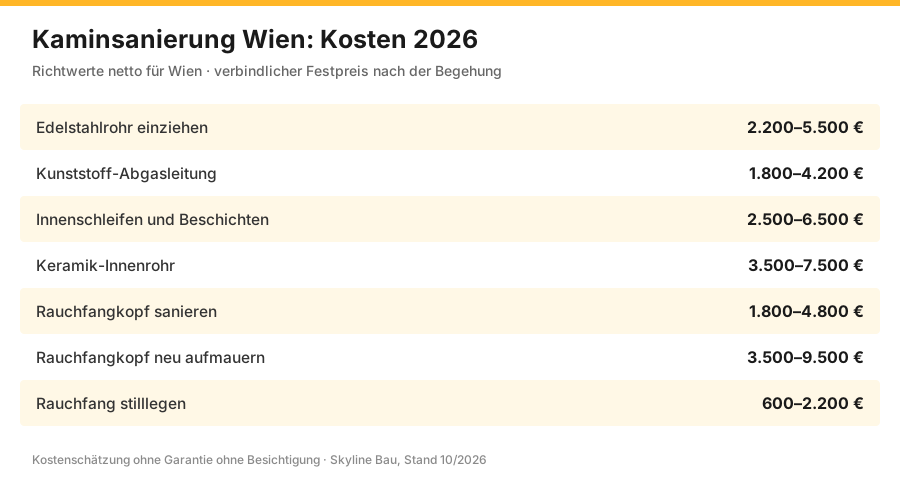
Chimney renovation Vienna: renovating a chimney in Vienna costs 1,800 to 9,500 euros per flue. Inserting a stainless steel liner €2,200–5,500, renovating the chimney head €1,800–4,800, internal grinding and coating €2,500–6,500. The basis is always the chimney sweep's report.
Chimney renovation Vienna: costs 2026
Net guide values, as of 2026, per flue and up to about four storeys. Binding after report and measurement.
| Method | When it fits | Net price | Duration |
|---|---|---|---|
| Inserting a stainless steel liner | Switch to condensing boiler, leaking flue | 2.200–5.500 € | 1–2 days |
| Plastic flue pipe | condensing boilers only, low flue gas temperature | 1.800–4.200 € | 1 day |
| Internal grinding and coating | cracked flue, cross-section to be kept | 2.500–6.500 € | 2–4 days |
| Ceramic inner liner | Solid fuel, high temperatures | 3.500–7.500 € | 2–4 days |
| Renovating the chimney head | Frost damage, spalling above the roof | 1.800–4.800 € | 1–3 days |
| Rebuilding the chimney head | Head no longer stable | 3.500–9.500 € | 3–5 days |
| Decommissioning the chimney | no connection planned any more | 600–2.200 € | 1 day |
Unit prices and ancillary services
| Item | Unit | Net price | What is included |
|---|---|---|---|
| Chimney sweep's report | lump sum | 120–380 € | Inspection, camera survey, written report |
| Camera survey | pcs | 180–450 € | Internal condition, cracks, sooting, cross-section |
| Cross-section calculation | lump sum | 150–400 € | does the liner suit the appliance |
| Double-wall stainless steel liner | lin. m | 120–260 € | Material and insertion |
| Connector and cleaning opening | pcs | 180–520 € | Cleaning door, condensate drain |
| Condensate drainage | lump sum | 150–380 € | mandatory for condensing appliances |
| Chimney cowl | pcs | 180–650 € | Rain guard, spark guard |
| Scaffolding or roof access | lump sum | 650–3.800 € | Roof ladder, anchor points, scaffolding |
| Cherry picker | Day | 480–1.200 € | if no scaffolding is possible |
| Sealing openings for fire protection | pcs | 180–450 € | former connections in apartments |
| Sign-off by the chimney sweep | lump sum | 120–320 € | Required before commissioning |
Total around €6,100 net. Without the liner the new boiler would be cheaper to connect – but its flue gases condense in the old chimney, the moisture is drawn into the masonry and after one to three winters appears as a brown stain in the apartment above.
Chimney renovation in a detached house
In a detached house, chimney renovation is almost always the result of a heating replacement. The old chimney was built for an oil or gas boiler with a high flue gas temperature. A condensing appliance delivers 40 to 60 degrees — the flue gets wet; this is called sooting (Versottung).
| Starting situation | What is done | Net price |
|---|---|---|
| Gas boiler becomes condensing boiler | Plastic flue pipe into the existing flue | 1.800–4.200 € |
| Oil becomes pellets or logs | Stainless steel liner, cleaning opening, condensate drain | 2.200–5.500 € |
| Flue sooted through, masonry soaked | Open the flue, renovate, reline, renew plaster | 9.000–20.000 € |
| Chimney head above the roof damaged | dismantle, rebuild, clad in sheet metal, cover slab | 1.800–4.500 € |
| No flue available, wood stove wanted | External stainless steel chimney, foundation, wall opening | 3.500–8.000 € |
In a detached house the order matters: first the chimney sweep with the report, then the decision on the heating system, then the renovation, then the appliance. Anyone who buys the appliance first may not get a sign-off.
A point many overlook: if the chimney is decommissioned because of a switch to a heat pump, it still has to be sealed tight and ventilated. Otherwise moisture is drawn into the house through the unused shaft. This costs 400 to 900 euros and is regularly forgotten.
How to recognise a chimney in need of renovation
| Findings | Cause | Urgency |
|---|---|---|
| Brown stains on the wall next to the chimney | Sooting – condensate and tar penetrate the masonry | high, masonry is destroyed |
| Smell of flue gas in the apartment | Leaking flue or backflow | immediately, risk of carbon monoxide |
| Spalling on the chimney head | Frost and penetrating moisture | high, bricks can fall |
| Cracks in the plaster along the chimney | Thermal stresses, settlement | have it checked |
| Chimney sweep raises objections | Report no longer satisfactory | by the deadline in the report |
| New appliance planned | old chimney unsuitable for condensing boilers | before replacing the appliance |
How a chimney renovation works
Which method for which purpose
| Equipment | Flue gas temperature | Suitable solution |
|---|---|---|
| Gas condensing boiler | low, moist | Stainless steel or plastic pipe, moisture-resistant |
| Old gas boiler without condensing technology | medium | Stainless steel liner or coating |
| Wood stove | high | Double-wall stainless steel or ceramic |
| Tiled stove | high | Ceramic or masonry flue according to the report |
| Pellet heating | medium to high | Stainless steel, moisture-resistant |
| No connection any more | — | decommission, close openings to fire protection standards |
The six most common mistakes
- Condensing appliance on an old chimney. The flue gases condense and the chimney soots through from the inside. After one to three winters, brown stains appear in the apartment.
- Renovated without a report. The method does not suit the appliance, the chimney sweep does not approve – the work has to be repeated.
- Cross-section not calculated. Too large cools down, too small backs up. Both lead to faults in the appliance.
- Condensate drain forgotten. The water collects at the base of the chimney and escapes into the masonry.
- Only the inside renovated, head forgotten. Frost has its greatest effect above the roof. A crumbling head is a danger to passers-by.
- Old connection openings left open. Decommissioned connections in apartments must be sealed to fire protection standards.
Who may do what: chimney sweep, installer, building contractor
Several trades work on the chimney, and responsibilities are clearly divided. Knowing them saves you the round in which three firms refer you to each other.
| Task | Responsible | When |
|---|---|---|
| Sweeping and periodic inspection | Chimney sweep | ongoing, under Viennese regulations |
| Report on the condition of the flue | Chimney sweep | before every renovation |
| Approval for commissioning | Chimney sweep | after the renovation, before connection |
| Heating appliance, boiler, connection | Gas and sanitary engineering | when replacing the appliance |
| Inserting inner liners, coating | Specialist firm for flue systems | during the renovation itself |
| Masonry, chimney head, plaster, roof connection | Building contractor | for structural damage |
| Scaffolding, roof access, fall protection | Building contractor | for all work above the roof |
| Coordination and overall responsibility | General contractor | when several trades are involved |
Our role is that of the executing building contractor and coordinator: we take on the structural part – chimney head, masonry, roof connection, plaster, access and safety – and bring in licensed partner firms for the flue system and the heating side. The sign-off is always done by the chimney sweep.
Sooting: why old chimneys get wet
The most common damage in old Viennese buildings is sooting – brown, tarry stains that break through the wall from the inside and cannot be painted over.
| Cause | What happens | Consequence |
|---|---|---|
| Cross-section too large | Flue gas cools down in the flue | Condensate forms on the wall |
| Modern appliances on an old flue | low flue gas temperature | Dew point lies inside the flue instead of above it |
| Uninsulated flue on the external wall | Flue cools down | permanent condensate formation |
| Leaks and old connections | Infiltrating air cools further | Draught problems, more condensate |
| Damp fuel | high water content in the flue gas | Sooting within a few heating seasons |
| Leaking chimney head | Rainwater runs into the flue | Soaking from above |
| Measure | Scope | Net price |
|---|---|---|
| Insert inner liner, eliminate the cause | depending on the method | 1.800–7.500 € |
| Hacking off sooted plaster | per m² | 35–75 € |
| Barrier plaster and new plaster | per m² | 65–140 € |
| Drying the wall surface | per device and day | 18–45 € |
| Paint with a suitable build-up | per m² | 12–28 € |
The chimney head above the roof
The part of the chimney above the roof surface stands unprotected in the weather and is therefore almost always the first area to be damaged. In Vienna, many heads also still date from the time of construction.
| Damage pattern | Cause | Consequence |
|---|---|---|
| Spalled plaster, open joints | Freeze-thaw cycles | Water penetrates the masonry |
| Loose bricks in the head area | washed-out mortar | Risk of falling onto the roof or the street |
| Missing or defective cover | never fitted or torn off | Rain runs straight into the flue |
| Leaking roof connection | old sheet metal, open flashing | Water in the attic along the chimney |
| Head too low above ridge or roof surface | later raising of the roof, neighbouring buildings | Draught problems, backflow of flue gas |
| Cracks in the head | thermal stress | Infiltrating air, sooting |
If the head is being renewed anyway, it is worth looking at three points that are then settled for decades: a proper cowl, a cleanly executed roof connection with new sheet metal, and sufficient height above the roof surface. Retrofitting each of these later requires the same access all over again.
Which inner liner for which purpose
| System | Suitable for | Limits | Net price |
|---|---|---|---|
| Single-wall stainless steel | Gas and oil appliances in a masonry flue | needs a sufficient cross-section | 2.200–5.500 € |
| Double-wall stainless steel | External routing, cold areas | more space required | €120–260 per rm |
| Plastic flue pipe | condensing appliances only | not for solid fuel, temperature limit | 1.800–4.200 € |
| Ceramic inner liner | Solid fuel, stoves, high temperatures | more elaborate installation, more loss of cross-section | 3.500–7.500 € |
| Coating from the inside | cracked flue, cross-section to be retained | requires sound masonry | 2.500–6.500 € |
The cross-section is calculated, not estimated. A cross-section that is too large leads to sooting, one that is too small to flue gas backflow. The calculation costs 150 to 400 euros and is a prerequisite for approval by the chimney sweep.
The process in detail
| Phase | What happens | Duration |
|---|---|---|
| 1. Report | Chimney sweep checks the flue, camera survey, written report | 1 appointment |
| 2. Defining the use | which appliance, which output, which flues will be needed in future | Owner's decision |
| 3. Calculation and system choice | Cross-section, material, accessories | 2–5 days |
| 4. Offer | by running metre and piece, including access and making good | 2 working days |
| 5. Preparation | Material, scaffolding or roof access, appointments with residents | 1–3 weeks |
| 6. Execution | Head, inner liner, connections, outlet | 1–5 days |
| 7. Making good | Plaster, painting, roof connection, cleaning | by scope |
| 8. Sign-off | Approval by the chimney sweep | 1 appointment |
| 9. Commissioning | Connect and adjust the appliance | by the installer |
The order of phases eight and nine is not negotiable: first the approval, then operation. Anyone who has the appliance connected beforehand has a problem with the insurance in the event of damage – and the installer will usually refuse anyway.
Typical cost traps
| Item | Why it is often missing | Order of magnitude |
|---|---|---|
| Roof access and fall protection | is taken for granted | 650–3.800 € |
| Making good plaster and paintwork | not part of the flue system trade | by area |
| Sealing old connection openings | only discovered when opened | €180–450 each |
| Condensate drainage | mandatory for condensing boilers, often not in the offer | 150–380 € |
| Chimney cowl | counts as an accessory | 180–650 € |
| Sign-off by the chimney sweep | handled by third parties | 120–320 € |
| Disposal of demolition material | considerable when rebuilding the head | by quantity |
Decommissioning done properly
| Step | What is included | Why |
|---|---|---|
| Clean the flue | Remove soot and deposits | prevents odour and self-ignition |
| Seal connection openings | properly bricked up, not just plastered over | Fire path between storeys |
| Cover the outlet | rain-proof but ventilated | no water in, no moisture trapped |
| Ensure ventilation | the flue must not be sealed airtight | otherwise residual moisture remains in the masonry |
| Document | which flue was decommissioned when | for later use and for the property management |
The fourth point is most often done wrong. A flue sealed airtight never dries out, and the trapped moisture works its way into the adjacent walls – the damage then looks like sooting, even though there has been no heating for years. The right solution is a cover that keeps rain out and lets air through.
Heating replacement and chimney
Most chimney renovations in Vienna today are not repairs but the result of an appliance change. What happens to the flue depends on what is newly installed.
| New system | What happens to the flue | Cost range |
|---|---|---|
| Gas condensing boiler | Insert flue pipe in the existing flue, condensate drainage | 1.800–4.200 € |
| District heating connection | Flue no longer needed, decommissioning | 600–2.200 € |
| Heat pump | Flue no longer needed, seal openings | 600–2.200 € |
| Pellet heating | own system, usually stainless steel | 2.200–5.500 € |
| Tiled stove or wood stove | Check flue, usually ceramic or stainless steel | 3.500–7.500 € |
| Individual apartment heating replaced by central heating | several flues no longer needed, one is upgraded | depending on number |
Conversely: an existing, intact flue is an asset. Bricking it up unnecessarily during renovation takes away the building's option to connect a stove later or switch to another system. In tenement buildings with several flues, it is almost always worth keeping at least one operational.
Chimney in a tenement building: several parties, several flues
| Situation | Special feature | Approach |
|---|---|---|
| Several flues in one chimney stack | Renovating one flue affects the neighbouring flues | assess all flues together |
| Connections in several apartments | Access to every affected unit required | Time slots, notice, involve the property management |
| One owner wants to switch | The flue is a common part | Resolution or consent required |
| Old connections left open unused | Draught, odour, fire path | seal properly, document |
| Chimney runs through the apartment | Work in an occupied room | Dust protection, short construction time, coordination |
| Loft conversion planned | Chimney must be routed through the new level | take into account in the planning |
For the property management this means in concrete terms: before the next meeting, have an inventory of all flues prepared with report and cost range. Then a phased plan can be adopted instead of discussing it anew with every appliance replacement. How this interacts with the other measures on the building is explained on the tenement building renovation page.
Open fireplace, wood stove, tiled stove
Some enquiries do not come from a heating renovation but from the wish for a stove. The question is then not whether the chimney looks nice, but whether it can handle the appliance.
| Equipment | Requirement for the flue | Typical result in an old building |
|---|---|---|
| Wood stove, logs | soot-fire resistant, suitable cross-section, sufficient draught | Insert stainless steel or ceramic |
| Tiled stove | higher heat output, own flue | Upgrade the flue, check structure for the weight |
| Pellet stove | lower flue gas temperature, tight system | Stainless steel, often with negative-pressure operation |
| Open fireplace | large cross-section, high air volume | rarely economical to build |
| Gas fireplace | like a gas appliance, tight flue | usually straightforward |
Then there is the supply air: a stove burns air from the room unless it is designed to be room-air independent. In tight, renovated apartments this is often not enough, and a separate supply air duct is needed. The chimney sweep also clarifies this in advance – and it is the point at which stove projects most often fail, not the chimney itself.
| Item | Net price |
|---|---|
| Survey of the flues and report | 180–450 € |
| Upgrading the flue for solid fuel | 3.500–7.500 € |
| Making the connection and flue pipe | 450–1.400 € |
| Retrofitting a supply air duct | 650–2.200 € |
| Fire-protection floor plate and wall clearance | 380–1.600 € |
When the chimney runs through the loft conversion
The same question comes up with every conversion: the chimney stands in the middle of the new apartment. Three routes are common, and the decision is made in planning, not on site.
| Option | When it fits | What to watch out for |
|---|---|---|
| Route the chimney through and clad it | Flues are still needed | Clearance from combustible components, accessibility of the cleaning door |
| Rebuild the chimney above the roof | Roof is raised, head too low | new height above roof surface, structural connection |
| Decommission and remove flues | no further use planned | Check the structure, the chimney stack often carries loads |
If the roof is raised, the required outlet height above the roof surface changes at the same time. The existing head is then usually too low and the extension is due anyway – a point that is regularly missing from the cost estimate of a conversion. Details on the conversion itself are on the loft conversion page.
Maintenance: what keeps the chimney going for a long time
| Measure | Interval | Effect |
|---|---|---|
| Sweeping and inspection | as prescribed, depending on use | Detect soot-fire risk and draught problems early |
| Visual inspection of the head | every 2–3 years, immediately after a storm | find loose bricks and open joints |
| Check the chimney cowl | annually with the roof inspection | prevent rain ingress |
| Check the roof connection | every 2–3 years | most common point of water ingress |
| Check cleaning doors | annually | Tightness, accessibility |
| Use dry fuel | ongoing | prevents sooting at the root |
The visual inspection of the head can be combined at no extra cost with the roof inspection that makes sense anyway. Anyone looking after a building should have both done in the same appointment – the access via rope or roof hatch is the same, and the most common damage lies exactly at this interface between chimney, sheet metal and roof covering.
Price examples from practice
Total around €5,800 net excluding the heating appliance itself, duration two days. The condensate drainage is not optional for condensing appliances – without it there is no approval.
Total around €20,060 net, construction time just over three weeks. The second flue was decommissioned and sealed at the same time – this cost an additional €1,400 and spares the building the next scaffolding appointment.
Fire protection and safety
| Topic | What matters | What goes wrong |
|---|---|---|
| Clearance from combustible components | Timber beams must not touch the chimney | often not observed in old buildings |
| Soot-fire resistance | mandatory for solid fuel | wrong system installed |
| Tightness | no flue gas escaping into living spaces | old open connections |
| Combustion air | sufficient supply air for the appliance | tight windows without air inflow |
| Carbon monoxide | invisible and odourless | Detector missing, symptoms overlooked |
| Cleaning openings | accessible and tightly closed | built over or just mortared shut |
What you can prepare
- Obtain the chimney sweep's report: it is the basis for every offer and states which flue is in which condition.
- Know what is to be connected: appliance type and output determine system and cross-section.
- Survey all flues in the building: number, location, which are still used, which have been dead for years.
- Clarify access to the attic and the outlet: keys, roof hatch, existing anchor points.
- Organise access to the affected apartments: especially with connection openings in several units.
- Collect old documents: earlier reports, renovations, plans showing the chimney routing.
- Plan early: there are usually weeks between report, offer, resolution and execution.
How to recognise proper workmanship
| Feature | Good workmanship | Warning signs |
|---|---|---|
| Before the offer | Report and camera survey are available | Price without knowledge of the flue |
| Cross-section | calculated and documented | "that'll be fine" |
| System | matched to the planned appliance | whatever happens to be in stock |
| Outlet | Cover, sufficient height, clean connection | open pipe, old sheet metal left in place |
| Cleaning opening | accessible, tight, documented | bricked up |
| Old connections | properly sealed | smeared shut with plaster |
| Sign-off | by the chimney sweep, in writing | verbal promise |
| Restoration | Plaster, painting, roof connection in the same contract | second company, second appointment |
How this differs from our other services
| Situation | Matching service |
|---|---|
| Renovate the chimney, renew the head, upgrade the flue | Chimney renovation, this page |
| Replace heating system, gas to district heating | Heating, ventilation & plumbing |
| Re-cover the roof, renew connections | Roof renovation |
| Access via the roof without scaffolding | work at height |
| Renovate damp wall after sooting | masonry repair |
| Loft conversion with chimney routing | Loft conversion |
| Bundle all measures on the tenement building | Tenement building renovation |
When you do not need us
The chimney sweep, not a building contractor, is responsible for the annual sweeping and the report. If they raise no objections and no appliance replacement is planned, there is nothing to renovate. Contact us if the report shows defects, if a new appliance is to be connected or if the chimney head is visibly deteriorating.
Chimney renovation in a detached house
In a detached house, chimney renovation is usually the result of a heating replacement: the old flue was built for an oil or gas boiler with a high flue gas temperature; the new condensing appliance needs a tight, moisture-resistant flue.
| Case in a detached house | What is done | Net price |
|---|---|---|
| Switch to a condensing appliance | Plastic or stainless steel pipe into the existing flue | 3.800–7.200 € |
| Sooted flue | Milling out, inner liner, new head, internal plaster | 9.000–20.000 € |
| Chimney head above the roof | Dismantle, rebuild, cover, sheet metal cladding | 1.800–4.500 € |
| Connecting a tiled stove or wood stove | Connection, certificate, sign-off by the chimney sweep | 1.400–3.600 € |
| Decommissioning the flue | Sealing top and bottom, ventilation, notification | 900–2.200 € |
| New flue for an extension | Prefabricated system including foundation and head | 6.500–14.000 € |
We carry out chimney renovation in Vienna and nearby Lower Austria. For the rest of Austria we do not act as an agent and tell you openly that a firm near you will be faster and cheaper.
Chimney renovation: understanding the costs before the first offer arrives
In Austria, the flue in the masonry is actually called a Rauchfang; "Kamin" is the word that came over from Germany and here often stands for the open fireplace in the living room. In renovation, both terms mean the same thing: the flue is repaired so that it is tight, frost-resistant and suitable for the connected appliance.
The costs of a chimney renovation fall into three blocks that should be considered separately. First, the diagnosis: report and camera survey together usually cost a few hundred euros and decide which method is possible at all. Second, the actual work on the flue – liner, coating or new head. Third, access to the roof, which is the biggest unknown in Vienna. A tenement building with a steep metal roof, no roof hatch and a narrow street in front needs scaffolding or a cherry picker, and for the cherry picker often a temporary no-parking zone. According to our table, this item ranges between €650 and €3,800 net and can be more expensive than the liner itself for a short chimney. Anyone comparing offers should therefore first check whether roof access is included at all.
Chimney grinding: what the method achieves and where it stops
During grinding, a rotating head with milling or grinding tools travels through the flue and removes loose joints, sooting crusts and projections. This makes the cross-section even again and creates space for what comes next. That is exactly the point many offers keep quiet about: grinding alone does not make a leaking chimney tight. It is the preparation for a mineral inner coating or an inserted liner that would otherwise not pass through narrow points.
For grinding and coating, our cost table gives €2,500 to €6,500 net per flue. The range depends on the length, the number of offsets – the angled sections common in old Viennese buildings – and how much material has to come off. Because a lot of dust is produced, all connection openings in the apartments are sealed beforehand. In a tenement building this means: every party on the same flue must be informed in advance and provide access. If a liner goes in after grinding, the method is a supplement, not an alternative.
Inserting a stainless steel liner into an old chimney: what the price per metre depends on
The inserted stainless steel liner is the most common solution when switching to a condensing appliance, because it is moisture-resistant and safely carries the condensate down. For a double-wall liner we calculate €120 to €260 net per running metre for material and insertion. Where you end up within this range is decided by four things: the diameter according to the cross-section calculation, whether the flue runs straight or is offset and therefore needs a flexible liner, whether grinding is needed beforehand and how many fittings are added for connection, cleaning door and condensate drain. A rigid liner is more robust and easier to clean; the flexible liner is the compromise for flues with offsets. Which one fits is determined by the chimney sweep in the report. If the boiler is replaced at the same time as the liner, we coordinate the appointment with the installer – more on building services on the heating and plumbing in Vienna page.
In the area around Vienna too: get an offer for chimney renovation on a detached house in Lower Austria
A large share of detached houses with old chimneys are not in Vienna but just outside, for example in Mödling, Baden, Purkersdorf, Tulln or around Korneuburg. We work there just as we do in the city. To get a reliable offer and not just a rough estimate, a few documents help: the current report or inspection record from your chimney sweep, photos of the chimney head above the roof and of the cleaning opening in the basement, the number of storeys and which heating appliance will be connected in future.
Why the appliance is so important: the diameter and material of the inner liner depend on it, as does whether a condensate drain is needed. A detached house also often has an advantage over a tenement building, because roof access via a ladder or roof window is enough and no scaffolding is needed in the courtyard. Whether your town is in our area can be seen on the construction company Lower Austria page; send documents via the enquiry form.
Frequently asked questions about chimney renovation in Vienna
How much does a chimney renovation cost?
Why do I need a report from the chimney sweep?
Why can't a condensing boiler be connected to the old chimney?
What is sooting?
What to do if there is a smell of flue gas in the apartment?
Stainless steel or plastic?
What is a cross-section calculation?
Why the condensate drain?
How much does renovating the chimney head cost?
Why is roof access so expensive?
Can I decommission a chimney?
Who is responsible in a tenement building?
Chimney renovation: who pays in a rented building?
Can I use the chimney for a wood stove?
Chimney renovation: how long does the renovation take?
Can I heat during the work?
Chimney renovation: do I need a permit?
How long does a renovated chimney liner last?
Chimney renovation: who carries out the work?
Chimney renovation: which certificates do I receive?
Chimney renovation: how quickly do I get an offer?
Why does an old chimney soot up?
Do I need a chimney renovation when switching to a condensing boiler?
What happens to the chimney with district heating or a heat pump?
Should I rather keep an unused flue?
Which inner liner is the right one?
How much does the renovation in a tenement building cost in total?
Is it worth renovating several flues together?
What does a window replacement have to do with the chimney?
Who approves the system?
Is a "Rauchfang" renovation the same as a chimney renovation?
Is it enough just to grind out a sooted chimney?
When do you need a flexible rather than a rigid stainless steel liner?
Related services
Cleaning after the work?
Construction and detailed cleaning after the chimney renovation is handled by our partner company Bling Bling Premium Cleaning. More at bling-bling.at.
Send enquiry
Enquire directly here — fixed-price quote free of charge. Skyline Bau replies within 2 working days.
Ready for your chimney renovation in Vienna?
Write to us directly on WhatsApp — send photos. Reply within 2 working days.
Note: Skyline Bau is the brand name of the construction and renovation division of Bling Bling GmbH and is not a separate legal entity. The sole contractual partner is Bling Bling GmbH. Bling Bling GmbH is a restricted construction trade business under § 99 GewO (Austrian Trade Regulation Act) and not a licensed master builder (Baumeister). Under § 99 (5) GewO, the title “Baumeister” is reserved for businesses licensed under § 94 no. 5 GewO. Regulated trades — master-builder services, structural engineering, gas and sanitary engineering, electrical engineering — are carried out exclusively by authorised, licensed partner companies.