Facade renovation Vienna the first thing people see of a building.
Facade renovation Vienna: from the construction company that does the work — not from an agent.
Facade renovation Vienna: a facade renovation in Vienna costs 180 to 350 euros per square metre on the street side with the stucco preserved, and 120 to 190 euros per square metre on the courtyard facade with an external thermal insulation composite system. Plus scaffolding at €12 to €22 per m² per month. Construction time 2 to 6 months.
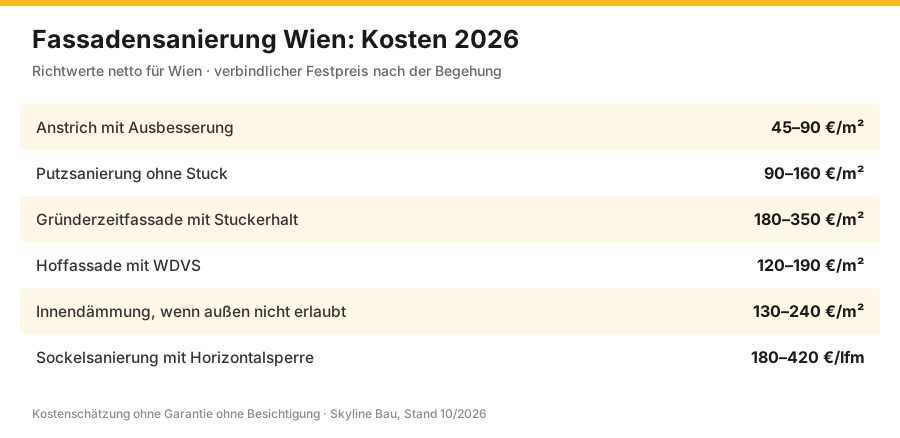
Facade renovation Vienna: costs 2026
Net guide prices, as of 2026, binding after a site visit. The range is explained by the proportion of stucco, the condition of the substrate and whether insulation is permitted.
| Scope | What is done | Net price | Construction time |
|---|---|---|---|
| Painting with repairs | Clean, close cracks, two coats of paint | €45–90/m² | 3–6 weeks |
| Plaster renovation without stucco | Knock off hollow areas, re-plaster, paint | €90–160/m² | 6–10 weeks |
| Gründerzeit facade with stucco preserved | Supplement stucco, window surrounds, cornices, plaster, paint | €180–350/m² | 3–6 months |
| Courtyard facade with ETICS | Insulation 14–20 cm, reinforcement, finishing plaster | €120–190/m² | 6–12 weeks |
| Internal insulation where external is not allowed | capillary-active system, junction details | €130–240/m² | 1–2 weeks per flat |
| Plinth renovation with horizontal damp-proof course | Renovation plaster, waterproofing, splash protection | €180–420/lin. m | 2–4 weeks |
Unit prices, so you can check a quote
| Item | Unit | Net price | What is included |
|---|---|---|---|
| Scaffolding incl. protective netting | m²/month | 12–22 € | Erection and dismantling, standing time, anchoring |
| Tapping and knocking off hollow areas | m² | 18–45 € | Manual work, disposal |
| New plaster, two-coat mineral | m² | 45–85 € | Spatter dash, base coat, finishing coat |
| Moulding and supplementing a stucco element | lin. m | 90–260 € | Silicone mould, cast, setting, working in |
| Repairing a cornice | lin. m | 110–280 € | Check reinforcement, reprofile, cover flashing |
| Re-forming window surrounds | lin. m | 35–90 € | Template, plaster, edge formation |
| Repairing cracks with a structural bond | lin. m | 25–70 € | Open, reinforce, close |
| Facade paint, silicate or silicone resin | m² | 18–38 € | Primer, two coats |
| ETICS 16 cm EPS | m² | 95–150 € | Bonding, dowelling, reinforcement, finishing plaster |
| ETICS 16 cm mineral wool | m² | 125–190 € | non-combustible, higher requirement |
| Reveal insulation at windows | lin. m | 28–65 € | Insulating wedge, plaster stop bead, sealing tape |
| Aluminium window sill | lin. m | 55–120 € | Cutting, brackets, installation, sealing |
| Sheet metal work: flashings on the facade | lin. m | 60–150 € | Cornice covering, junctions |
| Dismantling and reinstalling lightning protection | lump sum | 1.200–4.000 € | by a licensed electrician, with test report |
| Pigeon deterrent | lin. m | 35–90 € | Nets or spikes on cornices |
| Parking lane permit and information for neighbours | lump sum | 600–2.400 € | MA 46, notices, coordination |
Total around €220,300 net. With an approved basic refurbishment subsidised at 35 %, around €143,000 remains – spread over ten to fifteen years through proceedings under § 18 MRG, a very different calculation from the raw total.
Facade damage and what it means
- Hollow-sounding plaster. The bond with the substrate has been lost. Tapping shows the extent – it is often larger than the visibly damaged area.
- Spalling with exposed brick. Moisture has penetrated and burst the plaster in frost. Action is needed before the next winter.
- Cracks. Hairline cracks in the plaster are usually harmless; continuous cracks across several storeys point to movement in the structure – then a structural engineer must be involved before plastering.
- Green growth and algae. A moisture problem, usually on shady north sides or under defective gutters. Painting over it helps for two years.
- Salt efflorescence on the plinth. Rising damp. Without a horizontal damp-proof course it destroys any new plaster within a few years – see Wall damp-proofing Vienna.
- Rust streaks on cornices and balcony slabs. The reinforcement in the concrete is corroding. This is not a plaster issue but a matter of concrete repair.
- Deteriorated stucco. Missing elements, broken profiles, weathered capitals. Can be supplemented by taking moulds of existing parts.
- Damp interior walls on the external side. Often the result of defective downpipes or missing cornice coverings – the cause lies outside, the damage shows inside.
Plaster and paint: what belongs on a Gründerzeit facade
| System | Price per m² | Property | Suitable for |
|---|---|---|---|
| Lime plaster | 55–110 € | highly vapour-permeable, soft, self-healing with hairline cracks | historic facades, masonry exposed to moisture |
| Lime-cement plaster | 45–85 € | harder, more resilient, less vapour-permeable | plinth areas, heavily stressed surfaces |
| Renovation plaster to WTA | 55–110 € | porous, absorbs salts, stays dry on the outside | plinths with salt contamination |
| Silicate paint | 22–38 € | silicifies with the substrate, very vapour-permeable | mineral plasters, standard in period buildings |
| Silicone resin paint | 18–32 € | water-repellent, dirt-repellent | heavily weathered surfaces, ETICS |
| Emulsion paint | 14–26 € | film-forming, low vapour permeability | unsuitable on historic facades |
The rule for period buildings is: the further out, the more vapour-permeable. A dense emulsion paint on damp Gründerzeit masonry traps the moisture and pushes the plaster off from the inside – damage that only becomes visible after two winters.
To insulate or not: the decisive question in Vienna
Facade insulation noticeably reduces the heating demand and is subsidised. For Gründerzeit buildings in protection zones, however, it is usually not permitted on the street side – there the aim is to preserve the appearance. The usual solution: repair the street facade, insulate the courtyard facade.
External insulation on the courtyard facade
€120 to €190/m² for an external thermal insulation composite system of 14 to 20 cm. Maximum effect, no thermal bridges, eligible for THEWOSAN subsidies. The standard route wherever it is allowed.
Internal insulation
€130 to €240/m² when nothing can be done on the outside. Demanding in terms of building physics, because the wall is colder afterwards. Only with a capillary-active system or a tested vapour retarder and clean junctions at reveals and ceilings.
Only plinth and cellar ceiling
The cheapest partial measure: cellar ceiling insulation at €40 to €75/m², immediately noticeable in the ground-floor flats, without any intervention in the facade.
Not insulating at all
An honest option for richly articulated facades in protection zones. The lever then lies with the roof, cellar ceiling, windows and heating – that is often where you gain more than on a brick wall that is thick anyway.
What ETICS means in a period building
- Insulation material. EPS is cheaper, mineral wool is non-combustible and more vapour-permeable. From a building height of 22 m, OIB Guideline 2 prescribes additional fire protection measures.
- Window reveals. They are insulated as well, otherwise a thermal bridge remains there and mould appears on the internal corner in winter. This is not an option but part of the system.
- Window sills, roller shutter boxes, balcony junctions must be included in the planning – they can hardly be solved cleanly afterwards.
- Distance from the neighbouring plot. 16 cm of insulation sometimes crosses the property boundary; Vienna has rules for this that need to be clarified beforehand.
- The dew point moves outwards. That is the actual purpose: the wall stays warm and dry. That is why half-hearted insulation is worse than none.
Protection zone, MA 19 and listed building protection
Large parts of Vienna's Gründerzeit building stock lie in protection zones. There, MA 19 assesses every change visible from public space: plaster texture, colour, articulation, windows, roof structures, advertising. If the building is also listed, the Federal Monuments Office is involved as well.
- The colour cannot be chosen freely. A colour survey is often required: historic paint layers are exposed and the colour choice is derived from them. This costs €800 to €2,500 and takes two to four weeks.
- Stucco is supplemented, not replaced. Moulds are taken of existing elements, cast and set – no catalogue goods.
- Allow for lead time. Two to four months between submission and approval are normal. Anyone who erects the scaffolding first and asks afterwards pays for standing time.
- The courtyard side is different. Insulation is usually permitted there because the appearance from public space is not affected.
How a facade renovation proceeds
The eight most expensive mistakes in facade renovation
- Painting without tapping. Paint on hollow plaster lasts two to three years, then both fall off.
- Emulsion paint on period plaster. Traps moisture and pushes the plaster off.
- Renovating the plinth without a horizontal damp-proof course. Rising damp destroys the new plaster within two winters.
- Filling cracks instead of repairing them with a structural bond. The crack returns in the same place.
- Leaving out the window reveals when insulating. The thermal bridge remains, mould on the internal corner follows.
- Erecting the scaffolding too early. With 800 m² of scaffolding, each additional month costs up to €17,600.
- Replacing windows later. Then the scaffolding goes up a second time – or the new windows are fitted into the fresh facade.
- Starting without MA 19 clarification. Removal at your own expense, plus proceedings.
How to check a facade offer
Subsidies and who pays
| Case | Who pays or subsidises | Basis |
|---|---|---|
| Rented building, facade damaged | Landlord, from the rent reserve | Maintenance obligation under § 3 MRG |
| Reserve not sufficient | Refinancing via increased main rents | Procedure under § 18 MRG |
| Condominium ownership | Owners’ association, from the reserve fund | The facade is a common part of the property |
| Thermal improvement | Grant from the City of Vienna | THEWOSAN, proof via energy performance certificate |
| Facade as part of the building renovation | up to 40% of eligible costs | Sockelsanierung via wohnfonds_wien |
| Listed property | additional funding possible | Federal Monuments Office, separate submission |
The subsidy application must be submitted and approved before construction starts. Anyone who starts earlier loses the entitlement completely – with a construction sum of €220,000 that can quickly amount to €70,000.
Who we renovate facades for
Property management companies
Facade as part of the basic refurbishment, coordinated with the roof, windows and balconies. One scaffold for all trades, an auditable bill of quantities, weekly photo reports.
Tenement building owners
Repair the street facade, insulate the courtyard facade, make full use of subsidies. Coordination with MA 19 and wohnfonds_wien from a single source.
Owners' associations
Documents ready for a resolution, with variants and cost implications, so that the meeting can decide instead of postponing.
Homeowners
Facade with insulation, windows and plinth in one go. A clear price, one building site, one point of contact.
When you do not need us
If the plaster is firmly attached everywhere and only the paint has faded, a painting firm with scaffolding is enough – that costs €45 to €90 per square metre instead of €180. If the roof is due in two years anyway, wait and do both together: the scaffolding then only goes up once. And if the facade shows cracks across several storeys, you first need a structural engineer, not a plasterer – we tell you that during the site visit, even if it means postponing an order.
Renewing external plaster in Vienna
New external plaster is the core of every plaster renovation: tap and knock off hollow areas (€18 to €45/m²), then re-plaster in two mineral coats (€45 to €85/m²). Complete with painting, plaster renovation without stucco costs €90 to €160/m². Lime plaster is the right choice for Gründerzeit facades because it is vapour-permeable.
Facade renovation in the 9th district: Alsergrund
Alsergrund is one of the districts where Vienna's facade issues are concentrated in a small area. Gründerzeit apartment buildings with rich stucco stand next to plainer Biedermeier buildings, and large parts of the district lie in protection zones. In a facade renovation in 1090 Vienna, the street side is therefore almost always repaired rather than insulated, and we coordinate the colour and articulation with MA 19. The practical hurdles are often in front of the building: narrow pavements, little space for the scaffolding, parking lanes that have to be kept free via MA 46, and in streets such as Währinger Straße or Nußdorfer Straße the tram with its overhead line. Scaffolding near it requires coordination with the operator before the first frame goes up. On the courtyard side the buildings are often tightly built up, and material comes in through the entrance or over the scaffolding. Anyone who writes these points into the tender gets comparable prices and no surprises during erection.
Classifying building damage: the first step of any building renovation
Before anyone talks about plaster systems, it must be clear what is actually broken on the facade. A building renovation starts with damage mapping: each elevation is created as a drawing or photo montage, on which hollow areas, cracks, spalling, damp patches, missing stucco and rust on cornices are entered. For the upper storeys a view from below is not enough; tapping is done from a cherry picker or, on larger buildings, from a first section of scaffolding. This mapping produces the quantities in the bill of quantities – how many square metres of plaster will actually be knocked off, how many linear metres of cornice need reprofiling.
Why all this effort? Because building damage on Viennese facades rarely has its cause where it becomes visible. A damp patch under the window often comes from a leaking window sill, a crack across three storeys from settlement, plaster detachment at the plinth from rising damp. Without clarifying the cause, the damage is papered over and returns. For cracks that move we bring in a structural engineer, for moisture in the masonry masonry repair.
Vandalism on the facade: graffiti, scratches, impact damage
The ground-floor zone of a Viennese building has a different life from the upper storeys. Graffiti, scratched tags, plinth corners knocked off by delivery vehicles or bins – vandalism repair in Vienna usually involves only a few square metres, but in a visible spot. The problem is rarely the removal, but the transition: a freshly painted rectangle on a ten-year-old facade stands out more than the graffiti did. That is why it is not the stain that gets painted, but the area up to the next edge or window surround line. Corners knocked off plinths and portals are remodelled with mineral repair mortar and colour-matched. For buildings that are affected again and again, a permanent protective coating on the plinth zone is worthwhile, from which new graffiti can be cleaned off without solvents. Important for insurance: photograph the damage with a date before cleaning.
Liesing and the outskirts: housing estate homes instead of stucco
On the outskirts of the city a facade looks quite different. In Liesing, but also in parts of Floridsdorf or Donaustadt, detached and estate houses from the post-war period predominate: roughcast on brick or hollow blocks, hardly any articulation, rarely a protection zone. Here the insulation question is reversed – insulation is usually allowed and often sensible, because the walls are thinner than in Gründerzeit buildings. A facade renovation in Liesing is therefore often an external thermal insulation composite system straight away. Anyone comparing facade costs per m² for the whole of Austria on the internet should know that these averages usually describe exactly such houses: two storeys, free access, no stucco. They cannot be transferred to a Viennese period apartment building.
Facade renovation in 1150 Vienna: Rudolfsheim-Fünfhaus
Rudolfsheim-Fünfhaus is densely built up with Gründerzeit rental buildings, which are usually more plainly articulated than in the inner districts. Many street facades have already lost their stucco: in the post-war decades, cornices and window pediments were often knocked off and the surfaces plastered smooth. A renovation therefore raises a question that arises less often in Alsergrund: reconstruct the articulation, or renew the smooth surface and possibly insulate it? Whether insulating the street side is an option depends on the protection zone, the zoning plan and the pavement situation and is clarified with the authority in advance; what such a build-up looks like is shown under facade insulation.
On the busy axes such as the Gürtel, Felberstraße or outer Mariahilfer Straße, exhaust fumes and brake dust visibly take their toll on the facades; cleaning alone rarely brings a lasting result there if the paint is already chalking. In the courtyards there are often former workshops and courtyard wings with their own roofs, which make the scaffolding more difficult. At the plinth we often find salt damage and rising damp, which do not disappear with renovation plaster alone – here wall damp-proofing helps first.
Frequently asked questions about facade renovation in Vienna
What does a facade renovation cost in Vienna?
What does the facade renovation of a period apartment building cost?
Why is the street facade more expensive than the courtyard facade?
What does the scaffolding cost?
Why should I do the roof, facade and windows together?
How long does a facade renovation take?
Can work be done on the facade in winter?
How do I know that the facade needs renovating?
Is a new coat of paint enough?
What do cracks in the facade mean?
Which colour may I choose?
Which facade paint lasts longest?
What is the difference between lime plaster and lime-cement plaster?
Can the stucco be preserved?
What does supplementing the stucco cost in total?
Facade renovation: may I insulate the street facade?
What does an external thermal insulation composite system cost?
EPS or mineral wool?
Facade renovation: how thick should the insulation be?
Do the window reveals have to be insulated as well?
What about internal insulation?
Does insulation pay off economically?
What happens to the lightning protection?
What about pigeons and bird protection?
Is the plinth included?
What should be done about salt efflorescence on the plinth?
What does facade cleaning cost?
Can graffiti be removed?
Facade renovation: do I need a building permit?
What has to be considered regarding the parking lane and pavement?
How are the residents affected?
Can tenants reduce the rent?
Is the scaffolding a burglary risk?
Who pays for the facade renovation in a rented building?
Facade renovation: who pays in a condominium?
Facade renovation: which subsidies are available?
Facade renovation: when must the subsidy application be submitted?
What happens if more damage appears when knocking off?
How long does a renovated facade last?
How do I maintain the facade?
Can windows be replaced at the same time?
What about balconies on the facade?
Can facade greening be installed?
Do you also do individual facade areas?
Facade renovation: does Skyline Bau carry out the work itself?
Facade renovation: is there a fixed price?
Facade renovation: what warranty is there?
Facade renovation: how quickly will I get an offer?
What does the facade renovation of a detached house cost?
Can only the ground-floor zone of a facade be renovated?
Why does a repaired patch on the facade stand out so much?
Related services
Facade finished? Windows and surroundings are dusty.
After facade work, window panes, window sills and the pavement are covered in dirt. Bling Premium Cleaning takes care of glass and surroundings cleaning after the scaffolding is dismantled. More at bling-bling.at.
Send enquiry
Enquire directly here — fixed-price quote free of charge. Skyline Bau replies within 2 working days.
Have your facade renovated?
Write to us directly on WhatsApp — send the property, facade area and key details. Reply within two working days.
Note: Skyline Bau is the brand name of the construction and renovation division of Bling Bling GmbH and is not a separate legal entity. The sole contractual partner is Bling Bling GmbH. Bling Bling GmbH is a restricted construction trade business under § 99 GewO (Austrian Trade Regulation Act) and not a licensed master builder (Baumeister). Under § 99 (5) GewO, the title “Baumeister” is reserved for businesses licensed under § 94 no. 5 GewO. Regulated trades — master-builder services, structural engineering, gas and sanitary engineering, electrical engineering — are carried out exclusively by authorised, licensed partner companies.