Screed laying Vienna the floor on which everything else stands.
Screed laying Vienna: from the building contractor that does the work — not from an agent.
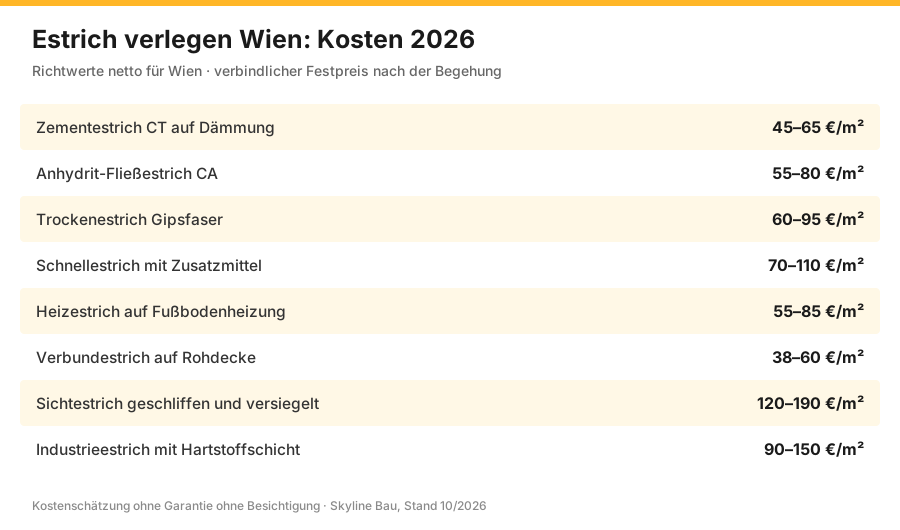
Screed laying Vienna: laying screed in Vienna costs 45 to 80 euros per square metre net, including insulation. Cement screed €45–65/m², flowing screed €55–80/m², dry screed €60–95/m². On top of that comes the drying time: cement screed needs four to six weeks until it is ready for flooring, anhydrite three to four, dry screed can be walked on the next day.
Screed laying Vienna: costs 2026
Prices for Vienna, as of 2026, net, including material, installation, edge insulation strips and screeding off. Not included are demolition of the old screed and the floor covering.
| Type of screed | Build-up | Net price | Ready for flooring after |
|---|---|---|---|
| Cement screed CT on insulation | 60–70 mm total | €45–65/m² | 4–6 weeks |
| Anhydrite flowing screed CA | 50–60 mm total | €55–80/m² | 3–4 weeks |
| Dry screed, gypsum fibre | 40–60 mm total | €60–95/m² | immediately |
| Rapid screed with admixture | 60–70 mm | €70–110/m² | 3–7 days |
| Heating screed on underfloor heating | 65–75 mm above pipe | €55–85/m² | after the heating-up programme |
| Bonded screed on bare slab | 30–50 mm | €38–60/m² | 3–4 weeks |
| Polished screed, ground and sealed | 60–80 mm | €120–190/m² | 6–8 weeks |
| Industrial screed with hard aggregate layer | 80–100 mm | €90–150/m² | 4–6 weeks |
Additional items that must be in the quote
| Item | Unit | Net price | When needed |
|---|---|---|---|
| Demolish and dispose of old screed | m² | 18–38 € | in renovations, almost always |
| Clean and prime the bare slab | m² | 4–9 € | always |
| Levelling fill on an uneven slab | m² | 12–28 € | usually necessary in old buildings |
| Impact sound insulation 30 mm | m² | 8–16 € | mandatory in residential buildings |
| Thermal insulation EPS 40 mm | m² | 7–14 € | above unheated rooms |
| Vapour barrier | m² | 3–7 € | above soil and garages |
| Fit edge insulation strips | lin. m | 2–4 € | always, without exception |
| Form movement joints | lin. m | 9–18 € | from 40 m² of area, in door openings |
| CM test of residual moisture with report | pcs | 90–180 € | before every floor covering |
| Functional heating with heating-up report | lump sum | 280–650 € | with underfloor heating, mandatory |
| Construction heating and drying equipment | Week | 180–420 € | in winter or under time pressure |
| Skim coat before flooring | m² | 8–18 € | for vinyl, design flooring, carpet |
Total around €9,980 net. The underfloor heating itself is not included; it costs an additional €70 to €140/m² and is installed by a licensed partner company.
If the issue is not a new screed in a residential building but broken areas in a commercial or warehouse floor, the route is structural repair: Industrial floor renovation.
Which screed for what
The choice determines construction time, build-up height, weight and suitability for wet rooms. There is no best screed, only the right one. Before the floor covering is laid, the CM test applies as proof in every case – with moisture in a new building or after damage, accompanying building drying helps.
Cement screed CT
The standard. Moisture-resistant, compression-resistant, inexpensive. Drawback: long drying, 4 to 6 weeks until ready for flooring, and it shrinks as it dries – hence movement joints. €45–65/m².
Anhydrite flowing screed CA
Self-levelling, therefore very flat and ideal for underfloor heating because it completely encloses the pipe. Not moisture-resistant; in a bathroom only with waterproofing on top. €55–80/m².
Dry screed
Gypsum fibre or wood-based boards, can be walked on immediately, no water in the building. The solution for limited build-up height and on timber beam ceilings, because it is light. €60–95/m².
Mastic asphalt screed AS
Laid hot, can be loaded immediately, no water. Expensive and laborious to deliver, rare in residential construction, sometimes the only solution in listed buildings and under deadlines.
| Application | Recommendation | Why |
|---|---|---|
| Apartment in a new building | Cement screed or anhydrite | Price and flatness, time is available |
| Apartment with underfloor heating | Anhydrite flowing screed | encloses the pipe, better heat transfer |
| Bathroom, WC, laundry room | Cement screed | moisture-resistant, anhydrite is not |
| Old building with timber beam ceiling | Dry screed | light, no water, ready for flooring immediately |
| Limited build-up height under 50 mm | Dry screed or bonded screed | lowest build-up height |
| Time pressure | Rapid screed or dry screed | ready for flooring in days instead of weeks |
| Basement, garage, workshop | Bonded or industrial screed | directly on the bare slab, high load capacity |
| Visible floor without covering | Polished screed | the surface is the end result, correspondingly laborious |
The build-up, layer by layer
Drying and readiness for flooring: the point where construction schedules fail
Placing screed takes one day. Drying takes weeks. Anyone who does not reflect this difference in the construction schedule produces either a delay or damage.
| Type of screed | Walkable | Loadable | Ready for flooring | Residual moisture limit |
|---|---|---|---|---|
| Cement screed CT | after 2–3 days | after 7 days | 28–42 days | ≤ 2.0 CM-% (without UFH), ≤ 1.8 (with UFH) |
| Anhydrite CA | after 1–2 days | after 5 days | 21–28 days | ≤ 0.5 CM-% (without UFH), ≤ 0.3 (with UFH) |
| Dry screed | immediately | immediately | immediately | not applicable |
| Rapid screed | after 1 day | after 2–3 days | 3–7 days | according to manufacturer |
| Mastic asphalt AS | after cooling | immediately | after 1 day | not applicable |
The rule of thumb and why it is dangerous
A common rule is: one centimetre per week up to 4 cm, considerably longer after that. That is true under good conditions – 20 °C, 50 % humidity, ventilated. In a Viennese old-building apartment in November without heating it is not. That is why the rule is: measure, don't calculate.
CM test
The calcium carbide method is the recognised procedure in Austria. A sample is taken from the lower half of the screed, crushed and sealed with calcium carbide in a pressure vessel; the resulting gas pressure shows the residual moisture. Measurements are taken at at least one point per room or per 200 m². You receive the report with date, measuring point and value – that is the basis to which floor layers and tilers refer.
Electronic meters that are only held against the surface are not sufficient for readiness for flooring. They show surface moisture, not the core.
What happens if flooring is laid too early
- Parquet absorbs the residual moisture, swells and cups. In the worst case the bond comes loose.
- Vinyl and design flooring are vapour-tight. The moisture builds up underneath, the adhesive saponifies, it smells.
- Tiles crack because the screed underneath is still shrinking.
- Carpet goes mouldy, mould forms in the backing.
In these cases the warranty lies with the floor layer who laid without a measurement report. For the client it still means: covering out, dry the screed, new covering. Four to eight weeks' delay and double the cost.
Screed and underfloor heating
With underfloor heating, the screed is not just a substrate but part of the heating system. It transfers the heat from the pipe into the room.
- Cover at least 45 mm above the pipe with cement screed, 40 mm with anhydrite. Less means striping: you can feel the pipes in the floor.
- Anhydrite has the advantage because, as a flowing screed, it completely encloses the pipe. With cement screed, air pockets remain under the pipe more easily.
- Functional heating is mandatory, not optional. Under the ÖNORM, the screed is heated up in stages and cooled down again, every step recorded. Without a heating-up report, no floor layer accepts the warranty.
- Measure readiness for flooring despite heating. Functional heating proves that the system works, not that the screed is dry. Both are necessary.
- Joints according to heating circuits: every heating circuit expands differently. Movement joints follow the circuit layout, not the floor plan.
- Retrofit milling is possible: grooves are milled into an existing screed and heating pipes laid in. €90–160/m², saves build-up height, responds quickly – but only with a sufficiently thick, crack-free existing screed.
Screed in Vienna's old buildings
Timber beam ceilings do not carry everything
A typical Gründerzeit ceiling carries 150 to 250 kg/m². A 70 mm cement screed alone weighs around 140 kg/m². Add furniture, people, screed insulation. That is why in old buildings dry screed is often the only permissible solution: 25 to 50 kg/m² instead of 140. For larger areas, the load-bearing capacity must be assessed by a structural engineer – via a licensed partner company.
The old sub-floor
Under the parquet in a Gründerzeit building there is usually a sub-floor on sleepers, and below it a fill of sand, slag or rubble. This fill provides sound insulation and load distribution at the same time. Anyone who removes it has to replace it – usually with bound expanded glass fill, which is lighter and insulates similarly.
Crooked ceilings
Level differences of 3 to 6 cm over six metres are normal. That determines the screed thickness: it is based on the highest point, so that the minimum thickness is maintained everywhere. A levelling survey before the quote is prepared prevents the nasty surprise that 11 cm instead of 7 cm is needed in one corner.
Moisture from below
On the ground floor and in the souterrain, moisture comes from the soil. Without a vapour barrier or waterproofing it migrates into screed and floor covering. Where rising damp is visible in the masonry, wall damp-proofing must be done first, then the floor.
Noise and neighbours
Demolishing the old screed is the loudest work in an apartment renovation. In Vienna it is permitted on working days from 7 am to 8 pm, but it is announced anyway. The rubble goes down the rubble chute into the skip, which needs a parking lane permit from the MA 46.
The ten mistakes we find most often
- No edge insulation strip or cut off too early. The screed touches the wall, impact sound travels unhindered into the neighbouring room.
- Covered without a CM test. The most common reason for damage to parquet and vinyl.
- Missing movement joints. With 90 m² of continuous screed without a joint, cracks form that show through the covering.
- Too little cover above heating pipes. You can feel the pipes, and the screed cracks along the lines.
- Anhydrite in the bathroom without waterproofing. Calcium sulphate is not water-resistant; when soaked it loses its strength.
- Dried too quickly. Draughts and construction heating in the first days lead to shrinkage cracks.
- Insulation butted instead of tight-jointed. Screed runs through the joints and forms sound bridges.
- Placed on a dirty bare slab. There is no bond, hollow spots form that sound hollow when walked on.
- Screed thickness measured at the lowest point. Then it is too thin elsewhere and breaks under load.
- No heating-up report. The floor layer will not lay or will not accept the warranty – rightly so.
How to check a screed quote
Standards we work to
| Set of rules | What it is about |
|---|---|
| ÖNORM B 2232 | Screed work, contract standard – execution, measurement, invoicing |
| ÖNORM EN 13813 | Screed material, designation and strength classes such as CT-C25-F4 |
| ÖNORM B 3732 | Screeds, planning and execution, thicknesses and build-ups |
| ÖNORM EN 1264 | Underfloor heating, functional heating and heating-up report |
| ÖNORM B 8115 | Sound insulation in building construction, impact sound requirements |
| ÖNORM DIN 18202 | Flatness tolerances of the finished screed surface |
| ÖNORM B 2110 | Contract standard – quote, acceptance, deadlines, warranty |
The designation of the screed is in our quote, so that it is clear what is being installed. “CT-C25-F4, 70 mm on insulation” can be checked, “screed according to the state of the art” cannot.
Screed: cost per m² incl. installation – what is in the price per square metre
Anyone searching for the price “incl. installation” wants to know which figure will really be on the invoice in the end. A price per square metre for placed screed is made up of four components: the material (cement-sand mix or calcium sulphate ready mix), the crew's working time for placing and screeding off, the machine – mixing pump or silo with hose line – and the journey including setting up and dismantling. In an 80 m² apartment, the fixed share for pump and journey is spread over many square metres. With 15 m² of bathroom and hallway, on the other hand, it carries full weight, which is why small areas per square metre are often noticeably above the table values.
The range of €45 to €80/m² (net reference values) for cement or flowing screed on insulation applies to usual apartment sizes and includes edge insulation strips and installation. Not included are demolition of the old floor, a levelling fill, functional heating and the skim coat before the covering. So always clarify whether “incl. installation” means only placing or the entire build-up until ready for flooring.
In short: the smaller the area and the more difficult the access, the higher the price per square metre – the material is rarely the reason.
What a square metre of screed costs in Austria – and why Vienna is often above it
Nationwide average prices from comparison portals rarely fit a Viennese building site. The reason is not the material and hardly the hourly rate, but the logistics. At a detached house in the Weinviertel, the mixer drives right up to the door, the area is done in one go, the hose is short. At a Gründerzeit building, the pump stands in the lane, often only with a temporary no-stopping zone that has to be applied for at the MA 46 in good time. The line runs through the entrance, courtyard and stairwell up to the fourth floor, and the stairwell has to be protected against it.
Added to this are noise considerations in an occupied building and ceilings that cannot take every weight. When you compare prices, ask about the area, build-up and access behind a figure. An “Austria price” without this information says little about your apartment.
Flowing screed: when the higher price pays off
At €55 to €80/m² net, anhydrite flowing screed costs more than classic cement screed. It pays off where its properties save money elsewhere: it flows closely around the pipes of underfloor heating, is placed quickly and lies so flat that the skim coat before vinyl or parquet is often thinner. However, calcium sulphate cannot tolerate permanent wetness – in the bathroom it needs careful waterproofing, and before the covering the surface must be sanded.
Screed repair: what prices depend on
Not every damaged floor has to come out. What matters is the damage pattern: individual shrinkage cracks can be resin-filled and stapled, smaller hollow spots injected through drill holes, sunken edge areas partly repaired. For such repairs there is no serious lump-sum price per square metre – they are invoiced by running metre of crack or number of drill holes, and only after the entire area has been tapped. If a large part sounds hollow, the patchwork quickly becomes more expensive than a new screed. Then the new build-up comes with demolition at €18 to €38/m² net plus disposal. If the substrate is damp, no repair helps before the cause has been eliminated – see Building drying in Vienna.
Screed layer in Vienna or a general contractor?
For an empty new-build area, a good screed layer is enough. In a renovation, on the other hand, the order of the trades decides the result. Before the screed, electrical and water pipes must lie on the bare slab and be covered with insulation, the underfloor heating needs its pressure test, and the floor layer only takes over when the residual moisture has been proven. If there is nobody to accept these handovers, the parties later blame each other. We plan the sequence, coordinate the dates with the installer for the underfloor heating and hand over a substrate ready for covering to the tiler or floor layer.
Laying screed in Korneuburg and the northern area around Vienna
We also take on screed work in the area around Vienna; for us, Korneuburg belongs to the near zone with daily travel. The sites there usually look different from a Gründerzeit building: detached houses, extensions and semi-detached houses with access right up to the door. The mixer or silo stands on the client's own land, the hose line stays short, and large areas can be placed in one operation. There is almost always underfloor heating in the build-up, often with a heat pump. Then what counts is tight enclosure of the pipes, the right cover and recorded heating-up before the covering – more on this under underfloor heating.
In older building stock, for example in estate houses near the Danube, moisture from below must be clarified first before rebuilding. For the journey to Korneuburg we charge a small surcharge; Stockerau is one zone further. Which other places we serve is on the page on the building contractor in Lower Austria.
What does 1 m² of screed cost in Austria – from unit price to budget
A single price per square metre only helps once it is clear which components have to be added. The following breakdown uses the net reference values on this page and shows how the total for a renovation is made up.
| Component | Net reference value per m² |
|---|---|
| Demolish old floor including screed | 18–38 € |
| Cement screed on insulation | 45–65 € |
| Anhydrite flowing screed | 55–80 € |
| Dry screed for timber ceilings | 60–95 € |
Worked example: in a 60 m² apartment with demolition and new cement screed, the result is €63 to €103 per square metre, so around €3,800 to €6,200 net in total. Skim coat, covering and disposal come on top. Anyone who only compares the screed price therefore often compares different services.
Frequently asked questions about screed in Vienna
How much does laying screed cost in Vienna?
How much does it cost to lay 100 m² of screed?
What does screed cost per m² including material?
How long does screed need to dry?
Is the rule “one centimetre per week” correct?
What does “ready for flooring” mean?
How is readiness for flooring measured?
Is an electronic moisture meter enough?
What happens if flooring is laid too early?
Can drying be accelerated?
Which screed is the best?
What is the difference between cement and anhydrite screed?
Which screed for underfloor heating?
What does CT-C25-F4 mean?
How thick does the screed have to be?
Why is screed thickness an issue in old buildings?
What is the edge insulation strip for?
Do I need movement joints?
What to do if the screed has cracks?
What is a hollow spot and why is it bad?
Can underfloor heating be milled in afterwards?
What is functional heating?
Does functional heating replace the CM test?
What is dry screed?
Why dry screed in old buildings?
What lies under the old parquet in a Gründerzeit building?
What does it cost to remove old screed?
Does the old screed always have to come out?
What is polished screed?
What is rapid screed?
What is bonded screed?
Which screed for basement and garage?
Which insulation goes under the screed?
Do I need a vapour barrier?
How flat does the screed have to be?
Does a skim coat have to be applied before the covering?
Can I tile on the screed?
How long does the laying itself take?
Can I live in the apartment while it dries?
Will it be noisy?
How does the screed get to the fourth floor?
Does Skyline Bau lay the screed itself?
Screed laying: is Skyline Bau a master builder (Baumeister)?
Screed laying: is there a fixed price?
Screed laying: what warranty is there?
What is not included in the price?
Screed laying: do you also do small areas?
Screed laying: how quickly can I get an appointment?
Do you lay screed throughout Vienna?
Why is screed more expensive per square metre for small areas?
Can a cracked screed be repaired instead of renewed?
What information does a screed quote need to be comparable?
Related services
Screed in? The dust has to go before the covering.
Screed dust is sharp-edged and settles in every crack. Before the floor covering is laid, thorough cleaning is necessary — Bling Premium Reinigung takes care of it. More at bling-bling.at.
Send enquiry
Enquire directly here — fixed-price quote for your screed free of charge, after site visit and measurement. Skyline Bau replies within 2 working days.
Ready for your screed in Vienna?
Write to us directly on WhatsApp — send photos of the room. Reply within two working days.
Legal notice: Skyline Bau is the brand name of the construction and renovation division of Bling Bling GmbH. The sole contractual partner is Bling Bling GmbH — a restricted construction trade business under § 99 GewO, not a licensed master builder (Baumeister). Skyline Bau carries out screed work within the scope of its trade licences. Regulated trades — master builder services (§ 94 no. 5), electrical engineering (§ 94 no. 16), gas and sanitary engineering (§ 94 no. 25), tiling (§ 94 no. 38) — are carried out exclusively by authorised, licensed partner companies.
Note: Skyline Bau is the brand name of the construction and renovation division of Bling Bling GmbH and is not a separate legal entity. The sole contractual partner is Bling Bling GmbH. Bling Bling GmbH is a restricted construction trade business under § 99 GewO (Austrian Trade Regulation Act) and not a licensed master builder (Baumeister). Under § 99 (5) GewO, the title “Baumeister” is reserved for businesses licensed under § 94 no. 5 GewO. Regulated trades — master-builder services, structural engineering, gas and sanitary engineering, electrical engineering — are carried out exclusively by authorised, licensed partner companies.