Paving in Vienna what matters lies beneath the stone.
Paving in Vienna: from the construction company that does the work — not from a broker.
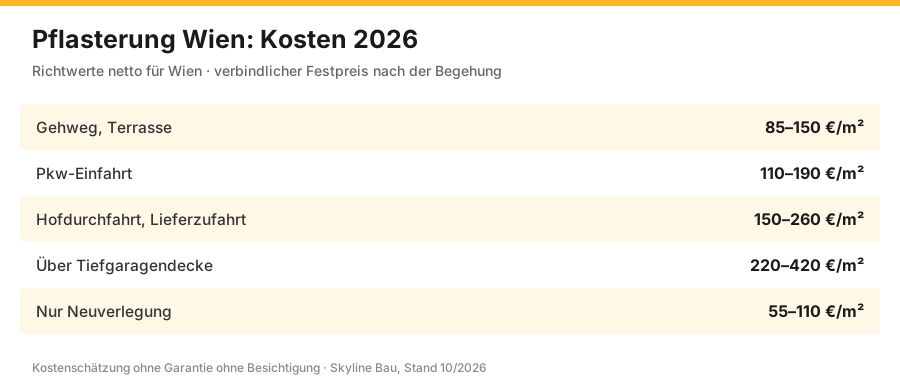
Paving in Vienna: paving costs between €85 and €260 per square metre in Vienna. Footpaths and terraces €85–150/m², car driveways €110–190/m², HGV-trafficable surfaces €150–260/m². The sub-base is what counts: beneath a driveway lie 30 to 40 cm of build-up.
What paving costs in Vienna
Guide prices net, as of 2026, binding after measurement on site. The price is decided by the sub-base, not by the stone.
| Use | Build-up | Price net | Base course |
|---|---|---|---|
| Footpath, terrace | light loads, pedestrians only | 85–150 €/m² | 15–20 cm |
| Car driveway | trafficable up to 3.5 t | 110–190 €/m² | 30–40 cm |
| Courtyard passage, delivery access | HGV-trafficable | 150–260 €/m² | 45–60 cm |
| Above an underground car park slab | Waterproofing, drainage, protective layer | 220–420 €/m² | according to structural calculations |
| Relaying only | Lift existing paving, renew bedding, relay | 55–110 €/m² | stays |
Unit prices
| Item | Unit | Price net | What is included |
|---|---|---|---|
| Lift and dispose of existing surface | m² | 12–35 € | Removal, loading, landfill |
| Excavation for the build-up | m³ | 28–75 € | loosening, loading, removal |
| Frost protection layer | m² | 18–38 € | Crushed stone, compacted layer by layer |
| Unbound base course | m² | 22–48 € | Graded aggregate, compaction, evenness |
| Bound base course | m² | 45–95 € | for heavy loads or where falls are critical |
| Bedding and laying of concrete pavers | m² | 38–75 € | Grit bed, laying, plate compacting |
| Bedding and laying of natural stone | m² | 65–140 € | more cutting and sorting work |
| Laying large-format slabs | m² | 75–160 € | often on pedestals or drainage mortar |
| Setting kerbs | linear m | 38–95 € | Concrete bed, haunching, alignment |
| Drainage channel | linear m | 120–320 € | Channel, grating, connection to sewer or soakaway |
| Soakaway | pc. | 900–2.800 € | Excavation, shaft rings, filter gravel, cover |
| Bound joint filling | m² | 18–45 € | for surfaces without re-sanding |
| Height adjustment to manholes | pc. | 180–520 € | Manhole covers, valve caps, gullies |
| Parking lane permit from MA 46 | lump sum | 250–900 € | for works with access across public land |
Total around €16,600 net, which is €255/m². Only about a third of the amount goes on the actual laying – the rest is in the sub-base and the drainage. That is exactly where cheap quotes cut corners, and exactly where the damage begins.
If an asphalt surface is required instead of paving – for instance as a condition in the permit or because of the connection to public land – we carry that out too: asphalting, from excavation through the frost blanket and base course to the wearing course.
For private roads and access routes with utility lines in the alignment, see road construction.
Why the sub-base decides how long it lasts
| Use | Frost protection | Base course | Bedding | Total build-up |
|---|---|---|---|---|
| Footpath, terrace | 10–15 cm | — | 3–5 cm | 15–20 cm |
| Car driveway | 20–25 cm | 10–15 cm | 3–5 cm | 30–40 cm |
| Lorry access | 30–40 cm | 15–20 cm | 3–5 cm | 45–60 cm |
- Compact in layers. The build-up is placed in layers of no more than 20 cm, each compacted in turn. Anyone who puts it all in at once will get settlement.
- A fall of at least 2%. Water has to run away from the building. Without a fall it stands on the surface and, when it freezes, pushes the stones up.
- The edge restraint is load-bearing. Without kerbs on a concrete bed with haunching, the surface creeps sideways – the most common damage on driveways.
- Re-sand the joints. The joint carries load too. Washed-out joints lead to chipped edges and loose stones.
- Found below the frost line. In Vienna at least 80 cm for the foundations of kerbs and walls, otherwise frost lifts them.
What does paving in Vienna cost?
The price per square metre depends on the material and the sub-base. As a guide:
As of 2026 · net, excl. 20% VAT · guide prices depending on material and sub-base. Final price after measurement on site, in writing as a fixed price under ÖNORM B 2110.
which surface?
Concrete pavers
The economical all-rounder in many shapes and colours. Robust, trafficable and easy to look after — the most common choice for driveways, courtyards and footpaths.
Natural stone
Granite, porphyry, sandstone — elegant and unique, long-lasting, but more expensive and more demanding to lay. The premium surface for terraces and prestigious areas.
Large-format slabs
A modern, calm look with few joints. They need a particularly even, load-bearing sub-base and experienced laying, otherwise they rock.
Permeable paving
Permeable surfaces that let rainwater through. Ecologically sensible and in some cases required to relieve the sewer system.
Paving — in all 23 districts and the surrounding area
We lay paving throughout Vienna, as well as in Klosterneuburg and the surrounding area of Lower Austria.
the sub-base decides
The most common cause of sunken or uneven paving is a poor sub-base. What counts:
- A load-bearing formation — The natural ground is compacted and improved where necessary. On soft ground everything settles later.
- A frost-proof base course — A sufficiently thick crushed-stone base course drains water away and prevents frost heave. Thicker under trafficable surfaces than under footpaths.
- The right fall — Paving needs a fall of around 2% so that water runs off and no puddles form. Without a fall the water stands.
- Clean bedding and jointing material — A grit bed and suitable jointing material hold the stones in place. The wrong material washes out or gets overgrown with weeds.
- Edge restraint — Without a stable edging the paving creeps out sideways. Kerbs or a concrete haunch hold the surface together.
from excavation to the finished surface
01 Survey & planning
Area, surface, use, falls and drainage. Whether it carries vehicles or only foot traffic determines the sub-base. Free of charge.
02 Quotation
Sub-base, surface, edging, drainage — as a bill of quantities with a fixed price under ÖNORM B 2110.
03 Excavation & sub-base
Excavation, compacting the formation, placing and compacting the base course. The invisible, decisive part.
04 Laying
Screeding the bedding, laying the stones in the chosen bond, setting the edge restraint.
05 Compacting & jointing
Brushing in the joints, plate compacting the surface, final clean. Only then is the paving finished.
Why choose Skyline Bau for your paving in Vienna
We are the company that carries out the construction work, and we do the sub-base and the paving with our own people. The advantage shows when the paving is part of a larger outdoor scheme: paving, garden wall, retaining wall and drainage often share the same excavation. Planned from a single source, levels and falls fit together at the end.
- One contractual partner for the sub-base, the paving and the adjoining external works.
- Fixed price under ÖNORM B 2110, in writing after measurement on site.
- A frost-proof sub-base — the point at which most paved surfaces fail.
- €3 million construction liability insurance.
How to recognise a reputable provider
1. Is the sub-base described?
Base course thickness, compaction, material — without details of the sub-base, the quote is guesswork. That is where durability is decided.
2. Are the falls planned?
Without falls you get puddles, and ice in winter. Around 2% belongs in every design.
3. Is the edge restraint included?
Without edging the paving creeps out. Kerbs or haunching are part of the job.
4. Does the sub-base suit the use?
A trafficable driveway needs more sub-base than a footpath. Anyone who builds both the same way is saving in the wrong place.
5. Has the drainage been sorted out?
Where does the water go? Channel, infiltration area or connection — that belongs in the quote, not in a variation claim.
6. Warranty correctly stated
Statutory 3 years on workmanship under § 933 ABGB (Austrian Civil Code).
Paving and rainwater in Vienna
With larger sealed areas, infiltrating or draining away rainwater becomes an issue — in some cases there are requirements to make surfaces permeable in order to relieve the sewer system. Permeable paving, grass grid pavers or a planned infiltration area are the answers. What is permitted and sensible depends on the site; we build the drainage into the design from the outset.
When you do not need us
For a few stepping stones in a flower bed or a small DIY terrace you do not need a construction company. We are the right people when a trafficable driveway, a larger area with a proper sub-base or paving as part of an outdoor scheme is to be built.
what is included
Paving is part of the outdoor works. What belongs together:
Wall and paving often share the same excavation and have to match in height.
Before paving, the ground is levelled and the sub-base prepared.
Where the ground steps, the retaining wall takes up the difference in height.
Excavation and removal before the sub-base.
Draining the surface — channel, infiltration or connection.
The overview of all construction services.
what you should know
So that you know exactly what to expect, we answer the most important questions here — honestly and from the practice of a construction company that carries out the work itself.
What matters when paving?
The sub-base is decisive: a load-bearing, well-compacted foundation of crushed stone, the right fall for water run-off and a clean edge restraint so that the paving does not shift. Badly laid paving sinks or gets overgrown — a good sub-base is half the job.
What types of paving stones are there?
Common choices are concrete pavers (inexpensive, versatile), natural stones such as granite (elegant, long-lasting) and clay pavers. The choice depends on the load (driveway vs. footpath), the look and the budget. Surfaces that carry traffic need correspondingly robust stones and sub-base.
How is water run-off dealt with?
A paved surface needs a slight fall so that rainwater runs off and does not stand. On larger areas, channels or infiltration are added. We plan the falls so that the water is carried away in a controlled way.
What does paving cost in Vienna?
The cost depends on the area, the type of stone, the sub-base and the laying pattern. Natural stone is more expensive than concrete pavers, and elaborate patterns take more working time. After a site visit you receive a fixed-price quote.
Paving a driveway in Vienna: the three critical points
A paved driveway rarely fails in the middle; it almost always fails at the edges. The first critical point is the transition to the pavement. Anyone creating a new driveway or widening an existing one needs the City of Vienna's consent for a dropped kerb, and the level of the new surface is set by the existing kerb edge, not the other way round. The second is the area in front of the garage door. If the surface falls towards the house, water runs into the garage during heavy rain. A channel drain laid crosswise and connected to the sewer or a soakaway intercepts it beforehand.
The third point is the wheel track itself. Where tyres always roll over the same spot and the steering wheel is turned while parking, blocks shift if edge kerbs are missing or the bond has been poorly chosen. For trafficked surfaces, a laying pattern with interlock, such as herringbone, is therefore preferred, and the edges are set in concrete. How much load the subsoil can carry only becomes clear once it has been excavated – made ground left over from earlier building periods is no rarity in Vienna.
Re-paving a courtyard in an old building
A courtyard behind a Gründerzeit building (built 1848–1918) is a construction site in its own right. It is usually only accessible through the building's carriage entrance, which is often no wider than a small van. Excavated soil and gravel are therefore moved with a mini excavator, a dumper or a wheelbarrow, and the skip stands on the street. Beneath the old paving there are often the building's drain, downpipes, inspection chambers and sometimes remains of former cesspits, all of which have to be located before the new build-up is laid. If the drain is in poor condition anyway, now is the cheapest moment to replace it, before the new paving goes down.
Old small granite setts can in many cases be lifted, cleaned and reused. This preserves the character of the courtyard and saves material, but sorting them takes time. What matters is the fall away from the building's walls: if water stands at the plinth, the moisture migrates into the masonry. Where basement walls are already damp, it is worth looking into wall damp-proofing before the courtyard is sealed with tight paving.
Laying paving on slopes, for example in Währing (1180)
On a slope, a paved surface behaves differently from one on level ground. In parts of the 18th district, for instance towards Gersthof and Pötzleinsdorf, driveways and garden paths have a marked longitudinal gradient. Rainwater picks up speed there and washes out unbound joints if it is not intercepted over a long stretch. Cross channels are therefore set at regular intervals, and on very steep sections the joints are filled with a bound jointing material.
A second issue is thrust: the blocks tend to creep downhill. Sturdy edge kerbs bedded in concrete and a restraint at the foot of the surface hold the bond together. Where the difference in height is too great for a ramp, paved areas are combined with steps or a retaining wall that holds back the terrain. Groundwater seeping down the slope should be collected in a drainage layer beneath the base course; otherwise the sub-base softens after wet winters.
Frequently asked questions about paving in Vienna
What does paving cost in Vienna?
Per square metre, concrete block paving costs €50 to €90, natural stone €90 to €180, a trafficable driveway €80 to €150. On top of that comes the frost-proof sub-base at €30 to €60. The final price depends on material, area and use.
Why is the sub-base so important?
Because the paving is only as good as the sub-base beneath it. If it is too weak, not compacted or not frost-proof, the surface sinks, becomes uneven or heaves in frost. The sub-base is the invisible part where most paving jobs fail.
Which paving stone is best?
It depends on the use. Concrete pavers are the robust, economical all-rounder for driveways and courtyards, natural stone the premium surface for terraces and prestigious areas. For a trafficable surface, load-bearing capacity is what counts; for a terrace it is more the look.
How thick does the sub-base need to be?
That depends on the use. A footpath manages with less; a trafficable driveway needs a much thicker, well-compacted crushed-stone base course so that vehicle loads leave no ruts. The exact thickness follows from the use and the ground conditions.
Why does paving need a fall?
So that rainwater runs off and no puddles form that turn into sheets of ice in winter. Around 2 per cent fall, away from the building, is usual. Without a fall the water stands on the surface and seeps into the sub-base.
What happens without a frost-proof sub-base?
Water in the sub-base freezes in winter, expands and lifts the paving unevenly — the surface becomes wavy and stones work loose. A sufficiently thick, free-draining base course prevents this. Without it, frost damage is guaranteed.
What is an edge restraint and why is it needed?
Kerbs or a concrete haunch along the edge of the surface. Without them the outer stones gradually creep sideways and the whole surface loses its hold. The edging holds the paving together — it is a must, not an extra.
Can a driveway that carries cars be paved?
Yes, but it needs a stronger sub-base than a footpath and a correspondingly robust stone. The base course is made thicker and compacted more carefully. If a driveway is built like a footpath, the cars soon press ruts into it.
What is permeable paving?
A permeable surface that lets rainwater drain into the ground through the joints or the stone itself instead of sending it into the sewer. This relieves the sewer system and is in some cases required for larger areas. An ecologically sensible option.
How long does paving take?
A modest area is finished within a few days; larger or more elaborate areas take longer. The excavation and sub-base often take more time than the visible laying — but that is exactly where quality is decided, which is why the care pays off.
Do I have to drain away the rainwater?
With larger sealed areas, drainage or infiltration becomes an issue, sometimes with requirements to make the surface permeable. Channels, permeable paving or an infiltration area are the solutions. We plan the drainage in from the outset.
Can old paving be repaired?
Individual sunken areas or loose stones can be lifted and relaid if the sub-base is fundamentally sound. If the sub-base is the problem, the only remedy is to rebuild the affected area. The site visit shows what is possible.
What is the difference between bound and unbound laying?
Unbound means the stones lie in a grit bed with jointing material — the standard, permeable and individually removable. Bound means they are laid in mortar, which is firmer but rigid and requires a watertight surface. What suits depends on the surface and its use.
Which jointing material is the right one?
That depends on the surface: classic jointing sand, crushed sand or, for higher demands, a bound jointing mortar that prevents weeds and washout. The wrong jointing material washes out or gets overgrown. We choose it to suit the stone and the use.
Can weeds grow through the paving?
In open sand joints, yes, over time. A well-compacted sub-base, clean jointing material or a bound jointing mortar reduce this considerably. On permeable surfaces it cannot be avoided entirely, but good workmanship keeps it to a minimum.
What needs to be considered with large-format slabs?
They need a particularly even, load-bearing sub-base, because any unevenness immediately shows as rocking. Because there are so few joints, the surface behaves differently from small-element paving. Laying them takes experience — not something for a quick fix.
Can paving be laid in winter?
Excavation and sub-base work are possible in cool weather too; laying in frost is tricky, because the sub-base must not be frozen and some materials cannot tolerate frost. With bound laying in mortar, the same applies as for bricklaying. We plan this into the schedule.
How do I look after a paved surface?
Sweep it, clean it when needed and keep an eye on the joints — washed-out joints are refilled. Aggressive pressure washers can blast out joints and damage some stones. You receive care instructions to suit the surface at handover.
What does a paved driveway cost?
That depends on the area, the stone and the sub-base. A trafficable driveway including a load-bearing sub-base comes in at around €80 to €150 per square metre. The heavy-duty sub-base is what makes the difference from a plain footpath — and accounts for most of the extra cost.
Can paving and lawn be combined?
Yes, for example with grass grid pavers or grass-joint paving that is trafficable and green at the same time. It is permeable and visually softer — good for parking spaces and access routes where a fully sealed surface is not needed or not wanted.
Does paving shift over time?
Without a stable edge restraint, yes — under load the stones push apart sideways and the surface loses its shape. With firm edging and a well-compacted bed, the paving stays put. That is why the edging matters so much.
How even will the surface be?
When done properly, even with the planned fall, without rocking stones or puddles. The key is a carefully screeded sub-base and a uniform bedding layer. At the end the surface is plate compacted so that everything settles and closes up.
Does the excavated material have to be disposed of?
Yes, the excavated soil and the old surface are removed and disposed of properly. That is a cost item which belongs in the quote. Contaminated spoil requires special disposal routes — we deal with that if it arises.
Do I get a warranty on the paving?
Yes, the statutory warranty of 3 years under § 933 ABGB (Austrian Civil Code) on the workmanship. Because we build frost-proof and with firm edging, the typical defects such as settlement, frost heave or creeping paving are not to be expected in the first place.
Can I combine paving with a garden wall?
Yes, and it makes sense. Paving, wall and drainage often share the same excavation and have to match in height. Planned together, the outdoor scheme comes out of one mould and you have one contractual partner instead of several firms.
What is the most common expensive surprise when paving?
The ground. If the excavation reveals soft, made-up ground, building rubble or rock, that changes the sub-base and the costing. Because we work at a fixed price after measurement on site, we check this in advance and clarify anything additional before it is ordered.
What does paving cost per square metre?
Why are some quotes half the price?
How thick does the build-up have to be?
What fall does the surface need?
Where does the water go?
What are permeable surfaces?
Do I need kerbs?
Concrete pavers or natural stone?
What does the material cost?
Can I reuse old paving?
What is the difference between bound and unbound construction?
Do I have to re-sand the joints?
What grows in the joints and what helps?
Can paving be laid above an underground car park?
How deep does a frost-free foundation have to be?
What about the manhole covers?
Paving: do I need a permit?
How long does a driveway take?
Can paving be done in winter?
How long does a paved surface last?
Can individual stones be replaced?
Paving: do you also do small areas?
Do I need a dropped kerb for a new driveway?
Can old granite paving in a courtyard be reused?
How do you stop paving from sliding down a slope?
Related services
Freshly paved? The first clean is part of it.
After laying, jointing sand and a film of mortar remain on the surface. Bling Premium Reinigung takes care of the first clean and, if you wish, the ongoing upkeep of the outdoor areas. Find out more at bling-bling.at.
Send enquiry
Enquire directly here — fixed-price quotation free of charge. Skyline Bau replies within 2 working days.
Ready for your paving in Vienna?
Write to us directly on WhatsApp — send photos. Reply within 2 working days.
Note: Skyline Bau is the brand name of the construction and renovation division of Bling Bling GmbH and not a separate legal entity. The sole contractual partner is Bling Bling GmbH. Bling Bling GmbH is a restricted building trade business under § 99 GewO (Austrian Trade Regulation Act) and not a licensed master builder (konzessionierter Baumeister). Under § 99 (5) GewO, the title „Baumeister“ (master builder) is reserved for businesses licensed under § 94 no. 5 GewO. Regulated trades — master builder services, structural engineering, gas and plumbing, electrical engineering — are carried out exclusively by authorised, licensed partner firms.