Facade insulation Vienna outside, inside or just the thermal bridges.
Facade insulation Vienna: from the construction company that does the work — not from an agent.
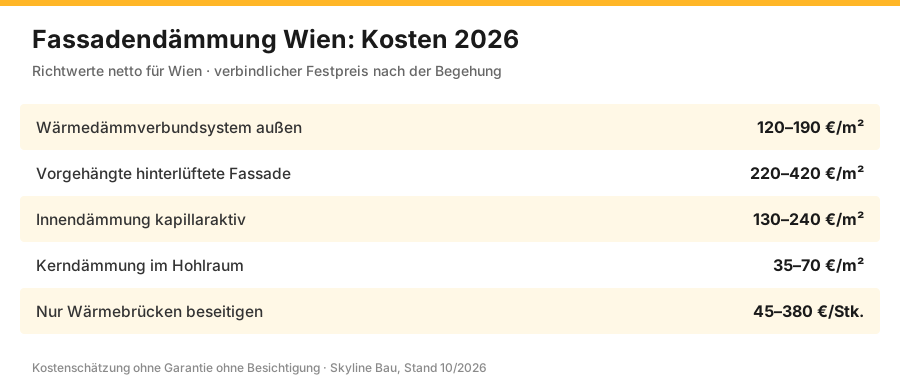
Facade insulation Vienna: insulating a facade in Vienna costs €120 to €420 per square metre, depending on the method. External thermal insulation composite system €120–190/m², ventilated facade €220–420/m², internal insulation €130–240/m². In a protected zone it is not the technology that decides, but MA 19 (the city's architecture and urban design department).
The cost of facade insulation in Vienna in 2026 is €90 to €300 per square metre. Broken down by insulation method:
- ETICS with EPS (standard, expanded polystyrene) — €90 to €150/m²
- ETICS with mineral wool (higher fire protection class, flame-retardant) — €130 to €200/m²
- Rainscreen facade with rear ventilation — €150 to €280/m²
- Internal insulation for old buildings (for facades in protected zones) — €50 to €100/m²
- High-end solutions that preserve stucco in protected zones — €200 to €300/m²
Example of a detached house with 150 m² of facade area: around €13,500 to €30,000 net including render and final coating. For a Viennese Gründerzeit tenement building with a 600 m² facade, the total investment is €54,000 to €180,000 — depending on protected-zone requirements and the chosen system.
The four ways to insulate a facade
Before anyone talks about materials and centimetres, there is a fundamental question: will the facade be insulated from the outside, from the inside or not at all? In Vienna, this decision depends less on technology than on the protected zone.
| Option | Price net | Effect | When it is an option |
|---|---|---|---|
| External thermal insulation composite system | 120–190 €/m² | highest, no thermal bridges | courtyard facades, plain facades outside protected zones |
| Ventilated rainscreen facade | 220–420 €/m² | high, very durable | new builds, commercial buildings, where the look is wanted |
| Capillary-active internal insulation | 130–240 €/m² | medium, thermal bridges remain | street facades in protected zones, individual flats |
| Cavity wall insulation | 35–70 €/m² | medium, very inexpensive | only with double-leaf masonry – rare in Viennese period buildings |
| Eliminate thermal bridges only | €45–380 each | localised, but effective against mould | when the surface may not be insulated |
Unit prices
| Item | Unit | Price net | What is included |
|---|---|---|---|
| Scaffolding incl. safety netting | m²/month | 12–22 € | erection and dismantling, anchoring, hire period |
| Check the substrate, knock off hollow areas | m² | 18–45 € | tapping, knocking off, re-rendering |
| Complete ETICS, 16 cm EPS | m² | 95–150 € | bonding, dowelling, reinforcement, top coat |
| Complete ETICS, 16 cm mineral wool | m² | 125–190 € | non-combustible, mandatory from 22 m |
| Ventilated facade, substructure | m² | 85–160 € | brackets, profiles, insulation, wind barrier |
| Fibre cement or HPL cladding | m² | 120–260 € | panels, fixings, joint pattern |
| Calcium silicate internal insulation | m² | 130–240 € | adhesive, boards, junctions, surface finish |
| Reveal insulation | linear m | 28–65 € | insulating wedge, plaster stop bead, sealing tape |
| New window sill | linear m | 55–120 € | aluminium, brackets, installation, sealing |
| Insulating the roller shutter box | pc. | 140–380 € | insulation, connection, inspection opening |
| Insulating the radiator recess | pc. | 45–120 € | insulation board, connection, surface finish |
| Perimeter insulation at the plinth | m² | 110–180 € | compression-resistant, insensitive to moisture |
| Removing and refitting the lightning protection | lump sum | 1.200–4.000 € | by a licensed electrical contractor, with test report |
| Energy performance certificate before and after | pc. | 450–1.200 € | prerequisite for THEWOSAN funding |
Total around €89,200 net. The €9,400 for the street-side thermal bridges is the most efficient part: it eliminates exactly the spots where mould would otherwise form – even without insulating the whole surface.
Outside or inside: the difference in building physics
| Criterion | External insulation | Internal insulation |
|---|---|---|
| Effect on the U-value | full | full across the surface |
| Thermal bridges | are insulated as well | remain at ceilings and internal walls |
| Internal wall temperature | rises, wall stays warm | wall behind becomes colder |
| Thermal mass | remains usable | is decoupled |
| Risk of condensation | low | present, depends on the system |
| Living space | stays | is lost, 6–10 cm per wall |
| Execution | no need to move out, done from outside | rooms temporarily unusable |
| On the street side in a protected zone | usually not permitted | always permitted |
Internal insulation is not an inferior substitute but a different construction method with its own rules. It works reliably with capillary-active systems such as calcium silicate, which absorb accumulating moisture and release it again. What does not work: gluing polystyrene to the inside wall. Moisture condenses behind it, and mould grows unseen.
Facade insulation Vienna from a single source
Facade insulation in Vienna means the thermal insulation of a building's external walls. In uninsulated buildings, a large share of the heating energy is lost through the facade — the largest continuous surface of the building envelope. Facade insulation tackles exactly this point, making it one of the most effective measures for making a building energy-efficient.
The benefits of facade insulation are many. It noticeably lowers heating costs, improves the indoor climate, protects the building fabric and increases the value of the property. In winter the warmth stays inside, and in summer the rooms heat up less. A well-insulated facade means comfort and cost-effectiveness at the same time. It is also a contribution to climate protection, because every kilowatt hour of heating energy saved reduces the building's CO2 emissions.
Skyline Bau plans and carries out facade insulation as a construction company working with licensed master builder (Baumeister) partner firms — and it does so without favouring any one method. Facade insulation is not a single, uniform process: there are several methods that differ considerably in effort, cost, insulating performance and suitability. Which method is right depends on the building. Skyline Bau gives impartial advice and carries out every method to a professional standard.
The most important method is the external thermal insulation composite system (ETICS, German: WDVS) — insulation boards bonded and dowelled directly to the external wall and then rendered. ETICS is the most frequently chosen solution for rendered facades. You will find a more in-depth description of this method on our detail page on ETICS Vienna.
The second major method is the ventilated rainscreen facade. Here the insulation is combined with a substructure and an outer cladding, leaving a ventilated air gap between insulation and cladding. This method involves more work and costs more, but offers design freedom and very good protection against moisture.
For buildings whose facade must be preserved for design or heritage reasons, internal insulation is an option — insulating the external walls from the inside of the rooms. It is particularly relevant in Vienna, because many Gründerzeit buildings lie in MA 19 protected zones, where facades may not be altered on the outside.
A further variant is cavity wall insulation for double-leaf masonry: insulation material is blown into the cavity between the two leaves of the wall. It is the cheapest method and preserves the external appearance — but it requires a usable cavity, which not every building has. Where there is no such cavity, ETICS or the ventilated facade come into consideration.
We know the insulation situation in the city — the uninsulated Gründerzeit buildings with their protected facades, the post-war buildings in urgent need of renovation, and the City of Vienna's subsidy landscape for thermal renovation. Skyline Bau chooses the right insulation method for each building and carries it out as a professional, subsidised part of the renovation.
With facade insulation, the difference between a specialist firm and a quick-fix provider is especially clear. A wrongly chosen method or poor workmanship not only means the potential savings go unused — it can also cause structural damage, for instance when internal insulation without a building-physics concept leads to moisture problems. Skyline Bau plans facade insulation with the care such a far-reaching measure deserves.
all services
ETICS
External thermal insulation composite system — insulation boards bonded to the external wall and rendered, the most common method.
Ventilated facade
Rainscreen cladding with an air gap — design freedom and good moisture protection.
Internal insulation
Insulation from the inside of the rooms — when the facade must be preserved on the outside.
Cavity wall insulation
Blown-in insulation of the cavity in double-leaf masonry — inexpensive and fast.
Advice on insulation materials
Choosing the right insulation material — from mineral wool and EPS to wood fibre.
Insulating older buildings
Facade insulation for uninsulated Gründerzeit and post-war buildings.
Solutions compliant with MA 19
Insulation concepts for buildings in protected zones with facades worth preserving.
Subsidy handling
Clarifying and processing subsidies for thermal renovation.
Facade insulation open to every method — ETICS, ventilated rainscreen facade, internal and cavity insulation, chosen to suit the building — a construction company that carries out the work with licensed master builder (Baumeister) partner firms, MA 19 experience, subsidy handling, fixed price under ÖNORM B 2110, our own construction team, 3-year warranty under § 933 ABGB.
What does facade insulation in Vienna cost?
The cost of facade insulation in Vienna depends above all on the chosen method, and also on the insulation material and its thickness, the facade area and the condition of the existing facade. Skyline Bau prepares a binding fixed-price quote under ÖNORM B 2110 after a site visit.
As of 2026 · net · guide values · scaffolding, preparatory work and subsidies affect the final price · final price after site visit.
The biggest cost factor is the method. With external insulation, it pays to take a sober look at the individual components.
Depending on thickness and quality, insulation and system materials account for up to around €70 per square metre. Scaffolding costs about €12, and professional installation by a trained team around €35.
These three items alone add up to a base of roughly €105 to €110 per square metre. That does not yet include render and surface finish, nor travel, planning, warranty and the company's profit.
A realistic fixed price for ETICS is therefore €150 to €300 per square metre; experience shows that quotes well below this are either incompletely calculated or based on undeclared work. At €250 to €400, the ventilated rainscreen facade is the most expensive method, because the substructure and cladding mean additional work. Cavity wall insulation is the cheapest solution, because it needs neither scaffolding nor a new facade surface; internal insulation is mid-range per square metre, but affects the interior rooms.
On top of this come ancillary costs: above a certain building height, external insulation requires scaffolding, which is calculated separately. Preparatory work on a damaged existing facade — render repairs, fixing cracks — is also reflected in the price. With internal insulation, the work involved inside the rooms has to be taken into account.
Set against this are the savings. Facade insulation lowers heating costs permanently — over its service life this adds up to a considerable sum. In addition, there is the City of Vienna's subsidy for thermal renovation. Skyline Bau looks at costs, savings and subsidies together, so that you can decide on an honest basis. Facade insulation is a long-term investment — it is done once and works for decades. This perspective belongs in every honest cost calculation.
why insulation pays off
Facade insulation is a substantial investment — and it is fair to ask whether it pays off. In most cases the answer is clear, for several reasons.
The first and most important reason is heating costs. A large share of heating energy escapes through an uninsulated facade. Professional facade insulation reduces this loss considerably and thus lowers heating costs permanently. At today's energy prices, the investment pays for itself over the years.
The second reason is the indoor climate. An insulated external wall stays warmer on the inside — this eliminates the unpleasant cold radiation from chilly walls and the risk of condensation and mould on cold wall surfaces. In summer the insulation works the other way round: the rooms heat up less. The living environment improves noticeably.
The third reason is preserving value. Insulation protects the building fabric from the weather and temperature changes, and an energy-efficient property is worth more on the market. There is also the contribution to climate protection through lower energy consumption. Skyline Bau plans facade insulation so that all these benefits come into play. This means facade insulation is rarely a pure expense — it is an investment that pays off through lower heating costs, greater living comfort and a higher property value.
the external thermal insulation composite system
The external thermal insulation composite system, ETICS for short (German: WDVS, colloquially also called Thermohaut), is the most widely used method of facade insulation. For most rendered facades it is the first choice.
An ETICS consists of several layers designed to work together: the insulation material, which is bonded and dowelled directly to the external wall, a stabilising reinforcing mesh and the final external render. These layers form a tested system — hence the name composite system. ETICS is suitable for almost all single-leaf external walls without usable cavities. This makes it the obvious solution for a large part of the existing building stock.
The advantages of ETICS lie in its high insulating performance, good predictability and, compared with the other methods, moderate price. Its drawback: it changes the facade surface — so it is not suitable for buildings whose facade is worth preserving for design or heritage reasons. In that case other methods are used.
Skyline Bau installs ETICS to a professional standard — from preparing the substrate and fitting the insulation boards to the top coat of render. A professional ETICS installation begins with a load-bearing substrate and ends with a crack-free, weather-resistant surface — each step builds on the one before. Because ETICS is the most common method, we have devoted a separate, detailed page to it: you will find all the details under ETICS Vienna.
the ventilated rainscreen facade
The ventilated rainscreen facade — also known as a ventilated curtain wall facade, or VHF for short in German — is the most demanding method of facade insulation and the one with the greatest design freedom.
Its build-up differs fundamentally from ETICS. A substructure is mounted on the external wall and the insulation material is placed into it. An outer cladding is then fitted in front of it — at a distance. Between insulation and cladding there remains an air gap, the ventilated zone. Hence the name.
This air gap is the clever building-physics feature of the method. The air flowing through it reliably carries moisture away — making the construction very robust against condensation and mould. Then there is the design freedom: the cladding can be made from a wide variety of materials, which allows great architectural scope. The ventilated facade is therefore often used in new builds and demanding renovations. It is also appealing as a design tool for giving a building a new face.
The price is the drawback: the ventilated rainscreen facade is the most expensive insulation method, because the substructure and cladding are labour-intensive. Skyline Bau advises whether a ventilated facade is the right choice for a building — it is particularly worthwhile where moisture protection or visual impact is the priority. For straightforward, economical full thermal insulation without special design requirements, ETICS is usually the more affordable choice.
internal insulation
Internal insulation is the solution for a situation that is particularly common in Vienna: the facade should not or may not be changed from the outside, yet the building is still to be improved in terms of energy efficiency.
With internal insulation, the insulation material is fitted not on the outside but on the room side of the external walls. The outer facade remains completely untouched. This makes internal insulation the method of choice for buildings in MA 19 protected zones: Vienna's richly articulated Gründerzeit facades with their stucco and ornamentation may not be altered on the outside — internal insulation nevertheless allows an energy upgrade.
Internal insulation is, however, demanding in terms of building physics. Because the external wall behind the insulation stays cold, condensation can form at the interface if the insulation is not installed properly. That is why internal insulation needs a well-thought-out concept — the right choice of insulation material, moisture-regulating systems where necessary, and careful detailing at junctions and adjoining building components.
Skyline Bau plans internal insulation with the necessary care for building physics. As a construction company that carries out the work with licensed master builder (Baumeister) partner firms and has MA 19 experience, we know both the heritage requirements for the protected facade and the building-physics requirements for damage-free internal insulation — and we bring both aspects together in a professional insulation concept.
If you are planning facade insulation in Vienna, Skyline Bau is the right choice: facade insulation in Vienna at a fixed price, professionally done and from a single source.
Especially in Vienna, with its large stock of protected Gründerzeit buildings, internal insulation is therefore often the only way to improve a building's energy performance at all. It demands more expertise than external insulation — but it makes thermal renovation possible where external insulation is ruled out by building law.
cavity wall insulation
Cavity wall insulation is the cheapest and quickest method of facade insulation to carry out — but it is only possible with a particular type of construction.
The prerequisite for cavity wall insulation is double-leaf masonry: an external wall made up of two leaves with a cavity between them. The insulation material is blown into this cavity — hence the term blown-in insulation. The material fills the existing cavity without any need to alter the facade.
The advantages are considerable: cavity wall insulation is inexpensive, because neither scaffolding nor a new facade surface is needed. It is carried out quickly. And it preserves the external appearance of the facade completely. Where the conditions are right, cavity wall insulation is therefore a very attractive solution.
Whether private or commercial — we carry out facade insulation in Vienna on schedule and cleanly. Facade insulation in Vienna by professionals saves time, money and nerves.
The decisive point is precisely this prerequisite: there has to be a usable cavity. Many buildings — especially Vienna's single-leaf masonry Gründerzeit buildings — do not have one. During the site visit, Skyline Bau checks whether the construction allows cavity wall insulation and, where it does not, proposes the right alternative. Where the cavity exists, cavity wall insulation is often the most economical solution of all — fast, inexpensive and without any intervention in the look of the facade.
If you are planning facade insulation in Vienna, Skyline Bau is the right choice: facade insulation in Vienna at a fixed price, professionally done and from a single source.
choosing the right method
The most important decision in facade insulation is the choice of method. It is not a matter of taste but depends on the building — and a good builder makes it together with the client according to clear criteria.
The decisive first point is the facade: may it be altered? With a plain rendered facade without protected status, external insulation — usually ETICS — is possible and usually the best choice. If the facade is protected or its design is to be preserved, external insulation is ruled out and internal insulation moves to the fore.
The second point is the type of construction: if the external wall has a usable cavity, inexpensive cavity wall insulation is possible. If there is no cavity, ETICS or the ventilated facade come into consideration. The third point is your goals: if moisture protection or visual impact is the priority, that points to the ventilated rainscreen facade; if economical full thermal insulation is the priority, ETICS is usually the choice.
With us, facade insulation in Vienna means one contact person, one contract, one fair price. That is how facade insulation in Vienna runs without surprises.
Skyline Bau gives impartial advice on this decision. Because we carry out every method, we have no interest in selling any particular one — we recommend the one that best suits the specific building in terms of building physics and economics. This method-neutral advice is the real value an experienced construction firm brings to facade insulation.
Providers who have mastered only a single method will naturally recommend that one method — even where it is not the best solution. Skyline Bau carries out all the methods and can therefore give genuinely open-minded advice. For the client, this is the assurance that in the end the method chosen is the one that suits their building, not the one the provider happens to offer.
Specifics
- MA 19 protected zones — protected Gründerzeit facades may not be altered on the outside; in that case, internal insulation.
- Open to every method — ETICS, ventilated facade, internal and cavity insulation, to suit the building.
- City of Vienna subsidies — thermal renovation is subsidised by the City of Vienna.
- Single-leaf masonry — many Viennese Gründerzeit buildings have no cavity for cavity wall insulation.
- Building physics with internal insulation — a well-thought-out concept prevents condensation behind the insulation.
- Scaffolding — external insulation of multi-storey buildings requires scaffolding, calculated separately.
- Thermal bridges — professional detailing prevents heat loss at junctions.
- Choice of insulation material — from mineral wool and EPS to wood fibre, to suit the method and the building.
- Condition of the facade — damaged existing facades are repaired before insulation.
- ETICS detail page — the most common method is covered in depth on a page of its own.
active in all Viennese districts
Subsidies: what you need to check yourself
Several funding schemes can apply to facade insulation in Vienna — THEWOSAN for the thermal renovation of residential buildings, the federal renovation bonus (Sanierungsbonus) and, if the heating system is replaced, additionally “Raus aus Gas” (Get Out of Gas). We deliberately do not quote specific amounts here. Funding levels, eligibility criteria and application deadlines change constantly, sometimes several times a year. A promise that is correct today may be wrong next month.
- Apply before work starts. This is the most common mistake. Anyone who starts facade insulation and only then submits the funding application usually gets nothing. The order is not negotiable.
- Check at the source. Current subsidy amounts for Vienna can be found with the City of Vienna and the Vienna Housing Fund (wohnfonds_wien); for federal subsidies, with the renovation campaign (Sanierungsoffensive). The free advice service Hauskunft is the usual first step.
- Insulation thickness is decisive. Subsidies are usually tied to minimum insulation thicknesses and achieved energy performance figures. We plan the facade insulation so that the requirements are met — but the approval is granted by the funding body, not by us.
- Your own labour is rarely recognised. Anyone who works on the project themselves often loses their entitlement. It is better to clarify this beforehand too.
We support you with the paperwork and plan so that the work qualifies for subsidies. What we do not do: promise you a subsidy amount that is not ours to decide.
With facade insulation in Vienna, experience and clean workmanship are what count. For facade insulation throughout Vienna and the surrounding area, you receive a transparent fixed-price quote.
what is included
Facade insulation rarely stands alone. What it connects with:
The external thermal insulation composite system — the technical build-up in which most facade insulation is carried out. Here are the system details.
When the facade is not only insulated but also repaired — cracks, render damage, cornices.
Facade plus roof plus windows plus heating. Only as a package do you get the full savings.
If you are planning facade insulation in Vienna, Skyline Bau is the right choice: facade insulation in Vienna at a fixed price, professionally done and from a single source.
Considerably cheaper than the facade — often the more sensible first step when the budget is limited.
In Viennese Gründerzeit buildings, external facade insulation is often not permitted — stucco, cornices, heritage protection. Then only internal insulation remains.
The overview of all renovation services.
Facade insulation — in all 23 districts and the surrounding area
We carry out facade insulation throughout Vienna, as well as in Klosterneuburg and the surrounding parts of Lower Austria. In Vienna's belt of Gründerzeit buildings, heritage protection often has to be taken into account — we clarify this before we quote.
Whether private or commercial — we carry out facade insulation in Vienna on schedule and cleanly. Facade insulation in Vienna by professionals saves time, money and nerves.
Insulation materials at a glance
After the method, the insulation material is the second important decision in facade insulation. The various materials differ in their properties — and the right one depends on the method, the building and your requirements.
Mineral wool — stone wool or glass wool — is a versatile classic: good insulating performance, non-combustible and vapour-permeable. Expanded polystyrene (EPS), colloquially known as Styropor, is a common and inexpensive insulation material for ETICS. Extruded polystyrene (XPS) is particularly moisture-resistant and is used where moisture protection matters.
Alongside these are ecological and specialist materials: wood fibre boards as a renewable building material with good building-physics properties, mineral foam boards as a non-combustible, moisture-regulating option suited to demanding internal insulation, and materials such as phenolic resin and polyurethane, which offer particularly high insulating performance at low thickness.
Skyline Bau advises on the choice of insulation material — because not every material suits every method and every building. With internal insulation, for example, moisture regulation is what matters; with ETICS, it is the tested interplay of the system components. Skyline Bau selects method and material as a coordinated whole. Only the combination of the right method and a suitable material produces facade insulation that works in the long term.
With us, facade insulation in Vienna means one contact person, one contract, one fair price. That is how facade insulation in Vienna runs without surprises.
Part of full thermal insulation
Facade insulation is the most effective, but not the only, insulation measure on a building. It only reaches its full effect in combination with the other components of the building envelope — what is known as full thermal insulation.
Heat escapes from a building through every component that borders on cold outside air or unheated areas: through the facade, through the roof or the top-floor ceiling, through the basement ceiling and through the windows. The facade is the largest surface and therefore the most important item — but an insulated facade above an uninsulated basement ceiling leaves part of the savings potential unused.
It therefore makes sense to think about facade insulation in context. It is often worth planning basement ceiling insulation and insulation of the top-floor ceiling at the same time — both are comparatively inexpensive measures with a good effect. Replacing the windows also fits into a coherent overall concept. Only the combination produces a truly energy-efficient building envelope.
Skyline Bau sees facade insulation as part of an overall concept. As a construction company that carries out the work with licensed master builder (Baumeister) partner firms, we can plan and carry out the entire thermal renovation from a single source — facade, roof, basement ceiling and windows coordinated with one another. This turns individual measures into well-thought-out full thermal insulation, and the City of Vienna's subsidy can be used to best effect. If scaffolding is going up for the facade anyway, some roof work can be done at the same time — synergies like these reduce the overall cost of the renovation.
With facade insulation in Vienna, experience and clean workmanship are what count. For facade insulation throughout Vienna and the surrounding area, you receive a transparent fixed-price quote.
Facade insulation Vienna for owners, property managers & developers
Homeowners
Facade insulation for your own home — lower heating costs, better indoor climate, higher property value.
Tenement buildings & property management
Thermal renovation of the facades of managed properties — including subsidy handling.
Listed buildings
Internal insulation for buildings in MA 19 protected zones with facades worth preserving.
Developers & new builds
ETICS or a ventilated facade as part of an energy-efficient new build.
If you are planning facade insulation in Vienna, Skyline Bau is the right choice: facade insulation in Vienna at a fixed price, professionally done and from a single source.
Typical service packages for facade insulation in Vienna
- Site visit and assessment of the facade and type of construction
- Method-neutral advice on the right insulation solution
- Selection of the suitable insulation material
- Clarification of subsidies for thermal renovation
- Repair of damaged existing facades as preparatory work
- Scaffolding for external insulation
- External thermal insulation composite system (ETICS)
- Ventilated rainscreen facade with substructure and cladding
- Internal insulation planned on the basis of building physics
- Cavity insulation of double-leaf masonry using blown-in insulation
- Detailing free of thermal bridges at all junctions
- Subsidy handling from application to payout
from advice to the finished facade
Why Skyline Bau for your facade insulation in Vienna
- A construction company that does the work — facade insulation with full responsibility for construction technology and building physics.
- Open to every method — ETICS, ventilated facade, internal and cavity insulation, with impartial advice.
- MA 19 experience — internal insulation concepts for buildings in protected zones.
- Care for building physics — well-thought-out concepts that avoid condensation and thermal bridges.
- Subsidy handling included — clarification, application and payout of subsidies.
- Our own construction team — no chain of subcontractors, reliable dates and consistent quality.
- Fixed price under ÖNORM B 2110 — binding and in writing, with preparatory work and scaffolding shown transparently.
- In-depth ETICS expertise — the most common method presented on a separate, detailed page.
- €3 million construction liability insurance.
- Subcontractor on the Parliament renovation 2022 — renovation work on the Parliament building, 1010 Vienna, in 2022.
How to recognise a reputable provider
Check these points with every provider of facade insulation in Vienna — including us. It takes ten minutes.
1. Can the facade be insulated at all?
In Viennese Gründerzeit buildings with stucco, cornices and articulated facades, external facade insulation is often not permitted. Anyone who does not check this beforehand is selling you something that cannot be done.
2. Has the substrate been checked?
ETICS only holds on a load-bearing substrate. Old render, cracks and damp have to go. Without a pull-off adhesion test, facade insulation is flying blind.
3. Have thermal bridges been planned in?
Window reveals, balcony slabs, roller shutter boxes. Anyone who only insulates the surface shifts the problem — and that is where mould then grows.
4. Is scaffolding shown separately?
Scaffolding is a cost block of its own in every facade insulation job in Vienna. Anyone who hides it in a lump sum is making up the difference elsewhere.
5. Ask for the GISA number
The trade register (Gewerberegister) shows which trades a firm has actually registered. Work that intervenes in the building fabric involves master builder (Baumeister) services under § 94 Z 5 GewO.
6. Do not confuse the warranty
By law 3 years under § 933 ABGB (Austrian Civil Code) for immovable property. Anything more must be stated in the contract.
what you should know
So that you know exactly what to expect, we answer the most important questions here — honestly and from the practice of a construction company that carries out the work itself.
What does facade insulation achieve?
Facade insulation significantly reduces heat loss through the external walls — this lowers heating costs, keeps the walls warmer on the inside and increases living comfort. In most cases an external thermal insulation composite system (ETICS) is applied. In Vienna, facade insulation is eligible for subsidies.
Which insulation materials are there for facades?
Common choices are EPS (Styropor), mineral wool (non-combustible, vapour-permeable) and wood fibre (ecological). The choice depends on fire protection, building physics, budget and regulations. We advise which material suits your facade.
Is facade insulation eligible for subsidies?
Yes — in Vienna there is the THEWOSAN subsidy for thermal renovation measures, and for multi-occupancy buildings the comprehensive base renovation (Sockelsanierung). It is important to apply for the subsidy before awarding the contract. We check what is possible.
How much does facade insulation cost in Vienna?
The cost depends on the area, insulation material, insulation thickness and scaffolding. The investment pays for itself through lower heating costs and is subsidised. After a site visit you receive a fixed-price quote.
Thermal insulation Vienna: which is right for your house?
For houses, thermal insulation on the facade usually means an external thermal insulation composite system (ETICS) – from €120/m², details on ETICS Vienna. With a Gründerzeit facade featuring stucco, everything on the outside stays as it is, and internal insulation is used instead. Insulating the loft and basement ceiling is covered on Insulation Vienna.
External thermal insulation composite systems in Hietzing (1130): villas, housing estates and protected zones
Hietzing is a special district for external insulation, because very different houses stand side by side here. In Alt-Hietzing around Schönbrunn and in the villa areas of Ober Sankt Veit there are protected zones and articulated facades with cornices, window surrounds and oriel windows. There, an external thermal insulation composite system on the street side is often not approvable, or only to a limited extent; MA 19 pays close attention to the appearance. In Speising, Lainz and on the edges towards the Lainzer Tiergarten, on the other hand, there are many detached and terraced houses from the 1950s to the 1980s with smooth rendered facades. For these houses, the bonded and dowelled system of insulation boards with reinforcement and top render is usually the most economical solution, because the surface is simple and the masonry of hollow bricks or concrete retains little heat. Typical questions there are the distance to the plot boundary when the house stands close to the neighbouring plot, the plinth in the splash-water zone and the roof overhang soffit, which often becomes too short with 16 cm of insulation. The situation is similarly mixed in Währing (1180): in the Cottage Quarter, villas with ornate facades predominate, while on the outskirts towards Gersthof there are post-war buildings where new external thermal insulation is possible without major intervention in the townscape.
Insulating and rendering a facade: what the price per square metre includes
Anyone comparing prices per square metre is often comparing different things. A complete external insulation system consists of several work stages: checking the substrate and knocking off hollow render, fitting the plinth profile, bonding and dowelling the insulation boards, a reinforcing layer with mesh, primer and top render, plus reveals, window sills and junctions with roof and balcony. On this page, the net guide values for a system with EPS are €95 to €150/m², and with mineral wool €125 to €190/m². This includes the top render; a coat of paint in a special colour may cost extra. Not included are the scaffolding, which is charged according to hire period, and the reveal insulation and new window sills, which are calculated per linear metre. It is precisely these ancillary items that make up a considerable share of the total on intricate facades with many windows. A quote without them looks cheap and becomes expensive on site.
Windows and insulation: why the order matters
The most common question after insulation concerns the windows. If the windows are replaced after the facade, the freshly finished reveal has to be cut open again, and the new junctions are worse than with a joint sequence. The sensible order is therefore: fit the new windows first, ideally a little further out in the insulation plane, then insulate. This way the insulation runs over the window frame, the thermal bridge at the reveal disappears and the window sill is the right length straight away. If the windows are only a few years old and are to stay, the reveal is connected with a thin insulation wedge and a render stop bead. How to choose and install windows is explained on our page on windows and doors in existing buildings. Anyone looking at the whole house will find the right sequence of roof, facade, windows and heating under energy-efficient renovation.
Frequently asked questions about facade insulation in Vienna
How much does facade insulation cost in Vienna?
What methods of facade insulation are there?
Which method is best?
What is ETICS?
What is a ventilated rainscreen facade?
When does internal insulation make sense?
Is internal insulation problematic?
What is cavity wall insulation?
Does every house have a cavity for cavity wall insulation?
How much energy does facade insulation save?
Are there subsidies for facade insulation?
Which insulation material is the right one?
Do I need scaffolding?
What are thermal bridges?
Does insulation change the appearance of the facade?
How long does facade insulation take?
Can an old building be insulated?
Does insulation improve the indoor climate?
How does this page differ from the ETICS page?
Facade insulation: is there a fixed price?
Facade insulation: what warranty does Skyline Bau give?
Does Skyline Bau repair a damaged facade first?
Facade insulation: does Skyline Bau also work outside Vienna?
Does Skyline Bau really give impartial advice?
What does it cost to insulate a 380 m² courtyard facade?
Which option is right for my house?
What is a ventilated rainscreen facade?
What is cavity wall insulation, in short?
Facade insulation: may I insulate the street facade?
What if no external insulation is allowed at all?
How is internal insulation done properly?
Why can't I glue polystyrene to the inside wall?
How much living space does internal insulation take up?
What are thermal bridges, and why tackle them first?
What does it cost to eliminate the thermal bridges?
Facade insulation: how thick should the insulation be?
Which insulation material for the facade?
Will the appearance of the house change?
What happens to the window sills?
Do I need to ventilate differently after insulation?
Can insulation cause mould?
What if the masonry is damp?
Facade insulation: what subsidies are available?
When does the application have to be submitted?
Does insulation pay off financially?
How long does the scaffolding stay up?
Facade insulation: who carries out the work?
Can I combine facade insulation and window replacement?
Is an external thermal insulation composite system allowed in Hietzing at all?
Should the windows be replaced before or after external insulation?
Is rendering already included in the price per square metre for external insulation?
Related services Skyline Bau
Related services
Insulated? Now the windows and pavement need cleaning.
Facade work leaves render residue on glass and window sills. Bling Premium Reinigung takes care of the window cleaning once the scaffolding has come down. Find out more at bling-bling.at.
Send enquiry
Enquire directly here — fixed-price quotation free of charge. Skyline Bau replies within 2 working days.
Ready for your facade insulation?
Message us directly on WhatsApp — send photos and the key details of your facade. Reply within two working days.
Note: Skyline Bau is the brand name of the construction and renovation division of Bling Bling GmbH and not a separate legal entity. The sole contractual partner is Bling Bling GmbH. Bling Bling GmbH is a restricted building trade business under § 99 GewO (Austrian Trade Regulation Act) and not a licensed master builder (konzessionierter Baumeister). Under § 99 (5) GewO, the title „Baumeister“ (master builder) is reserved for businesses licensed under § 94 no. 5 GewO. Regulated trades — master builder services, structural engineering, gas and plumbing, electrical engineering — are carried out exclusively by authorised, licensed partner firms.